Extended Reading (Highly Recommended)
[Federal Reserve Guide] What Is an FOMC Meeting? Understand the US Interest Rate Meeting in One Article
Complete Guide to Central Bank Board Meetings: How Are Rate Hikes and Rate Cuts Decided? Understand Their Impact on You in One Article
What Traders Should Focus on Most Is Not Rate Hikes or Rate Cuts: Market Expectations and Central Bank Statements Are the Key
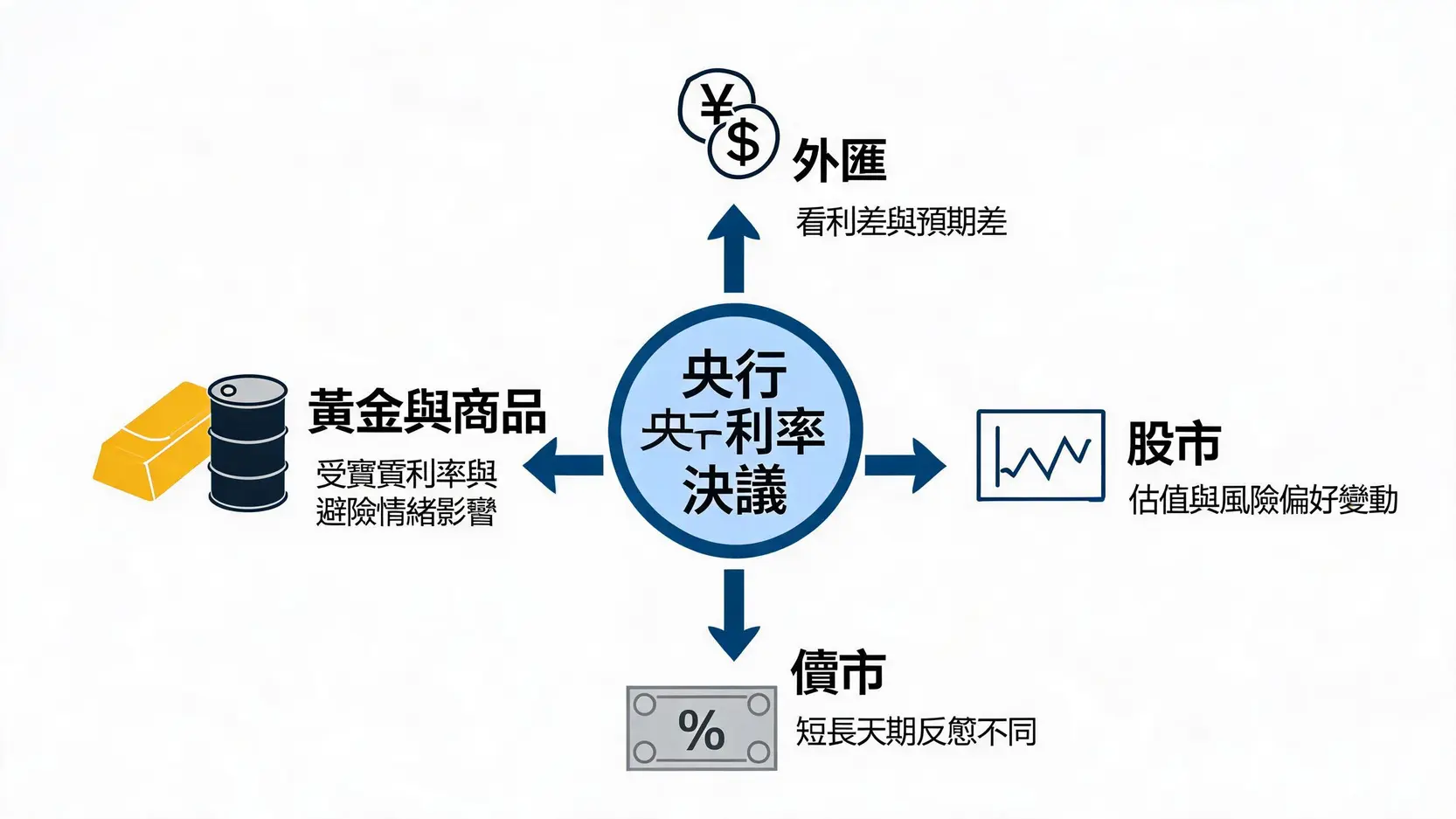
Many beginners assume that a rate hike means the currency must rise, and that a rate cut means the stock market must fall. This understanding is actually too one-dimensional. The real market reaction often comes from “how the result compares with expectations”. In other words, the interest rate decision itself is only part of the answer, while the expectation gap is the trigger for violent price movement.
The Differences Between Market Expectations, Dot Plots, Statements, and Press Conferences
A complete interest rate decision usually contains several layers of signals:
- Policy rate outcome: Hike, cut, or hold.
- Statement wording: For example, whether it mentions sticky inflation, solid employment, or slowing economic growth.
- Rate forecasts or dot plot: Used by the market to judge the direction of policy over the coming quarters.
- Press conference tone: When the chair answers questions, more detailed policy tendencies are often revealed.
Taking the Federal Reserve as an example, the market not only looks at the rate range, but also whether the statement and follow-up remarks contain more hawkish or dovish wording. The latest official statement can be directly viewed at Federal Reserve Issues FOMC Statement. For Malaysian readers who care about regional policy, they can also pay attention to Bank Negara Malaysia’s OPR decisions, because ASEAN capital flows and exchange rate expectations are also affected by policy communication.
Why Markets Can Still Fluctuate Sharply Even When the Outcome Matches Expectations
This is what confuses many traders the most: if the market had already expected no rate hike or cut, why can prices still surge or plunge after the announcement? There are usually three reasons:
- Expectations were priced in, but the details were not: An unchanged number does not mean unchanged wording.
- Market positioning is overcrowded: Once the direction falls short of expectations, short-term stop-losses and reversals can amplify volatility.
- The future path has been rewritten: The market is not trading today, but the next 3 to 12 months.
For example, rates may remain unchanged, but if the central bank suddenly hints that inflation risks have increased and does not rule out further tightening in the future, this is a hawkish hold. Conversely, if rates are also kept unchanged but the wording shifts toward concerns over slowing growth, the market may interpret it as a dovish stance. This kind of situation “where things seem unchanged but have actually changed completely” is exactly why interest rate decisions matter to traders.
How to Interpret Interest Rate Decisions Before and After Trading: How to Trade Before and After Interest Rate Decisions Without Easily Making Mistakes
If you treat an interest rate decision as a single news event, you will probably only see intense volatility; but if you break it down into expectations, results, tone, and capital flows, you will be better able to understand the market. The following method is highly practical for forex, index, and gold trading.
First Look at Market Pricing, Then Look at How Unexpected the Decision Itself Is
Before the announcement, first ask yourself three questions:
- What did the market originally expect?
- Which side is the current positioning leaning toward?
- If the result exceeds expectations, who will be forced to stop out?
There are many market pricing tools, such as interest rate futures, bond yield curves, and the advance movement of currency pairs. Taking the US as an example, tools like FedWatch are often used to observe changes in market bets on future interest rates. For event-driven traders, this is more useful than only reading news headlines.
If you usually trade based on fundamentals, it is recommended to also strengthen your understanding with Forex Trading Strategy Guide: A Full Analysis of 5 Major Mainstream Strategies, Combined With Forex Rebates to Maximize Returns!, and 2026 Forex Trading Beginner’s Guide: Master Risk Management and Broker Selection for Stable Profits!.
Use Three Steps to Break Down Hawkish, Dovish, and Neutral Signals
In practice, you can use this simplified framework:
| Interpretation Aspect |
Hawkish |
Dovish |
Neutral |
| Interest Rate Outcome |
Higher than expected |
Lower than expected |
In line with expectations |
| Statement Wording |
Greater focus on inflation, fewer hints of easing |
Greater focus on growth risks, hints at easing |
Tone remains unchanged |
| Press Conference |
Leaves room for further rate hikes |
Strengthens the possibility of rate cuts |
Vague balance |
As long as two or more of the items lean in the same direction, the market will usually quickly form a main narrative. At this point, what traders need to do is not guess the top or bottom, but distinguish whether this is the first wave of sentiment or the second wave of repricing. The former is often very sharp, while the latter is more likely to have continuity.
Risk Management During Announcements: Spreads, Slippage, and Position Adjustment
The biggest risk before and after an interest rate decision is not necessarily getting the direction wrong, but a sudden surge in execution costs. Common issues include:
- Widening spreads: It may look like only a few points, but the actual entry and exit costs may double.
- Slippage: Your stop-loss price may not necessarily be executed at the level you saw.
- Liquidity gaps: These are especially obvious at the moment of the announcement and during the press conference Q&A.
- Emotional chasing: The first large candlestick is the easiest moment for traders to lose discipline.
Therefore, when it comes to how to trade before and after interest rate decisions, the core has never been “whether you dare to enter the market”, but “how to stay alive until the opportunity matures”. Some traders reduce their positions before the announcement, widen their stop-loss distance, or switch to smaller position sizes; others simply wait for the first wave of direction to complete before looking for a retest structure. If your profits are often eaten away by trading costs, you can also read From Analyzing Forex Trading Fees to Protecting Every Bit of Your Profit.
Extended Reading (Highly Recommended)
[US Rate Hike Timetable 2026] Fed Interest Rate Meeting Dates, Latest Results Announcements, and Key Interpretations
FOMC Countdown: Three Major Scenarios for Cooling Rate Cut Expectations and High-Probability Investment Strategies
How Traders Can Actually Prepare for Interest Rate Decisions
If you do not want to be thrown around by the market every time an announcement is made, you can prepare a simple checklist before the meeting day:
- Confirm the meeting time, statement release time, and press conference time.
- Organize the market consensus expectation and minority expectations.
- Mark the key levels of important assets, such as the US Dollar Index, gold, and major currency pairs.
- Set three scenarios in advance: hawkish, dovish, and completely in line with expectations.
- Write down the handling rules for slippage or abnormal volatility.
This kind of preparation may seem very basic, but it can significantly reduce emotional decision-making in real time. Truly mature trading is not about who reacts faster, but who has done the homework before volatility arrives.
FAQ: Are Interest Rate Decisions Important to Traders?
Why does the market still surge or plunge when interest rates remain unchanged?
Because the market trades future expectations, not the current number. Even if interest rates remain unchanged, as long as the central bank statement, dot plot, or press conference tone changes, the market will recalculate the future policy path, and prices may naturally fluctuate sharply.
Are beginners suitable for entering trades when interest rate decisions are announced?
It is usually not very suitable to chase orders directly at the moment of the announcement. This is because spreads, slippage, and false breakouts are all common during that period. For beginners, learning to interpret interest rate decisions and observe the first wave of reaction is more important than rushing to capture the first move.
Besides the interest rate number, what other central bank signals should be watched?
At a minimum, you should look at the statement, economic outlook, dot plot or rate path, press conference content, and how the central bank describes inflation, employment, and growth risks. Many times, what truly affects the market is these details, not the interest rate itself.
How do interest rate decisions affect forex trading?
Forex places the greatest emphasis on relative interest rate differentials and policy expectation gaps. If a country’s central bank is more hawkish than the market expected, that currency usually has a greater chance of strengthening; if it is more dovish, it may come under pressure. However, the actual trend still needs to be judged together with US dollar strength, risk sentiment, and existing positioning.
Is it better to position before the announcement or follow up after the announcement?
Both are possible, but the logic is different. Positioning before the announcement seeks to profit from the expectation gap and carries higher risk; following up after the announcement seeks to profit from directional confirmation and usually has a more stable win rate, but the entry cost may be higher. The key is not which method is more powerful, but whether you have a clear scenario and risk control.
Conclusion
Interest rate decisions matter to traders not simply because of the words rate hike or rate cut, but because they redefine the market’s judgment on future policy, capital flows, and risk appetite. Truly mature traders do not only stare at the number at the moment of the announcement, but incorporate market expectations, central bank language, cross-asset movements, and risk management into their trading plans.
The more you understand “why interest rate decisions matter to traders”, the less likely you are to be led by short-term volatility. Understanding expectation gaps, respecting volatility, and managing positions well are the keys to turning central bank events into executable trading strategies.