Data Trading Guide: 5 Scalping Strategies & Apps

Updated: 2026/04/28  |  CashbackIsland

data-trading-strategy-guide

【Data Trading Guide】5 High-Frequency Scalping Strategies and Top Financial Calendar App Recommendations!

Markets change in an instant, and when key economic data is released, prices can move violently within seconds. Are you still always one step behind, watching opportunities slip away? This guide, designed for traders seeking ultimate efficiency, breaks down the core of “news data second-level trading”, teaches you how to build effective data market scalping strategies, and provides real-world recommendations of the most powerful financial calendar apps. It helps you fully master data trading techniques, gain market insight ahead of time, and capture the critical 30-second golden window. Say goodbye to gut-based trading and start your data-driven investment journey! 


What Is News Data Trading? Why Is Speed the Key to Winning?

News data trading, also known as “data market trading” or “event-driven trading”, focuses on capturing rapid market volatility triggered by real-time economic news and data releases, (such as unemployment rates, inflation figures, and interest rate decisions). When data is released, market consensus is disrupted, a surge of orders enters the market, and asset prices (such as forex, gold, and indices) can experience sharp moves within seconds to minutes. For short-term traders, this represents a rare golden opportunity, and “speed” is the only key to capturing it.


Understanding Second-Level Reactions From CPI and Non-Farm Payroll Data Releases

To understand second-level reactions, few examples are more classic than US Non-Farm Payrolls (NFP) or the Consumer Price Index (CPI). These indicators are seen as the “thermometer” of the economy and directly influence Federal Reserve monetary policy. For example:

  • Scenario: The market expects Non-Farm Payrolls to increase by 200,000.
  • Actual release: The increase is 400,000, far above expectations.
  • Market reaction (within seconds): The strong data signals a strong economy, increasing the likelihood of Fed rate hikes to control inflation. The US dollar index may surge within 1–5 seconds, while gold and non-US currencies such as EUR may drop sharply. Professional traders must interpret and execute trades immediately upon release, as any delay may result in missing the optimal entry point.

This reaction is driven directly by institutional and algorithmic trading systems, which are programmed to execute trades instantly upon data release, leaving virtually no time for human decision-making.

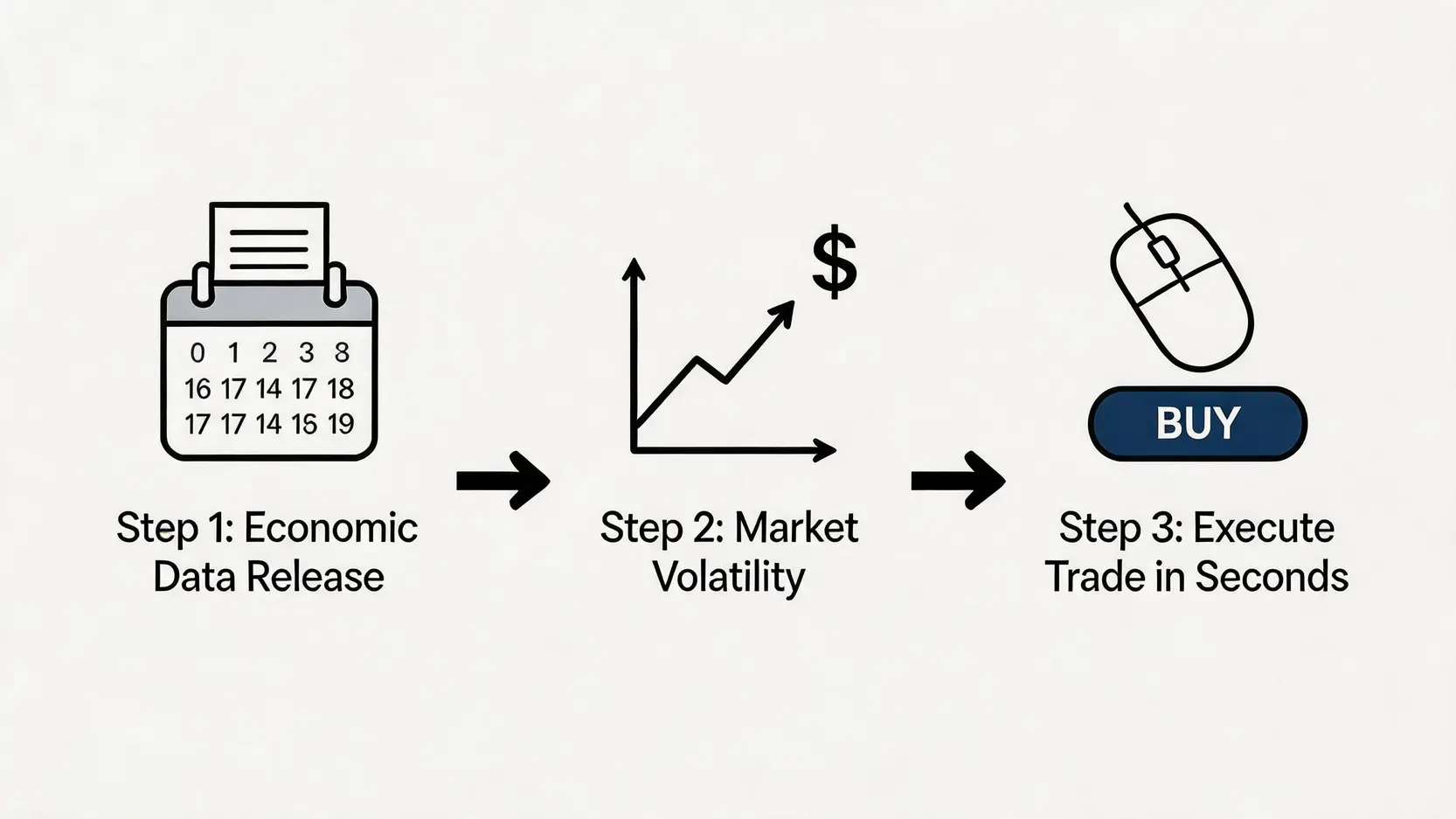
一張流程圖,展示經濟數據公佈後如何引發市場波動,以及交易者如何快速執行交易。

Economic data release second-level market reaction chain


Key Differences Between Second-Level Trading and Traditional Short-Term Trading

Although both are forms of short-term trading, second-level data trading is fundamentally different from traditional intraday trading (Day Trading) or swing trading (Swing Trading):

Characteristics

News data second-level trading

Traditional short-term trading
Driving factors Single, pre-scheduled economic data release Technical analysis, market sentiment, and combined news flow
Trading duration A few seconds to a few minutes From minutes to several hours
Volatility Extremely high, with instant explosive moves Relatively stable, developing gradually
Core strategy Speed, execution capability, and risk control Chart patterns, indicator signals, and trend analysis


Two Major Risks That Must Be Understood Before Data Trading: Slippage and Volatility

While pursuing high returns, it is essential to face the extreme risks that come with second-level trading:

  • Slippage: Due to a sharp drop in market liquidity at the moment of data release (wider bid-ask spreads), the difference between your intended order price and the actual execution price can be significant. For example, you may intend to buy EUR at 1.0800, but the actual execution could be 1.0815. This is slippage.

一張示意圖,解釋什麼是交易滑點,顯示預期成交價與實際成交價之間的差異。

Illustration of common “slippage” risk in data-driven trading

  • Extreme volatility (Volatility): Prices may swing sharply in both directions within a very short period, easily triggering stop-loss orders. Without strict risk management, a single data trade can result in significant losses.

Therefore, data trading is not only about speed, but also a true test of trading risk management skills

Further reading (Highly recommended)

2026 Forex Trading Beginner Guide: Master Risk Management and Broker Selection for Stable Profits!


5 Practical Data Market Scalping Strategies

After understanding the basic concepts, the next step is how to execute data market scalping strategies in real markets. The following five strategies cover the full process from anticipation to execution.


Strategy 1: Pre-Data Positioning Based on Expectations

This strategy is based on strong expectations of data outcomes and involves positioning in advance. It is suitable for experienced traders with a deep understanding of macroeconomics.

  • How it works: 5–10 minutes before data release, based on market consensus and your own analysis, place pending orders (Buy Stop/Sell Stop) or open small positions. For example, if CPI is widely expected to come in higher than forecast, you may preemptively short gold in small size.
  • Advantages: If the direction is correct, it can capture the maximum move.
  • Disadvantages: Extremely high risk. If data deviates from expectations, losses can occur immediately. Strict stop-loss is required.


Strategy 2: Post-Data Trend-Following Method

This is the most mainstream and relatively stable strategy, waiting for market direction to become clear before entering.

  • How it works: Do not rush into the market after data release. Observe the close of the first 1-minute or 5-minute candlestick. If price strongly breaks and holds above or below a key level, enter in the direction of the breakout.
  • Advantages: Avoids guessing direction, relatively higher win rate.
  • Disadvantages: May miss the initial move and result in less optimal entry prices.


Strategy 3: Reversal Trading Based on “Better/Worse Than Expected” Outcomes

This strategy exploits market psychology such as “buy the rumor, sell the fact”. Even if data is good or bad, if it fails to meet extreme expectations, price may reverse.

  • How it works: For example, the market expects a 50 bps Fed rate hike, but only 25 bps is delivered. Although still a hike (positive for USD), it falls short of expectations, so USD may spike briefly then reverse. This creates an opportunity to short USD.
  • Advantages: Captures turning points in market sentiment.
  • Disadvantages: Requires strong understanding of sentiment and data interpretation, difficult for beginners.


Strategy 4: Confluence Trading With Key Technical Levels

This strategy combines fundamental drivers with technical analysis to improve trading accuracy.

  • How it works: Before data release, identify key support and resistance levels, trendlines, or Fibonacci retracement zones. After data release, if price tests these levels and forms clear candlestick signals (such as pin bars or engulfing patterns), enter based on confirmation.
  • Advantages: Provides more reliable entry and exit signals, filters market noise.
  • Disadvantages: Requires solid technical analysis skills.


Strategy 5: Risk Management—How to Set Second-Level Stop-Loss and Take-Profit

This is not a standalone strategy but the foundation of all strategies. In second-level trading, risk management is more important than direction prediction.

  • Stop Loss: Must be placed immediately after entry. The stop-loss range should not be too tight and is usually set beyond recent volatility ranges or key technical levels. In data trading, stops should be slightly wider than usual to account for extreme volatility and avoid being prematurely “taken out”.
  • Take Profit: Do not set overly high profit targets. The first target can be set at a risk-reward ratio of 1:1 or 1:1.5. When the price reaches the first target, you can close half the position to lock in profits and move the stop-loss of the remaining position to the entry price (break-even), allowing the remaining profits to continue running.


To Do a Good Job, One Must First Sharpen One’s Tools: Comparison and Recommendations of 4 Top Financial Calendar Apps

To achieve second-level reaction trading, a fast, accurate, and powerful financial calendar app is essential. Below are four tools we have tested and highly recommend.


【All-in-One Top Choice】Investing.com

Pros: Global data coverage with extremely fast updates, widely regarded as an industry benchmark. It provides importance ratings (three stars being the highest) and includes detailed historical charts and market expectations, making it one of the most comprehensive platforms.

Cons: Contains many ads, and the interface is relatively cluttered.


【Best Localized Platform】Futu Niuniu

Pros: Deep integration of Hong Kong, US, and A-share market data. In addition to macroeconomic data, it also provides earnings reports and corporate event alerts. Push notifications are very fast, making it ideal for equity-focused investors.

Cons: Its depth of analysis for forex and commodities is not as strong as dedicated macroeconomic calendar apps.


【Forex Trader Specialist】Tradays Forex Calendar

Pros: Designed specifically for forex traders, with a clean interface and no ads. Data updates are fast, and it supports multiple languages. It also shows the impact of economic data on specific currency pairs directly within the calendar.

Cons: Limited functionality, focused mainly on forex-related data.


【Macro Analyst Essential】MacroMicro

Pros: Not only provides data, but also offers in-depth analysis and visualization of the underlying economic trends. Founder Rachel’s macroeconomic insights are highly regarded, making it suitable for investors who want a broader understanding of data impact.

Cons: Some advanced content requires a paid subscription, and real-time speed may be slightly slower than Investing.com.


Three Core Techniques for Mastering Data Trading

Once you have strategies and tools, the final step is internalizing trading skills. This determines whether you can make the right decisions under high-pressure conditions.


Technique 1: How to determine data importance? (Three-star system guide)

Financial calendars usually mark data importance with “stars” or “high/medium/low” labels. In general, only “three-star” or “high-impact” data are worth second-level trading, as they are most likely to trigger significant market volatility. Examples include:

  • US: Non-Farm Payrolls, CPI, interest rate decisions, GDP, retail sales.
  • Eurozone: CPI, interest rate decisions, Germany ZEW economic sentiment index.
  • UK: CPI, interest rate decisions, retail sales.

Focusing only on these key data releases helps filter out market noise and concentrate on the biggest opportunities.


Technique 2: Understanding the trading logic between “previous”, “forecast” and “actual” values

This is the core of data trading techniques. The market trades “expectation gaps”, not whether data is simply good or bad.

  • Previous: The last reported figure.
  • Forecast (Consensus): Economists’ expected value.
  • Actual: The real released figure.

Trading logic: The real opportunity comes from the gap between the “actual” and “forecast values”. Actual >> forecast = strongly bullish. Actual << forecast = strongly bearish. If the actual result is close to expectations, the market reaction may be muted or even reversed.

一張對比圖,解釋如何解讀經濟數據的公佈值與預測值,以及它們對市場的潛在影響。

Core of trading opportunity: The expectation gap between “actual” and “forecast”


Technique 3: Signal confirmation skills to avoid “false breakout” traps

False breakouts after data releases are very common. Price may spike in one direction within seconds, then quickly reverse. How to avoid this?

  • Wait for candle close: Do not enter immediately in the first second of movement. Wait for the first 1-minute or 5-minute candle to close. If the closing price holds above or below the breakout level, the breakout is more reliable.
  • Check volume: Genuine breakouts are usually accompanied by high trading volume. If price breaks out but volume is weak, it is likely a false breakout.
  • Multi-timeframe analysis: Check higher timeframes (such as 15-minute or 1-hour charts) to confirm whether price has also broken key structural levels.


Conclusion

In summary, in a data-driven financial market, mastering the techniques and strategies of news data second-level trading, and effectively using tools such as financial calendar apps, is the key to improving short-term trading win rates. This path requires extreme discipline, fast reaction speed, and respect for risk. Starting today, stop trading based on intuition and begin your data-driven investment journey. You will discover a completely new dimension of profit opportunities. Try the recommended tools immediately and turn knowledge into your market advantage!


FAQ

Q: Is news data trading suitable for beginners?

A: Honestly, it is not suitable. Second-level trading requires strong psychological resilience, strict discipline, and fast reaction ability. Market volatility is extremely high, and without a solid understanding of risks and strategies, beginners can easily suffer significant losses. It is recommended to start with a demo account or small capital practice first.

Q: Does second-level trading require special hardware or network setup?

A: Yes, it requires relatively high-quality hardware and network conditions. An ideal setup includes a high-performance computer, stable low-latency fiber internet, and a reliable ECN/STP trading platform to ensure fast order execution and reduce slippage. Professional traders even use VPS (Virtual Private Server) to shorten physical distance to broker servers.

Q: Besides financial calendars, what other supporting tools are recommended?

A: There are several categories of tools that can help: 1) News aggregation terminals such as Bloomberg Terminal or Refinitiv Eikon, which provide faster information than public sources but are expensive. 2) Social media sentiment tools, such as monitoring specific financial accounts on Twitter (X), to capture real-time market sentiment. 3) Professional charting software like TradingView which offers powerful charting tools and indicators for technical analysis.

Q: Which asset classes are most suitable for data trading?

A: Assets with high liquidity and strong sensitivity to macroeconomic data are most suitable. These include major currency pairs (such as EUR/USD, GBP/USD, USD/JPY), gold (XAU/USD), crude oil (WTI/Brent), and major stock index futures (such as the S&P 500 and Nasdaq 100). These markets typically show the most direct and volatile reactions during data releases.

If you liked this article, please share it!

Related Articles

  • Volatility Surface Guide: Skew Trading Strategies
    Practical Applications of Volatility Surfaces: From Options Modeling to Advanced Skew Trading Strategies In options markets, implied volatility is never a flat line. Instead, it forms complex "smile" or "skew" surfaces. For advanced traders, mastering the practical applications of volatility surfaces is equivalent to possessing a lens that reveals market...
    2026 年 6 月 3 日
  • Foreign Capital Flow Model: Track Institutional Money
    Building a Foreign Capital Flow Copy Trading Model: A Stock Market Indicator for Accurately Tracking Institutional Positioning In Asia-Pacific stock markets, foreign capital inflows and outflows often determine the direction of the index. However, simply looking at daily net buy and sell data is no longer enough. Only by building...
    2026 年 6 月 3 日
  • Options Buying Strategies for Extreme Market Risks
    Options Buyer Strategies During Extreme Market Conditions: Black Swan Hedging and Cross-Market Arbitrage During Volatility Surges The most terrifying aspect of financial markets is not a gradual decline, but overnight flash crashes and cross-market capital withdrawals accompanied by volatility surges. In the highly unpredictable global macroeconomic environment of 2026, geopolitical...
    2026 年 6 月 3 日
返回顶部