US Rate Hike 2026: Fed Schedule & Market Impact

【US Interest Rate Hike Schedule 2026】Overview of Federal Reserve Meeting Dates, Latest Decisions, and Market Impact
Does every Federal Reserve (Fed) policy meeting leave global markets holding their breath? Are you worried that every move in US interest rates could disrupt your stock, property investments, or mortgage plans? In financial markets, having the information is having the advantage. This article authoritatively compiles the most complete 2026 US interest rate hike schedule and will continuously update with the latest decisions, helping you understand rate trends, grasp market pulses, and make smarter financial decisions.
Complete 2026 Federal Reserve Meeting Date Schedule
The Federal Open Market Committee (FOMC) of the Fed holds eight regular meetings each year, approximately every six weeks, to assess economic conditions and determine monetary policy direction. The following schedule for 2026 meetings is based on historical patterns, and exact dates should be confirmed with official Fed announcements. Meeting results are usually released at 2:00 PM Eastern Time.
| Meeting Quarter |
Expected Meeting Date (US Time) |
Post-Meeting Press Conference |
Key Decisions (Continuously Updated) |
| First Quarter | January 27-28 | ✔️ | To Be Announced |
| March 17-18 | ✔️ (Economic Projections and Dot Plot Released) | To Be Announced | |
| Second Quarter | April 28-29 | ✔️ | To Be Announced |
| June 16-17 | ✔️ (Economic Projections and Dot Plot Released) | To Be Announced | |
| Third Quarter | July 28-29 | ✔️ | To Be Announced |
| September 22-23 | ✔️ (Economic Projections and Dot Plot Released) | To Be Announced | |
| Fourth Quarter | November 4-5 | ✔️ | To Be Announced |
| December 15-16 | ✔️ (Economic Projections and Dot Plot Released) | To Be Announced |
Latest Federal Reserve Decisions and Key Insights
After each policy meeting, the market’s focus is not only on whether interest rates rise or fall but also on the post-meeting statement and Chairman Jerome Powell’s remarks, which reveal possible future monetary policy directions.
Current Federal Funds Rate Target Range
As of now, the latest decision keeps the federal funds rate target range at [X.XX% – Y.YY%] (to be updated with the latest results). This rate is the benchmark for interbank lending in the US and underpins global financial market pricing, directly affecting everything from credit card interest rates to corporate loan costs.
Post-Meeting Statement Highlights: Future Rate Outlook (Dot Plot Analysis)
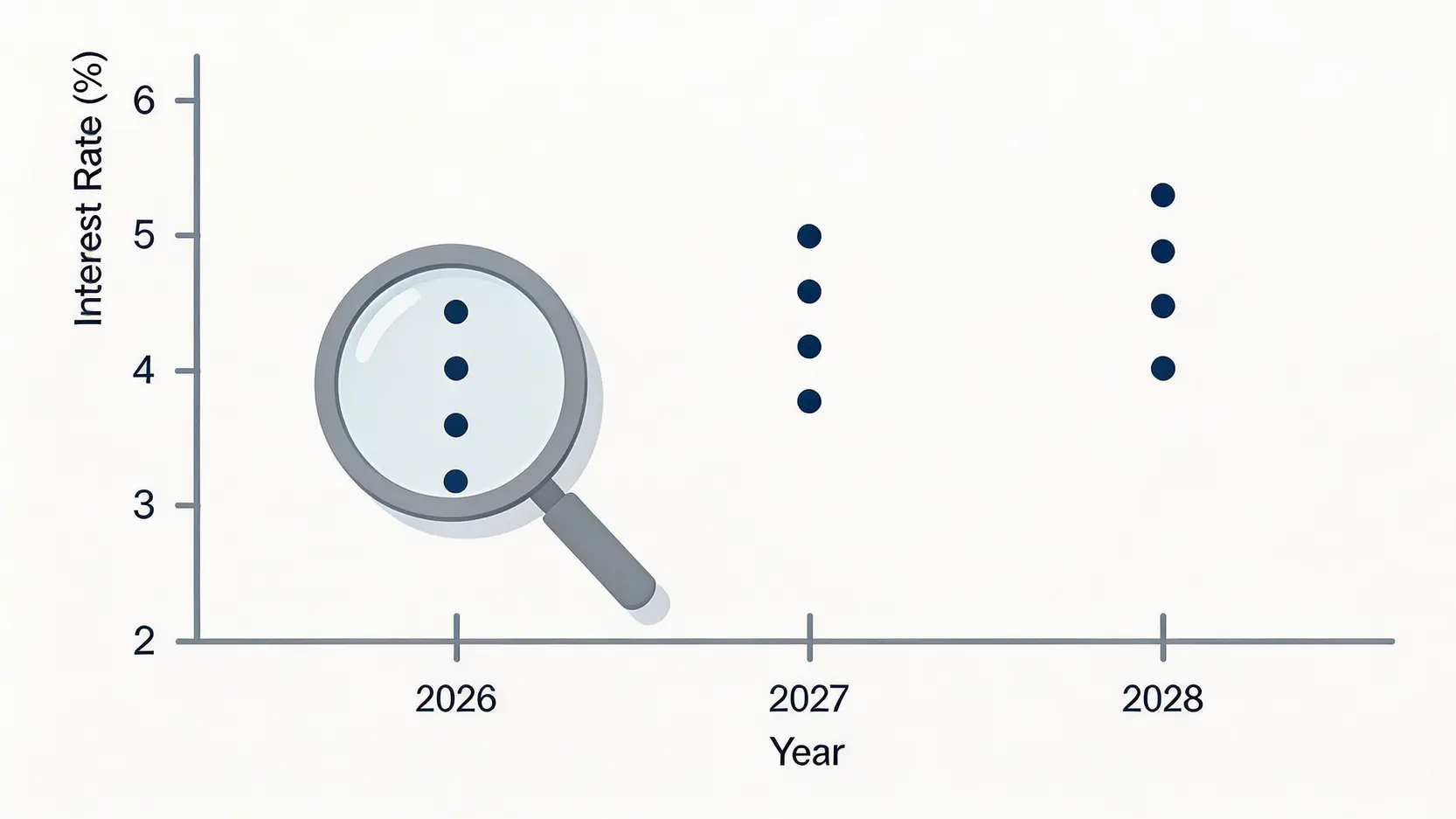
After meetings in March, June, September, and December each year, the Fed releases a “Dot Plot” chart. This chart anonymously shows each FOMC member’s projection of the federal funds rate over the coming years. While it is not an official policy commitment, the market treats it as a crucial window into the Fed officials’ rate expectations.

Dot Plot: A Window into Future Rate Trends
- Median Trend: Observing the median of the dot plot helps gauge whether the committee’s overall rate expectation leans “hawkish” (favoring hikes) or “dovish” (favoring cuts).
- Degree of Divergence: The dispersion of the dots reflects members’ consensus on future economic paths. Greater divergence indicates higher uncertainty regarding future policy.
Interpreting the latest dot plot helps investors anticipate the likely rate path and adjust their portfolios accordingly. For example, when a rate hike is expected, investors may consider increasing exposure to value stocks less sensitive to rates or holding more cash.
Further Reading (Highly Recommended)
Complete 2026 US Stock CFD Trading Guide: Platform Comparison, Pros and Cons, and Beginner Tutorials!
Why Does the Federal Reserve Raise or Cut Rates?
The Fed adjusts rates like regulating the economy’s “temperature” with the main goals of achieving “maximum employment” and “price stability”. Understanding its underlying motivations helps assess the broader economic environment.

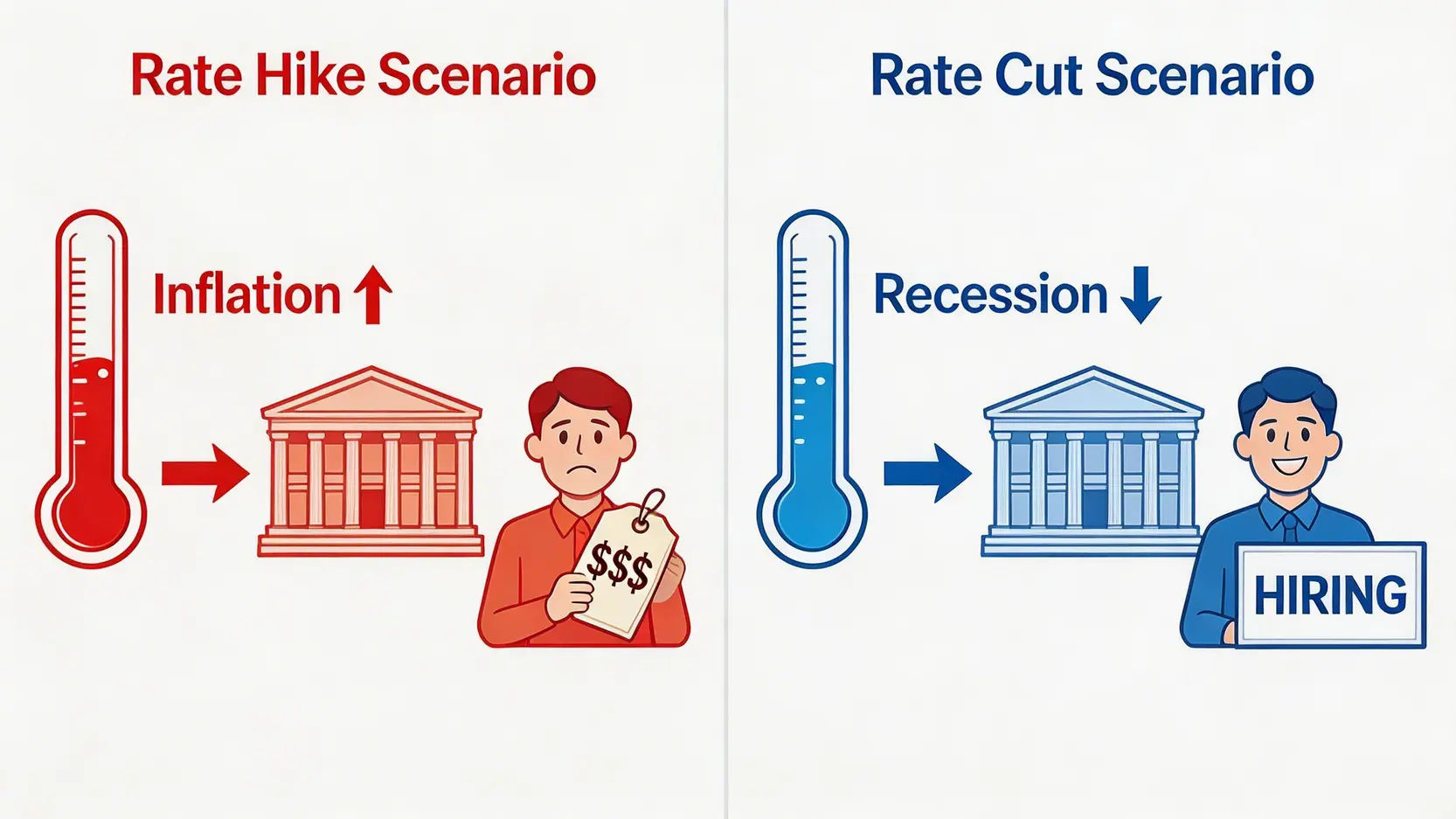
The Fed’s “Economic Temperature Control”: Rate Hikes to Curb Inflation vs. Rate Cuts to Stimulate Growth
Controlling Inflation: The Main Purpose of Rate Hikes
When the economy overheats and prices rise too fast (i.e., inflation) is high the Fed chooses to “raise rates”. Rate hikes increase borrowing costs, making business investment and personal consumption (such as buying a car or home) more expensive, thereby cooling the economy and reducing price pressures. In simple terms, rate hikes act as an economic brake. Excessive inflation erodes purchasing power, so controlling inflation is vital for maintaining economic health.
Stimulating Growth: Factors Behind Rate Cuts
Conversely, when the economy is in recession or growth is weak and unemployment rises, the Fed implements “rate cuts”. Lower rates reduce borrowing costs, encouraging businesses to expand investment and hire more staff while stimulating consumer spending, injecting vitality into the economy. Rate cuts are like pressing the economic accelerator, aiming to return the economy to a growth trajectory.
How Do US Rate Changes Affect Hong Kong?
Due to the Hong Kong dollar’s peg to the US dollar under the linked exchange rate system, US rate policy almost directly affects Hong Kong’s financial ecosystem. Every Fed decision triggers chain reactions in Hong Kong markets.

How US Rate Hikes Affect Hong Kong Markets: Transmission Pathways
Impact on Hong Kong Property Market: Pressure on P-Plan and H-Plan Mortgages
When the US hikes rates, Hong Kong banks usually follow by raising the Prime Rate (P-Plan) and HIBOR-linked rates (H-Plan), meaning:
- Increased Mortgage Burden: Homeowners with mortgages face higher monthly payments, directly impacting household disposable income.
- Higher Entry Barriers: Prospective buyers encounter stricter loan assessments, making it harder to enter the market.
- Downward Pressure on Property Prices: A persistent rate hike environment cools market sentiment, putting downward pressure on prices.
Impact on Hong Kong Stock Market: Capital Flows and Sector Rotation
US rate hikes often attract international capital to US dollar assets, creating potential outflow pressure for Hong Kong stocks. Sector responses vary:
- Negatively Affected Sectors: Rate-sensitive high-valuation tech stocks, local property stocks, and utilities may face higher borrowing costs, compressing earnings and valuations.
- Beneficial Sectors: Financial stocks such as banks and insurers typically benefit from wider interest margins, improving earnings prospects.
Investors should monitor rate trends closely and adjust their portfolios to navigate sector rotation.
Impact on HKD Exchange Rate and Bank Deposit Rates
Under the linked exchange rate system, Hong Kong rates generally follow US trends to maintain HKD stability. US rate hikes widen the HK-US interest differential, potentially triggering carry trades and capital outflows, prompting HKMA intervention to stabilize the currency. For the public, the most immediate effect is higher bank deposit rates, making fixed deposits more attractive and positive for low-risk investors.
Further Reading (Highly Recommended)
Complete 2026 US Stock CFD Trading Guide: Platform Comparison, Pros and Cons, and Beginner Tutorials!
Frequently Asked Questions About Federal Reserve Policy Meetings (FAQ)
Q: How many FOMC meetings are held each year?
A: The Federal Open Market Committee (FOMC) holds eight regular meetings annually, roughly every six weeks. Special meetings may occur under extraordinary economic circumstances. After the March, June, September, and December meetings, the Fed additionally releases economic projections and the so-called “Dot Plot”.
Q: How do US rate hikes affect my mortgage payments?
A: Under Hong Kong’s linked exchange rate system, local bank rates are closely tied to US rates. When the US raises rates, Hong Kong banks generally follow by increasing the Prime Rate (P) or HIBOR-linked rates (H), causing your mortgage rate to rise and monthly payments to increase, adding to your financial burden.
Q: What is the “Dot Plot” and how does it forecast rates?
A: The Dot Plot, released quarterly by the FOMC, shows each committee member’s anonymous projections for the federal funds rate over the next few years. By observing the median of these dots, the market can infer the Fed officials’ overall view of the future rate path and their policy stance, whether “hawkish” (favoring hikes) or “dovish” (favoring cuts). It is an important reference for predicting rates but is not an official policy commitment.
Q: Which is better for the stock market, rate hikes or cuts?
A: Generally, rate cuts are viewed as positive for stocks, as they reduce corporate borrowing costs and stimulate economic growth. Rate hikes are usually negative, as they increase costs for businesses and may shift capital from stocks to more stable returns in bonds or deposits. However, market reactions are complex; sometimes expectations are priced in early, and actual announcements can trigger reverse movements (“sell the news”).
Conclusion
In summary, closely monitoring this US rate hike schedule and deeply understanding the economic signals behind each latest FOMC announcement is essential for every investor navigating market fluctuations in 2026. From property mortgages to stock investments, every Fed decision is closely tied to our wealth. We will continue to provide updates on the Fed’s latest actions and professional analyses, helping you make the most informed financial decisions amid changing market conditions.
Related Articles
-
In-Depth Review of Intelligent Order Flow Detection Tools: Understanding Institutional Activity and Identifying Real Market Buying and Selling Pressure What Is Order Flow, and Why Is It a “Leading Indicator” for Price Prediction? Candlestick charts and technical indicators can be misleading, but the real-money "Order Flow" within the market cannot....2026 年 6 月 4 日
-
Social Sentiment Quantitative Indicators: Mining PTT and Dcard Discussions to Predict Stock Prices What Are Social Sentiment Quantitative Indicators, and Why Are They Becoming Increasingly Important? In an era of information overload, financial markets are no longer driven solely by cold financial statements and macroeconomic data. The "Shipping King" phenomenon...2026 年 6 月 4 日
-
Avoid Fraudulent Platforms! A Visual Guide to Taiwan FSC Licensed Futures Merchant Verification and Scam Prevention In recent years, driven by heightened volatility in global financial markets and the impact of monetary easing policies worldwide, more investors have begun seeking diversified investment instruments. However, underground futures operators and overseas fraudulent...2026 年 6 月 4 日