Why Japan Property Is Attracting Global Investors

Updated: 2026/06/23  |  CashbackIsland

japan-asset-revaluation-safe-haven

Global Asset Repricing: Why Has Japan’s Property Market Become a Safe Haven for Smart Money Amid Yen Depreciation?

What Is “Global Asset Repricing”? Why Has Japan Become the Main Focus?

While investment forums around the world are heatedly discussing yen depreciation pressure, the real smart money has already begun positioning quietly. This is not merely a short-term exchange rate fluctuation, but a far-reaching wave of “global asset repricing”. This article provides an in-depth look at why the seemingly weak yen has instead become a catalyst, making core assets such as Japan’s property market more attractive than ever in the eyes of global capital and turning them into a key target for funds. This trend is opening a once-in-a-lifetime window of wealth for well-prepared investors. 


From Valuation Depression to Value Discovery: A Historic Opportunity for Japanese Assets

After the “Lost Three Decades”, Japanese assets have long been in a “valuation depression” compared with major economies such as Europe and the US. However, fortunes have now shifted. The discount of the past has become the greatest advantage today. As Japan’s structural economic reforms deepen and inflation returns mildly, global investors have begun to re-examine this undervalued market. This is not a simple price rebound, but a complete “value discovery”. Assets that were once ignored are now attracting global attention with their intrinsic value, especially from capital seeking stable returns and long-term growth.


The Dual Effect of Yen Depreciation: Lowering the Entry Barrier and Amplifying Overseas Returns

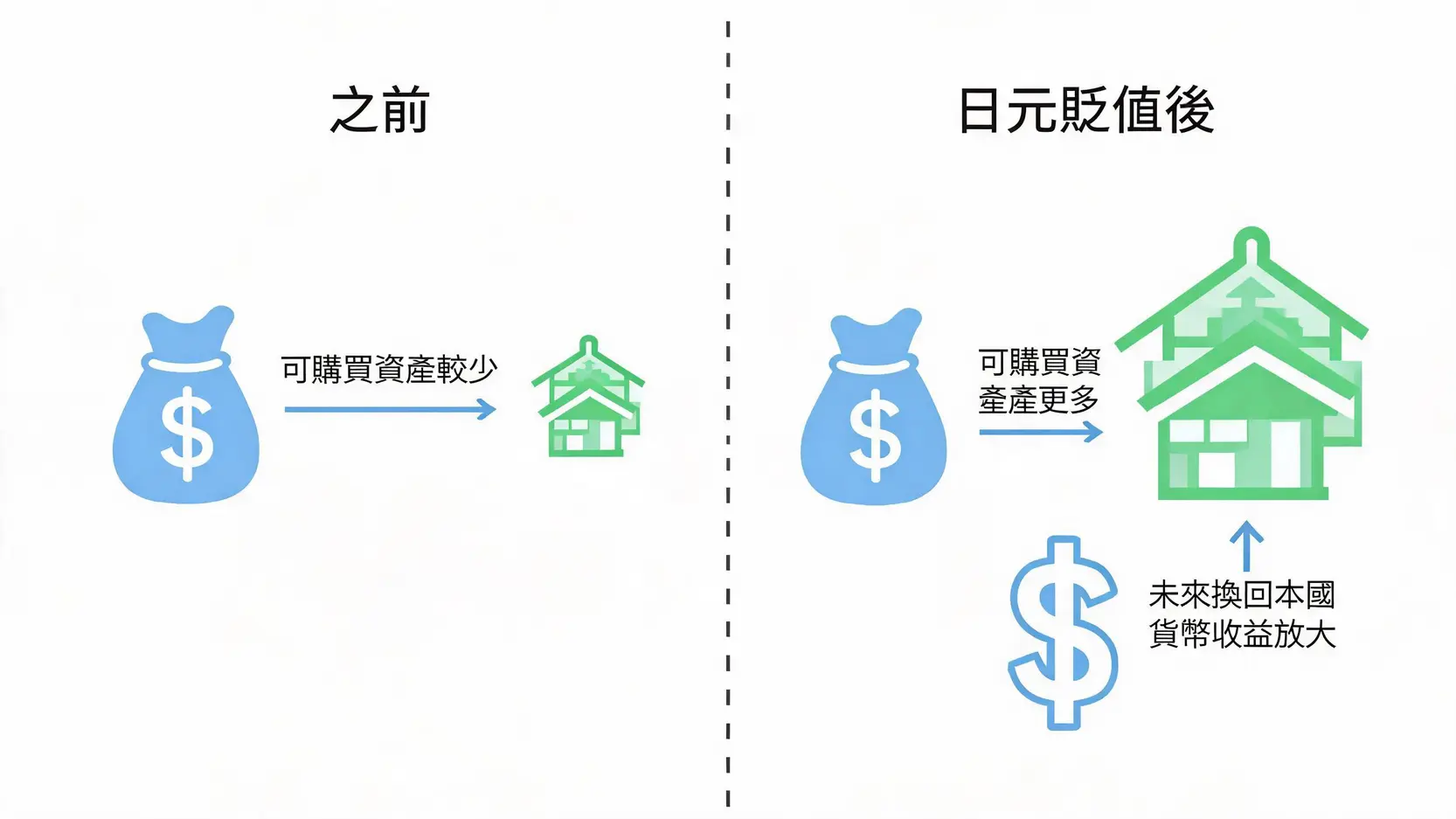
For overseas investors, yen depreciation is undoubtedly a double-edged sword, but both sides shine with opportunity. First, it greatly lowers the entry barrier. With the same US$1 million, a more favorable exchange rate allows investors to exchange for more yen and purchase higher-quality or larger assets. Second, it can effectively amplify future returns. Whether it is stable rental income or future capital gains from selling assets, returns may be further amplified by exchange rates when converted back into a stronger home currency, (such as the US dollar or New Taiwan dollar). The exchange rate difference between “buying and selling” provides overseas investors with additional profit potential, making it the most direct dividend in this wave of global asset repricing.

一張圖表演示日元貶值如何讓海外投資者用同樣的美元買到更多日本資產,並在未來放大收益。

The Dual Dividend of Yen Depreciation: Lowering the Entry Barrier and Amplifying Future Returns


A Geopolitical Safe Haven: Japan’s Stability Advantage Amid Global Uncertainty

In recent years, global geopolitical risks have continued to rise, and capital has been searching for safe havens like a frightened bird. Against this backdrop, Japan’s attributes as a “capital safe haven” have become increasingly prominent, as it is a mature economy with political stability, sound regulations, and orderly social conditions. For investors seeking to diversify risk and protect their assets, allocating part of their capital to Japan is not only based on optimism about its economic recovery, but also an important layer of insurance for their global investment portfolio.


Japan’s Property Market: The Brightest Star in Asset Repricing

In the wave of global asset repricing, if the Japanese stock market is the vanguard, then Japan’s property market is undoubtedly the brightest star. It has not only attracted the attention of institutional investors, but has also become a popular option for ordinary middle-class families to achieve global asset allocation. 

Globally Leading Rental Yields: Data Analysis of Tokyo and Osaka Investment Potential

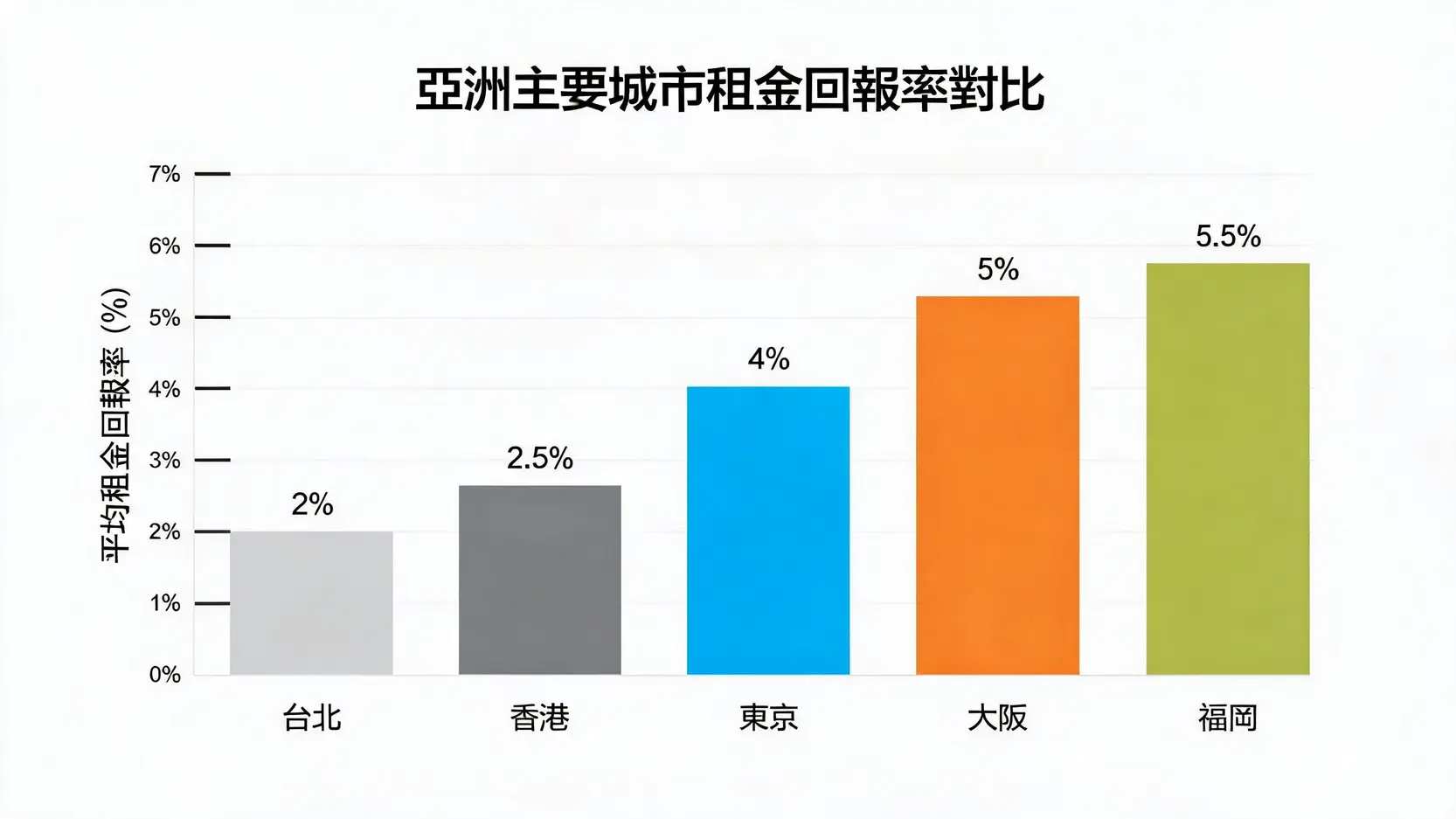
Compared with other global first-tier cities, rental yields in Japan’s major cities are highly competitive. In places such as Taipei, Hong Kong, and Shanghai, rental yields for city-center residential properties are generally below 2%, while the situation in Japan is very different. Below is a comparison of average rental yields (gross yield) in core areas of major cities:

  • Tokyo (Core Areas): Approximately 3.5% – 4.5%
  • Osaka (Core Areas): Approximately 4.0% – 5.5%
  • Fukuoka: Approximately 4.5% – 6.0%
  • Taipei (City Center): Approximately 1.5% – 2.5%
  • Hong Kong (City Center): Approximately 2.0% – 2.8%

The data shows that investing in Japan’s property market, especially in high-potential cities such as Osaka and Fukuoka, can generate rental returns that are twice as high as, or even higher than, those in other major Asian cities. For investors seeking stable cash flow, the appeal is self-evident.

一張條形圖,對比東京、大阪、福岡與台北、香港的房地產租金回報率,顯示日本城市的租金回報率更高。

Rental Yields in Japan’s Major Cities Are Highly Competitive Globally


Foreign Capital Inflows: The Investment Footprint From Blackstone to Sovereign Funds

The heat in the market can be seen from the movements of large institutions. Blackstone, the world’s largest alternative asset manager, has invested billions of dollars in Japan’s real estate market in recent years, acquiring various assets from residential properties and office buildings to logistics centers. In addition, international capital, including the Government of Singapore Investment Corporation (GIC) and sovereign wealth funds from the Middle East, is also accelerating its allocation to Japanese real estate investment. Their actions represent the most authoritative endorsement of the value of Japanese assets and indicate that this trend is far from over. 

More Than Residential Properties: Hidden Opportunities in Office and Logistics Real Estate

In addition to common residential investments, Japan’s commercial real estate also offers many opportunities. As corporate profitability improves and the “return to office” trend continues, demand for Grade A office buildings in core business districts such as Tokyo and Osaka remains strong. In addition, the rapid development of e-commerce has made modern logistics and warehousing facilities scarce resources, with rents and asset values continuing to rise. For investors with stronger capital strength, these areas contain even greater “blue ocean” opportunities.


Differentiated Highlight: The Repricing From “Price” to “Value”, a Structural Shift You Must Understand

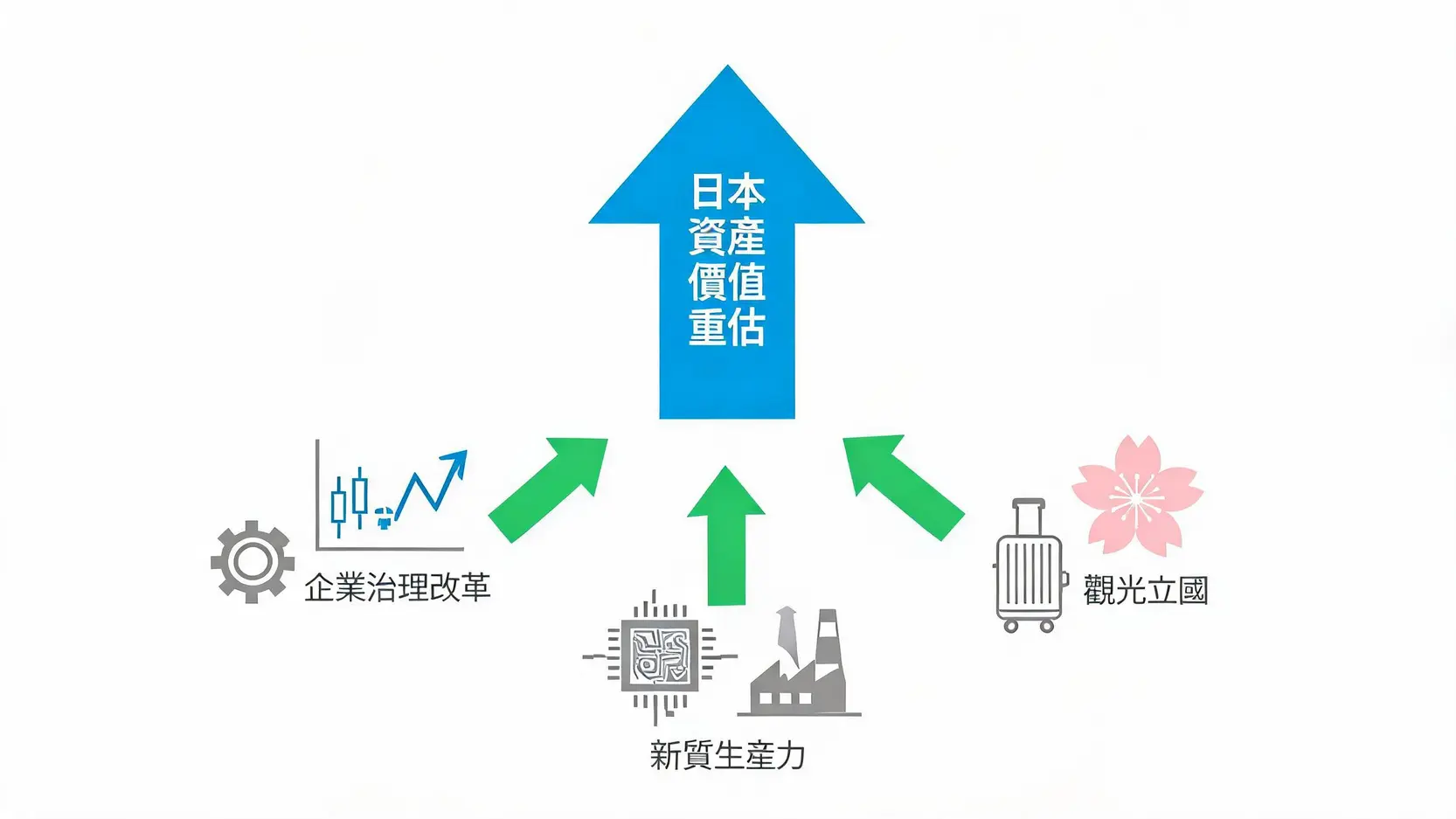
The rise of Japanese assets in this round is by no means simply about being “cheap”. Behind it lies a profound structural transformation, an evolution from “price recovery” to “value repricing”. Only by understanding these changes can investors truly grasp the core of the opportunity.

一張概念圖,展示了支撐日本資產價值重估的三大結構性轉變:企業治理改革、新質生產力(半導體)和觀光立國。

Three Core Engines Driving Japan’s Value Repricing


Corporate Governance Reform: What Warren Buffett Values Is Not Just Cheapness

Warren Buffett’s major investments in Japan’s five major trading houses in recent years have attracted global attention. What he values is far more than low stock prices. It is also the fundamental improvement in Japanese corporate governance. Under the requirements of the Tokyo Stock Exchange (TSE), many companies with low price-to-book ratios (P/B Ratio) have been urged to take measures to improve shareholder returns and corporate value. This reform is improving the profitability and investment appeal of Japanese companies from within, injecting new vitality into the overall economy.


The Rise of New Quality Productive Forces: The Revival of Semiconductors and High-End Manufacturing

Japan is regaining its key position in the global technology supply chain. With TSMC’s plant in Kumamoto as a landmark event, Japan’s semiconductor supply chain is rapidly reviving. This has not only driven the economy and real estate market in areas such as Kumamoto, but also symbolizes Japan’s full return in fields of “new quality productive forces”, such as high-end manufacturing and precision instruments. A strong real economy foundation is the stabilizing anchor that supports long-term asset value growth.


Tourism-Oriented Nation: How the Tourism Recovery Drives Commercial Real Estate Value

Yen depreciation has also greatly stimulated Japan’s tourism industry. Tourists from Taiwan, Malaysia, Europe, the US, and other places have poured in, not only bringing strong profits to the hotel industry, but also greatly boosting retail, dining, and other commercial activities. The strong recovery in tourism has directly driven the value of commercial real estate in tourist cities (such as Tokyo, Osaka, Kyoto, and Hokkaido), including hotels, shops, and guesthouses, making it one of the most explosive segments of Japan’s property market.


Frequently Asked Questions (FAQ)

Q: Is It Still Not Too Late to Invest in Japan’s Property Market Now?

A: It is definitely not too late. The current market rise is still more in the early stage driven by exchange rate advantages and value discovery. Japan’s structural economic shifts, such as corporate reform and the return of inflation, are long-term positive factors. Rather than chasing hotspots that have already risen sharply, investors should pay more attention to areas with solid fundamentals and strong rental demand, but where prices have not yet fully reflected their value, and carry out “value investing”.

Q: Besides Tokyo, Which Other Japanese Cities Are Worth Investing In?

A: Of course! Although Tokyo, as the capital region, has an irreplaceable position, other cities are also showing huge potential. For example, Osaka is viewed favorably for its infrastructure and development prospects due to the 2025 World Expo and the upcoming integrated resort (IR); Fukuoka, as the gateway to Kyushu, continues to see population growth and is Japan’s “startup capital”; while Sapporo in Hokkaido has also attracted significant attention thanks to its unique tourism resources and urban redevelopment plans. 

Q: If the Yen Rebounds, Will My Overseas Assets Shrink?

A: This is an exchange rate risk that all overseas investors will consider. Indeed, if the yen appreciates significantly, the asset value calculated in your home currency may decline. But this is a double-edged sword: a stronger yen usually also means Japan’s economic fundamentals are stronger, which may further push up the price of your real estate itself and form a hedge. For large-scale investments, you may consider using tools such as forward foreign exchange contracts to partially lock in exchange rates. But for most long-term investors, the core should be the appreciation potential of the asset itself, rather than excessive speculation on short-term exchange rate fluctuations.


Conclusion

In summary, yen depreciation pressure is not a crisis, but a catalyst that has opened the curtain on global asset repricing. In this wave, Japan’s property market has become an ideal “safe haven” and valuation depression for global capital, thanks to its superior rental yields, asset stability, and the long-term dividends of economic structural reforms. For investors seeking diversified asset allocation and protection against single-market risks, deeply understanding this value repricing, triggered by exchange rates and supported by fundamentals, is the key to seizing the golden opportunity in the Japanese market over the next decade.

编者
Evan Lin

Evan Lin

我是Evan Lin,从大学时期开始接触外汇交易,至今已有多年实战经验,熟悉技术分析与EA策略,热衷于研究市场脉动与风险管控,喜欢分享实战经验和交易技巧,和大家一起学习、一起进步!

If you liked this article, please share it!

Related Articles

  • Japan Ends Negative Rates: Why Is the Yen Still Weak?
    Farewell to Negative Interest Rates! The Truth Behind Japan Meeting Its Inflation Target: Why Has Yen Depreciation Pressure Increased Instead of Easing? The Japanese economy is staging an extremely contradictory drama: after waiting for thirty years, it has finally welcomed the long-awaited Japan inflation, yet the market’s response has been...
    2026 年 6 月 23 日
  • YCC to QT: BOJ & Fed Policy Shift Analysis
    A Complete Analysis of Central Bank Policy Shifts: From YCC to QT, Decoding the BOJ and the Fed’s Next Move The Bank of Japan (BOJ) and the US Federal Reserve (Fed), two giants of the global financial markets, are seeing their diverging monetary policy directions become the core force driving...
    2026 年 6 月 23 日
  • Will the Yen Appreciate? 2026 Forecast & Key Turning Point
    Have Yen Appreciation Expectations Been Established? A Complete Analysis of 2026 Investment Bank Forecasts, Revealing the Key Turning Point Mainstream View: Why Does the Market Generally Expect the Yen to Appreciate in 2026? After a long period of historic depreciation, the market has seen a significant shift in expectations for...
    2026 年 6 月 23 日
返回顶部