Australian Dollar Outlook: 4 Key AUD/USD Drivers

Updated: 2026/06/22  |  CashbackIsland

aud-usd-trend-drivers

Australian Dollar Outlook: Beyond Interest Rates! The Four Key Drivers of AUD/USD

Many new forex traders and investors focus almost exclusively on the Reserve Bank of Australia’s (RBA) interest rate decisions when analyzing the Australian dollar, while overlooking the broader and more fundamental factors that influence the Australian dollar (AUD). In reality, relying solely on rate hikes or rate cuts to determine the long-term direction of AUD/USD is like trying to perform an entire symphony with just one instrument. It inevitably provides an incomplete picture. Experienced market participants understand that a more comprehensive approach is required to accurately assess the factors driving the Australian dollar.

This article takes you beyond a single-indicator mindset by examining the four core engines that drive the Australian dollar from the perspective of a seasoned investor. By understanding the complex interaction between Australia’s economy, commodities, China, and global risk sentiment, you will be able to build a multi-dimensional analytical framework and interpret AUD/USD with greater confidence. Whether you are a forex trader or an investor considering Australian dollar-denominated assets, this guide will become an essential reference.

澳元匯率四大核心驅動因素的概念示意圖,包括澳洲經濟、大宗商品、中國因素和全球風險情緒。

Driving the Australian Dollar: The Four Core Engines


Engine 1: How Australia’s Domestic Economic Fundamentals Influence the Australian Dollar

To understand the value of any country’s currency, you must first examine its economic “fundamentals”, namely its domestic macroeconomic conditions. For the Australian dollar, these include the Reserve Bank of Australia’s monetary policy, inflation, and the health of the labor market. These indicators serve as Australia’s economic health check and directly influence international investors’ confidence in the Australian dollar.


Interest Rate Policy (RBA): The Anchor of Currency Value

The Reserve Bank of Australia’s (RBA) Official Cash Rate is the most direct factor affecting the Australian dollar. At its core, an interest rate represents the price of money. When the RBA raises interest rates, the return on holding Australian dollars increases, attracting international capital seeking higher yields and pushing the Australian dollar higher. Conversely, when the RBA cuts rates, the Australian dollar becomes less attractive, potentially leading to capital outflows and downward pressure on the currency.

As of June 2026, the RBA’s Official Cash Rate remains at 4.35%. Market participants closely monitor every RBA policy statement and every speech by the Governor, looking for clues about the future direction of monetary policy. For example, if the statement suggests growing concern about future inflation, markets may anticipate a more hawkish stance (favoring further rate hikes) and begin building long Australian dollar positions in advance. 

Inflation Data (CPI): The Barometer of Purchasing Power

The Consumer Price Index (CPI) is the primary measure of inflation. Stable and moderate inflation is generally viewed as a sign of a healthy economy. However, excessively high inflation erodes purchasing power and forces the central bank to tighten monetary policy (by raising interest rates). As a result, when Australia’s CPI exceeds market expectations, investors often interpret this as increasing pressure on the RBA to raise rates, providing short-term support for the Australian dollar.

Conversely, persistently weak CPI data indicates soft economic demand, increasing the likelihood that the RBA will cut interest rates to stimulate the economy, which is generally negative for the Australian dollar. Investors should pay close attention to the quarterly CPI reports published by the Australian Bureau of Statistics (ABS), as they provide the key benchmark for assessing Australia’s inflation outlook.


Employment Report: A Reflection of Economic Health

Employment data, particularly the unemployment rate and employment growth, is an important indicator of economic strength. A healthy labor market suggests stable household income, stronger consumer spending, and a positive economic outlook. Strong employment data generally boosts confidence in the Australian economy and supports the Australian dollar.

In addition, a strong labor market may lead to faster wage growth, which can increase inflation expectations. This reinforces the earlier point, as markets may expect the RBA to raise interest rates to contain inflation. Consequently, the monthly employment report is one of the most closely watched economic releases among traders.


Further Reading (Highly Recommended)

The Ultimate Guide to the US Dollar Exchange Rate: Understanding Trends, History, and the Best Currency Exchange Strategies

Forex Trading Guide for Beginners: Learn the Basics of Forex Trading From 0 to 1!


Engine 2: The Global Commodity Cycle and the Commodity Currency Connection

The Australian dollar is widely known as a “commodity currency”, meaning its exchange rate is closely linked to global commodity price cycles. This is because Australia is one of the world’s most resource-rich economies, with commodities accounting for the majority of its exports.


Iron Ore and Coal: Australia’s Economic Lifeline and Their Relationship With the Australian Dollar

Australia is the world’s largest exporter of iron ore and one of the leading exporters of coal. These commodities are essential raw materials for industrial production, with China being their largest buyer. As a result, international prices for iron ore and coal directly affect Australia’s trade surplus and national income.

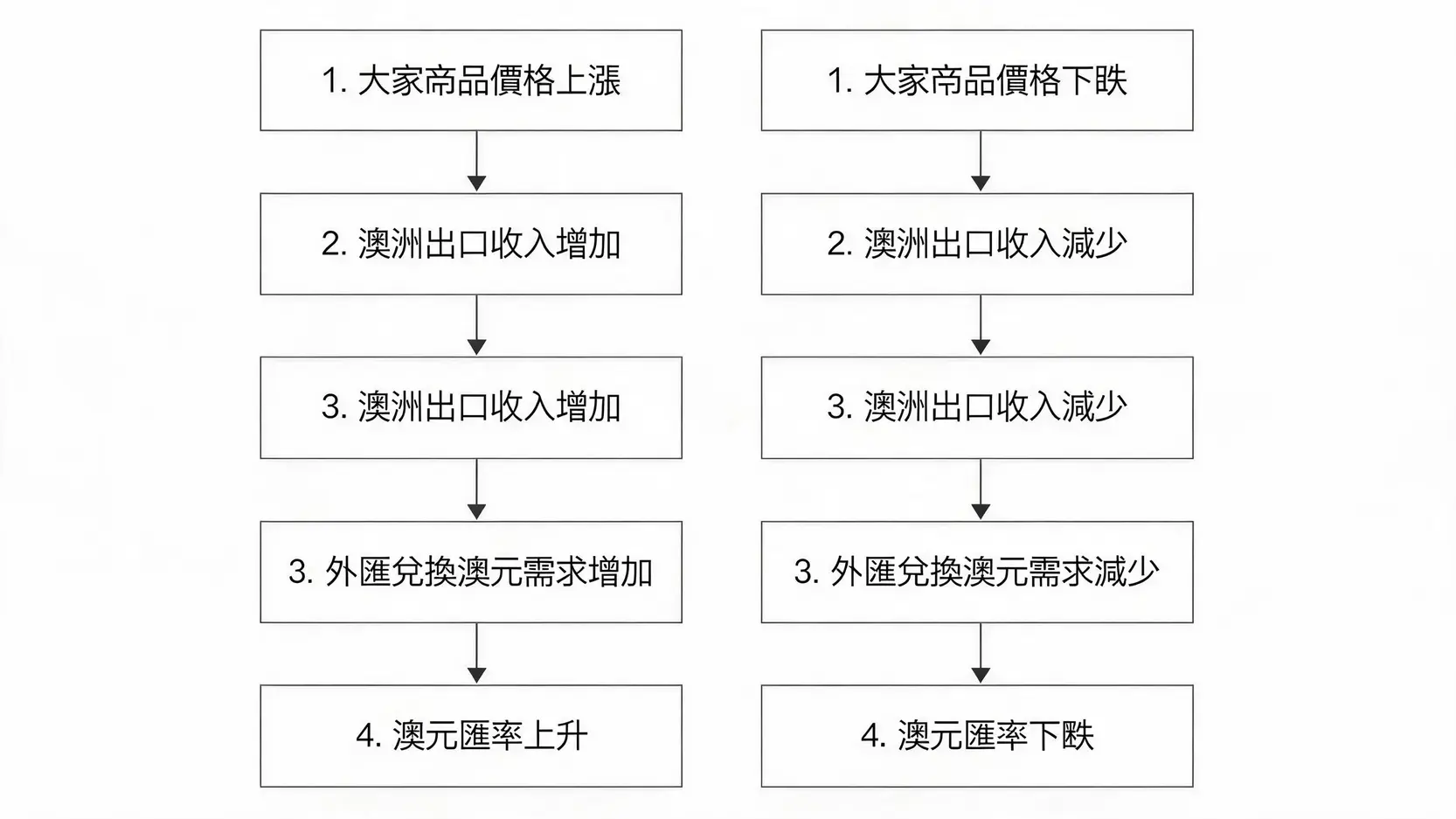
  • Price increases: When the global economy expands and demand for industrial products such as steel rises, iron ore prices increase. Australian exporters earn more foreign currency (primarily US dollars). To cover domestic costs, they convert these US dollars into Australian dollars, increasing demand for AUD and pushing the exchange rate higher.
  • Price declines: Conversely, if the global economy slows and industrial demand weakens, iron ore prices fall, reducing Australia’s export earnings and placing downward pressure on the Australian dollar.

Many professional commodity investors compare iron ore futures charts directly with AUD/USD charts, where their strong positive correlation becomes immediately apparent.

大宗商品價格(如鐵礦石、煤炭)對澳元匯率影響的流程圖。

How Commodity Prices Influence the Australian Dollar


The Impact of Energy and Agricultural Commodity Prices

In addition to iron ore and coal, Australia is also a major exporter of liquefied natural gas (LNG), gold, wheat, beef, and other energy and agricultural products. Price movements in these commodities also affect Australia’s terms of trade and, ultimately, the Australian dollar. For example, although a surge in global energy prices may increase worldwide inflation concerns, Australia, as a net exporter of energy resources, may actually benefit in the short term through stronger export revenues, providing support for the Australian dollar.


Engine 3: Why China’s Economy Is a Barometer for the Australian Dollar

If commodities represent the Australian dollar’s underlying DNA, China’s economy is the external force that amplifies or weakens those characteristics. Given the close trade relationship between the two countries, the Australian dollar is often regarded as a “proxy currency” for China’s economy.


Why Is Australia’s Largest Trading Partner So Important?

According to Australia’s Department of Foreign Affairs and Trade (DFAT), China has remained Australia’s largest trading partner for many years. In 2025, total bilateral trade in goods and services reached AUD 326 billion. Australia’s exports to China consist primarily of iron ore, coal, and natural gas, all of which are essential inputs for China’s vast manufacturing and infrastructure sectors.

As a result, any change in China’s economic outlook immediately affects market expectations for commodity demand, indirectly influencing the Australian dollar.

  • Strong Chinese economic data: Better-than-expected Purchasing Managers’ Index (PMI), industrial production, retail sales, and other indicators lead markets to expect sustained demand for Australian resources, supporting the Australian dollar.
  • Weak Chinese economic data: Poor economic figures, a property market downturn, or local government debt concerns raise fears of weaker commodity demand, placing downward pressure on both commodity prices and the Australian dollar.

Monitoring China’s economic releases is therefore essential for forecasting the medium-term direction of the Australian dollar.


The Transmission Effect of Renminbi Exchange Rate Movements

The Australian dollar also shares a positive correlation with the Chinese renminbi, (particularly the offshore renminbi (CNH)). When China’s economic outlook improves and the renminbi appreciates, investor demand for the Australian dollar often strengthens as well because of its close economic ties with China. Conversely, during periods of heightened US-China tensions or depreciation pressure on the renminbi, negative sentiment may also spill over into the Australian dollar.


Engine 4: Global Market Risk Sentiment (Risk-On/Risk-Off)

This is one of the most important yet frequently overlooked dimensions when analyzing the Australian dollar. Unlike traditional safe-haven currencies such as the US dollar, Japanese yen, and Swiss franc, the Australian dollar is classified as a “risk currency”. 

Why Is the Australian Dollar Considered a “Risk Currency”?

This is primarily due to its characteristics as both a “commodity currency” and a “proxy for China’s economy”. When the global economic outlook is positive and investors are willing to pursue higher returns, markets enter a “Risk-On” environment. Under these conditions, capital flows away from safe-haven assets and into equities, commodities, and currencies closely linked to global growth, making the Australian dollar one of the primary beneficiaries.

Conversely, during periods of market panic, such as financial crises, recession fears, or geopolitical conflicts, investors rapidly exit higher-risk assets and move into safe-haven currencies such as the US dollar and Japanese yen. This “Risk-Off” environment typically results in heavy selling pressure on the Australian dollar because of its sensitivity to the global economic cycle.


The Correlation Between the S&P 500 and the Australian Dollar

A simple way to gauge global risk sentiment is by observing the US stock market, particularly the S&P 500 Index. Under normal market conditions, AUD/USD exhibits a strong positive correlation with the S&P 500. When US equities rally and market optimism prevails, the Australian dollar often strengthens alongside them. Conversely, when the US stock market experiences sharp declines and fear spreads across financial markets, the Australian dollar generally comes under pressure as well.


Why Does the Australian Dollar Usually Weaken During Geopolitical Tensions?

Geopolitical uncertainty is a classic ”Risk-Off“ catalyst. Whether triggered by regional conflicts, trade wars, or terrorist attacks, these events significantly undermine investor confidence. During such periods, markets prioritize safety and liquidity, with the US dollar benefiting from its status as the world’s primary reserve currency. Consequently, even if the conflict has no direct connection to Australia, the Australian dollar often weakens because of its status as a risk currency.
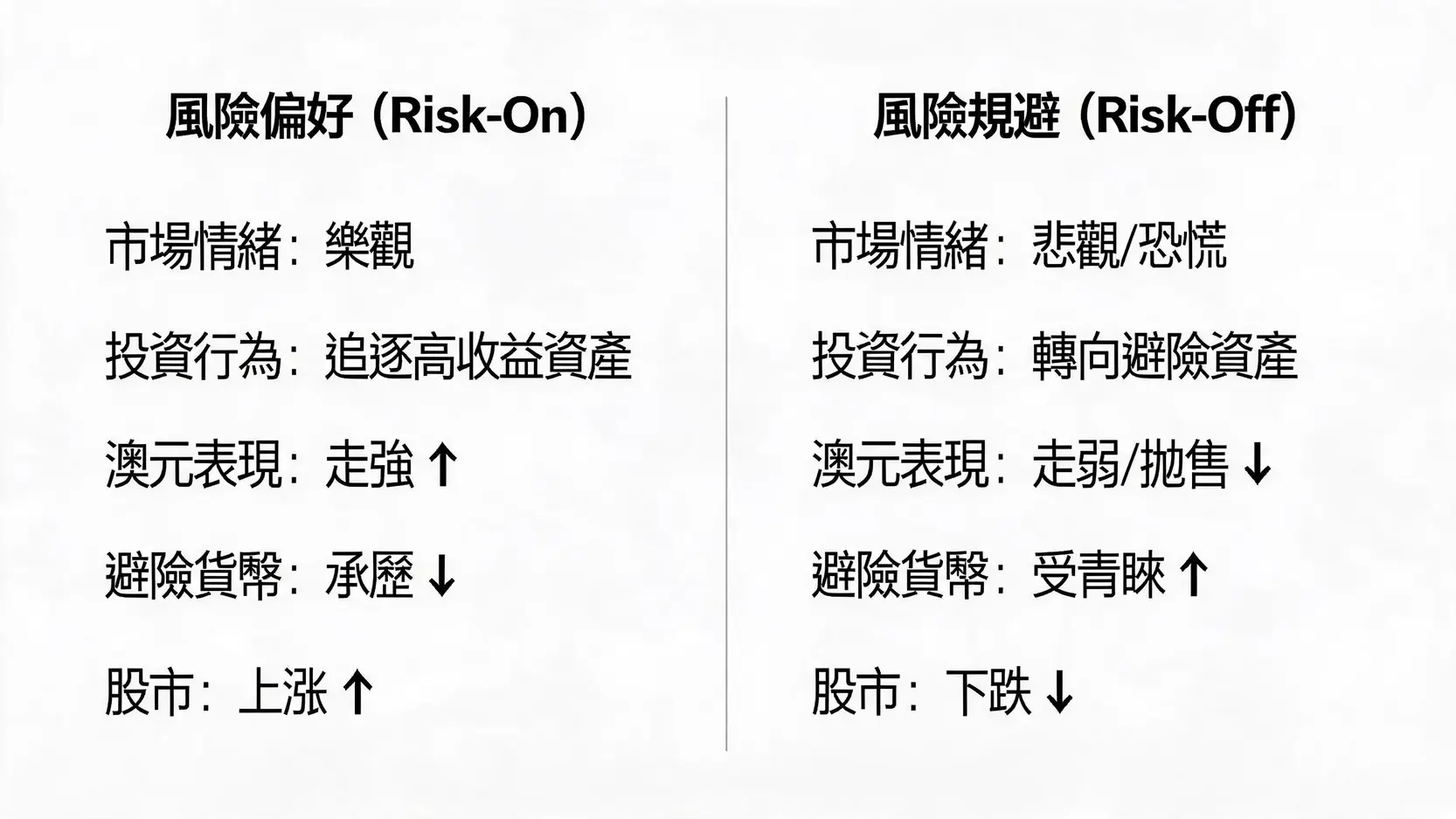
全球市場風險情緒(Risk-On/Risk-Off)對澳元及其他資產影響的對比圖。

Global Market Risk Sentiment and the Australian Dollar


Further Reading (Highly Recommended)

Introduction to Commodity Investing: Master Futures Trading, Volatility, and Inflation Hedging Strategies

Safe-Haven Currency Rotation Strategy: Which Currencies to Buy During Times of Uncertainty? A Complete Guide to the US Dollar, Japanese Yen, and Swiss Franc


Australian Dollar Outlook FAQ

Q: Why do the Australian dollar (AUD) and New Zealand dollar (NZD) often move in the same direction?

A: The Australian dollar (AUD) and New Zealand dollar (NZD) are highly correlated for several reasons: 1. Similar geographic location and economic structure: Both are developed economies in Oceania and rely heavily on commodity exports (Australia is primarily an exporter of minerals, while New Zealand exports dairy products and other agricultural goods). 2. The same largest trading partner: China is also New Zealand’s largest trading partner, meaning both currencies are significantly influenced by Chinese economic data. 3. Similar risk characteristics: Both are classified as “risk currencies” and therefore tend to move in the same direction when global market risk sentiment changes.

Q: Does Australia’s property market affect the Australian dollar?

A: Yes, but the impact is relatively indirect. Australia’s property market is a major pillar of its domestic economy and accounts for a significant share of GDP. A healthy property market supports the construction sector, financial industry, and consumer spending, strengthening the broader economy and providing support for the Australian dollar. Conversely, a sharp correction in the housing market could weaken consumer confidence, slow economic growth, and potentially force the Reserve Bank of Australia to cut interest rates, placing downward pressure on the Australian dollar.

Q: Besides trading AUD/USD, what other ways are there to invest in the Australian dollar?

A: In addition to trading the most common AUD/USD currency pair through a forex broker, there are several other ways to gain exposure to the Australian dollar: 1. Australian dollar cross pairs: Trade the Australian dollar against other currencies, such as AUD/JPY (Australian Dollar/Japanese Yen) or EUR/AUD (Euro/Australian Dollar). These cross pairs are influenced by both currencies involved. 2. Australian dollar-denominated assets: Invest in Australian equities, government bonds, or corporate bonds. 3. Futures and options: Trade Australian dollar futures contracts or options through a futures exchange. 4. Australian dollar deposits: Open an Australian dollar foreign currency account with a bank to earn interest, while keeping in mind the risks associated with exchange rate fluctuations.

Q: If the Reserve Bank of Australia raises interest rates, will the Australian dollar definitely appreciate?

A: Not necessarily. Although higher interest rates are theoretically positive for a currency, market reactions are more complex. If a rate hike has already been fully priced in, the exchange rate may show little reaction after the announcement or may even decline as markets “sell the fact”. In addition, investors must consider the central bank’s forward guidance. If the RBA raises rates but simultaneously signals that this marks the end of the current tightening cycle, markets may interpret it as a dovish rate hike, and the Australian dollar could still weaken. Expectations, the central bank’s statement, and the other three core drivers must all be evaluated together.


Conclusion

In summary, the Australian dollar is a multifaceted reflection of Australia’s domestic economic health, the global commodity cycle, the economic performance of its largest trading partner, China, and international investors’ risk appetite. A disciplined Australian dollar investor must learn to analyze all four core drivers together rather than focusing solely on each month’s interest rate decision.

Once you begin analyzing the RBA’s interest rate projections, China’s PMI data, iron ore price trends, and the S&P 500 Index side by side, your understanding of AUD/USD will reach an entirely new level. Only by building this comprehensive macroeconomic perspective can you clearly identify the true direction of Australia’s economy and the Australian dollar in an increasingly complex foreign exchange market, enabling you to make more informed investment decisions.

编者
Evan Lin

Evan Lin

我是Evan Lin,从大学时期开始接触外汇交易,至今已有多年实战经验,熟悉技术分析与EA策略,热衷于研究市场脉动与风险管控,喜欢分享实战经验和交易技巧,和大家一起学习、一起进步!

If you liked this article, please share it!

Related Articles

  • How to Read Central Bank Signals Like a Trader
    Interpreting Central Bank Rhetoric Through Macquarie’s Forecast: How Should Traders Read Policy Signals? Interpreting central bank rhetoric through Macquarie’s forecast has never been just about “what the investment bank said”, but about how to connect central bank rhetoric analysis, hawkish and dovish signals, and market expectation-gap trading into an executable...
    2026 年 6 月 23 日
  • Will the RBA Raise Rates in August? AUD Outlook
    Will the RBA Raise Rates in August? A Complete Analysis of the Australian Dollar Outlook and AUD/USD Trading Scenarios As August approaches, global financial markets are once again turning their attention to the Reserve Bank of Australia's (RBA) interest rate decision. With inflation remaining stubbornly high, expectations of an August...
    2026 年 6 月 22 日
  • RBA Holds Rates at 4.35%: Impact on the Australian Dollar
    RBA June Interest Rate Decision: Rates Held Steady at 4.35%! An In-Depth Analysis of How the Hawkish Pause Affects the Australian Dollar Exchange Rate The highly anticipated RBA June interest rate decision is finally here. Following its two-day monetary policy meeting, the Reserve Bank of Australia (RBA) announced on June...
    2026 年 6 月 22 日
返回顶部