Why Can a Rate Hold Boost the Australian Dollar?

Why Does an Unchanged Interest Rate Benefit the Australian Dollar Instead? Understanding the Real Signal Behind the RBA Holding Rates Steady
Why does an unchanged interest rate sometimes strengthen the Australian dollar? At first glance, it seems counterintuitive, but the forex market has never focused solely on the numbers themselves. Instead, it reacts to “the gap between the actual outcome and market expectations”. When the Reserve Bank of Australia (RBA) leaves interest rates unchanged while delivering a hawkish message, the market may reassess key questions such as why the Australian dollar strengthens despite unchanged RBA interest rates and why the RBA holding rates steady supports AUD/USD. In other words, what truly drives the Australian dollar is often not whether interest rates changed, but the central bank’s policy language, its assessment of inflation risks, and the market’s repricing of future interest rate differentials.
If you have been following the Australian dollar exchange rate recently, consider first reading RBA June Interest Rate Decision: Rates Held at 4.35%! An In-Depth Analysis of How a Hawkish Pause Affects the Australian Dollar Exchange Rate, then compare it with A Complete Guide to Australian Dollar Trends: It’s Not Just About Interest Rates! The Four Key Drivers of AUD/USD. Doing so will make it much easier to see the complete market picture.
Why an Unchanged Interest Rate With a Hawkish Tone Is Not a Neutral Signal
Many investors automatically interpret “unchanged interest rates” as “no positive news, or even bearish”. This is one of the most common misconceptions. In reality, a central bank holding interest rates steady simply means it did not adjust its policy tools at that meeting. It does not mean its policy stance has shifted toward easing, nor does it mean the market should become bearish on the currency.
In the case of the RBA, when the official cash rate remains unchanged but the statement continues to emphasize persistent inflation, a tight labor market, and resilient demand, the market interprets this as meaning that while rates were not raised this time, further tightening remains possible. This is what is known as a “hawkish hold”.
The market can react very differently to the same unchanged interest rate decision:
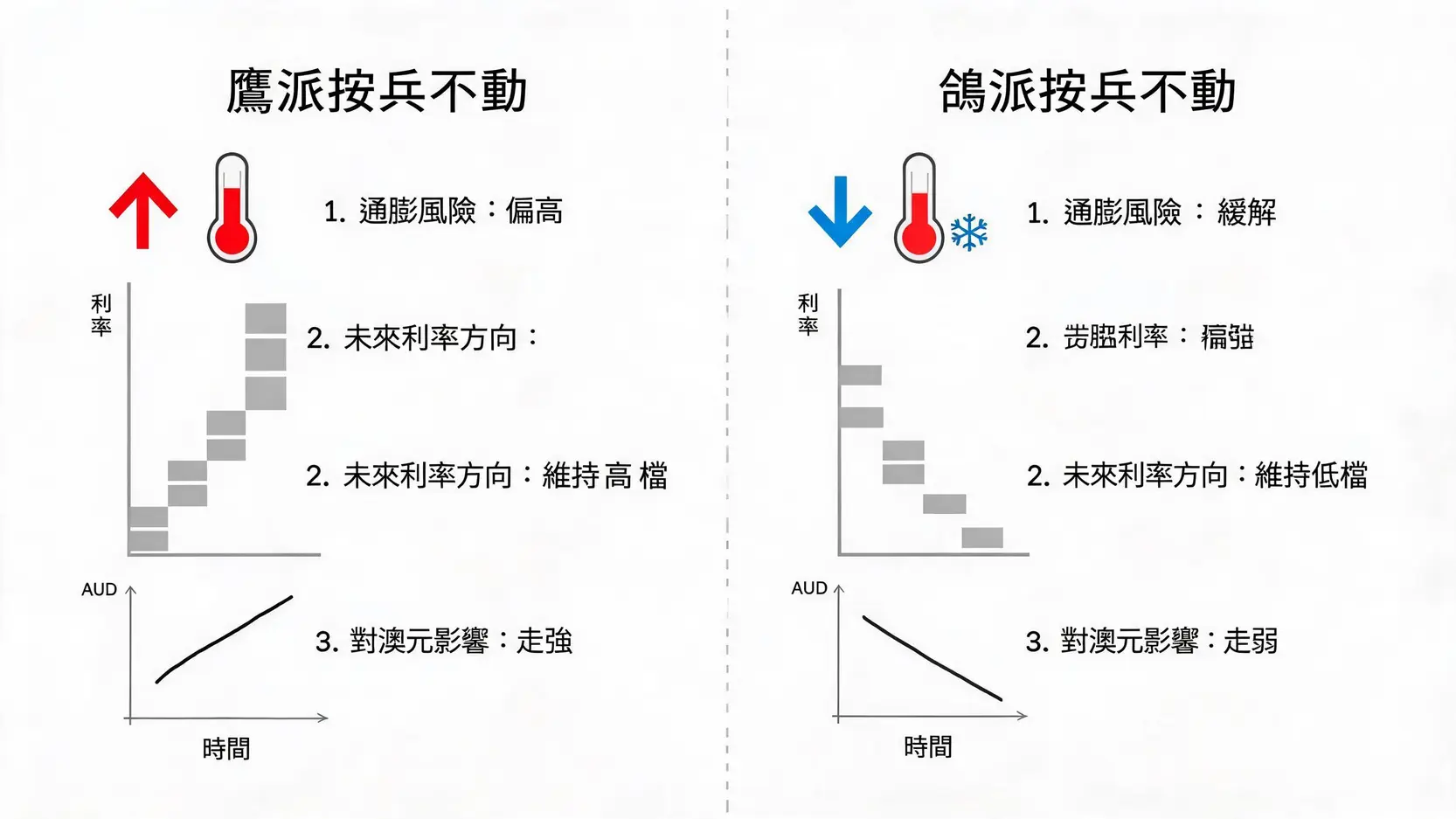
- Hawkish hold: Emphasizes unresolved inflation risks and leaves the door open for future rate hikes, which is generally bullish for the Australian dollar.
- Dovish hold: Emphasizes slowing economic growth, weakening demand, and the possibility of future rate cuts, which is generally bearish for the Australian dollar.
Therefore, the reason an unchanged interest rate can strengthen the Australian dollar has little to do with the words “unchanged interest rates”. The real question is whether the central bank leaves room for a hawkish interpretation. This is why many traders first read the headline and then immediately examine the wording of the policy statement.
The same unchanged interest rate decision can have completely opposite effects on the Australian dollar depending on the central bank’s tone.
If you would like to gain a deeper understanding of this type of policy language, you may also find it helpful to read What Is a “Hawkish Pause”? Understand Central Bank Policy Language and Stay Ahead of Future Market Trends. This concept is central to understanding the Australian dollar’s recent short-term strength.
What Does It Mean When the Central Bank Holds Rates While Maintaining a Tightening Bias?
This usually signals three things:
- Inflation has not yet fully returned to the central bank’s comfort zone.
- The labor market has not weakened enough to justify rate cuts.
- Interest rates are already high, but the central bank does not want to declare victory too early.
As long as future rate hikes have not been completely ruled out, the Australian dollar continues to benefit from its interest rate advantage. This is particularly true when other major central banks are approaching easing cycles. If Australia maintains higher interest rates for longer, it may gain a relative advantage.
What Is the Difference Between a Hawkish Hold and a Dovish Hold?
The difference lies in the future policy path, not the current outcome. A hawkish pause communicates “we’re waiting and watching, but it’s not over yet”, while a dovish pause suggests “we’ve probably reached the peak and may soon change direction”. Since the forex market always trades future expectations, the impact on AUD/USD is naturally very different.
How Expectation Gaps Allow an Unchanged Interest Rate to Strengthen the Australian Dollar
One of the most common situations in the forex market is not when the news itself is surprising, but when it is simply not as bad as the market expected. This is known as the expectation gap.
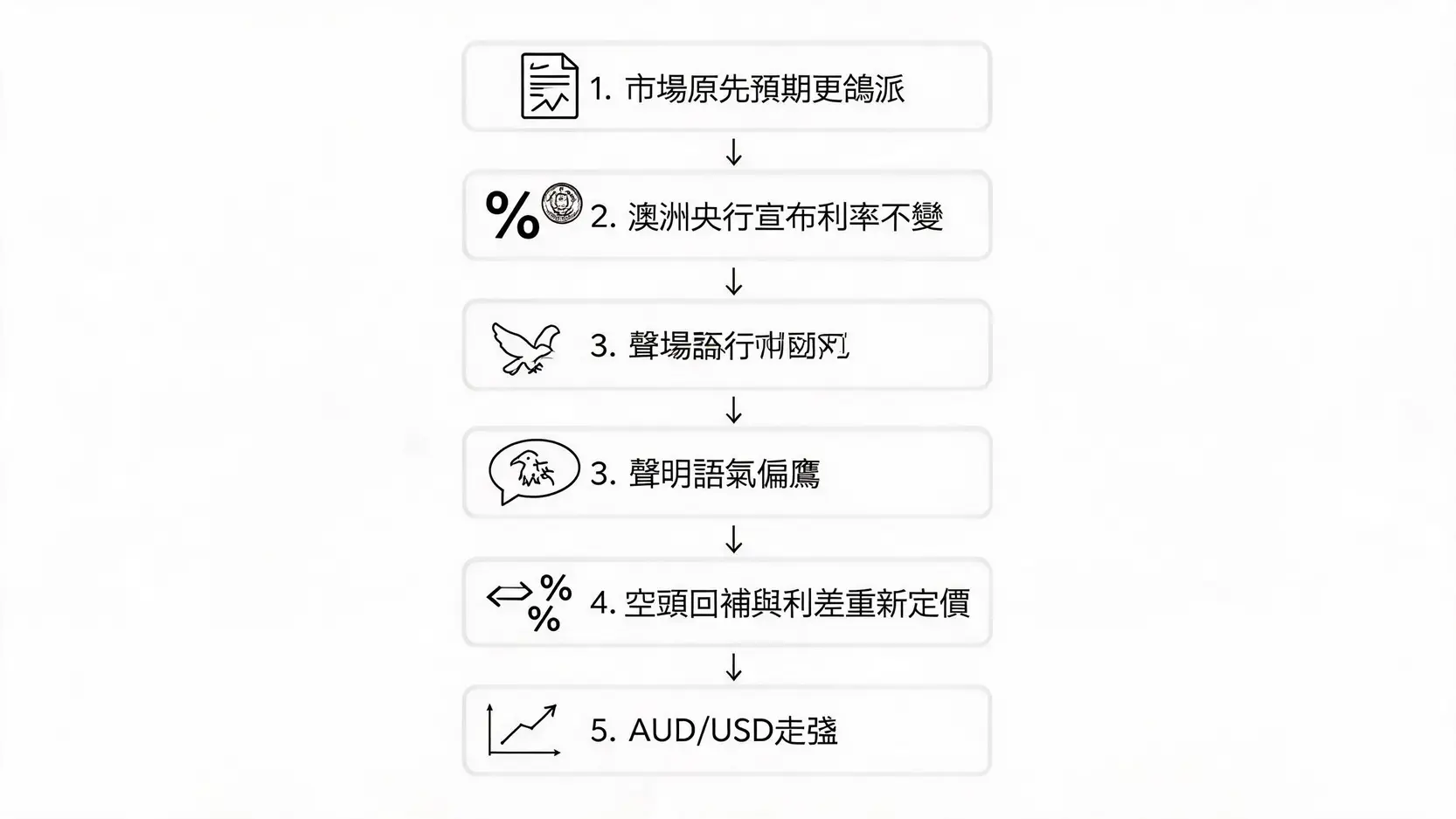
Suppose the market widely expected the RBA to adopt a significantly more dovish stance or even hint at future rate cuts before the decision. If the RBA leaves rates unchanged but issues a stronger-than-expected statement, the Australian dollar may strengthen immediately. This happens because traders holding bearish positions rush to cover them, creating strong short-term buying pressure.
This is the most common explanation for why an unchanged interest rate can strengthen the Australian dollar. The news itself is not necessarily very strong. Rather, the market had become too pessimistic beforehand.
If you have recently followed Are Expectations for an August Rate Hike in Australia Rising? A Complete Analysis of Australian Dollar Trends and AUD/USD Trading Scenarios, you will notice that market pricing is rarely linear. As long as expectations for future rate hikes have not been completely removed, the Australian dollar is unlikely to experience a one-sided collapse and is instead more likely to rebound following a decision that is “simply less dovish” than expected.
The Market Expected a More Dovish Outcome, but the Result Was Not as Weak
In this situation, the Australian dollar usually rises because of two forces:
- Short covering: Traders who had previously bet on a weaker Australian dollar quickly close their positions.
- Repricing: The market revises its expectations upward for future rate hikes or for interest rates to remain elevated for longer.
Therefore, when analyzing the Australian dollar, it is not enough to simply ask whether the interest rate decision “remained unchanged”. You must also consider what the market had expected before the announcement. If expectations were excessively pessimistic, an unchanged interest rate can itself become a bullish catalyst.
The Australia-US Interest Rate Differential, Capital Flows, and the Repricing of Carry Trades
The Australian dollar is a currency that is highly sensitive to interest rate differentials. When the market concludes that Australian interest rates may remain elevated for longer while expectations for US monetary easing continue to rise, investors begin reassessing the Australia-US interest rate differential. Even if Australia does not raise interest rates, the Australian dollar may still become more attractive relative to the US dollar if the US moves closer to rate cuts.
At that point, not only does demand for the spot market increase, but carry trades and bond allocations may also be affected. In particular, relatively stable Australian government bond yields can encourage some investors to shift capital back into Australian dollar-denominated assets.

The Australian dollar often rises not because interest rates have changed, but because the outcome is stronger than the market expected.
If you want to understand the Australian dollar’s drivers beyond monetary policy, you should also read An In-Depth Analysis of the Relationship Between the Australian Dollar and Iron Ore: The Three Key Factors for Forecasting the AUD Exchange Rate, as commodity prices and interest rate differentials often influence the Australian dollar together.
Further Reading (Highly Recommended)
The Australia-US Interest Rate Differential and Inflation Data Are the Real Keys to Whether the Australian Dollar Can Continue Strengthening
When discussing why an unchanged interest rate can actually benefit the Australian dollar, you cannot stop at the news headline. The two factors that truly determine whether the rally can continue are the Australia-US interest rate differential and Australia’s inflation outlook.
If the RBA leaves interest rates unchanged, but the market sees that Australian inflation remains persistent and the labor market has not cooled significantly, the possibility of future rate hikes or delayed rate cuts remains. Conversely, if upcoming data weakens across the board, the previous rebound in the Australian dollar is likely to prove nothing more than a short-term, news-driven rally.
According to authoritative sources, Australia’s monetary policy and inflation trend should continue to be monitored through official channels, such as the RBA section on the Reserve Bank of Australia website, which can be used to track interest rate decisions and changes in market expectations. The value of these resources is not in predicting the future, but in helping you determine whether market pricing has already moved too far ahead.
In addition, remember one important principle when analyzing the Australian dollar: the forex market does not focus on absolute levels, but on relative changes. Australian economic data does not have to be exceptionally strong to support the currency. As long as it comes in better than market expectations, or is simply not as weak as the data from the US, the Australian dollar may still benefit.
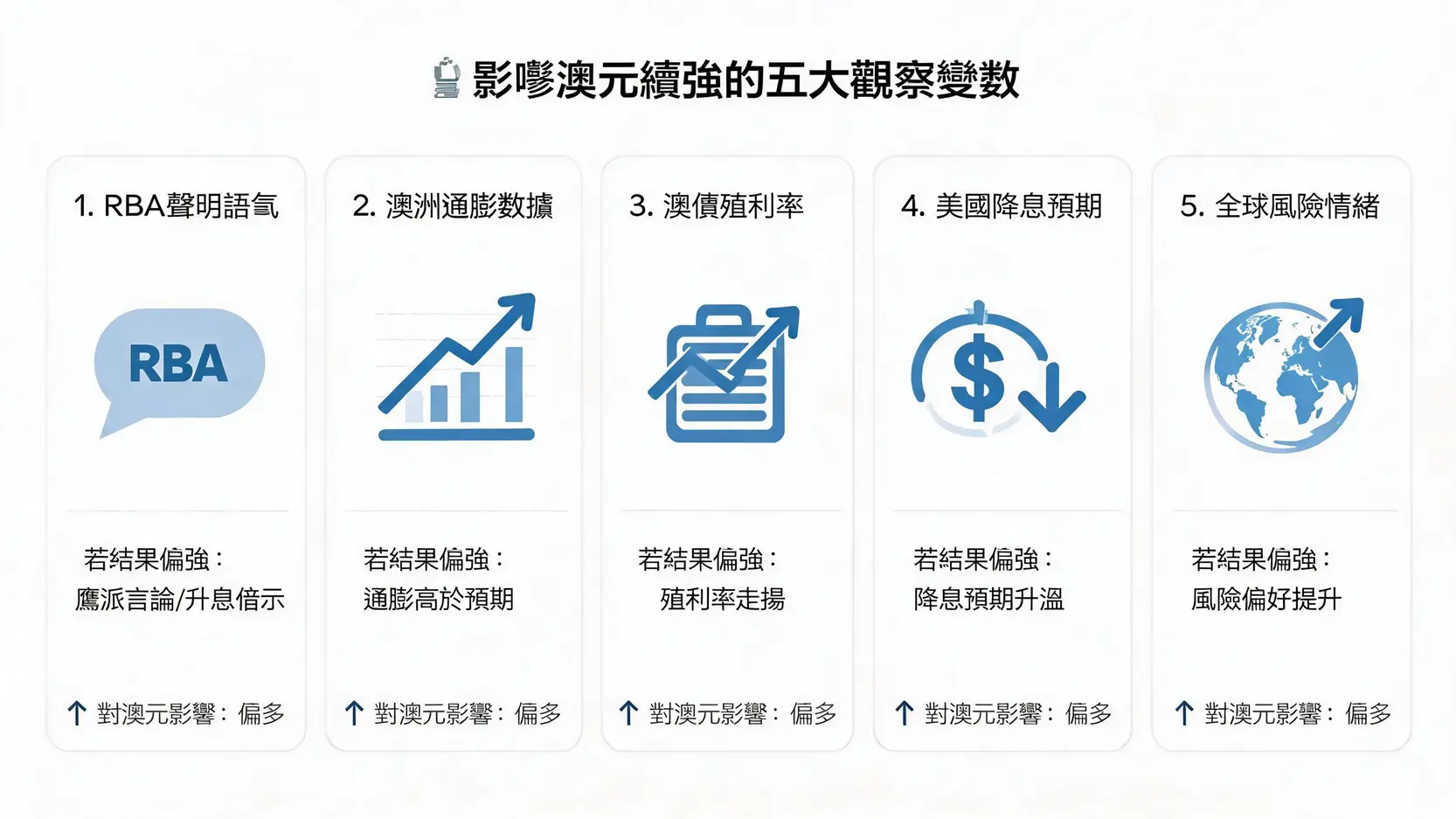
| Key Indicator | If the Outcome Is Stronger Than Expected |
Impact on the Australian Dollar |
| RBA Statement Tone | Leaves the Door Open for Rate Hikes or Higher Rates for Longer | Bullish |
| Australian Inflation Data | Higher Than Expected or Declining More Slowly | Bullish |
| Australian Government Bond Yields | Rising or Relatively Resilient | Bullish |
| US Rate Cut Expectations | Increasing | Bullish for AUD/USD |
| Global Risk Sentiment | Steadily Improving | Supportive of the Risk-Sensitive Australian Dollar |

Five Key Indicators to Watch Alongside the Interest Rate Decision to Determine Whether the Australian Dollar Can Continue Strengthening
How to Tell Whether the Australian Dollar Is Truly Strengthening: Watch the Statement and AUD/USD’s Market Reaction
The biggest mistake in the market is mistaking a news-driven candlestick for a genuine trend reversal. To determine whether an unchanged interest rate supporting the Australian dollar is merely a short-term reaction or the beginning of a medium-term trend, you should verify at least three layers of evidence.
Watch for Key Words in the Statement: Inflation, Demand, Labor Market, and Risk Balance
Don’t rush to read media summaries. Instead, go straight to the central bank’s statement and look for these signals:
- Inflation: Is it still described as being too high or persistent?
- Demand: Is it still characterized as resilient rather than cooling rapidly?
- Labor market: Does it remain tight, with no significant deterioration in the unemployment rate?
- Risk balance: Does the statement still acknowledge elevated upside inflation risks?
If three out of these four areas remain strong, then the reason an unchanged interest rate can benefit the Australian dollar becomes clear: the market will interpret it as the RBA not yet being ready to turn dovish.
Confirm the Move by Watching Both AUD/USD and Australian Government Bond Yields
A short-lived spike in the Australian dollar is not enough. Ideally, you should also monitor the following:
- Whether AUD/USD can hold above a key resistance level after breaking through it.
- Whether Australian 2-year and 3-year government bond yields move higher or at least remain stable.
- If the US Dollar Index weakens at the same time, the strength of the Australian dollar should be interpreted with greater caution.
Simply put, if both the Australian dollar and Australian government bond yields remain strong, the move is generally more convincing than a one-day surge in the exchange rate alone.
Avoid Mistaking a Short-Term News Rally for a Medium-Term Trend
A short-term news-driven rally usually has three characteristics:
- The currency surges within 30 minutes after the announcement but gives back all the gains the following day.
- Only the exchange rate moves, while the bond market and interest rate futures fail to follow.
- Subsequent economic data fails to support the hawkish narrative.
A genuine medium-term trend is usually accompanied by a hawkish statement, persistent inflation, resilient bond yields, and progressively higher highs in AUD/USD. When these conditions occur together, the Australian dollar’s strength becomes much more credible.
Why an Unchanged Interest Rate Can Benefit the Australian Dollar: The Three Things Investors Most Commonly Overlook
First, the market trades expectations, not the outcome itself. If an unchanged interest rate is better than expected, it is bullish.
Second, central bank policy language can sometimes matter more than the interest rate itself. A single sentence such as “we remain vigilant about inflation” can be enough to change the direction of the forex market.
Third, relative interest rate differentials always matter more than one country’s interest rate alone. Australia may leave rates unchanged, but if the US becomes more dovish, AUD/USD can still move higher.
Many investors in Taiwan and Malaysia focus solely on whether the RBA raises interest rates when analyzing the Australian dollar. In reality, this often causes them to react too slowly. The Australian dollar is a highly sensitive risk currency influenced jointly by monetary policy, commodities, bond yields, and the US dollar cycle. One news headline alone is never enough.
Further Reading (Highly Recommended)
FAQ
Q: What is the most common reason the Australian dollar rises when the RBA leaves interest rates unchanged?
A: The most common reason is not the interest rate itself, but that the decision is less dovish than the market expected. When the RBA leaves interest rates unchanged while maintaining a hawkish stance, short covering and the repricing of interest rate differentials can drive the Australian dollar higher.
Q: What is the difference between an unchanged interest rate and expectations for future rate hikes?
A: An unchanged interest rate describes what the central bank does today, while rate hike expectations describe “what the market believes may happen in the future”. The forex market usually places greater importance on the latter. Therefore, even if rates remain unchanged today, the Australian dollar may still strengthen if expectations for future rate hikes increase.
Q: How can I tell whether the Australian dollar’s strength is a short-term rebound or a genuine trend reversal?
A: Watch three things together: whether the RBA’s statement remains hawkish, whether Australian government bond yields continue to strengthen, and whether AUD/USD can hold above its breakout level. If the currency spikes immediately after the announcement but gives back the gains the next day, it is most likely only a short-term rebound.
Q: Why is the Australia-US interest rate differential so important for AUD/USD?
A: Because AUD/USD fundamentally reflects the relative comparison between the monetary policies and capital attractiveness of the two countries. Even if Australia does not raise interest rates, the Australian dollar can still benefit against the US dollar if the US moves closer to rate cuts. This is the power of the relative interest rate differential.
Q: Besides the interest rate decision, what other data should I watch when analyzing the Australian dollar?
A: The key indicators include Australia’s inflation, employment, wages, retail sales, Australian government bond yields, and commodity prices such as iron ore. Together, these factors shape market expectations for future RBA policy and influence the sustainability of the Australian dollar’s trend.
Conclusion
The reason an unchanged interest rate can benefit the Australian dollar is actually quite straightforward: the market focuses on expectation gaps, central bank policy language, and relative interest rate differentials. When the RBA holds rates steady without becoming as dovish as the market feared, and instead continues to emphasize inflation risks, the Australian dollar can naturally be repriced higher.
What truly matters is not assuming that “unchanged” is automatically bearish, but asking the right questions instead: Was this decision stronger or weaker than the market expected? Was the statement hawkish? Is the Australia-US interest rate differential moving in a direction that favors the Australian dollar? Once you understand these questions, you will truly understand the Australian dollar, rather than simply reacting to the news headlines.
Related Articles
-
Essential Reading on Japan Investment Risks: Five Potential Risks You May Not Know Besides Yen Depreciation Driven by the historic depreciation of the yen, global capital is flowing into Japan with unprecedented enthusiasm. Both the stock market and the real estate market are showing a thriving picture. The market is...2026 年 6 月 23 日
-
Will the Gold Price Bull Market Continue? 2026 XAUUSD Trend Analysis, Experts Reveal Three Key Drivers Recently, gold prices have repeatedly hit new highs, and the market is actively debating whether gold has entered a new historic gold price bull market. Many investors are both excited and concerned, wondering how...2026 年 6 月 23 日
-
Ultimate Guide to Trading XAUUSD Trends: From Candlestick Teaching to Practical Strategies for Stable Profits for Beginners XAUUSD (spot gold against the US dollar), as one of the world’s most popular trading instruments, offers abundant profit opportunities through its sharp price fluctuations, but also comes with considerable risk. Many beginners...2026 年 6 月 23 日