FOMC Guide: US Rate Meetings & Investment Impact

Updated: 2026/04/09  |  CashbackIsland

fomc-meeting-guide

【Federal Reserve Simplified Guide】What Is the FOMC Meeting? A Complete Overview of US Rate Meetings, Interest Rate Decisions, and Investment Impacts

Whenever you hear news reports saying “What Is the US Federal Reserve” or “FOMC announces Interest Rate Decisions”, does it feel both important and unfamiliar? These seemingly distant meetings have outcomes that can sway global stock and currency markets, and even affect your mortgage rates. As a savvy investor, understanding how the Federal Reserve rate meetings operate is crucial. This article will comprehensively unveil the mysteries of the US Federal Reserve, thoroughly explain what the FOMC meeting is, and show how its interest rate decisions transmit through multiple channels to ultimately impact the depth and breadth of your wallet, helping you easily grasp the pulse of the global economy.


What Is the US Federal Reserve? Breaking Down the World’s Most Powerful Financial Institution

The United States Federal Reserve System, abbreviated as the Federal Reserve (The Fed) is often described as the world’s “central bank”. Its decisions affect not only the US domestically but also have a decisive influence on financial markets worldwide. To understand its decisions, we must first examine its structure and mission.


Background and Organizational Structure of the Federal Reserve

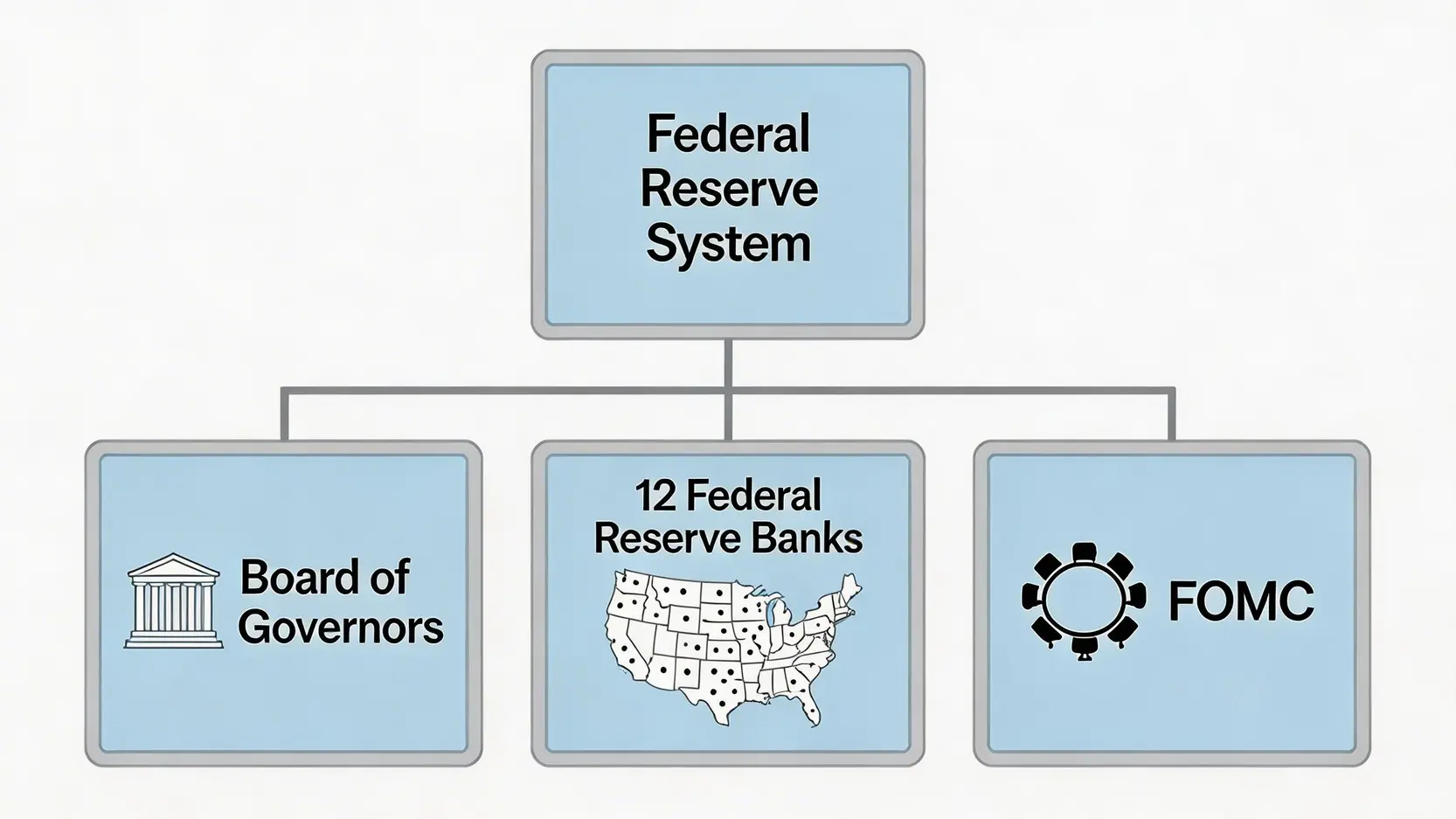
The Federal Reserve was established in 1913 to provide the US with a safer, more flexible, and more stable monetary and financial system. Its organizational structure mainly consists of three key components:

  • Board of Governors: Located in Washington, D.C., it is the central decision-making body of the Federal Reserve. It consists of seven governors nominated by the US President and confirmed by the Senate, serving 14-year terms to ensure independence in decision-making.
  • 12 Federal Reserve Banks: Located in major US cities such as New York, Chicago, and San Francisco, these banks serve as regional branches of the Fed, responsible for executing monetary policy, supervising local banks, and providing payment services.
  • Federal Open Market Committee (FOMC): This is the core unit that executes monetary policy and decides interest rate directions, and it is also the main body referred to in the commonly heard “rate meetings”.

美國聯儲局三大組成部分示意圖,包括聯邦準備理事會、12家聯邦準備銀行和聯邦公開市場委員會。

Three Core Structures of the US Federal Reserve


The Federal Reserve’s Two Core Missions: Price Stability and Maximum Employment

The Fed’s monetary policy goals are very clear, defined by Congress as its “Dual Mandate”:

  1. Price Stability: Controlling inflation to maintain stable prices. Generally, the Fed sets a long-term inflation target around 2%. When inflation is too high, it tends to tighten monetary policy (such as raising interest rates); conversely, it may loosen policy to stimulate the economy.
  2. Maximum Employment: Promoting economic growth to create sufficient employment opportunities and keep unemployment at low levels.

These two goals can sometimes conflict; for example, overly stimulating employment may trigger inflation. Therefore, the Fed’s challenge is to achieve a delicate balance between them, which is why its interest rate decisions receive such close attention.


Further Reading (Highly Recommended)

【Forex Beginner Guide】From 0 to 1 for New Investors, Understanding Forex Trading Basics!

Hong Kong Stock Investment for Beginners: Learning How Stocks Make Money from Scratch (Includes 2026 Popular HK Stock Account Recommendations)


Federal Reserve Rate Meetings: What Is the FOMC Meeting?

When news mentions “Federal Reserve Rate Meetings”, it actually refers to the policy meetings of the Federal Open Market Committee (FOMC). These meetings are the focus of global investors because they directly determine the US benchmark rate, the Federal Funds Rate which in turn affects global capital flows and asset prices.


FOMC Composition and Voting Mechanism

The FOMC consists of 12 voting members, designed to balance central and regional opinions:

  • Seven Board of Governors members: They are permanent voting members.
  • President of the New York Federal Reserve Bank: As the execution core of financial markets, holds permanent voting rights.
  • Presidents of the remaining 11 Reserve Banks: Rotate annually, with four gaining voting rights at a time.

This design ensures that the economic conditions of different regions are fully considered in decision-making. Although all 12 Reserve Bank presidents participate in discussions, only the above 12 members have final voting rights.


Meeting Process: How Are Rate Hikes, Cuts, or Holds Decided?

The FOMC rate meetings follow a rigorous decision-making process. Members review detailed economic data, including employment reports, inflation data (CPI, PCE), retail sales, industrial production, and global economic conditions. They discuss risks and uncertainties in the economic outlook and present their views on monetary policy. Ultimately, they vote on whether to adjust the Federal Funds Rate target range. After the decision, a policy statement is released, and the Fed Chair holds a press conference to explain the rationale behind the decision.


2026 Federal Reserve Rate Meeting Schedule

Knowing the FOMC meeting schedule is an important step in planning investment strategies. Below is the 2026 meeting schedule, with interest rate decisions announced after each meeting. Investors should closely monitor market fluctuations around these dates.

Meeting Month Meeting Date

Whether It Includes the Summary of Economic Projections (SEP)

January January 28-29 No
March

March 17-18

Yes
April/May April 29-30 No
June June 10-11 Yes
July July 29-30 No
September September 16-17

Yes

November November 4-5 No
December December 15-16 Yes

Source: Federal Reserve Official Website, with specific dates subject to official announcements


How Do Rate Meeting Results Affect You? From the Stock Market to Daily Life

Although the Fed’s interest rate decisions may seem macroeconomic, they are closely connected to our personal finances. From investment portfolios to daily expenses, their impact is everywhere, especially for economies like Hong Kong that operate under a linked exchange rate system.


Signals of Interest Rate Decisions: The Economic Meaning of Hikes and Cuts

Each rate adjustment reflects the Fed’s assessment of current economic conditions and its policy direction for the future. We can interpret them as the following signals:

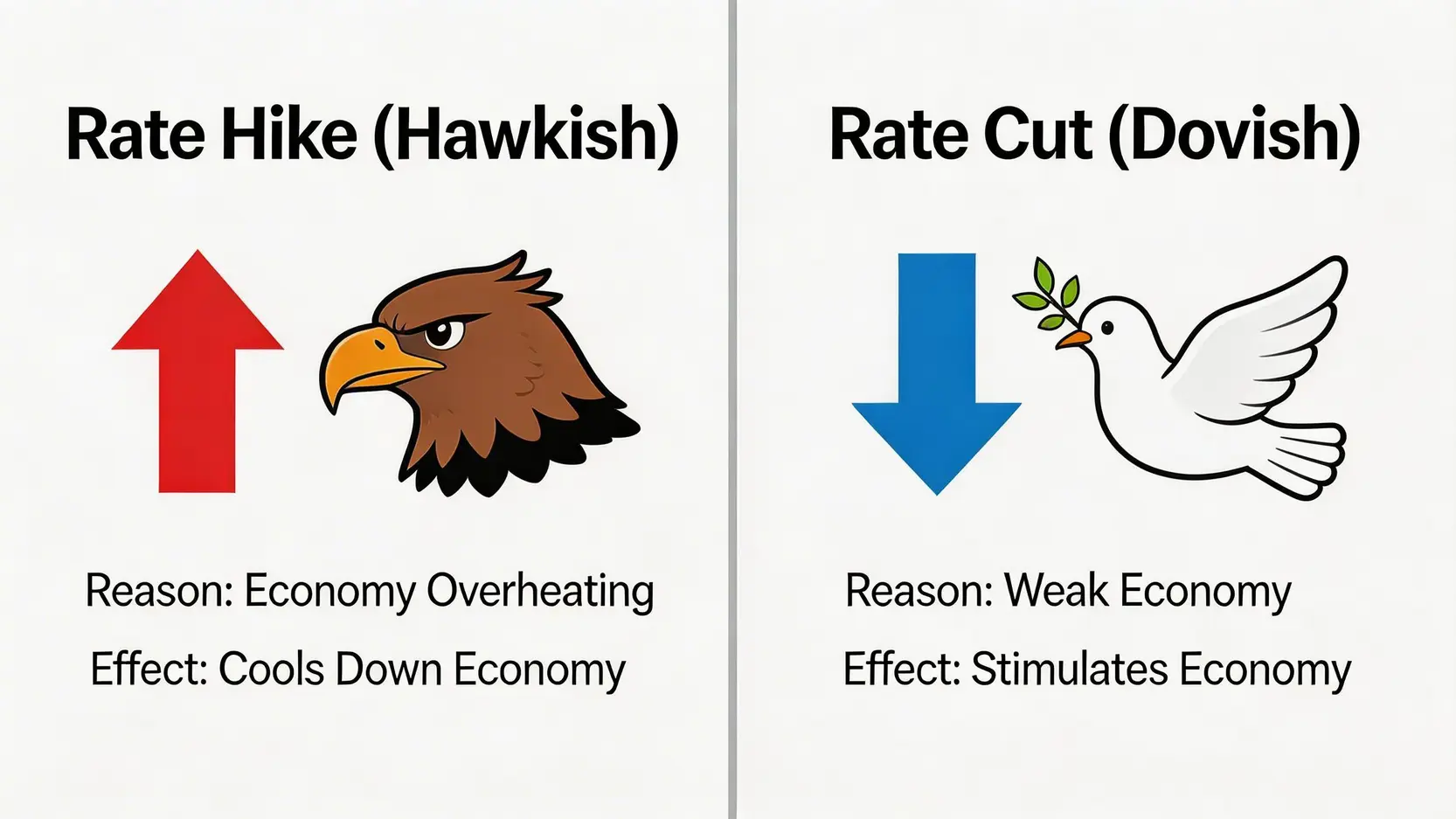
  • Rate Hike (Hawkish): When the Fed chooses to raise rates, it usually indicates an overheated economy with rising inflationary pressures. This aims to increase borrowing costs to cool the economy. For investors, it may signal higher corporate financing costs, reduced consumer spending, and tighter market liquidity.
  • Rate Cut (Dovish): When the economy weakens and recession risks rise, the Fed may cut rates. This aims to lower borrowing costs, stimulate corporate investment and personal consumption, and inject liquidity into the market. It is generally seen as a positive signal for financial markets.
  • Maintaining Rates: Indicates that the Fed considers the current rate level appropriate or holds a wait-and-see stance on future economic trends, requiring more data to guide the next action.

聯儲局加息(鷹派)與減息(鴿派)的對比圖,解釋兩者對經濟的不同影響。

Hawkish Rate Hike vs. Dovish Rate Cut: Understanding Fed Policy Signals at a Glance


Direct Impacts on Hong Kong’s Stock Market, Property Market, and the Hong Kong Dollar

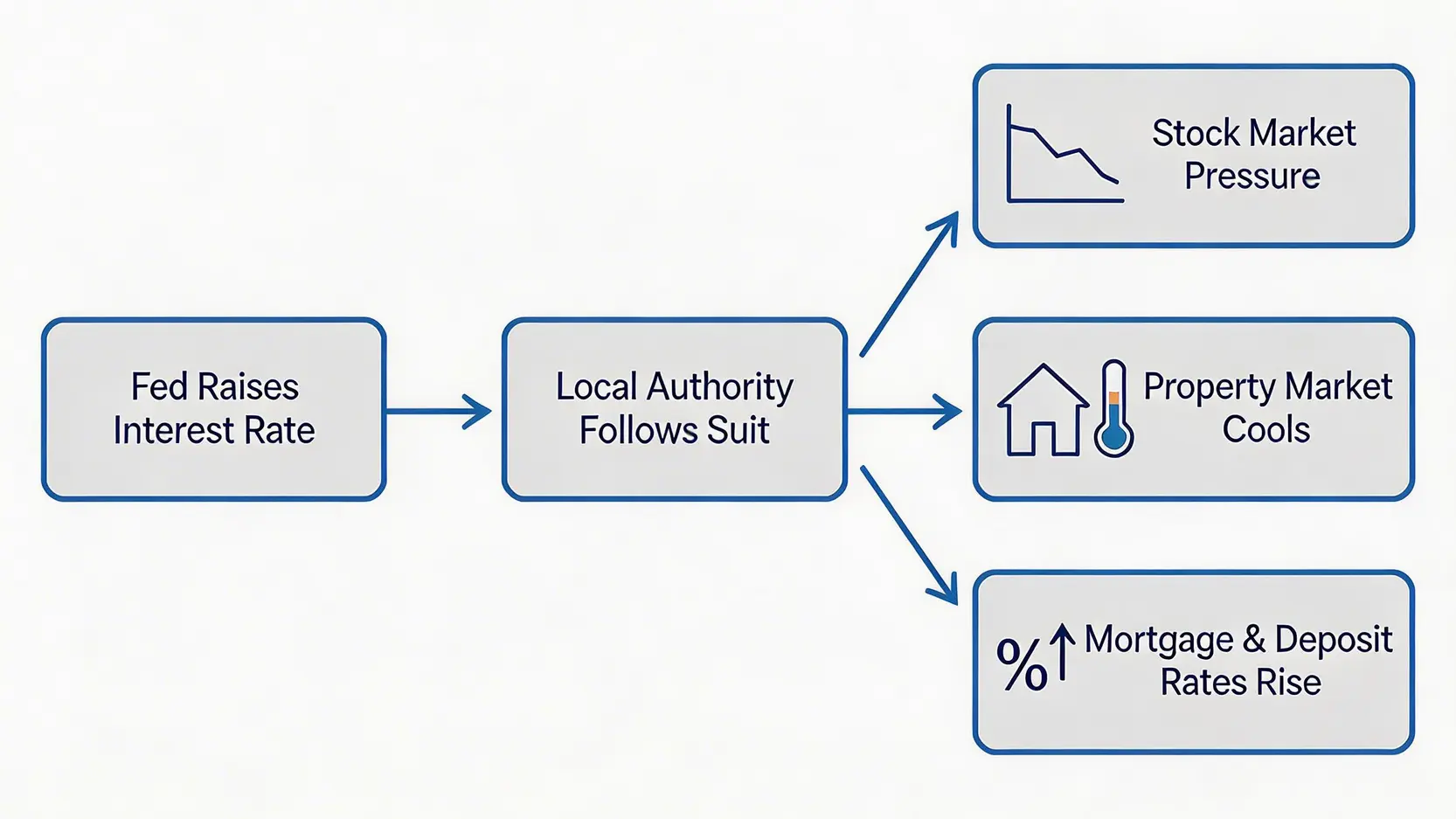
As Hong Kong operates under a linked exchange rate system with the US dollar, the Hong Kong Monetary Authority (HKMA) typically follows the Fed’s rate movements. This means the Fed’s decisions have a direct and immediate effect on Hong Kong markets:

美國加息對香港市場影響的傳導機制流程圖,顯示從聯儲局加息到影響香港股市、樓市和利率的過程。

How Fed Rate Hikes Gradually Affect Hong Kong Markets

  • Impact on the Stock Market: Fed rate hikes increase corporate borrowing costs, particularly affecting highly leveraged companies (such as property stocks) and high-valuation growth stocks (such as tech stocks). Funds may also shift from equities to lower-risk assets (such as US dollar deposits). Conversely, rate cuts can boost market sentiment and corporate profit expectations, benefiting stock prices. For more beginner guidance on HK stock investment, relevant tutorials are recommended.
  • Impact on the Property Market: Hong Kong mortgage rates (such as Prime Rate P and HIBOR-based H) are closely tied to US rates. When the Fed raises rates, Hong Kong banks usually follow, increasing mortgage burdens and potentially cooling the property market. Rate cuts can reduce mortgage pressure for homeowners and stimulate property demand.
  • Impact on the Hong Kong Dollar: Under the linked exchange rate system, Hong Kong’s rates must closely track US rates to maintain HKD stability. If the US raises rates while Hong Kong does not, interest rate differentials may trigger capital outflows, activating the weak-side convertibility undertaking, requiring HKMA intervention. Consequently, the interest on your HKD deposits will also adjust with US rate changes.


Further Reading (Highly Recommended)

【Forex Beginner Guide】From 0 to 1 for New Investors, Understanding Forex Trading Basics!

Hong Kong Stock Investment for Beginners: Learning How Stocks Make Money from Scratch (Includes 2026 Popular HK Stock Account Recommendations)


FAQ: Common Questions About Federal Reserve Rate Meetings

Q: How many times does the FOMC meet each year?

A: The FOMC holds eight regular rate meetings annually, approximately every six weeks. In special circumstances, if significant economic changes occur, ad hoc meetings may also be convened to make decisions.

Q: What is the typical market reaction after a rate meeting?

A: Market reactions are very rapid. At the moment interest rate decisions are announced, stock, currency, bond, and commodity markets usually experience sharp fluctuations. If the decision or the tone of the post-meeting statement differs from market expectations, volatility can be even more pronounced. For example, an unexpected rate hike may cause stock prices to fall and the US dollar to strengthen.

Q: Why is the Fed Chair’s post-meeting statement so important?

A: The Chair’s post-meeting statement and press conference provide rich information beyond the rate decision, known as “Forward Guidance.” The Chair explains the rationale for the decision and gives hints about future economic prospects and policy paths. Markets closely analyze the wording, such as whether it is “hawkish” (tending toward tightening) or “dovish” (tending toward easing), to judge the likely direction of future rates.

Q: What is the “Dot Plot”?

A: The “Dot Plot” is a chart released after the meetings (in March, June, September, and December), showing each FOMC member’s anonymous projections for the federal funds rate over the next few years. It is not an official policy commitment but is regarded by the market as an important window into the Fed’s internal policy inclinations, reflecting the committee’s median interest rate expectations.


Conclusion

In summary, understanding what the US Federal Reserve is and how its FOMC rate meetings operate is an essential lesson for modern investors. From macroeconomic policy to personal asset allocation, every decision by the Fed profoundly influences our wealth through interest rates and market expectations. Whether you are a stock market beginner or an experienced investor, mastering the core concepts of Federal Reserve rate meetings and discerning the economic signals behind them can help you make wiser investment decisions in a complex and ever-changing financial market, laying a solid foundation for your future financial goals.

If you liked this article, please share it!

Related Articles

  • Volatility Surface Guide: Skew Trading Strategies
    Practical Applications of Volatility Surfaces: From Options Modeling to Advanced Skew Trading Strategies In options markets, implied volatility is never a flat line. Instead, it forms complex "smile" or "skew" surfaces. For advanced traders, mastering the practical applications of volatility surfaces is equivalent to possessing a lens that reveals market...
    2026 年 6 月 3 日
  • Foreign Capital Flow Model: Track Institutional Money
    Building a Foreign Capital Flow Copy Trading Model: A Stock Market Indicator for Accurately Tracking Institutional Positioning In Asia-Pacific stock markets, foreign capital inflows and outflows often determine the direction of the index. However, simply looking at daily net buy and sell data is no longer enough. Only by building...
    2026 年 6 月 3 日
  • Options Buying Strategies for Extreme Market Risks
    Options Buyer Strategies During Extreme Market Conditions: Black Swan Hedging and Cross-Market Arbitrage During Volatility Surges The most terrifying aspect of financial markets is not a gradual decline, but overnight flash crashes and cross-market capital withdrawals accompanied by volatility surges. In the highly unpredictable global macroeconomic environment of 2026, geopolitical...
    2026 年 6 月 3 日
返回顶部