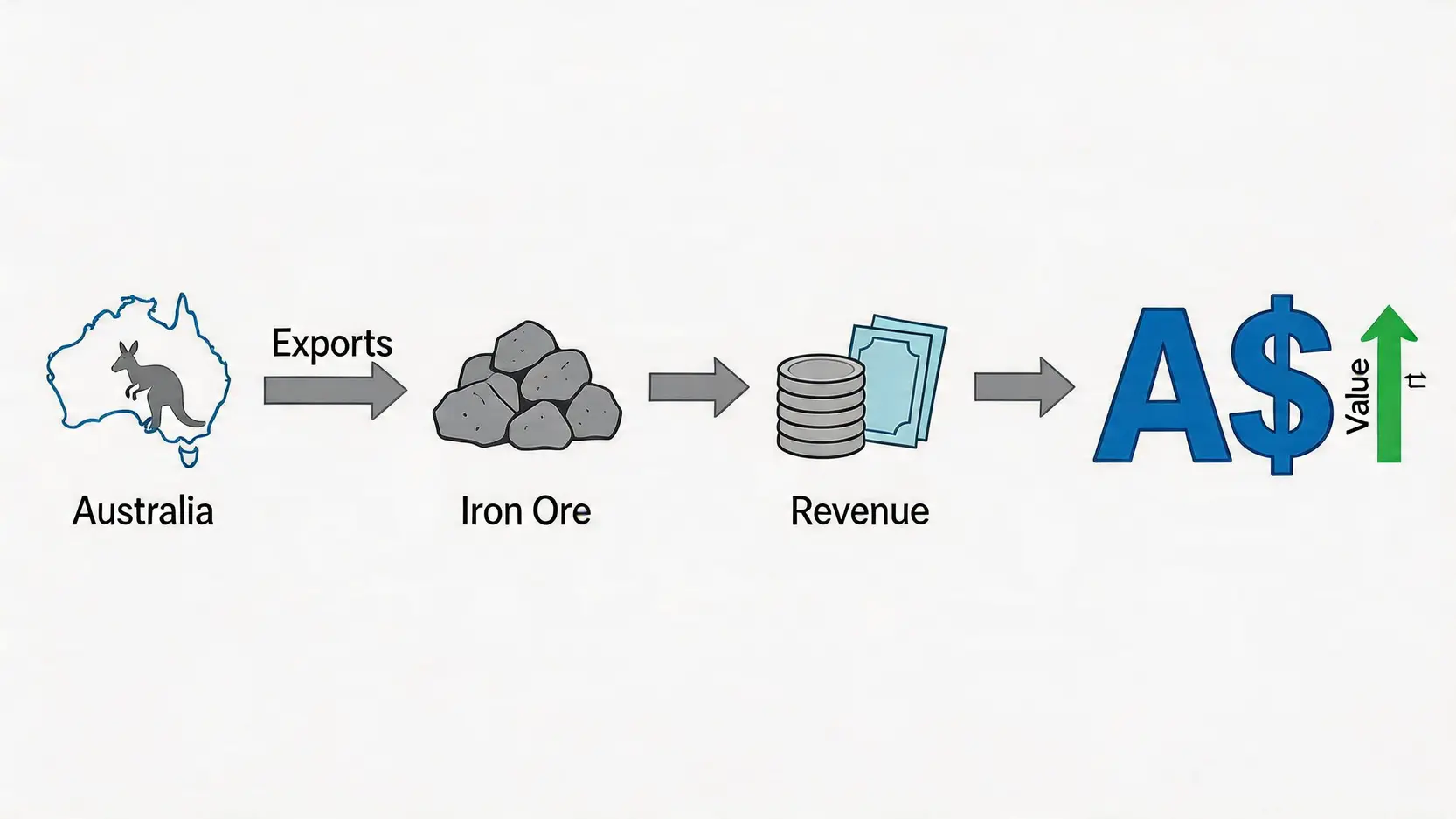
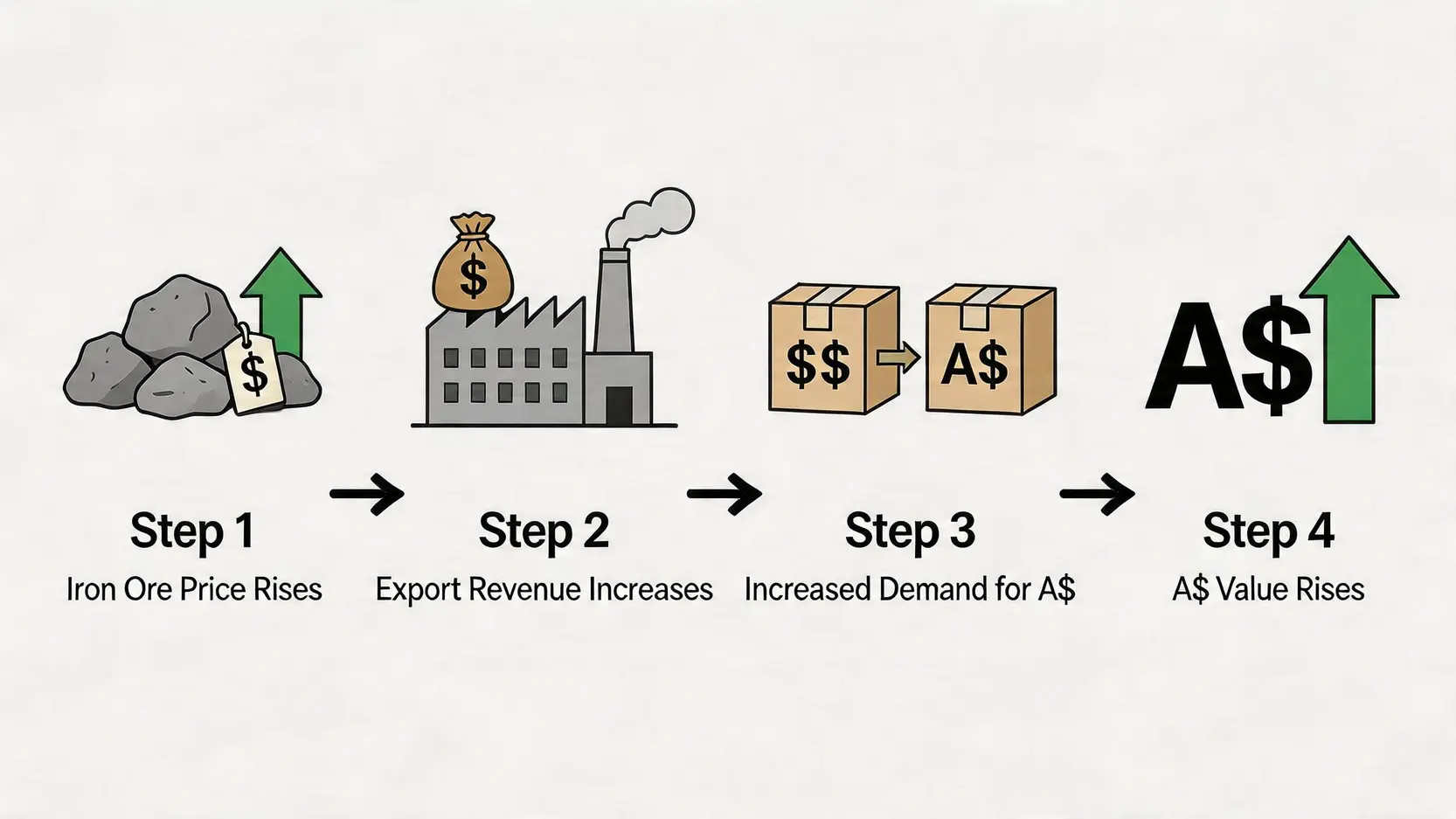
Iron ore price transmission pathway to AUD exchange rate
This mechanism explains why the iron ore price chart and the AUD/USD exchange rate often show strong similarity.
Mechanism 2: The China Factor – How the Largest Buyer Drives AUD Trends?
China is the world’s largest steel producer and also the largest buyer of Australian iron ore, with its import volume accounting for more than 70% of Australia’s total iron ore exports. Therefore, China’s economic conditions directly determine the level of iron ore demand, which in turn indirectly affects Australian dollar trends.
- Infrastructure and real estate: When China’s economy is booming and large-scale infrastructure and property development projects are underway, demand for steel becomes very strong, which drives up iron ore prices and supports the Australian dollar.
- Manufacturing Purchasing Managers’ Index (PMI): China’s PMI data is an important leading indicator for observing economic activity. When PMI is strong, especially above the 50 expansion threshold, it usually signals manufacturing expansion, which increases iron ore demand and becomes a bullish signal in AUD trend analysis.
- Economic stimulus policies: When the Chinese government launches large-scale economic stimulus plans, the market expects increased infrastructure investment, which pushes iron ore futures higher in advance and transmits into the AUD exchange rate.
Therefore, monitoring China’s economic data is almost equivalent to forecasting the demand outlook for iron ore, which is crucial for understanding why the Australian dollar is influenced by iron ore.
Mechanism 3: Market Sentiment and Risk Appetite – The Dual Impact of Global Economic Conditions on the Australian Dollar
As a commodity currency, the Australian dollar is also a “risk on currency”. This means that when global economic prospects are optimistic and investor risk appetite is high, the Australian dollar tends to be strongly supported. Conversely, when global recession fears rise and market risk aversion increases, investors tend to sell the Australian dollar and shift into safe-haven currencies such as the US dollar and Japanese yen.
The relationship between this mechanism and iron ore lies in the following:
- Economic boom: When the global economy is performing well, industrial production and construction activity usually increase. This not only pushes up commodity prices such as iron ore but also strengthens market risk sentiment, with both factors jointly supporting the Australian dollar.
- Economic recession: When the global economy faces recession risks, industrial demand contracts, leading to a decline in iron ore prices. At the same time, market panic drives capital out of the Australian dollar, resulting in a “double hit” effect.
Practical Guide: How to Use Iron Ore Data for AUD Trend Analysis
Theory must be combined with practice in order to navigate financial markets effectively. The following three-step framework shows how to use iron ore data for AUD trend analysis.
Step 1: Monitor Key Indicators (Iron Ore Futures, China PMI)
First, you need to develop the habit of regularly tracking key data:
- Iron ore futures prices: This is the most direct indicator. You can monitor iron ore futures on the Singapore Exchange (SGX) or the Dalian Commodity Exchange (DCE). In general, price trends tend to lead movements in the AUD spot exchange rate. You can find real-time quotes on financial websites such as Investing.com.
- China official/Caixin Manufacturing PMI: Data released at the beginning of each month is a key market focus. The strength or weakness of the data immediately affects market expectations for iron ore demand, which is then reflected in the Australian dollar exchange rate.
Step 2: Combine Australian Reserve Bank (RBA) Interest Rate Policy for Comprehensive Judgment
Iron ore prices are an important factor influencing the Australian dollar, but not the only one. The monetary policy of the Reserve Bank of Australia (RBA) is equally crucial. You need to analyze both together:
- Bullish alignment: If iron ore prices are in an upward trend and the RBA signals a hawkish stance (for example, hinting at rate hikes to combat inflation), this will strongly support the Australian dollar.
- Offsetting signals: If iron ore prices rise but the RBA maintains a dovish stance due to concerns about domestic economic slowdown (hinting at rate cuts or maintaining low interest rates), the AUD gains may be limited. The reverse is also true. You can refer to further in-depth analysis on how RBA interest rate policy affects the Australian dollar.
Remember, central bank interest rate decisions directly affect the “cost of holding” a currency and are an indispensable part of exchange rate analysis.
Case Study: Historical Correlation Between Iron Ore Prices and the Australian Dollar
Looking back, from mid-2020 to early 2021, as the global economy recovered from the pandemic and China’s infrastructure demand remained strong, iron ore prices surged from around 80 USD per ton to over 200 USD. During the same period, AUD/USD rose from around 0.65 to nearly 0.80, showing a clear and strong positive correlation between the two.
However, in the second half of 2021, as China tightened regulations on the property sector and iron ore demand expectations weakened, prices were cut in half. At the same time, the Australian dollar also declined, once again confirming the close relationship between the Australian dollar and iron ore.
Frequently Asked Questions (FAQ)
Q: Besides iron ore, what other commodities affect the Australian dollar?
A: Although iron ore is the single most influential commodity, Australia is also a major exporter of coal, gold, natural gas, and agricultural products (such as wheat and beef). Therefore, price movements in these commodities, especially coal and gold, can also impact the Australian dollar to some extent. However, their influence is generally weaker than iron ore.
Q: How does US dollar strength affect the iron ore and Australian dollar relationship?
A: The strength of the US dollar is a very important external variable. Since most commodities are priced in US dollars and the main trading pair of the Australian dollar is AUD/USD, the US dollar index (DXY) has a significant impact. Even if iron ore prices rise, a stronger US dollar driven by hawkish Federal Reserve policy may limit AUD gains or even cause it to fall. Therefore, the US dollar factor must be included in the analysis.
Q: Where can I find the most up-to-date iron ore prices?
A: Many major financial information platforms and trading tools provide real-time iron ore futures prices, such as TradingView, Bloomberg, Reuters, and Investing.com. It is recommended to monitor iron ore futures contracts priced in US dollars on the Singapore Exchange (SGX), as they better reflect international market pricing.
Q: How does China’s environmental policy affect this relationship?
A: China’s environmental policies, especially production restrictions in the steel industry, directly reduce iron ore demand, putting downward pressure on prices and therefore weakening the Australian dollar. In recent years, whenever the market expects strict steel production cuts in China, both iron ore and the Australian dollar have typically declined simultaneously, making this a new influential variable in the iron ore–AUD relationship.
Conclusion
In summary, to conduct accurate Australian dollar trend analysis, understanding the relationship between the Australian dollar and iron ore is an indispensable component. From Australia’s economic structure as a “commodity currency” country, to the three core transmission mechanisms of export supply and demand, the China factor, and global risk sentiment, iron ore prices are undoubtedly a key leading indicator for forecasting movements in the Australian dollar exchange rate. By applying a comprehensive analytical framework that combines iron ore data with Reserve Bank of Australia policy, investors can more fully assess market conditions and navigate the AUD investment market with greater confidence amid both opportunities and challenges.