Will the RBA Raise Rates in August? AUD Outlook

Updated: 2026/06/22  |  CashbackIsland

aud-august-rate-hike-forecast

Will the RBA Raise Rates in August? A Complete Analysis of the Australian Dollar Outlook and AUD/USD Trading Scenarios

As August approaches, global financial markets are once again turning their attention to the Reserve Bank of Australia’s (RBA) interest rate decision. With inflation remaining stubbornly high, expectations of an August rate hike have intensified, fueling heated debate between bulls and bears and directly influencing the Australian dollar’s outlook. How strong are current market expectations? What are the key arguments for and against a rate hike? More importantly, how would different policy outcomes affect your AUD/USD trading strategy? This article provides an in-depth analysis of the latest macroeconomic data, breaks down potential market reactions under different scenarios, and offers key insights to help you plan your August trading strategy. Whether you are a long-term investor or a short-term trader, understanding these developments is essential. 


Current Market Expectations for the August Interest Rate Decision

Ahead of every RBA meeting, markets are filled with speculation and expectations. To understand what the market is truly pricing in, the most direct and effective approach is to monitor interest rate futures pricing and the views of major financial institutions. At present, both indicators point to a complex and divided outlook.


Rate Hike Probability Implied by the Interest Rate Futures Market

Interest rate futures are used by professional investors to hedge future interest rate risk or speculate on policy changes. Their pricing directly reflects the market’s collective expectations for future interest rates. According to the Australian Securities Exchange (ASX) RBA Rate Tracker, as of mid-June, the implied probability of a 25-basis-point rate hike in August fluctuated between approximately 40% and 50%. This suggests that the market has not fully priced in a rate hike, with expectations remaining evenly balanced. This uncertainty is one of the primary reasons for the recent increase in volatility in the Australian dollar (AUD). When the implied probability rises above 50%, it generally provides support for the Australian dollar. Conversely, a decline in the probability tends to put downward pressure on the currency. 


Summary of Forecasts From Major Investment Banks and Economists

Compared with the quantitative signals from the futures market, forecasts from major investment banks and economists provide more fundamental analysis. At present, major institutions remain sharply divided over whether the RBA will raise rates in August.

  • Supporting a rate hike (Hawkish): Several domestic institutions, including Westpac and National Australia Bank (NAB), believe that persistent second-quarter inflation and a still-tight labor market justify another rate hike in August to ensure inflation returns to the RBA’s 2-3% target range.
  • Supporting no change (Dovish): On the other hand, international investment banks such as Goldman Sachs and J.P. Morgan remain more cautious. They argue that the delayed effects of previous rate hikes are becoming increasingly evident, consumer spending has already begun to weaken, and given the uncertain global economic outlook, the RBA is likely to keep rates unchanged while assessing additional economic data.

This divide between “domestic hawks” and “international doves” highlights the difficult position facing the RBA and suggests that the August interest rate decision is likely to be highly uncertain, with significant market volatility expected.

鷹派與鴿派對於澳洲央行8月是否加息的觀點對比圖。

The market remains sharply divided over the likelihood of an August rate hike, highlighting the difficulty of the policy decision.


Further Reading (Highly Recommended)

Forex Trading Guide for Beginners: Learn the Basics of Forex Trading From 0 to 1!

The Relationship Between the Australian Dollar and Iron Ore: Three Key Factors for Forecasting the AUD Exchange Rate


The Core Arguments Supporting an August Rate Hike: Inflationary Pressures Remain Unresolved

Although the market remains divided over the likelihood of an August rate hike, the case for further monetary tightening by the Reserve Bank of Australia (RBA) remains strong, with persistent inflation at its core. The latest Consumer Price Index (CPI) data and a still-tight labor market are the primary arguments supporting the hawkish camp.


Latest CPI Analysis: Is Core Inflation Still Stubborn?

According to the latest data released by the Australian Bureau of Statistics (ABS), although annual CPI growth for the second quarter of 2026 has moderated from its peak, core inflation, measured by the Trimmed Mean CPI, has declined more slowly than expected and is projected to remain around 3.4%, still well above the RBA’s 2-3% target range. In particular, services inflation, including rents, insurance, restaurants, and travel, continues to show strong price persistence. This suggests that inflationary pressures have spread beyond goods into broader areas of the economy. For the RBA, persistent core inflation remains a major concern. If left unchecked, inflation expectations could become unanchored, ultimately requiring even greater economic costs to bring inflation under control. To reinforce market confidence in the RBA’s commitment to fighting inflation, another rate hike in August remains a reasonable policy option.

Tight Labor Market Conditions and Wage Growth Pressures

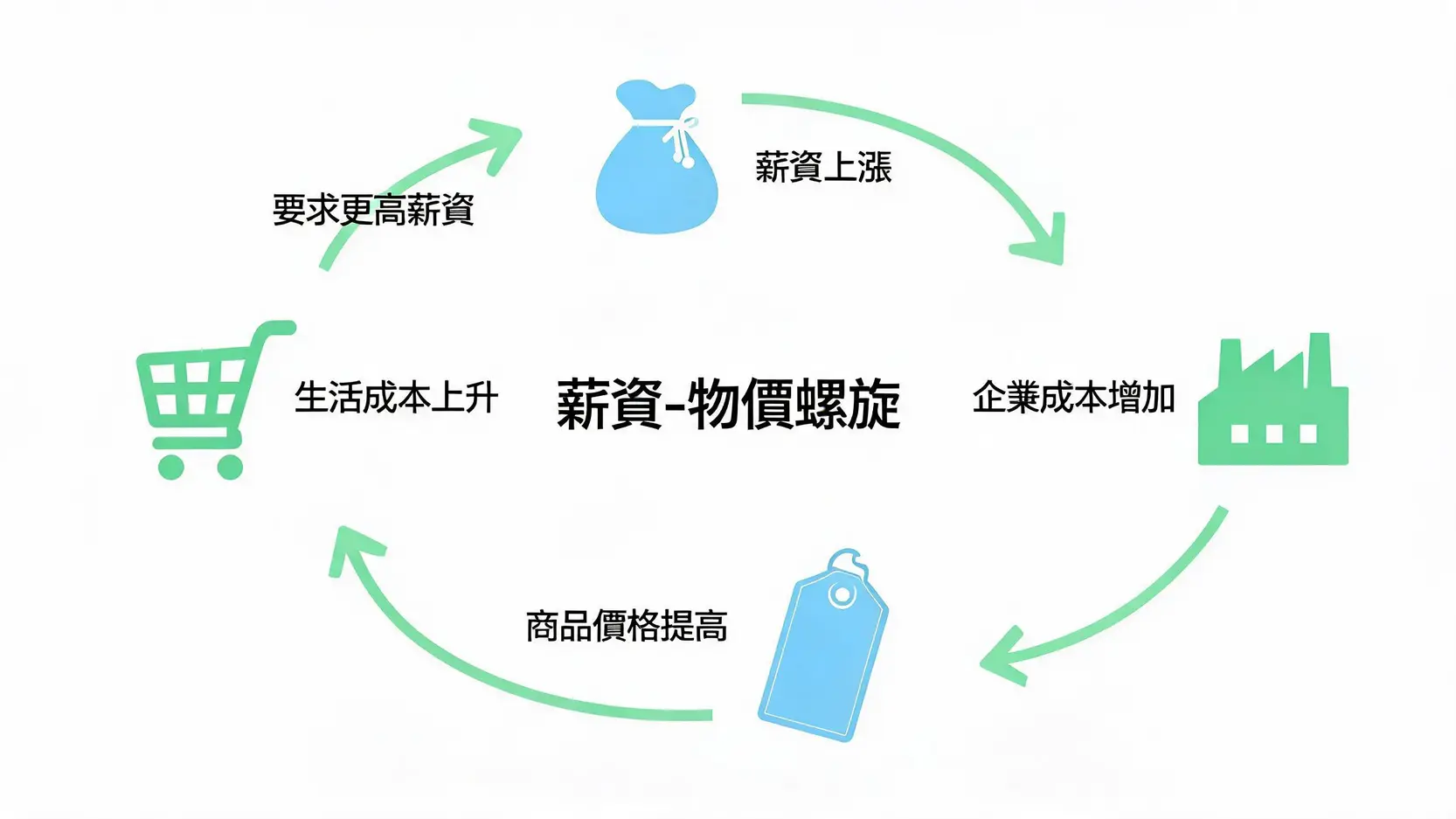
Another issue preventing the RBA from relaxing is the exceptionally strong labor market. Australia’s unemployment rate has remained between 3.8% and 4.0%, close to historical lows, while job vacancies continue to exceed pre-pandemic levels by a wide margin. This labor shortage has strengthened workers’ bargaining power and accelerated wage growth. The latest Wage Price Index is expected to record annual growth of more than 4.0%, the highest level in over a decade. While stronger wage growth benefits households, from a macroeconomic perspective it also increases the risk of a “wage-price spiral” where businesses raise prices to offset rising labor costs, further fueling inflation. At this critical stage in the inflation fight, containing the transmission of wage growth into broader price increases remains another compelling argument in favor of an August rate hike.

薪資-物價螺旋式上升的循環流程圖。

Wage growth may trigger a self-reinforcing inflation cycle.


The Case Against an August Rate Hike: Concerns Over Economic Slowdown

In sharp contrast to inflation data, signs of weakness are gradually emerging across the Australian economy. Those opposing an August rate hike argue that the cumulative impact of more than a year of consecutive rate increases has already significantly slowed economic activity. Tightening monetary policy further at this stage could unnecessarily increase the risk of recession. This view is primarily based on the following two arguments.


Weak Signals From Retail Sales and Consumer Confidence

Two key indicators of consumer activity, retail sales and consumer confidence, have both recently weakened. According to the latest data, Australia’s retail sales fell by 1.1% month over month in May, well below market expectations, indicating that households are cutting back on discretionary spending under the combined pressure of high interest rates and elevated living costs. At the same time, the Westpac-Melbourne Institute Consumer Sentiment Index has remained around 80, firmly within pessimistic territory, suggesting that most Australian households remain concerned about their financial outlook. Household consumption is Australia’s largest economic driver. If consumer spending continues to weaken, overall economic growth will face considerable challenges. As a result, the dovish camp argues that the RBA should allow more time for the cumulative effects of previous rate hikes to work through the economy rather than tightening policy further.


The Impact of Global Economic Uncertainty on Australia

As a highly trade-dependent economy, Australia’s economic performance is closely tied to global conditions. At present, the global outlook remains highly uncertain. While the US economy has demonstrated resilience, Europe’s recovery remains sluggish, and Australia’s largest trading partner, China, continues to face challenges from a weak property market and local government debt issues. These factors directly affect demand for Australia’s key commodity exports, including iron ore and coal, which in turn influence Australia’s export income and the Australian dollar. Against this backdrop of uncertain global demand, an aggressive unilateral rate hike by the RBA could cause excessive appreciation of the Australian dollar, weakening export competitiveness and placing additional pressure on the economy. Consequently, global economic uncertainty remains a key argument against an August rate hike.


Trading Scenarios and Response Strategies Under Different Policy Outcomes

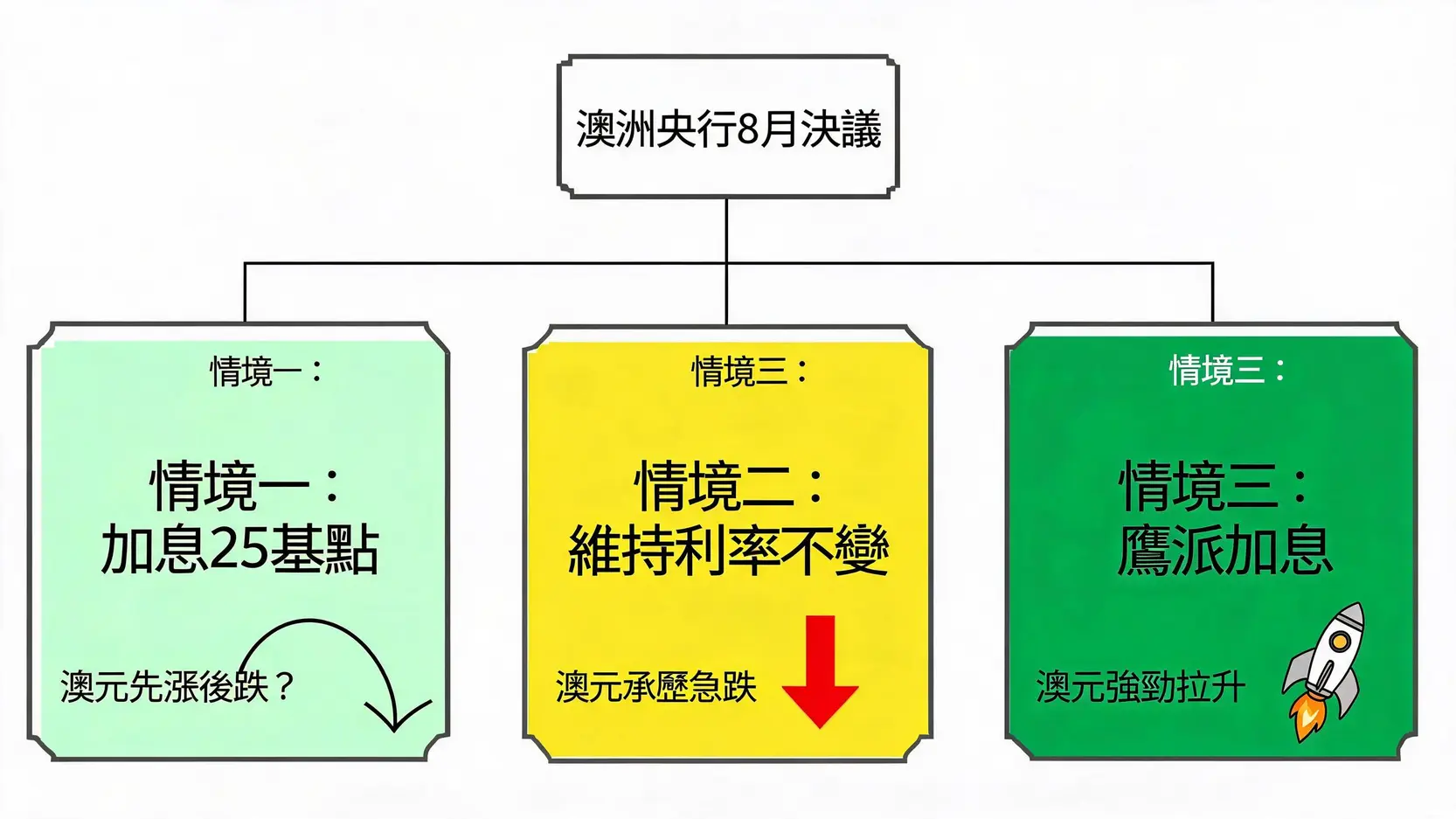
Given the high degree of uncertainty surrounding the August interest rate decision, planning trading scenarios in advance is essential. Whatever decision the RBA ultimately makes, it is likely to trigger significant market volatility. Below are the three most likely scenarios, together with their potential impact on AUD/USD and corresponding trading strategies. For a deeper understanding of the key factors affecting the Australian dollar against the US dollar, refer to our comprehensive analysis.

澳洲央行8月利率決議的三種可能結果及其對澳元走勢影響的流程圖。

AUD trading scenarios under different interest rate decision outcomes.


Scenario 1: A 25-Basis-Point Rate Hike as Expected, With the Australian Dollar Potentially “Selling the Fact”

If the Reserve Bank of Australia raises interest rates by 25 basis points to 4.60%, as part of the market expects:

  • Initial market reaction: Since the market has already priced in roughly a 40-50% probability of a rate hike, AUD/USD may briefly surge on confirmation of the hawkish policy, testing overhead resistance around 0.6750.
  • Subsequent price action: The key will be the tone of the RBA’s statement. If the statement adopts a cautious tone and suggests this could be the final rate hike of the current tightening cycle, the market could experience a classic “sell the fact” reaction. This means the initial rally may quickly be erased by profit-taking, with AUD/USD potentially falling back to test support around 0.6680.
  • Trading strategy: Chasing the rally immediately after the announcement is not recommended. Instead, wait for the price to retest a key resistance level. If signs of fading bullish momentum emerge (such as a long upper shadow), consider initiating short positions. Conversely, if the price finds support after pulling back to the support zone, it may present a short-term buying opportunity.


Scenario 2: An Unexpected Decision to Leave Rates Unchanged, Triggering a Sharp Australian Dollar Decline Toward Key Support

If the Reserve Bank of Australia leaves the Cash Rate unchanged at 4.35%, the market is likely to interpret this as a dovish signal.

  • Initial market reaction: Such an outcome would disappoint traders positioned for a rate hike. AUD/USD is expected to come under immediate selling pressure, breaking below the recent support level at 0.6650 and moving toward the next major psychological and technical support around 0.6580.
  • Subsequent price action: The extent of the decline will depend on the RBA’s forward guidance. If the statement strongly suggests that “a pause does not mean the tightening cycle has ended” and continues to express concern about inflation, downside may be limited. However, if the statement highlights growing concerns about the economic outlook, selling pressure could intensify.
  • Trading strategy: Traders without positions may consider following the downside momentum after a confirmed break below key support, while maintaining disciplined stop-loss levels. Traders looking to buy the dip should remain patient and wait for clear reversal signals around long-term support levels such as 0.6580 or the lower support at 0.6520, including bullish divergence or a hammer candlestick, before entering. Learning more about Australian dollar technical analysis can help you better identify entry opportunities.


Scenario 3: A Hawkish Rate Hike Accompanied by Stronger Tightening Signals, Where Could the Australian Dollar Go?

This is a low-probability but high-impact scenario. Not only does the Reserve Bank of Australia raise rates by 25 basis points, but it also explicitly states in the post-meeting statement or press conference that inflation concerns have intensified and that further rate hikes over the coming months remain possible.

  • Initial market reaction: This would be viewed as an extremely hawkish signal. AUD/USD would likely break above the short-term high described in Scenario 1 and rally sharply, targeting 0.6800 and potentially extending toward the 0.6850 area.
  • Subsequent price action: Under this scenario, the Australian dollar would receive strong fundamental support, fueling bullish sentiment. Provided subsequent economic data does not deteriorate significantly, the AUD/USD uptrend could continue for some time.
  • Trading strategy: This represents the most favorable scenario for establishing long positions. Traders may consider entering long trades after AUD/USD breaks above a key resistance level (such as 0.6750) and confirms the breakout, with stop-loss orders placed below the breakout level.


Further Reading (Highly Recommended)

A Complete Guide to Central Bank Board Meetings: How Are Rate Hikes and Rate Cuts Decided? Understanding Their Impact on You

How Rate Hikes Affect the Economy: Understanding the Central Bank’s Role and Gaining Insights Into the Stock Market, Property Market, and Personal Finances


FAQ

Investors commonly have several questions regarding August rate hike expectations and the outlook for the Australian dollar. Below are some of the most frequently asked questions, together with professional answers.

Q: If the RBA does not raise rates in August, could it still raise rates later this year?

A: The possibility remains. If the Reserve Bank of Australia chooses to “pause” in August, its primary objective would be to assess additional economic data and evaluate the cumulative effects of previous rate hikes. If third-quarter CPI data (typically released in late October), once again exceeds expectations, or if the labor market remains overheated, pressure on the RBA to resume rate hikes at its November or December meeting would increase significantly. Therefore, an unchanged decision in August should not be viewed as the end of the current tightening cycle, but rather as a potential “hawkish pause”.

Q: How low does Australia’s inflation rate need to fall before the RBA considers cutting interest rates?

A: The Reserve Bank of Australia’s stated objective is for Trimmed Mean Inflation to return sustainably to its 2-3% target range. Markets generally expect that before the RBA seriously considers “rate cuts”, core inflation must fall below 3% and there must be clear evidence that inflation will continue declining. Based on current forecasts, this may occur as early as the first half of 2027. Until then, the market’s primary focus will remain on “how long interest rates stay elevated”.

Q: How will Federal Reserve policy affect the RBA’s August decision?

A: Federal Reserve policy provides important guidance for central banks globally, but the RBA primarily bases its decisions on domestic economic conditions. Nevertheless, the Fed influences Australia through two main channels. First, it affects global risk sentiment and the direction of the US dollar, which indirectly impacts the Australian dollar and imported inflation. Second, if the Federal Reserve continues to deliver hawkish signals, it provides the RBA with greater flexibility and confidence to raise rates, helping prevent excessive interest rate differentials from placing downward pressure on the Australian dollar. Overall, Federal Reserve policy is an important external consideration for the RBA, but it is not the determining factor.

Q: Besides interest rates, what other factors are influencing the Australian dollar recently?

A: In addition to interest rate expectations, several other key factors are currently driving the Australian dollar. First, commodity prices, particularly iron ore, Australia’s largest export, directly affect Australia’s terms of trade and the value of the Australian dollar. Second, China’s economic data. As Australia’s largest trading partner, China’s industrial production, PMI, retail sales, and other economic indicators directly influence market expectations for Australia’s export outlook. Third, global risk sentiment. The Australian dollar is widely regarded as a “risk-sensitive currency”. When global financial markets become more risk-averse (such as during geopolitical conflicts), capital tends to flow into safe-haven currencies such as the US dollar and Japanese yen, placing downward pressure on the Australian dollar.


Conclusion

Looking ahead to August, the Reserve Bank of Australia’s interest rate decision stands at a critical crossroads. On one hand, persistently high core inflation and a tight labor market provide strong justification for another rate hike. On the other hand, weakening consumer spending and uncertainty surrounding the global economy make policymakers cautious about tightening further. This combination of competing macroeconomic forces has created deep divisions in market expectations regarding an August rate hike and suggests that the Australian dollar could experience significant volatility in the coming weeks.

For AUD/USD traders, this presents both challenges and opportunities. Rather than attempting to predict the policy outcome, preparation is the wiser approach. Investors should closely monitor Australia’s upcoming second-quarter CPI and employment reports, as these will provide the final pieces of evidence influencing the RBA’s decision. At the same time, by preparing for the various scenarios outlined in this article and establishing corresponding trading plans, key price levels, and risk management strategies in advance, traders can remain flexible, navigate heightened market uncertainty with confidence, and capture potential trading opportunities.

编者
Evan Lin

Evan Lin

我是Evan Lin,从大学时期开始接触外汇交易,至今已有多年实战经验,熟悉技术分析与EA策略,热衷于研究市场脉动与风险管控,喜欢分享实战经验和交易技巧,和大家一起学习、一起进步!

If you liked this article, please share it!

Related Articles

  • How to Read Central Bank Signals Like a Trader
    Interpreting Central Bank Rhetoric Through Macquarie’s Forecast: How Should Traders Read Policy Signals? Interpreting central bank rhetoric through Macquarie’s forecast has never been just about “what the investment bank said”, but about how to connect central bank rhetoric analysis, hawkish and dovish signals, and market expectation-gap trading into an executable...
    2026 年 6 月 23 日
  • Australian Dollar Outlook: 4 Key AUD/USD Drivers
    Australian Dollar Outlook: Beyond Interest Rates! The Four Key Drivers of AUD/USD Many new forex traders and investors focus almost exclusively on the Reserve Bank of Australia's (RBA) interest rate decisions when analyzing the Australian dollar, while overlooking the broader and more fundamental factors that influence the Australian dollar (AUD)....
    2026 年 6 月 22 日
  • RBA Holds Rates at 4.35%: Impact on the Australian Dollar
    RBA June Interest Rate Decision: Rates Held Steady at 4.35%! An In-Depth Analysis of How the Hawkish Pause Affects the Australian Dollar Exchange Rate The highly anticipated RBA June interest rate decision is finally here. Following its two-day monetary policy meeting, the Reserve Bank of Australia (RBA) announced on June...
    2026 年 6 月 22 日
返回顶部