Hawkish Pause Explained: Central Bank Signal Guide

Updated: 2026/06/22  |  CashbackIsland

hawkish-pause-guide

What Is a “Hawkish Pause in Rate Hikes”? Understand Central Bank Messaging and Anticipate Future Market Trends

When following interest rate decisions by the Reserve Bank of Australia (RBA) or the Federal Reserve (Fed), have you ever found yourself confused by terms such as “hawkish”, “dovish”, or “hawkish pause in rate hikes”? These are not just financial buzzwords. They are the key to understanding central banks’ policy intentions and accurately anticipating market direction. Interpreting these signals can help investors gain an edge in constantly changing financial markets. This article will fully demystify these financial terms, provide an in-depth analysis of the definition of a hawkish pause in rate hikes and its impact on markets, including stocks, currencies, and bonds, helping you clearly understand the hawkish and dovish stances of central banks around the world.


The Two Central Bank Stances: Hawkish vs. Dovish

In economics and financial markets, “hawk” and “dove” are figurative terms representing two fundamentally different monetary policy stances. These approaches reflect completely different priorities and policy tools when central banks respond to economic challenges.


Understanding the Hawkish Stance: Prioritizing Inflation Control Through Rate Hikes and Tightening

A “hawkish” stance is like a hawk in the sky, sharp-eyed and decisive. Central bank officials with a hawkish stance view controlling inflation as their top priority. They believe persistently rising prices erode consumers’ purchasing power and cause long-term damage to the economy. Therefore, even if it comes at the expense of short-term economic growth or leads to higher unemployment, they tend to adopt restrictive monetary policies. Common hawkish measures include:

  • Rate hikes: Raising benchmark interest rates to increase borrowing costs for businesses and individuals, thereby reducing consumption and investment while cooling an overheated economy.
  • Balance sheet reduction (quantitative tightening): Halting or reducing purchases of government bonds and other assets, or even selling existing holdings to withdraw liquidity from the market.
  • Hawkish communication: Emphasizing concerns about inflation in public speeches or meeting minutes and signaling that restrictive policies are likely to continue, thereby managing market expectations.


Understanding the Dovish Stance: Prioritizing Economic Growth Through Rate Cuts and Easing

By contrast, a “dovish” stance symbolizes peace and moderation. Central bank officials with a dovish stance place greater emphasis on supporting economic growth and maximizing employment. They believe moderate inflation is acceptable and may even help stimulate economic activity. When the economy faces recession risks or rising unemployment, they are more willing to adopt expansionary monetary policies to support growth. Common dovish measures include:

  • Rate cuts: Lowering benchmark interest rates to reduce borrowing costs, encourage business investment and consumer spending, and stimulate overall economic demand.
  • Balance sheet expansion (monetary easing): Injecting liquidity into the market by purchasing large amounts of government bonds and other financial assets through open market operations.
  • Dovish communication: Highlighting downside risks to the economy, showing greater tolerance for inflation, and signaling that accommodative policies are likely to remain in place.

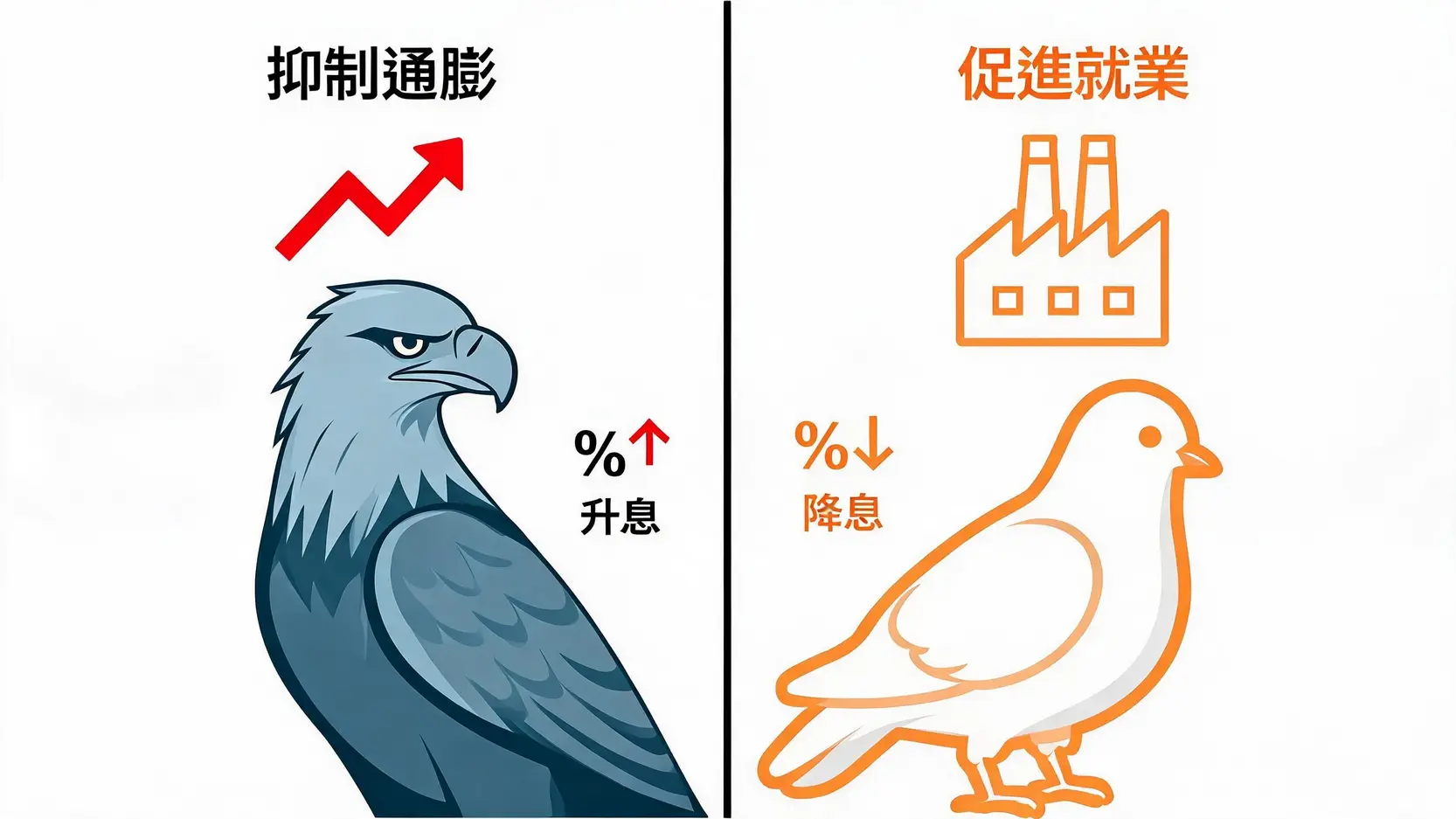
鷹派與鴿派貨幣政策立場對比圖,左邊是代表升息抑制通膨的鷹,右邊是代表降息促進就業的鴿。

Hawkish vs. Dovish: A Visual Comparison of the Two Central Bank Stances


How Can You Tell Whether a Central Bank Is Hawkish or Dovish From Its Statements?

Determining a central bank’s stance requires reading between the lines of its official documents and policymakers’ remarks. Investors should pay close attention to the following:

  1. The wording of the policy statement: Carefully analyze the language used in the post-meeting statement. For example, repeated references to “significant inflation risks” or a “strong commitment to restoring price stability” are typical hawkish signals. In contrast, greater emphasis on “uncertainty surrounding economic growth” or a “softening labor market” points to a dovish stance.
  2. Interest rate dot plot (using the Fed as an example): The Fed’s dot plot reflects each policymaker’s projection for future interest rates. If most projections move higher, it suggests an overall hawkish stance. If they move lower, the stance is more dovish.
  3. The central bank governor’s press conference: The Q&A session often reveals more details than the official statement. The governor’s views on inflation, economic growth, and the future policy path are key indicators of the central bank’s stance.


A Closer Look: What Is a “Hawkish Pause” in Rate Hikes?

Now that we have covered the basics of hawkish and dovish policies, let’s take a closer look at today’s main topic: the “hawkish pause in rate hikes”. This is a relatively complex policy signal with important implications. It does not mean the tightening cycle has ended. Instead, it may signal that more tightening is still to come.


Definition: A Temporary Pause in Rate Hikes While Keeping the Door Open for More

A “hawkish pause in rate hikes” (Hawkish Pause or Hawkish Skip) refers to a situation where a central bank decides to leave interest rates unchanged after a series of consecutive rate hikes, while simultaneously making it clear through its statement or press conference that this is only a “temporary pause” and that further rate hikes remain possible. In other words, the central bank chooses to “skip” a rate hike at the current meeting, but its commitment to fighting inflation remains firm, and it stands ready to raise rates again if necessary.


Why “Pause”? Allowing Time to Assess the Effects of Previous Rate Hikes

Monetary policy works with a “time lag”. The full impact of a single rate hike may take several months or even more than a year to be fully reflected throughout the economy. After raising interest rates rapidly and substantially, central banks need time to observe:

  • Cumulative effects: How effective have the previous rate hikes been in reducing inflation, cooling the labor market, and slowing economic growth?
  • Data dependence: Waiting for more economic data (such as CPI reports and employment figures) to gain a more comprehensive assessment of current economic conditions.
  • Avoiding excessive tightening: Aggressive rate hikes are like slamming on the brakes. Tightening too much or too quickly could lead to a “hard landing”, pushing the economy into a severe recession. A pause helps reduce the risk of policy overshooting.


Why Is It Still “Hawkish”? Signaling an Unchanged Commitment to Fighting Inflation

If the central bank simply pauses rate hikes, markets may interpret it as a dovish policy shift. To avoid this misunderstanding, central banks often pair the pause with hawkish communication, including:

  • Emphasizing that inflation remains elevated: Reiterating that inflation is still well above the long-term target of 2%.
  • Keeping policy options open: Clearly stating that “future decisions will depend on incoming data” and that “additional rate hikes remain possible”.
  • Raising interest rate projections: Upward revisions to future economic forecasts may also be accompanied by higher projected peak interest rates, signaling that the tightening cycle is not yet complete.

This “pause, observe, and respond” strategy allows policymakers to assess the impact of previous actions while maintaining market discipline regarding inflation expectations. It is an effective form of expectation management.

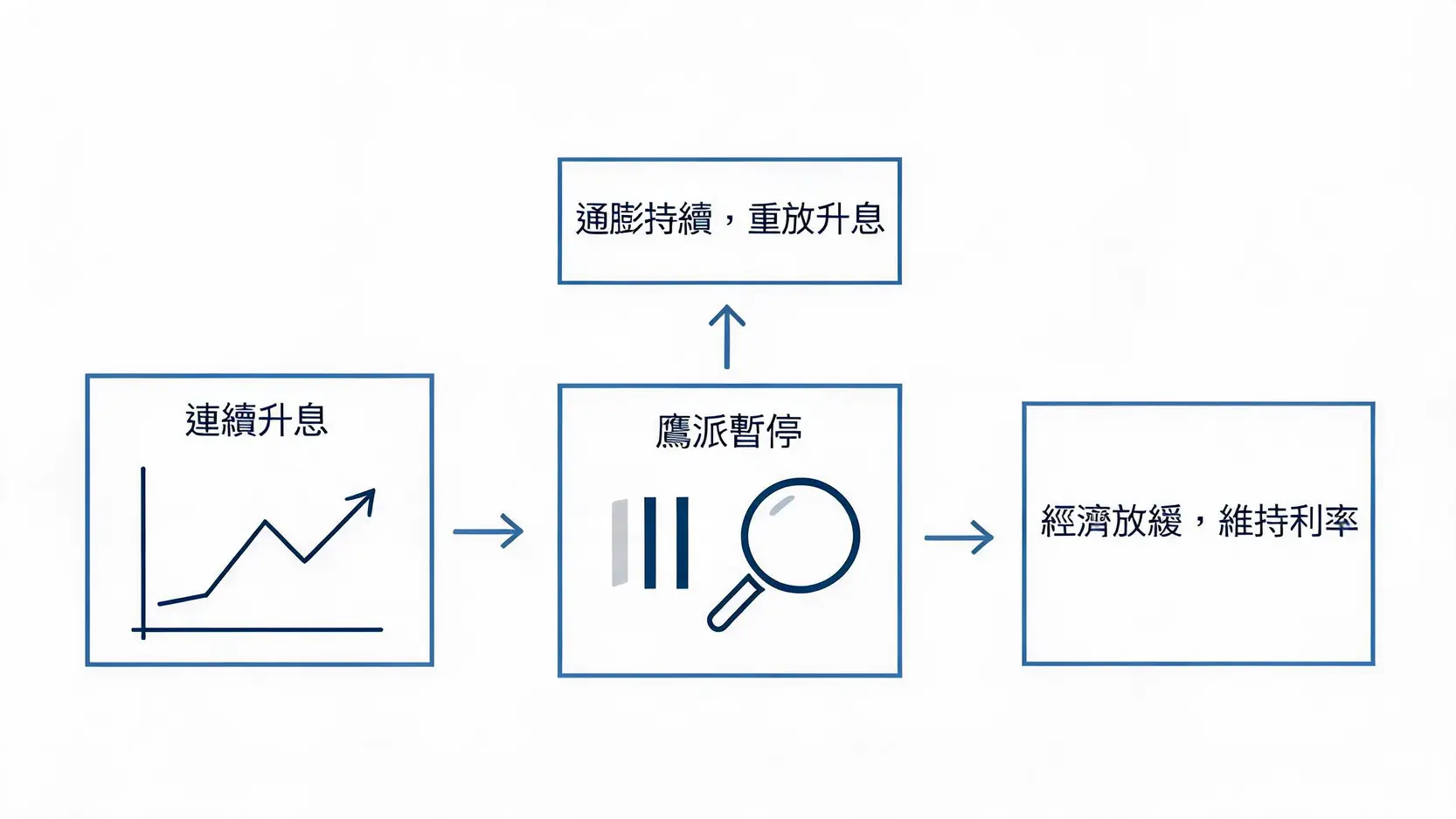
鷹派暫停加息流程圖,展示央行從連續升息到暫停觀察,再到可能重啟升息或維持利率的決策路徑。

Decision Path of a Hawkish Pause


The Potential Impact of a “Hawkish Pause” on Financial Markets

For financial markets, a “hawkish pause” is a signal filled with uncertainty. It is neither entirely bearish (since rates are no longer rising) nor bullish (because the possibility of further rate hikes remains). Different asset classes may therefore react differently.


Impact on the Stock Market: Greater Short-Term Uncertainty

The stock market’s reaction is typically complex. On one hand, pausing rate hikes temporarily eases pressure from rising financing costs, providing short-term support for equities. On the other hand, the “hawkish” message implies that interest rates are likely to remain higher for longer, weighing on long-term corporate earnings expectations and overall market valuations. As a result, the stock market may trade within a range, while investor sentiment becomes increasingly sensitive to each new economic data release.


Impact on Foreign Exchange: Potential Support for the Domestic Currency

A “hawkish pause” signals that domestic interest rates are likely to remain elevated and could rise further. This makes the country’s currency more attractive. International capital (often referred to as hot money) tends to flow toward countries offering higher interest rates to earn better returns. As a result, the currency of a country adopting a hawkish pause is generally supported and may even strengthen against currencies issued by countries pursuing dovish policies.


Impact on the Bond Market: Bond Yields May Stay Elevated

Bond prices move inversely to bond yields. The core message of a “hawkish pause” is that “the fight against inflation is not over”. This weakens market expectations for near-term rate cuts. As a result, bond yields, particularly short-term yields that closely track policy rates, are likely to remain elevated and may even rise further if markets anticipate additional rate hikes. For bond investors, this means the risk of declining bond prices remains.

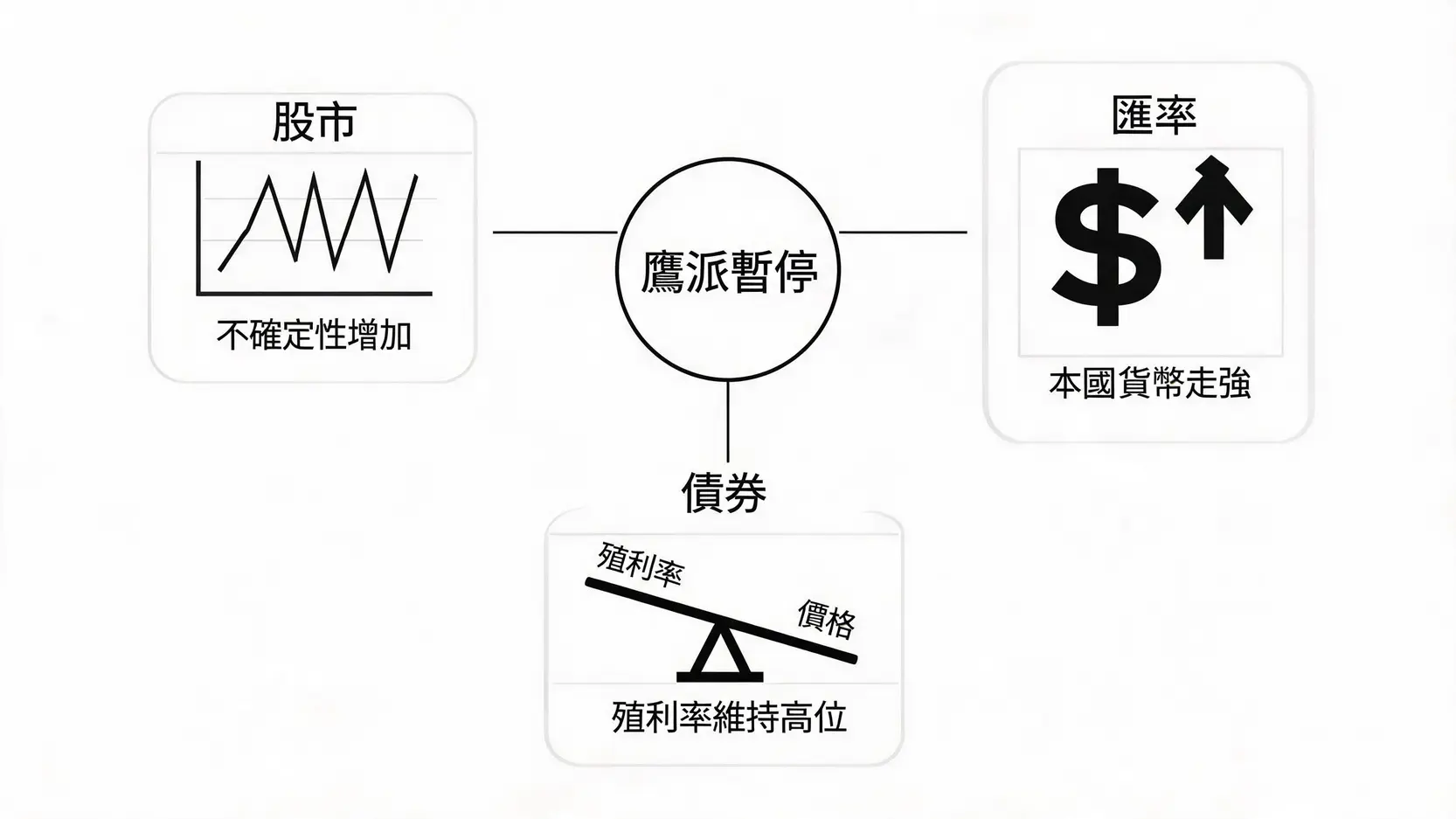
鷹派暫停對金融市場影響的示意圖,包括對股市、匯率和債券市場的可能作用。

How Does a Hawkish Pause Affect the Three Major Financial Markets?


Key Insight: Recent Policy Stances of Major Global Central Banks (As of June 2026)

Now that we understand the theory, let’s examine the latest developments among the world’s major central banks. Please note that central bank policy stances can change rapidly, and the following analysis is based on publicly available information as of early June 2026.


What Is the Reserve Bank of Australia’s (RBA) Current Stance?

At its May 2026 meeting, the Reserve Bank of Australia (RBA) raised the cash rate target to 4.35% while maintaining a cautious stance toward inflation in its policy statement. Markets generally believe the RBA is currently in a data observation phase. Although the pace of consecutive rate hikes may have paused, its repeated emphasis on uncertainty surrounding the pace at which inflation will return to target closely resembles a “hawkish pause”. This suggests that if future inflation data exceeds expectations, the RBA could resume raising interest rates at any time. The next meeting is scheduled for around June 16, when markets will closely monitor its latest policy signals.


The Federal Reserve’s Hawkish Path

During the first half of 2026, the Federal Reserve (Fed) kept interest rates at elevated levels. Although markets had previously anticipated rate cuts, persistent inflation and a resilient labor market led Fed officials to remain highly patient. Fed Chair Jerome Powell repeatedly emphasized that the Fed needs to see more evidence that inflation is moving sustainably back toward its 2% target before considering policy easing. This “no rate cuts until inflation is truly under control” approach is a classic example of a hawkish stance. While the Fed has not continued raising rates, its “higher-for-longer” message is effectively a broader form of hawkish policy and continues to have far-reaching implications for global financial markets.


Is the Bank of Japan (BOJ) Shifting Away From Its Dovish Stance?

The Bank of Japan (BOJ) provides an interesting contrast. For decades, the BOJ was known as the world’s most “dovish” central bank, maintaining negative interest rates and large-scale asset purchases to combat deflation. However, as inflation in Japan finally began to recover, the BOJ gradually exited its ultra-accommodative policies during 2024 and 2025. By 2026, market attention had shifted entirely toward the timing of the BOJ’s next rate hike. Although the transition from an extremely dovish stance toward a more normalized monetary policy remains gradual and cautious, the overall direction is clearly becoming more “hawkish”. This structural shift has had a significant impact on global capital flows and the Japanese yen exchange rate.


FAQ

Q: What does a central bank typically do after a “hawkish pause”?

A: There is no fixed playbook. It depends entirely on incoming economic data. There are generally three possible scenarios: 1. If inflation remains stubbornly high or the economy proves unexpectedly strong, the central bank may resume raising interest rates after one or two subsequent meetings. 2. If data shows inflation is coming under control and the economy is slowing as expected, the central bank may maintain the “pause” for a longer period, entering a higher-for-longer rate environment. 3. If economic data deteriorates sharply and recession risks emerge, the central bank may quickly shift from a hawkish to a dovish stance and prepare for rate cuts, although this is less common during the early stages of a hawkish pause.

Q: What does a “dovish pause” mean?

A: A “dovish pause” is the opposite of a hawkish pause. It typically occurs during a rate-cutting cycle. It refers to a situation where a central bank decides to keep interest rates unchanged after a series of consecutive rate cuts while signaling that there is still room for further cuts in the future to address continued economic weakness. The purpose of the pause is to evaluate the effects of previous rate cuts while preserving policy flexibility to provide additional economic stimulus if needed.

Q: How should investors respond during a “hawkish pause”?

A: During a hawkish pause, market uncertainty tends to be high, so investment strategies should focus on “stability” and “flexibility”. First, avoid excessive leverage and maintain sufficient cash flow to withstand market volatility. Second, consider allocating assets that may benefit from a high-interest-rate environment, such as short-term bonds or high-dividend value stocks. Finally, closely monitor every central bank statement and the release of key economic data, and adjust your portfolio accordingly to keep pace with rapidly changing market expectations.

Q: Which is better for the stock market, a hawkish stance or a dovish stance?

A: Generally speaking, a dovish stance featuring rate cuts and accommodative policies is considered positive for the stock market because it lowers financing costs for businesses and stimulates economic activity. In contrast, a hawkish stance involving rate hikes and tighter policies is generally viewed as negative. However, this is not always the case. If the economy is overheating and inflation is spiraling out of control, decisive hawkish policies may weigh on the stock market in the short term but contribute to long-term economic stability, ultimately laying the foundation for the next bull market. Therefore, whether a policy is favorable depends on the prevailing economic environment.


Conclusion

Understanding key terms such as “hawkish”, “dovish”, and “hawkish pause in rate hikes” is the first step toward interpreting central bank monetary policy, seeing through market uncertainty, and making informed investment decisions. In short, a hawkish pause in rate hikes is not a calm harbor, but rather the brief calm before the storm. It signals that the central bank’s tightening cycle has not yet come to an end, and the market must remain prepared for potential policy changes ahead. Through the detailed explanations in this article, we hope you will feel more confident in analyzing financial news and better understand the underlying logic behind the policy decisions of major central banks around the world.

If you liked this article, please share it!

Related Articles

  • Gold Price Outlook 2026: Will the Bull Market Continue?
    Will the Gold Price Bull Market Continue? 2026 XAUUSD Trend Analysis, Experts Reveal Three Key Drivers Recently, gold prices have repeatedly hit new highs, and the market is actively debating whether gold has entered a new historic gold price bull market. Many investors are both excited and concerned, wondering how...
    2026 年 6 月 23 日
  • XAUUSD Trading Guide: Trends & Beginner Strategies
    Ultimate Guide to Trading XAUUSD Trends: From Candlestick Teaching to Practical Strategies for Stable Profits for Beginners XAUUSD (spot gold against the US dollar), as one of the world’s most popular trading instruments, offers abundant profit opportunities through its sharp price fluctuations, but also comes with considerable risk. Many beginners...
    2026 年 6 月 23 日
  • Gold Investment Guide: Compare 4 Gold Investment Options
    How Does Gold Preserve Value? Understand the Pros and Cons of 4 Major Gold Investment Channels in One Article (Physical Gold/ETFs/Futures/Stocks) Faced with global inflationary pressure and market uncertainty, more and more people are turning their attention to gold, using it as a core tool for gold value preservation and...
    2026 年 6 月 23 日
返回顶部