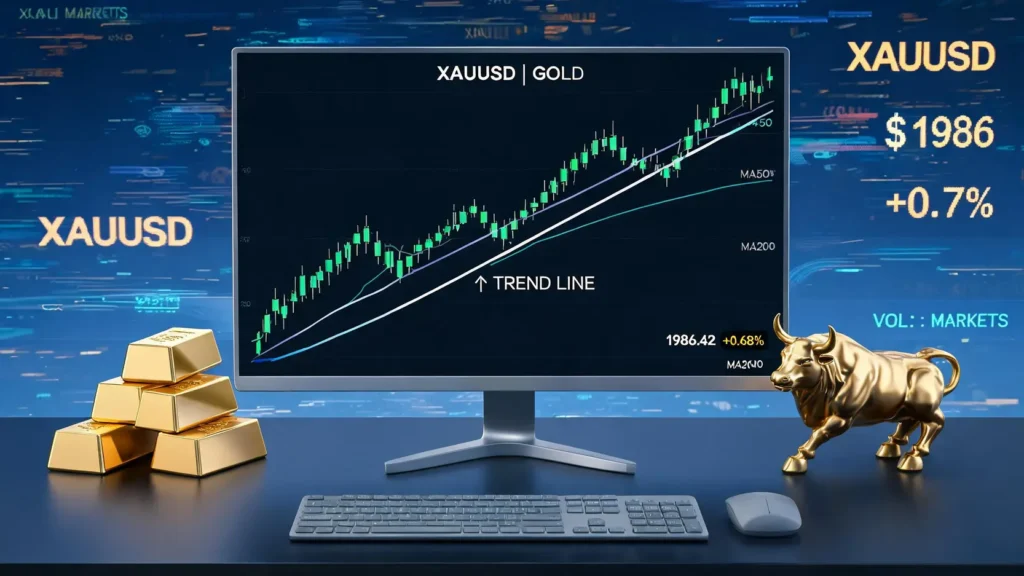
Gold’s safe-haven attribute: During inflationary periods, the purchasing power of fiat currency declines, while the value of gold remains relatively stable or even rises.
Gold’s Intrinsic Value and Scarcity
Gold’s value first comes from its scarcity. The total amount of gold on Earth is limited, and mining difficulty and costs have been increasing year by year. This means the supply of gold cannot be easily “printed” like fiat currency. This characteristic of “scarcity creates value” gives it a natural ability to resist inflation. When central banks print large amounts of money, causing an oversupply of currency and a decline in purchasing power, gold’s limited supply highlights its function as a store of value. In addition, gold has stable chemical properties, is resistant to corrosion and oxidation, and is easy to divide and preserve. These physical characteristics further strengthen its credibility as a carrier of value.
Historical Data on Gold’s Performance During Economic Recessions
History is the best teacher. Looking back at financial crises over the past few decades, gold’s safe-haven attributes have been clearly demonstrated. During periods of market panic and sharp stock market declines, capital often flows into gold in search of a safe haven.
- 2008 Financial Crisis: When global stock markets collapsed, gold prices briefly fell in the early stage due to liquidity demand, but then entered a multi-year bull market, rising from about USD 800 per ounce at the end of 2008 to a peak of more than USD 1,900 per ounce in 2011.
- 2020 COVID-19 Outbreak: The early stage of the pandemic triggered global market panic, and US stocks hit circuit breakers multiple times. However, gold prices once again showed resilience and reached a new historical high in the same year, breaking above USD 2,000 per ounce.
According to historical data analysis, gold often performs better than risk assets such as stocks during economic recessions. As GoldSilver.com’s analysis points out, gold has demonstrated strong ability to preserve and even increase value during multiple past economic recessions, making it an indispensable stabilizer in an investment portfolio.
A Safe-Haven Effect Against Currency Depreciation and Hyperinflation
When a country’s currency depreciates rapidly due to policy mistakes or economic collapse, assets held in that currency may become worthless overnight. In such extreme situations, gold’s “safe-haven effect” is fully demonstrated. This is because gold is a globally recognized standard of value and is not a liability of any single country or government. Its value will not disappear because of the collapse of a particular economy. For investors living in politically or economically unstable regions, holding physical gold is equivalent to buying ultimate insurance for their assets against systemic risk. This is also why gold always attracts large amounts of safe-haven capital when global geopolitical tensions rise or when the monetary policies of major economies trigger concerns.
Extended Reading (Highly Recommended)
Hot Money Inflows! Investor Action Guide: Should You Buy Stocks, Buy Bonds, or Exchange for US Dollars at This Stage?
Hot Money Inflows! Investor Action Guide: Should You Buy Stocks, Buy Bonds, or Exchange for US Dollars at This Stage?
The Big Showdown of the Four Major Gold Investment Channels: A Complete Comparison of Pros and Cons
After understanding gold’s value-preservation appeal, the next step is to choose the “entry method” that best suits you. Different gold investment channels vary greatly in trading costs, convenience, and risk attributes. Below, we will conduct a comprehensive showdown among physical gold, gold ETFs, gold futures, and gold-related stocks to help you understand how they work.
| Investment Channel |
Advantages |
Disadvantages
|
Suitable For |
| Physical Gold |
Holds a real asset, with no counterparty risk and ultimate safe-haven value |
High storage and insurance costs, wide bid-ask spreads, and weaker liquidity |
Investors seeking long-term value preservation and who are extremely risk-averse |
| Gold ETFs |
Low trading costs, high liquidity, and accessible with small capital |
Management fees are required, there is tracking error, and it does not involve direct ownership of gold |
Most investors, especially beginners who want flexible asset allocation |
| Gold Futures |
High leverage, can trade long or short, and extremely low trading costs |
High risk, with maturity date restrictions, requires margin management, and is not suitable for beginners |
Professional traders and investors seeking short-term price spreads who can tolerate high risk |
| Gold-Related Stocks |
Potential to earn returns beyond gold prices (dividends + company growth) |
Besides gold prices, it is also affected by multiple risks such as company operations and the overall stock market |
Investors who can tolerate higher risk and are interested in individual stock research |
Physical Gold (Gold Bars/Gold Coins): Visible Peace of Mind and Its Cost
Physical gold, such as gold bars and gold coins, is the most traditional form of gold investment. Its biggest advantage is the sense of security that comes from “holding it in your hand”. You own a real piece of precious metal, with no default risk from any financial institution (counterparty risk). In extreme situations such as war or financial system collapse, physical gold is the only widely accepted medium of exchange that can cross borders.
- However, this peace of mind comes at a cost: Liquidity and spreads: Buying and selling physical gold usually requires going through gold shops or precious metals dealers, and their quoted bid-ask spreads are far higher than those of financial products. This means that between buying and selling, you will lose part of the spread.
- Storage costs and risks: Keeping gold at home raises security concerns. If you rent a bank safe deposit box, you need to pay custody fees. These are hidden costs of holding physical gold.
Gold ETFs (Exchange-Traded Funds): A Flexible Choice for Modern Investors
Gold ETFs (Exchange-Traded Funds) are financial products that securitize gold and track the performance of spot gold prices. Investors can trade gold ETFs conveniently on a stock exchange, just like buying and selling stocks. Want to learn more about what an ETF is? You can refer to this beginner’s guide to ETF investing.
- Advantages: Trading is very convenient, liquidity is extremely high, bid-ask spreads are small, and management fees are relatively low. The investment threshold is low. You can buy one share with a few hundred US dollars or even less, making it easy to include gold in your asset allocation.
- Disadvantages: Although ETF issuers hold corresponding physical gold as reserves, investors themselves do not directly own the gold. Instead, they hold fund units. In addition, ETFs charge a certain annual management fee, and there may be a slight “tracking error” between their prices and actual gold prices.
Gold Futures: A High-Leverage Game for Professional Players
Gold futures are standardized contracts in which buyers and sellers agree to trade a specific amount of gold at an agreed price at a specific time in the future. The biggest feature of futures trading is “leverage”.
- Advantages: Investors only need to pay part of the total contract value as margin to trade the full contract value, which greatly amplifies potential profits (and, of course, losses). Trading costs are extremely low, and long and short positions can both be traded, creating profit opportunities whether gold prices rise or fall.
- Disadvantages: High leverage brings high risk. Once the market moves unfavorably, losses can occur very quickly, and additional margin may even be required. Futures contracts have expiration dates and require constant rollover, making them unsuitable for long-term holding. This is a tool for professional traders, and beginners should strongly avoid it.
Gold-Related Stocks (Gold Mining Stocks): Dual Amplification of Volatility and Returns
Investing in gold-related stocks mainly refers to buying shares of mining companies that extract gold. This is an indirect form of gold investment.
- Advantages: Gold mining stocks have a high positive correlation with gold prices, but their volatility is often greater. When gold prices rise, mining companies’ profits may increase disproportionately, which may drive stock price gains beyond the rise in gold itself. In addition, some mature mining companies also pay dividends.
- Disadvantages: Investing in gold mining stocks involves not only the risk of gold price fluctuations, but also individual company operating risks, political risks (where the mines are located), financial risks, and more. Their performance depends not only on gold prices, but also on the company’s management capability and cost control. This is fundamentally different from pure gold safe-haven investing.
How to Choose Based on Different Investment Goals? A Decision Tree Guide for Beginners
After understanding the characteristics of each tool, the key question is: “Which one should I choose?” There is no standard answer to this question. It depends entirely on your investment goals, risk tolerance, and capital size. Below is a decision tree guide to help you clarify your thinking.
Seeking Long-Term Value Preservation and Ultimate Risk Hedging: Physical Gold vs. Gold ETFs
If your core goal is to convert part of your assets into “deep reserve assets” that can be passed down and resist extreme risks, then physical gold is undoubtedly the first choice. It allows you to completely detach from the financial system and provides the purest form of protection. But if your capital size is not large, or you place more importance on asset flexibility and appreciation potential, then gold ETFs will be a more efficient choice. You can view them as a core satellite allocation, using lower costs to share in the gains from rising gold prices while maintaining high liquidity and the ability to adjust positions at any time. For most investors looking to carry out asset allocation, gold ETFs are the simplest and most practical starting point for participating in the gold market.
Seeking Short-Term Spreads and Swing Trading: Gold Futures vs. Gold ETFs
If you expect gold to experience sharp short-term volatility and want to profit from price spreads, then the choice is between gold futures and gold ETFs. Gold futures provide the highest leverage and lowest trading costs, making them the preferred tool for professional short-term traders. They use leverage to amplify returns and can enter and exit the market quickly. However, for general investors, this kind of high-risk operation is extremely difficult to manage. In comparison, although gold ETFs do not offer leverage, their high liquidity and close tracking of gold prices are fully sufficient for swing trading needs. You can focus more purely on judging gold price trends without being distracted by margin requirements and contract expiration issues, and the risk is also easier to control.
For Those Who Prefer High Risk and High Return: The Unique Opportunities of Gold Mining Stocks
For investors with higher risk tolerance and the ability to research individual stocks, gold mining stocks offer a unique opportunity. They are like a “leveraged gold investment”, but the leverage comes from the company’s profitability. If you choose an outstanding mining stock and gold prices enter a bull market, its share price may rise far more than gold itself. Conversely, if gold prices fall or the company performs poorly, losses will also be amplified. This is more like value investing in a specific industry, rather than pure commodity hedging.
Extended Reading (Highly Recommended)
What Are Investment Risks? A Full Analysis of 5 Common Types of Investment Risk, A Must-Read for Beginners!
[2026 Complete Beginner’s Guide to US Stocks] From Opening Hours to ETF Recommendations
Common Questions About Gold Value Preservation and Hedging (FAQ)
Q: Does investing in a gold ETF mean truly holding gold?
A: Legally speaking, you hold units of the fund company, not ownership of the gold itself. However, reputable gold ETFs (such as GLD and IAU) invest the vast majority of their assets in physical gold and have it custodied by third-party institutions. So although you cannot exchange ETF units for gold bars, their value is indeed supported by physical gold reserves and can reflect the rise and fall of gold prices very accurately.
Q: What is the difference between buying physical gold and opening a gold passbook?
A: Physical gold means you personally hold and store gold bars or gold coins. A gold passbook (Gold Passbook Account) is a service provided by a bank. You buy gold from the bank, and the bank records the grams you purchased in your passbook, but the gold itself is still held by the bank. The advantage of a gold passbook is that it eliminates storage concerns and is more convenient to trade than physical gold. The disadvantage is that bid-ask spreads are usually wider, and some banks may charge custody fees. In essence, it is a claim you have against the bank, rather than direct ownership of gold.
Q: Do gold investments need to be taxed?
A: This depends on the tax laws of your region. In Taiwan, gains from buying and selling physical gold are classified as property transaction income and must be included in personal consolidated income tax reporting. Gold ETFs traded through a securities account currently fall under securities transaction income for capital gains, which is exempt from income tax, but a 0.1% securities transaction tax must be paid. As for profits from gold futures, they are classified as futures trading income and must be reported. In Malaysia, capital gains from gold investment are usually tax-free. Since tax laws vary by region and may change, it is recommended to consult a professional accountant before making large transactions.
Q: What proportion should gold account for in asset allocation?
A: There is no absolute number. It depends on your personal risk tolerance and market outlook. Generally speaking, in a balanced investment portfolio, the recommended gold allocation is between 5% and 10%. When market risks are expected to be higher and inflationary pressure is greater, this proportion can be moderately increased to 15%; conversely, when the economic outlook is optimistic and market risk appetite is high, it can be moderately reduced. The key is to view gold as insurance and a stabilizer, not as the main tool for speculative profit.
Conclusion
In summary, as a long-standing tool for value preservation and hedging, gold plays a more important role than ever in investment portfolios in today’s uncertain financial environment. From physical gold, which is the most stable and provides the ultimate sense of security, to gold ETFs, which are flexible and low-cost, and then to high-leverage gold futures and gold mining stocks with high return potential, each investment channel has its own unique use cases, advantages, and disadvantages.
Investors should choose the most suitable tool based on their capital size, risk tolerance, and investment goals, whether they are seeking long-term value preservation or short-term price spreads. Remember, there is no best tool, only the strategy that best suits you. In a volatile market, making good use of gold hedging will be a key step in protecting the purchasing power of your assets.