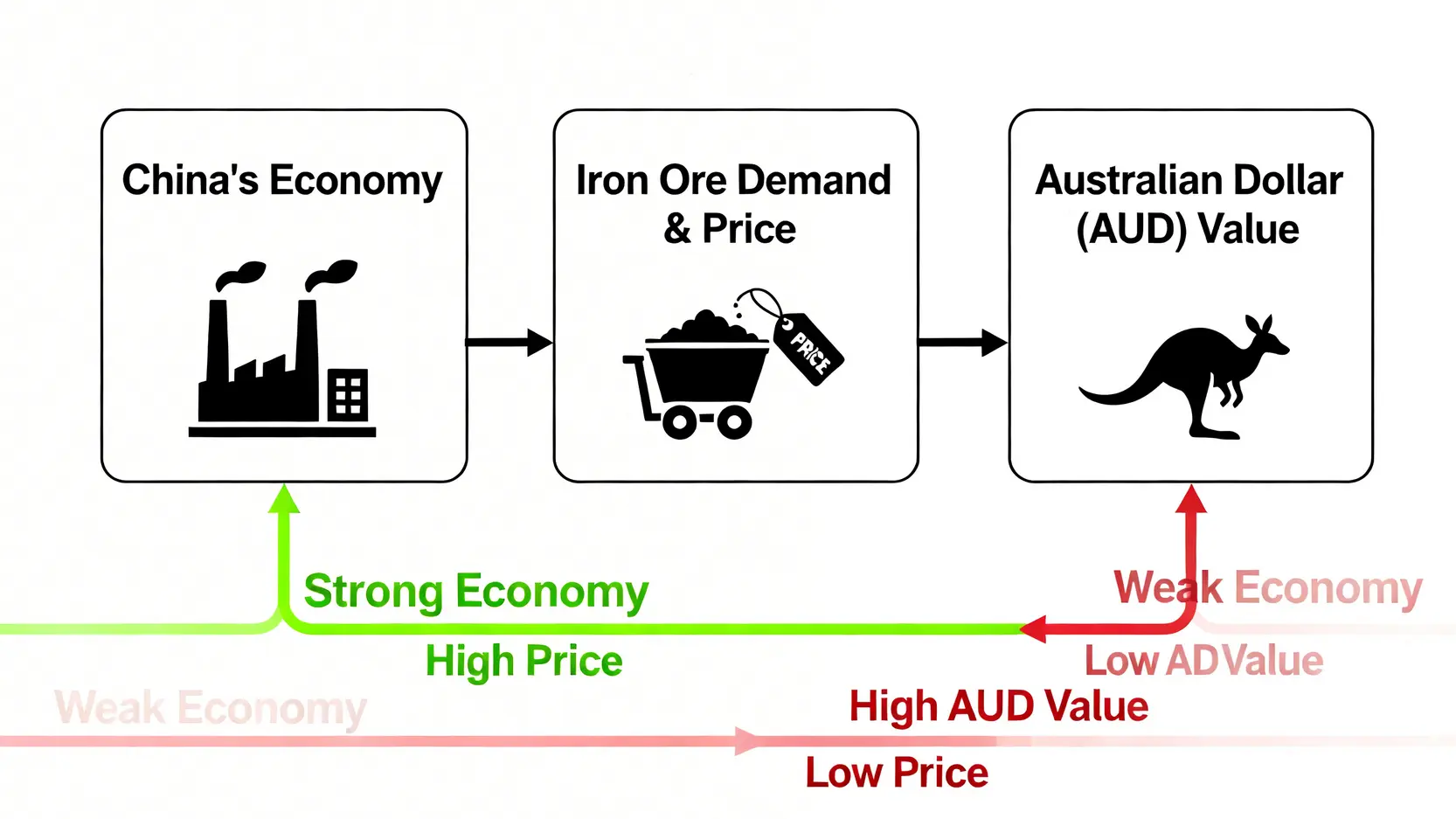
Transmission Mechanism Between the Australian Dollar, China’s Economy, and Iron Ore Prices.
US Dollar Strength Cycle: How Does Global Risk Aversion Suppress the Australian Dollar?
As the world’s primary reserve currency, the US dollar often moves inversely to other currencies. When the global economic outlook becomes uncertain and geopolitical risks rise, investors tend to sell higher-risk assets (such as the Australian dollar and equities) and instead buy the US dollar, which is viewed as a “safe haven”. This risk aversion pushes up the US Dollar Index (DXY) and places strong pressure on risk currencies such as the Australian dollar.
In addition, the monetary policy of the Federal Reserve is equally crucial. If the Federal Reserve continues to raise interest rates to control inflation, it will further strengthen the US dollar’s dominant position and significantly reduce the attractiveness of non US currencies such as the Australian dollar. Therefore, even if Australia’s own economic fundamentals remain stable, the Australian dollar may still weaken under the global environment of a strong US dollar.
Further Reading (Highly Recommended)
[Forex Education 2024] The Ultimate Beginner’s Guide to Forex Trading: Master Forex Trading Skills From 0 to 1!
2026 Beginner’s Guide to Forex Trading: Master Risk Management and Broker Selection for Stable Profits!
2026 Australian Dollar Forecast: What Do Analysts From Major Banks Think?
After understanding the fundamental factors affecting the Australian dollar, let us now look at how market experts view the Australian dollar outlook. Combining the perspectives of major investment banks and analysts can provide a more comprehensive reference for investment decisions. It is important to note that forecasts are not 100 percent accurate, but they can reveal the market’s prevailing sentiment and potential direction.
Technical Analysis: Key Support and Resistance Levels for AUD/USD
From the perspective of forex technical analysis, the Australian dollar against the US dollar (AUD/USD) exchange rate is currently at a critical level. Chart analysts point out that the primary support level below is around the 0.6300 to 0.6400 range, which is a psychological level that has been tested and rebounded from multiple times historically. If this level breaks, it may trigger another round of decline, potentially testing the 0.6000 round number level. On the upside, the main resistance level lies near 0.6750 to 0.6850, where previous highs and key moving averages converge. Only when the exchange rate effectively breaks above and stabilizes above this resistance level will the Australian dollar forecast potentially shift from bearish to bullish.
- Primary Support Level: 0.6300 – 0.6400
- Secondary Support Level: 0.6000
- Primary Resistance Level: 0.6750 – 0.6850
- Secondary Resistance Level: 0.7000
Traders can use these key price levels to set stop losses and profit targets, but it is important to remember that technical analysis is not infallible and must be combined with fundamental analysis for a comprehensive assessment.
Institutional Forecast Summary: Outlook Analysis From Goldman Sachs, Citibank, and Dah Sing Bank
Major financial institutions hold differing views on the Australian dollar outlook for 2026, reflecting the complexity of the current market environment. The following summarizes the perspectives of several representative banks, allowing you to quickly grasp the pulse of the market.
| Financial Institution |
End of 2026 Forecast (AUD/USD) |
Core View |
| Goldman Sachs |
0.6600 |
Neutral to Bearish. It believes that although Australia’s inflation remains sticky, the RBA has limited room for further rate hikes. The strength of China’s economic recovery remains uncertain and will continue to limit the upside potential of the Australian dollar. |
| Citibank |
0.6900 |
Cautiously Optimistic. It expects that the Federal Reserve may shift toward rate cuts in the second half of the year, and the strength of the US dollar may ease. If China introduces effective economic stimulus policies, commodity prices may stabilize, which would be favorable for the Australian dollar. |
| Dah Sing Bank |
0.6500 |
Range Bound. It believes that bullish and bearish factors are intertwined, making it difficult for the Australian dollar to experience a one-sided trend. With the global economic outlook still uncertain, risk aversion sentiment may rise from time to time. The exchange rate is expected to fluctuate repeatedly within the 0.63-0.67 range. |
Overall, the market generally holds a cautious attitude toward the short-term outlook of the Australian dollar, but there are differences of opinion regarding the medium to long-term trend. The key variables still lie in the economic performance and monetary policy paths of China and the US.
Australian Dollar Investment Strategies: Bottom-Fishing, Time Deposits, or Hedging?
In the current market environment, investors with different needs can adopt different strategies. There is no best strategy, only the strategy that suits you best.
- Students or Travelers With Practical Needs: If you have an actual need for Australian dollars, rather than waiting for the so-called “lowest price”, it is better to adopt a strategy of buying in batches. For example, over the next few months, exchange a portion whenever the exchange rate reaches what you consider a relatively low level. This can average out your cost and avoid the risk of buying a large amount at a high level at once.
- Investors Seeking Interest Income: At present, Australia’s interest rates still have a certain advantage compared with Hong Kong or Taiwan. If you believe the Australian dollar will rebound in the long term, you may consider placing Australian dollar time deposits to achieve the benefit of both “earning interest and gaining from price appreciation”. However, you must bear the risk of exchange rate fluctuations. If the Australian dollar continues to fall, the interest earned may not be sufficient to offset the exchange loss.
- Forex Traders: For short-term traders, volatility is where opportunities lie. Traders can use the key technical levels mentioned above for range trading, meaning buying near support levels and selling near resistance levels. However, strict stop loss settings are essential to control risk. It is also worth paying attention to the timing of important economic data releases from Australia and China to capture short-term market movements before and after the announcements.
Conclusion
In summary, the question “Why has the Australian dollar fallen so sharply?” has a complex and multifaceted answer. It is mainly influenced by the relatively dovish policy of the Reserve Bank of Australia, the challenges of China’s economic recovery, and the strong US dollar cycle. Although the short-term outlook for the Australian dollar remains uncertain, investors can make more informed decisions by deeply understanding these fundamental factors. While major banks hold differing Australian dollar forecasts, their views also provide a useful reference for market sentiment. Whether for short-term trading or long-term positioning, closely following the latest Australian dollar news analysis and formulating a clear strategy based on your own risk tolerance and investment objectives is the most effective way to respond to market volatility.
Frequently Asked Questions About the Australian Dollar Forecast (FAQ)
Q: Will the Australian dollar exchange rate return to its previous levels?
A: The so-called “hometown rate” (for example, 1 AUD = above 6 HKD) is unlikely to reappear in the short term. This would require multiple favorable factors to occur simultaneously, such as the Reserve Bank of Australia shifting toward significant rate hikes, a strong recovery in China’s economy driving a surge in commodity prices, and a sharp weakening of the US dollar. Based on the current situation, it is difficult for all these conditions to be met within 2026, so investors should maintain realistic expectations.
Q: Is now a good time to exchange Australian dollars?
A: There is no absolute answer to this question, as it depends on your purpose and risk preference. If you have rigid future needs (such as studying abroad or immigration), adopting a batch exchange strategy with cost averaging would be a more prudent approach. If you are an investor attempting to “bottom-fish”, you must be psychologically prepared for the possibility that the exchange rate may continue to fall further. It is recommended not to invest all funds at once. You may consider building a small initial position and setting a stop loss level.
Q: Besides the US dollar, which other currencies influence the Australian dollar trend?
A: In addition to the US dollar, the Australian dollar has the closest relationship with the New Zealand dollar (NZD). This is because the two countries have similar economic structures and are both commodity exporting nations, so their exchange rate trends often move in tandem. In addition, the Japanese yen (JPY), as a traditional safe haven currency, tends to strengthen when market risk aversion rises. In such situations, the AUD/JPY cross pair often declines, which can indirectly influence the overall performance of the Australian dollar.
Q: Why does the Australian dollar not rise even when Australia’s inflation remains high?
A: Traditionally, high inflation would prompt central banks to raise interest rates, which supports the currency. However, the current situation is more complex. First, the market questions the determination and effectiveness of the Reserve Bank of Australia in controlling inflation, believing that its pace of rate hikes has lagged behind other major central banks. Second, the market is more concerned about the risk of a global economic slowdown, and this macro concern has overshadowed the simple interest rate differential. Under strong risk aversion sentiment, capital prefers to flow into the US dollar. Even if the US dollar does not necessarily offer the highest interest return, its perceived safety gives it a relative advantage.