The Impact of Rate Hikes on the Economy: Understand the Role of Central Banks and Gain Insight Into the Impact on the Stock Market, Real Estate Market, and Personal Finances!
Recently, central banks around the world have been raising interest rates frequently. Are you also feeling anxious and uneasy about it? Not sure what impact rate hikes will have on your life and investments? This article will provide an in-depth explanation of how rate hikes work, the role of central bank rate hikes, and a comprehensive discussion of how rate hikes affect the economy, the stock market, the real estate market, as well as analysis of the impacts of rate hikes and rate cuts. It will help you master key knowledge, make informed decisions, and respond smartly to the impact of rate hikes on the stock market and real estate market.
In today’s financial environment, it is crucial to understand the dynamics of rate hikes and the potential chain effects they may bring. Whether you are a beginner investor or an experienced professional, a thorough analysis of the impact of rate hikes on the economy can help you see the road ahead more clearly and plan your financial strategy early.
What Are Rate Hikes? An In-Depth Analysis of the Role of Central Bank Rate Hikes
The term “rate hikes” often appears in news reports, but what does it actually mean? Why do central banks in various countries frequently use this tool to manage the economy? Understanding the underlying principles is the first step to gaining insight into financial changes.
The Definition and Purpose of Rate Hikes: Why Do Central Banks Raise Interest Rates?
A rate hike, simply put, is when a central bank raises its benchmark interest rate. This benchmark rate usually refers to the interest rate for interbank lending, or the rate at which the central bank lends to commercial banks. When a central bank announces a rate hike, it effectively increases the cost for the banking system to obtain funds, which in turn affects interest rates for various loans and deposits in the market.
The main purposes of central bank rate hikes include:
- Curb Inflation: When there is excessive money supply in the market, causing general price increases (inflation), the central bank will lower money liquidity through rate hikes. Higher interest rates increase borrowing costs, encouraging individuals and businesses to reduce borrowing and consumption and increase savings instead, thereby reducing the total amount of money in the market and curbing rising prices. This is the most core aspect of the role of central bank rate hikes.
- Stabilize the Exchange Rate: If a country faces capital outflows and pressure for its currency to depreciate, rate hikes can increase the attractiveness of domestic assets, attract international capital inflows, and support the domestic currency exchange rate.
- Prevent the Economy From Overheating: When economic growth is too rapid, it may lead to asset price bubbles or excessive resource consumption. Rate hikes can moderately cool down the economy and help avoid more severe crises in the future.
- Create More Policy Room: Raising rates during economic expansion can leave room for future rate cuts when the economy slows, giving the central bank greater flexibility to stimulate the economy in the face of a recession.
By understanding these purposes, you can see that rate hikes are not simply an interest rate adjustment, but a complex macroeconomic policy tool.
How Central Banks Influence Market Interest Rates and Money Supply Through Rate Hikes
How do central bank rate hikes turn from theory into real-world impact? The mechanism mainly works through the following channels:
- Benchmark rate transmission: The benchmark interest rate raised by the central bank will directly or indirectly affect commercial banks’ deposit and lending rates. As the cost for commercial banks to borrow from the central bank increases, they will naturally raise loan interest rates for businesses and individuals, and at the same time increase deposit rates to attract deposits.
- Higher funding costs: When businesses expand operations, they need to borrow from banks. After a rate hike, borrowing costs increase, which may lead businesses to delay investment plans and reduce production, thereby affecting the supply side of the overall economy.
- Consumer confidence and spending behavior: For ordinary individuals, higher loan interest rates mean higher monthly payments for mortgages, auto loans, and consumer credit, reducing disposable income. At the same time, higher deposit rates encourage people to save money rather than spend it. Both effects weaken overall consumption demand.
- Reduced money supply: Taken together, the amount of money circulating in the market will relatively decrease as borrowing declines and savings increase. This is an important tool for controlling money supply among the impacts of rate hikes on the economy.
Through these step-by-step effects, central banks aim to guide the economy toward a healthy path of development. Especially in controlling inflation, the role of central bank rate hikes plays an indispensable part.
The Impact of Rate Hikes on the Economy: The Inflation, Consumption, and Savings Triangle
The impact of rate hikes on the overall economy is comprehensive. It is like a double-edged sword: while curbing inflation, it can also put pressure on economic growth. A deep understanding of this “triangle relationship” is very important for financial planning for both individuals and businesses.
The Double-Edged Sword of Curbing Inflation: How Rate Hikes Affect Prices
When prices surge and people’s purchasing power declines, the central bank’s most direct response is to raise interest rates. The mechanism by which rate hikes curb inflation mainly works through the following aspects:
- Cooling demand: Higher interest rates increase borrowing costs for businesses, reducing investment expansion, which in turn suppresses demand for production inputs. The burden of personal loans (such as mortgages, auto loans, and consumer credit) also increases, reducing unnecessary consumption, and overall social demand weakens accordingly. When demand decreases, the pressure for prices to rise naturally declines.
- Reduced money supply: Rate hikes encourage saving and reduce the amount of money circulating in the market, easing the situation where “too much money chases too few goods”, which directly helps relieve inflationary pressures.
- Exchange rate appreciation effect: In some cases, rate hikes may attract foreign capital inflows and push up the domestic currency exchange rate. A stronger currency makes imported goods cheaper, helping reduce imported inflationary pressure.
However, while rate hikes curb inflation, they can also bring side effects. If rate hikes are too large or too rapid, economic activity may cool sharply, or even fall into recession. Businesses’ willingness to invest may decline, unemployment may rise, and consumer confidence may be damaged. This becomes the “double-edged sword” of curbing inflation. Finding the balance point of the impact of rate hikes on the economy is the central bank’s greatest challenge.
Weaker Consumption and Stronger Saving Intentions: Changes in Personal Finances
For your and my wallet, the most intuitive feeling of rate hikes is: “Spending becomes more expensive, and saving becomes more worthwhile”.
- Weaker Consumption:
- Heavier loan burdens: Many people’s mortgages, auto loans, and consumer loans are mostly variable rate. After a rate hike, monthly repayments on these loans increase, directly squeezing household disposable income and causing people to reduce other non-essential spending.
- Expectations: When the market expects the economy to slow, or uncertainty about the future increases, people tend to consume more conservatively and reduce large purchases.
- Stronger Saving Intentions:
- Higher deposit rates: To align with central bank rate hikes, banks will also raise interest rates on demand deposits and time deposits. For conservative investors, this makes depositing funds in banks more attractive, with relatively low risk, and therefore encourages more people to pull money away from consumption or investing and shift toward saving.
This shift of “weaker consumption, stronger saving intentions” is an important part of the impact of rate hikes on the economy. It influences every household’s financial decisions at the micro level, and then aggregates into overall macroeconomic trends. This is also why, in analysis of the impacts of rate hikes and rate cuts, changes in consumption and savings are always closely watched.
The Impact of Rate Hikes on the Stock Market and Real Estate Market: Must-Know Risks for Investors and Homebuyers
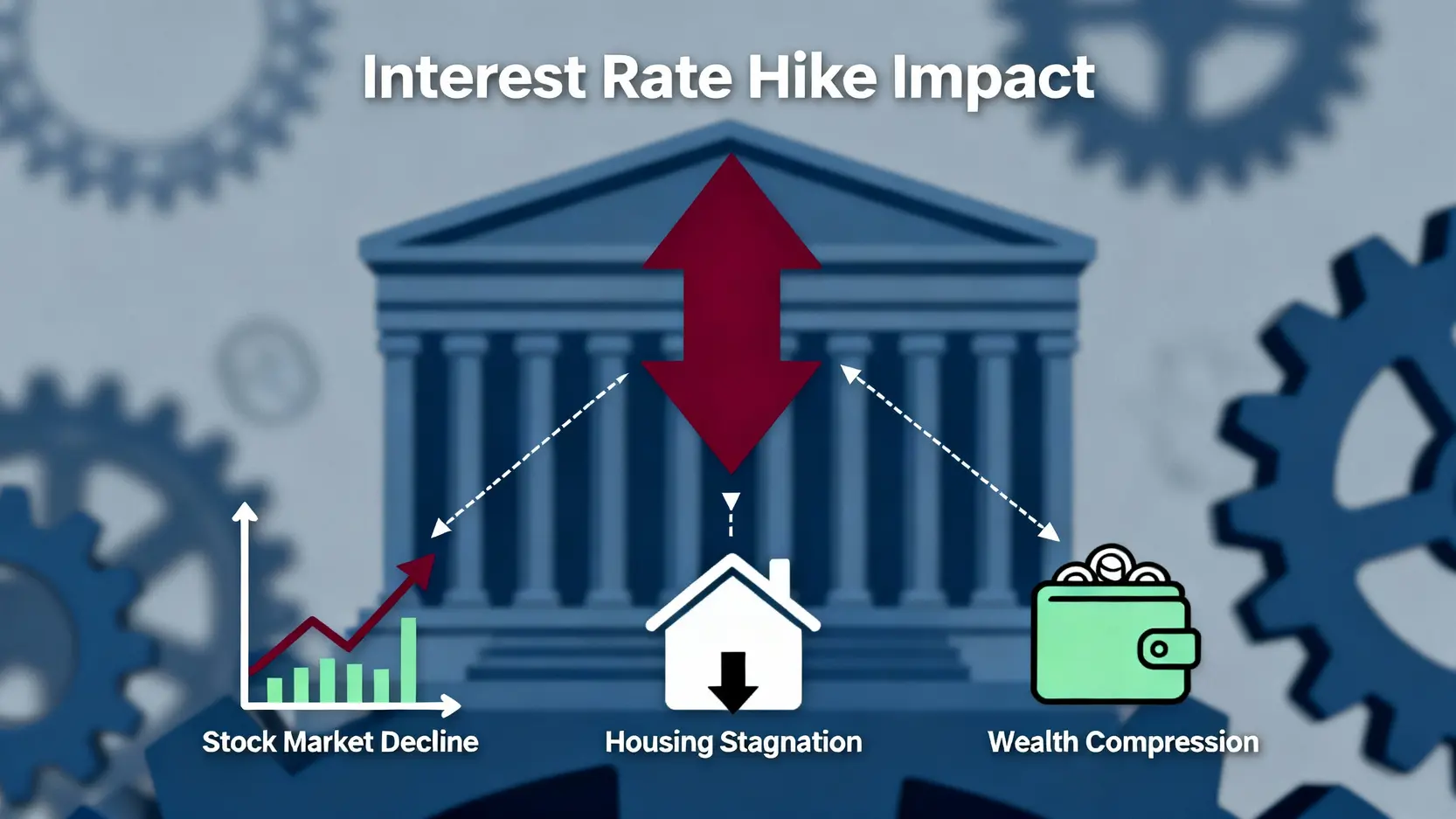
Changes in the direction of rate hikes have a particularly significant impact on financial markets, with the stock market and real estate market drawing the most attention. For investors and homebuyers, understanding these risks and responding early is key to protecting your wealth.
Increased Stock Market Volatility: Performance Differences Between High-Yield Stocks and Growth Stocks
When interest rates rise, the stock market usually faces greater challenges. The main reasons are as follows:
- Higher Funding Costs: For businesses, higher costs for operational expansion and borrowing can compress profit margins, which in turn affects stock prices.
- Shift in Capital Flows: Rate hikes increase the attractiveness of fixed-income instruments such as bank time deposits and bonds. Some funds may shift from the higher-risk stock market to the relatively steadier fixed-income market, leading to equity outflows.
- Downward Revisions to Earnings Expectations: As consumption and investment momentum weaken, the market may revise down expectations for corporate future earnings, which in turn affects how investors value stocks.
In a rate hike environment, different types of stocks will also perform differently:
- Growth stocks face a larger impact: Growth stocks are typically companies whose profitability has not yet fully materialized, but have strong future growth potential. These companies usually require significant capital for R&D and expansion, so they are more sensitive to interest rates. Rate hikes increase their borrowing costs and reduce the “discounted value” of future earnings, putting greater pressure on valuations.
- High-yield stocks (value stocks) are relatively more resilient: By contrast, high-yield stocks (or value stocks) are typically companies with stable operations, strong profitability, and ongoing dividend distributions. In a rate hike environment, their stable cash flow and dividend income can be attractive to income-seeking investors, making them relatively more resilient and potentially a safe haven for capital.
Therefore, in response to the impact of rate hikes on the stock market and real estate market, investors should re-evaluate their portfolios and consider adjusting the allocation between growth stocks and value stocks.
Cooling Pressure on the Real Estate Market: Higher Mortgage Rates and Lower Homebuying Willingness
The real estate market is another area that is highly sensitive to rate hikes. Changes in mortgage rates directly affect buyers’ affordability and willingness to purchase.
- Higher mortgage rates: After the central bank raises rates, banks will follow by increasing mortgage rates, which means higher monthly mortgage payments. For homebuyers who already have a mortgage, pressure will increase significantly; for potential buyers, the threshold for buying a home rises and affordability declines.
- Lower homebuying willingness: Higher mortgage burdens, coupled with uncertainty about the future economic outlook, can make potential buyers question “whether now is a good time to buy”, strengthening a wait-and-see sentiment and reducing willingness to purchase.
- Higher financing costs for developers: Not only buyers, but developers’ financing costs will also increase due to rate hikes, which may slow the pace of new project launches and even affect construction progress.
- Downward Pressure on Home Prices: When demand falls and supply is excessive, home prices naturally face correction pressure. Especially in areas that have risen sharply in the past and have strong investment sentiment, consolidation or declines are more likely.
For homebuyers, in addition to owner-occupier needs, if investment returns are also considered, it is necessary to re-evaluate the balance between rental yield and mortgage costs. Therefore, how rate hikes affect the real estate market is a key focus for many people.
Bond Market Impact and Capital Flows: Sector Rotation of Funds
The bond market also plays a key role in a rate hike environment. Generally, rate hikes cause bond prices to fall because newly issued bonds offer higher yields, making existing bonds relatively less attractive. However, for some conservative investors, the post-rate hike bond market provides higher fixed-income opportunities.
- The inverse relationship between bond prices and yields: When interest rates rise, the prices of outstanding bonds fall. This is because newly issued bonds have higher coupon rates, increasing the opportunity cost for investors holding older bonds. As a result, older bond prices must decline to offer yields comparable to new bonds.
- Funds shifting from stocks to bonds: As bond yields rise after rate hikes, the bond market becomes more attractive to investors with lower risk tolerance. This can drive some funds to flow from the higher-risk stock market into the relatively steadier bond market, causing sector rotation of funds across financial markets.
- Investment-grade bonds and high-yield bonds: In the early stage of rate hikes, investment-grade bonds may be favored due to their lower risk. However, for high-yield bonds (junk bonds), issuers’ default risk increases as borrowing costs rise. Therefore, investing in such bonds requires greater caution in a high-rate environment.
Understanding how rate hikes affect the bond market helps investors balance risk and return in their portfolios and make more precise allocations across different market cycles.
How Will Rate Hikes Affect Your Wallet? A Personal Financial Planning Guide
The impact of rate hikes on personal finances is obvious and direct. From mortgages and auto loans to the interest you earn on deposits, nothing is unaffected. Only by understanding these specific impacts can you adjust your financial plan early and ensure your wallet is not “hurt” by higher rates.
Mortgages, Auto Loans, and Consumer Credit: Higher Monthly Repayments
This is one of the most direct impacts of rate hikes. If you have a variable-rate mortgage, auto loan, or personal credit, a rate hike means your monthly repayments will increase. Even a small rate increase can add up to a significant cost over time.
- Mortgage: Most mortgages are variable rate. After a rate hike, your monthly payments will increase accordingly. If your mortgage burden is already heavy, this will further squeeze your living expenses. It is recommended that you review your mortgage contract to understand the rate adjustment mechanism, and evaluate whether you need to make early repayments or consider refinancing into a fixed-rate plan (if the market offers one and it is beneficial).
- Auto Loans and Consumer Credit: Interest rates on these loans are usually higher than mortgages, and the repayment pressure from rate hikes may be even more significant. It is recommended to prioritize repaying higher-interest consumer credit to reduce interest expenses.
Only by planning and responding early can you protect your monthly cash flow amid the impact of rate hikes on the economy.
Higher Deposit Interest: Idle Cash Allocation Strategies
Although rate hikes increase borrowing costs, they are good news for savers!
- Higher time deposit interest: Banks will raise time deposit rates, allowing your idle funds to earn higher interest income. For conservative investors, or those with near-term large funding needs (such as a home down payment or children’s education funds), placing funds in time deposits or high-interest demand deposit accounts is a relatively steady choice.
- Cash is king: In the early stage of a rate hike cycle, market volatility is higher. Keeping part of your funds in cash or high-liquidity deposits allows you to stay flexible and wait for better investment opportunities.
Make good use of the higher deposit interest brought by the role of central bank rate hikes, re-evaluate your idle funds, and let them create more value for you.
Exchange Rate Movements and the Impact on Overseas Investments
Rate hikes can also affect exchange rates, which in turn impacts your overseas investment portfolio.
- Exchange rate movements: When a country’s central bank raises rates, it usually attracts international capital inflows because the country’s assets (such as deposits and bonds) can offer higher returns, which may lead to an appreciation of the domestic currency. For investors holding foreign currency assets, a stronger domestic currency may reduce the value of overseas assets when converted back into the domestic currency. Conversely, if you invest overseas, a depreciation of the domestic currency may bring additional gains.
- Overseas investment costs and returns: If you invest in overseas stocks or funds, exchange rate fluctuations directly affect your investment returns. In addition, interest rates on overseas loans may also be affected by local central bank rate hikes. Therefore, when making overseas investments or planning, in addition to considering the performance of the underlying assets, be sure to factor in exchange rate risk.
In analysis of the impacts of rate hikes and rate cuts, the exchange rate factor cannot be overlooked, especially for individuals with frequent international transactions or large overseas asset holdings, who need to evaluate carefully.
Analysis of the Impacts of Rate Hikes and Rate Cuts: Response Strategies Across Cycles
Financial markets are always in constant cyclical rotation. Rate hikes and rate cuts are both tools central banks use to manage the economy. Understanding the mechanisms and timing of rate hikes and rate cuts, and learning how to adjust strategies across different cycles, is a required lesson for becoming a mature investor.
Comparison of the Mechanisms and Timing of Rate Hikes and Rate Cuts
Rate hikes and rate cuts are two opposite operations of central bank monetary policy, but the logic behind both is to maintain economic stability and health.
Rate Hikes:
- Mechanism: Raise the benchmark interest rate, increase funding costs, encourage saving, and reduce borrowing and consumption.
- Timing: Usually occurs when the economy is overheating, inflationary pressures are high, asset bubble risks are elevated, and unemployment is relatively low. The goal is to cool the economy, curb inflation, and stabilize prices.
- Typical Case: In 2021-2022, major central banks around the world launched large-scale rate hikes to address severe inflation caused by post-pandemic economic recovery and supply chain issues.
Rate Cuts:
- Mechanism: Lower the benchmark interest rate, reduce funding costs, encourage borrowing and consumption, and stimulate economic activity.
- Timing: Usually occurs when the economy is in recession, inflation is weak, unemployment is rising, and economic growth momentum is insufficient. The goal is to inject liquidity into the economy, stimulate investment and consumption, and promote economic recovery.
- Typical Case: After the 2008 global financial crisis or the 2020 COVID-19 outbreak, central banks in many countries generally adopted aggressive rate-cutting strategies to rescue their economies.
Both policies are like a prescription. Only when applied to the right condition can they deliver the greatest effect. Investors should closely monitor global economic data and statements from central bank officials to determine which stage of the cycle the market is currently in.
How to Adjust Investment and Financial Management Strategies Across Rate Hike and Rate Cut Cycles
After understanding the characteristics of rate hikes and rate cuts, the next step is how to flexibly adjust your investment and financial management strategies across different cycles.
Strategies in a Rate Hike Cycle:
- Stocks: Prefer value stocks, high-dividend stocks, and defensive sectors (such as utilities and consumer staples). Avoid highly leveraged, rate-sensitive growth stocks.
- Bonds: Consider shorter-maturity bonds or floating-rate bonds to reduce interest rate risk. Long-term bond prices are more sensitive to interest rates and require caution.
- Real Estate: Homebuying willingness declines, and home prices may face correction pressure. Owner-occupiers can wait patiently, while investors need to evaluate prudently.
- Deposits: Make good use of time deposits or high-interest demand deposits to increase cash flow income.
- Personal Finances: Prioritize repaying high-interest loans, and review whether mortgage rates can be adjusted or refinanced.
Strategies in a Rate Cut Cycle:
- Stocks: Prefer growth stocks, technology stocks, and cyclical stocks. Economic recovery will drive corporate earnings growth.
- Bonds: Long-term bonds may rise in price as interest rates fall and can be considered for allocation.
- Real Estate: Lower mortgage rates reduce the burden of homebuying and help boost the real estate market.
- Deposits: Deposit interest declines, so consider allocating funds to other investment instruments to pursue higher returns.
- Personal Finances: Consider increasing low-interest borrowing for investing or consumption.
In short, the essence of analyzing the impacts of rate hikes and rate cuts lies in “going with the trend”. There is no one-size-fits-all investment strategy. Only by continuous learning and adjustment can you stay competitive in ever-changing financial markets. Closely monitoring how rate hikes affect the market and adjusting your strategy in a timely manner are essential skills for every investor.
Frequently Asked Questions (FAQ)
How Soon Will Rate Hikes Affect Mortgages?
Typically, after the central bank announces an interest rate hike, it takes some time for banks to adjust their loan interest rates, but the impact will quickly reflect on your mortgage statement. Most variable-rate mortgages are adjusted based on the “Chunghwa Post two-year fixed deposit floating rate” or the bank’s own “benchmark rate”. These benchmark rates usually adjust on the next business day or within the following few days after the central bank’s rate hike, and your mortgage payment amount will change starting from the next payment cycle. Therefore, the impact is usually visible within a month.
Are Rate Hikes Good for Time Deposits?
Yes, rate hikes are definitely beneficial for time deposits! When the central bank raises rates, banks typically follow by increasing time deposit rates to attract deposits. This means you can earn higher interest income by placing your funds in time deposits. For conservative investors, or those with a clear near-term plan for using funds (such as preparing a down payment or children’s education funds), rate hikes make time deposits a more attractive cash allocation option, providing relatively steady returns.
Are Rate Hikes Good or Bad?
It is difficult to simply say whether rate hikes are good or bad, because their impacts vary across different groups and different aspects. For borrowers, corporate borrowers, and investors in the stock market and real estate market, rate hikes may bring pressure and challenges in the short term because they increase borrowing costs and suppress consumption and investment. But for time deposit savers, retirees who rely on fixed income, and the overall economy seeking to curb inflation, rate hikes may bring positive effects. From the central bank’s perspective, rate hikes are intended to stabilize the economy and curb overheating and inflation, and in the long run, to maintain a healthy financial environment. Therefore, what matters more is understanding the impact and making appropriate adjustments to personal finances.
Summary
This article starts by examining the role of central bank rate hikes and provides a comprehensive analysis of the impact of rate hikes on the economy, the stock market, real estate markets, and the far-reaching impact on personal finances. It also includes an analysis of both rate hikes and rate cuts. We have learned how rate hikes affect prices, consumption, and savings, and how they influence the stock, real estate, and bond markets. For individuals, reviewing the repayment pressure from mortgages, auto loans, and consumer credit, as well as taking advantage of opportunities from higher deposit interest, are key to protecting your wallet in a rate hike environment.
Financial markets are full of uncertainties, but as long as you master the core knowledge and understand the principles behind policy tools, you can respond more calmly. By understanding how rate hikes affect your asset allocation, you can move forward steadily in a changing financial environment. Review your portfolio now, prepare for future rate hike and rate cut changes, and keep your wealth growing!