Forex Trading Guide: Beginner Basics from 0 to 1

Updated: 2026/03/25  |  CashbackIsland

forex-trading-for-beginners

【Introduction to Foreign Exchange Trading】Beginner Investing from 0 to 1: Master the Basics of Forex Trading!

Want to enter the world of forex investing but feel intimidated by complex terms and charts? Many new investors dream of generating passive income through forex trading but worry about losses due to a lack of fundamental knowledge. This article is designed for beginners with zero experience, providing a complete introduction to forex trading in the simplest and most understandable way. From core concepts to practical steps, it guides you to take your first step into forex investing confidently, no longer as a market outsider.


What Is Forex Trading? Essential Basics for Beginners

Before diving into trading strategies, it is crucial to establish a solid foundation. Understanding how the forex market operates is the cornerstone for every beginner forex investor. Forex trading is more than exchanging cash for travel; it is a global financial market full of opportunities.


What Is Forex: More Than Just Exchanging Travel Currency

“Forex” (Foreign Exchange, abbreviated as Forex or FX) refers to the “exchange of foreign currencies”. Broadly speaking, when you exchange Hong Kong dollars for Japanese yen during a trip to Japan, that is a basic form of forex trading. In investing, forex trading involves buying one currency while simultaneously selling another. Traders profit by predicting the rise or fall of the exchange rate between two currencies. For example, if you expect the euro (EUR) to strengthen against the US dollar (USD), you buy euros (and sell US dollars) and later sell euros (buy back dollars) when the rate rises to earn the difference.


Key Terminology Explained: Currency Pairs, Spread, Leverage, Margin

Newcomers to forex trading often feel overwhelmed by professional jargon. Here are the core concepts every beginner investor should understand:

  • Currency Pair: Forex trading always occurs in pairs. For example, “EUR/USD” is a currency pair. The first currency is the “base currency” (EUR), and the second is the “quote currency” (USD). The rate indicates how many units of the quote currency one unit of the base currency can buy.
  • Spread: The difference between the buying price (Ask) and the selling price (Bid), which is the main source of profit for trading platforms (brokers). Smaller spreads mean lower trading costs, similar to a transaction fee.
  • Leverage: Leverage is a double-edged sword. It allows you to control a large trade size with a relatively small amount of capital (margin). For example, 100:1 leverage means a $1,000 margin can control a $100,000 trade. It can amplify profits but also magnifies losses.
  • Margin: The funds required in your trading account to open and maintain a leveraged position. It is not a fee but a deposit ensuring you have sufficient funds to cover potential losses.

一張解釋外匯交易中槓桿與保證金關係的概念圖,顯示小額保證金如何透過槓桿撬動大規模交易。

Leverage Principle: Use a small margin to control a large trade size, amplifying potential profits and losses.


Unique Advantages of the Forex Market: 24-Hour Trading, High Liquidity

The forex market is the largest and most liquid financial market globally. According to the Bank for International Settlements (BIS), daily trading volume reaches trillions of US dollars, offering several advantages:

  • 24-Hour Trading: Due to different global time zones, the market operates almost continuously from the Sydney open to the New York close, Monday to Friday. This allows flexible trading according to your schedule.
  • High Liquidity: Large trading volume ensures high market liquidity. Under normal conditions, you can buy or sell at prices close to market value anytime without worrying about counterparties, keeping transaction costs (spreads) relatively low. For more authoritative information on the forex market, see Wikipedia.


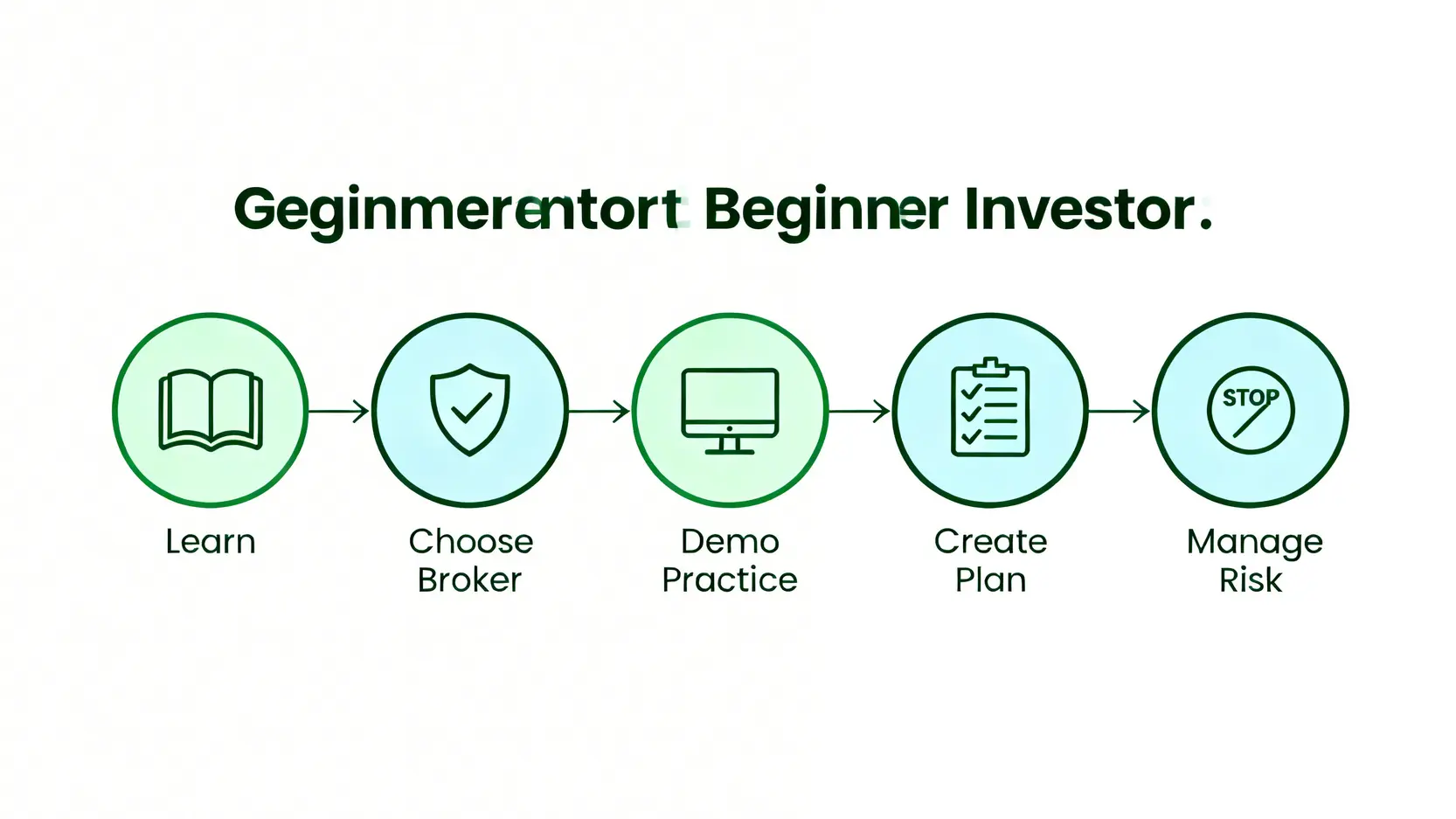
Beginner Forex Investing: Master 5 Key Steps

After learning the basics, the next stage is practical application. Following these five key steps can help you systematically start your beginner forex journey while avoiding unnecessary risks.

一張展示新手外匯投資五大關鍵步驟的流程圖,包含學習分析、選擇平台、模擬練習、制定計劃和風險管理。

Beginner Forex Investment Roadmap: Follow the Five Key Steps to Start Your Trading Journey Securely.


Step 1: Learn Basic Analysis (Technical Analysis vs. Fundamental Analysis)

Market Analysis Is the Core of Trading Decisions, Mainly Divided Into Two Schools:

  • Technical Analysis (Technical Analysis): Focuses on “Charts Speak”. Technical analysts study historical price charts, trading volumes, and various technical indicators (such as Moving Averages MA, Relative Strength Index RSI) to predict future price movements. They believe all market information is already reflected in prices.
  • Fundamental Analysis (Fundamental Analysis): Emphasizes macroeconomic factors that affect a country’s economy, such as interest rate decisions, GDP growth rates, unemployment rates, inflation data, etc. Fundamental analysts believe that a country’s economic strength ultimately determines the strength of its currency.

For beginners, it is recommended to start with forex technical analysis as it is more intuitive; however, in the long term, combining both methods allows a more comprehensive grasp of market trends. Learning forex fundamental analysis can help you better understand the reasons behind exchange rate fluctuations.

Step 2: How to Choose a Safe and Compliant Forex Trading Platform?

Choosing a reliable trading platform is the first line of defense for safeguarding your funds. An unreliable platform may render all your efforts futile. When selecting a platform, be sure to consider the following criteria:

  • Regulatory License: This is the most important indicator! Ensure the platform is regulated by top-tier financial institutions, such as the UK’s FCA, Australia’s ASIC, or the US’s NFA. Regulated platforms usually require client funds to be segregated, providing an extra layer of protection.
  • Trading Costs: Compare spreads, commissions, and overnight swaps across different platforms, and choose the one with lower overall costs.
  • Platform Stability: Mainstream trading software like MT4 and MT5 are industry standards, stable and feature-rich. Ensure the platform does not experience delays or disconnections during critical trading moments.
  • Deposit and Withdrawal Convenience: Check whether the platform supports your preferred deposit and withdrawal methods, and understand processing speed and associated fees.

For more detailed selection criteria, refer to 【2025 Forex Broker Recommendations】A Must-Read for Beginners! 5 Key Points to Choose the Best Forex Trading Platform. 

Recommended Reading (Highly Recommended)

【2025 Forex Broker Recommendations】A Must-Read for Beginners! 5 Key Points to Choose the Best Forex Trading Platform

Forex Risk Management: Experienced Traders Teach How to Hedge and Trade Safely


Step 3: Open a Demo Account for Risk-Free Practice

Before investing real funds, always practice thoroughly with a demo account. Almost all legitimate trading platforms offer this feature. Demo accounts use virtual funds but reflect real market conditions. You can:

  • Familiarize yourself with all platform functions.
  • Test and validate your trading strategies.
  • Experience real market fluctuations and develop trading discipline.

It is strongly recommended to achieve stable profits in a demo account for 1–3 months before considering a small real-money investment.


Step 4: Create Your First Trading Plan and Strategy

Trading without a plan is like sailing without a map, easily losing direction. A basic trading plan should include:

  • Trading Goals: What monthly or quarterly returns do you aim to achieve?
  • Trading Instruments: Which currency pairs will you focus on? (Beginners are recommended to start with major pairs like EUR/USD, GBP/USD)
  • Entry and Exit Conditions: Under what circumstances will you open or close a position based on your analysis?
  • Risk Management Rules: How much loss will you tolerate per trade? (For example, no more than 1–2% of total capital)

Strictly following your trading plan helps you overcome emotional decision-making, marking the line between professional and amateur traders.


Step 5: Risk Management: How to Set Stop-Loss and Take-Profit?

“Survival” is the first rule in the forex market. Learning to control losses is more important than learning to make profits. The core tools of forex risk management are stop-loss and take-profit:

  • Stop-Loss (SL): A preset order that automatically closes a position when the market price reaches your defined loss level. It ensures losses do not spiral and is the most important tool to protect your capital.
  • Take-Profit (TP): Similarly, a preset order that automatically closes a position when the price reaches your target profit. It helps control greed and prevents giving back profits.

Every trade must have both stop-loss and take-profit set—this is strict discipline! To learn more about risk management techniques, see Forex Risk Management: Experienced Traders Teach How to Hedge and Trade Safely. 

Common Forex Investment Methods Compared

For ordinary investors, participating in the forex market mainly involves two approaches: high-risk, high-reward forex margin trading, and relatively stable foreign currency deposits. Understanding the differences helps you choose the investment tool best suited to you.

Comparison Items Forex Margin Trading

Foreign Currency Time Deposit

Risk Level High Low
Potential Return High Low
Leverage Usage Yes (Core Feature) No
Main Source of Profit Exchange Rate Spread, Overnight Interest Fixed Interest, Exchange Rate Appreciation
Suitable For Aggressive investors who can tolerate high risk and seek short-term returns Conservative investors who avoid risk and seek capital preservation or long-term allocation

一張對比圖,比較外匯保證金交易(高風險高回報)與外幣定存(低風險低回報)的特性。

Investment Method Comparison: Forex Margin Trading Pursues High Returns With High Risk; Foreign Currency Time Deposits Are Like Stable Savings, Offering Lower Returns but Controllable Risk


Forex Margin Trading: High Leverage, High Risk

Forex margin trading is currently the most mainstream online forex investment method. Through leverage, investors can participate in large-scale market trades with relatively small capital. Its advantages include high potential returns and flexible trading (both long and short positions), but the disadvantages are also obvious. Leverage equally amplifies losses, and if market movements are misjudged, it may lead to rapid capital loss or even liquidation.


Foreign Currency Time Deposit: Low-Risk Asset Allocation

Foreign currency time deposits are similar to traditional bank fixed deposits, except the currency is foreign instead of local. The main returns come from the bank’s fixed interest and possible exchange gains when converting back to the local currency in the future. The risk is much lower, with principal security guaranteed, but potential returns are also limited. This method is mainly suitable for asset allocation, risk diversification, or for those with actual foreign currency needs.


How to Choose the Appropriate Method Based on Your Goals?

The choice entirely depends on your investment goals, risk tolerance, and capital scale.

  • If you seek high short-term returns, are willing to spend time learning market analysis, and can tolerate significant capital fluctuations, forex margin trading may be your choice.
  • If your goal is capital preservation, or to prepare funds in advance for studying abroad or traveling without taking excessive risk, foreign currency time deposits would be a safer option.


Conclusion

Successful forex investment begins with solid foundational knowledge and cautious practice. This article provides a complete beginner’s guide to forex from concept to practice, aiming to help new forex investors build confidence. Remember, there is no shortcut to overnight wealth in the forex market. The key to success lies in continuous learning, strict risk management, and disciplined execution. Start now by opening a demo account and begin your forex trading journey!


Forex Beginner FAQ

Q: How much capital is needed for forex investment?

A: It depends on the trading platform. Many forex brokers offer “mini” or even “micro” accounts, with minimum deposits as low as 100 USD or less. From a risk management perspective, however, beginners are advised to start with at least 500 to 1000 USD, allowing better position allocation and tolerance for normal market fluctuations.

Q: What are the trading hours of the forex market?

A: The forex market is global, spanning multiple time zones, and is open 24 hours a day, five days a week. In Hong Kong time (GMT+8), it starts with the Sydney market opening on Monday early morning and continues until the New York market closes on Saturday early morning. The period when European and North American sessions overlap (approximately 8 PM to 12 AM Hong Kong time) is the most active and volatile.

Q: What common trading mistakes should beginners avoid?

A: Common mistakes for beginners include: 1) trading without stop-loss; 2) using excessive leverage resulting in oversized positions; 3) averaging down when in loss instead of cutting losses; 4) trading without a plan, relying on gut feeling; 5) engaging in “revenge trading” after several losses to try to recover quickly.

Q: Is forex trading legal?

A: Forex trading is completely legal in most countries and regions. The key is to choose a legal trading platform regulated by local or international authorities. These regulatory bodies aim to protect investors and ensure fair and transparent trading

Q: How do forex trading platforms make money?

A: Legitimate platforms profit mainly through several methods. The primary one is the “spread”, the small difference between buy and sell prices. Some account types may charge a fixed “commission”. For traders holding positions overnight, the platform may also charge or pay “overnight interest”.

If you liked this article, please share it!

Related Articles

  • Volatility Surface Guide: Skew Trading Strategies
    Practical Applications of Volatility Surfaces: From Options Modeling to Advanced Skew Trading Strategies In options markets, implied volatility is never a flat line. Instead, it forms complex "smile" or "skew" surfaces. For advanced traders, mastering the practical applications of volatility surfaces is equivalent to possessing a lens that reveals market...
    2026 年 6 月 3 日
  • Foreign Capital Flow Model: Track Institutional Money
    Building a Foreign Capital Flow Copy Trading Model: A Stock Market Indicator for Accurately Tracking Institutional Positioning In Asia-Pacific stock markets, foreign capital inflows and outflows often determine the direction of the index. However, simply looking at daily net buy and sell data is no longer enough. Only by building...
    2026 年 6 月 3 日
  • Options Buying Strategies for Extreme Market Risks
    Options Buyer Strategies During Extreme Market Conditions: Black Swan Hedging and Cross-Market Arbitrage During Volatility Surges The most terrifying aspect of financial markets is not a gradual decline, but overnight flash crashes and cross-market capital withdrawals accompanied by volatility surges. In the highly unpredictable global macroeconomic environment of 2026, geopolitical...
    2026 年 6 月 3 日
返回顶部