The Core Drivers Behind Commodity Price Volatility
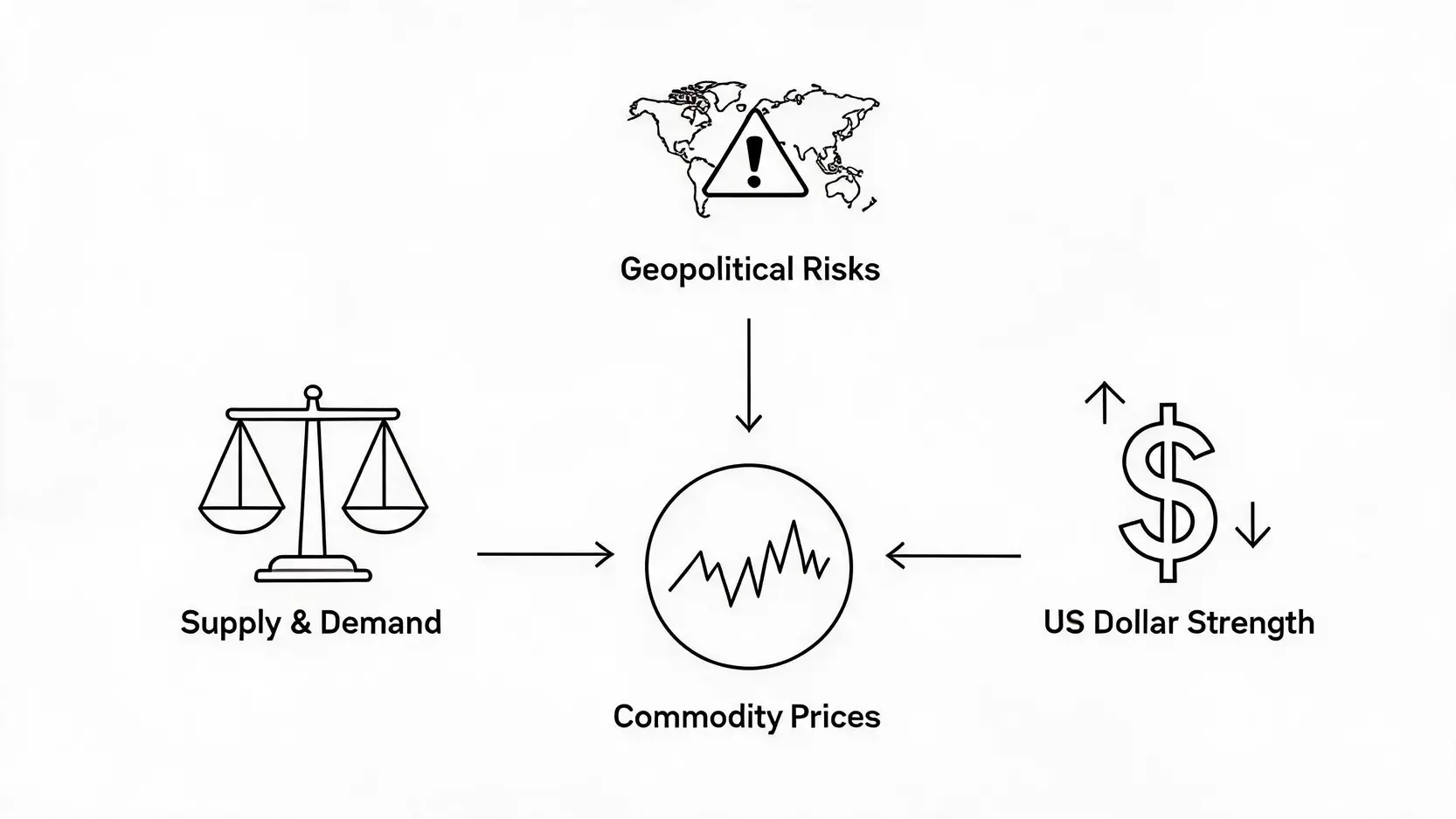
- Supply and Demand: This is the most fundamental factor. On the supply side, weather disasters can affect crop yields, mining strikes can reduce metal production, and OPEC+ production increase or cut decisions directly impact crude oil supply. On the demand side, global economic growth stimulates demand for industrial metals and energy, while rising consumption in emerging markets also boosts demand for specific commodities.
- Geopolitical Risks: Commodity production is often concentrated in specific countries or regions. Political instability in oil-producing nations, military conflicts along key shipping routes, or trade wars between major economies can rapidly trigger market panic, causing prices to surge or collapse.
- US Dollar Trends: International commodities are mostly priced in US dollars. When the US dollar strengthens, commodities become more expensive for buyers holding other currencies, potentially reducing demand and suppressing prices. Conversely, when the US dollar weakens, commodity prices tend to rise. Commodity prices generally have a negative correlation with the US dollar.
How to Interpret Market Volatility and Develop Your Investment Strategy?
Interpreting market volatility cannot rely solely on intuition. Investors can use various tools and indicators as supporting references. For example, while the Volatility Index (VIX) mainly reflects stock market fear, its sentiment impact can spill over into commodity markets. More directly, traders should monitor futures open interest and inventory data for specific commodities (such as the crude oil inventory reports published by the US Energy Information Administration (EIA)). These are important indicators for assessing market positioning and future trends. When volatility is expected to increase, investors may consider reducing position sizes, setting stricter stop losses, or using options for hedging purposes.
Beginner’s Guide: Practical Commodity Futures Trading Tutorial
Futures are one of the most direct and flexible ways to participate in commodity markets. They allow investors to control higher-value contracts with relatively small amounts of capital through margin, enabling leveraged trading opportunities. Below is a commodity futures trading tutorial designed for beginners to help you enter the market step by step.
Step 1: Choosing the Right Futures Trading Platform and Understanding the Account Opening Process
Choosing a safe and reliable trading platform is the top priority. Key considerations should include:
- Regulatory Credentials: Ensure the platform is regulated by authoritative institutions such as the National Futures Association (NFA) in the US or the Financial Conduct Authority (FCA) in the UK.
- Trading Products: Check whether the platform offers the commodity futures you are interested in, such as gold, crude oil, or corn.
- Trading Costs: Compare commissions, transaction fees, and overnight financing charges across different platforms.
- Software Usability: Evaluate whether the order interface is clear and user-friendly and whether the charting tools are comprehensive.
The account opening process is usually straightforward. Investors simply need to complete an online application form, upload identity verification documents, complete a risk assessment questionnaire, and deposit funds after approval to begin trading.
Step 2: Understanding Futures Contract Specifications and the Margin System
Every futures contract has standardized specifications. Beginners must understand the following key elements:
- Contract Symbol (Ticker): For example, gold futures use GC, while light crude oil uses CL.
- Contract Size: Specifies the quantity of the commodity represented by one contract. For example, one gold futures contract represents 100 ounces.
- Tick Size: The minimum price movement and its corresponding monetary value.
- Expiration Month: The delivery month of the contract.
Margin is the core mechanism of futures trading. You do not need to pay the full contract value, only a portion known as the “initial margin” to open a position. However, remember that leverage is a double-edged sword. It amplifies profits, but it also magnifies losses.
Further Reading (Highly Recommended)
US Stock Index Futures Trading Guide: Master Dow Jones and Nasdaq Futures Trading Strategies in 5 Steps (2026 Beginner’s Guide)
US CPI Data Guide: Quickly Understand Core CPI and the Impact of the Three Major Inflation Indicators
Step 3: Basic Order Placement Operations and Risk Management Techniques
After becoming familiar with the platform and contract specifications, you can begin placing trades. The most basic instructions are “Buy” (Long) and “Sell” (Short). If you expect prices to rise, you buy. If you expect prices to fall, you sell. However, successful traders never ignore risk management:
- Set a Stop-Loss: At the same time you place a trade, set a predetermined loss price. Once the market moves against you and reaches this level, the position will automatically close to prevent losses from expanding indefinitely.
- Set a Take-Profit: Likewise, set a target profit price. When the market reaches the target, the position will automatically close, allowing profits to be locked in.
These two tools are a trader’s “seatbelt”. You should develop the habit of setting them every time you place a trade.
Besides Futures, What Other Commodity Investment Methods Are Available?
For investors who do not wish to directly trade highly leveraged futures, the market also offers other more accessible choices. Understanding different investment tools can help you find the most suitable path for commodity investing based on your own risk tolerance and investment goals.
Commodity ETFs: The Choice for Passive Investors
Commodity ETFs (Exchange-Traded Funds) are as easy to invest in as stocks. You can directly buy and sell them through a securities account, eliminating the need to open a futures account or manage margin requirements.
- Advantages: Low entry barriers, convenient trading, and high transparency, while also effectively diversifying risk. For example, purchasing a gold ETF (such as GLD) is equivalent to indirectly holding physical gold, with prices linked to gold market movements.
- Disadvantages: Management fees are involved, and some ETFs that track futures may incur “rollover costs”, which could affect long-term returns.
CFDs vs. Physical Commodities: Comparing the Advantages and Disadvantages
A CFD (Contract for Difference) is a financial derivative that allows you to speculate on asset price movements without actually owning the underlying asset. CFDs also offer high leverage and flexible trading, but the risks are relatively high, and overnight financing charges apply, making them more suitable for short-term traders.
Physical commodities, such as purchasing gold bars or silver coins, represent the most traditional investment method. Their greatest advantage is that you own tangible assets with no counterparty risk. However, the disadvantages are equally obvious: high storage and custody costs, lower liquidity, and wider bid-ask spreads, making them unsuitable for frequent trading.
In summary, every investment tool has its own suitable use case. Beginners can start with ETFs and consider futures or CFDs after becoming more familiar with the market. To gain a deeper understanding of how futures work, you may refer to the official information provided by the Chicago Mercantile Exchange (CME Group).
Conclusion
In summary, commodities are an indispensable component of modern investment portfolios, especially in environments characterized by inflation and high market uncertainty. They serve as excellent tools for diversification and inflation protection. From understanding how inflation pushes prices higher, to mastering the impact of supply and demand, geopolitics, and US dollar trends on volatility, and learning how to utilize trading instruments such as commodity futures or ETFs, investors can better capture opportunities in constantly changing markets. Every investment journey begins with learning. Start your commodity investment journey today and build stronger protection for your growing assets.
Further Reading (Highly Recommended)
US Stock Index Futures Trading Guide: Master Dow Jones and Nasdaq Futures Trading Strategies in 5 Steps (2026 Beginner’s Guide)
US CPI Data Guide: Quickly Understand Core CPI and the Impact of the Three Major Inflation Indicators
Common Questions About Commodity Investing (FAQ)
Q: Is commodity investing risky? What type of investors is it suitable for?
A: Yes, commodity investing carries relatively high risks, mainly due to its high price volatility. In particular, leveraged instruments such as futures and CFDs further amplify these risks. It is more suitable for investors who have a certain understanding of the market, possess higher risk tolerance, and wish to diversify their portfolios to hedge against inflation risks. Beginners are advised to start with smaller amounts of capital or begin with lower-risk commodity ETFs.
Q: How much capital is needed to start investing in commodities?
A: The required capital depends on the investment tool you choose. Purchasing physical gold may require several thousand or even tens of thousands of Taiwan dollars. If investing in commodity ETFs, the process is similar to buying stocks, where a single share may cost only several hundred or several thousand dollars. For futures trading, investors need to pay “margin”. For example, the initial margin for Micro Gold Futures may be around USD 1,000, although this amount may change depending on market volatility.
Q: Between gold and crude oil, which is more suitable for beginners?
A: Generally speaking, gold is more suitable for beginners. Gold price movements are relatively easier to understand, mainly influenced by safe-haven sentiment, the US dollar, and interest rate policies, with volatility that is more moderate compared to crude oil. Crude oil, on the other hand, is influenced by more complex factors, including OPEC+ production decisions, global economic data, and geopolitical conflicts, resulting in extremely volatile price movements and higher demands on analytical skills and risk management.
Q: What is the future “rollover” or “rolling over”?
A: Futures contracts have expiration dates. If investors wish to continue holding positions after expiration, they must close the expiring old contract before it expires and simultaneously open a new contract with a later expiration month. This process is called “Rollover”. Rollover may incur spread costs, which is an important factor to consider when holding futures or futures ETFs over the long term.