Safe-Haven Currency Rotation: USD, JPY & CHF Guide

Safe-Haven Currency Rotation Strategy: What Currencies to Buy in Turbulent Times? A Complete Guide to the US Dollar, Japanese Yen, and Swiss Franc
Amid rising global geopolitical risks and an uncertain economic outlook, market volatility has become the new normal. Many investors ask “which currencies to hold in turbulent times” to preserve value. In reality, within the turbulence of financial markets, certain “safe-haven currencies” consistently serve as capital shelters. This article provides an in-depth explanation of what safe-haven currencies are, analyzes the strengths and weaknesses of major options such as the US dollar, Japanese yen, and Swiss franc, and explores the investment strategy of “safe-haven currency rotation”, including the timing dynamics of the Japanese yen and Swiss franc, helping you find a financial safe harbor in uncertain markets.
What Are Safe-Haven Currencies? The Three Key Conditions of a Capital Safe Haven
A safe-haven currency (Safe-Haven Currency), also known as a “safe harbor currency”, refers to a currency that maintains relative stability or even appreciates during periods of uncertainty and heightened risk. Investors shift capital from high-risk assets (such as equities) into these currencies to preserve value. To be recognized as a safe-haven currency, it generally needs to meet the following three core conditions:
Condition One: High Market Liquidity and Stable Currency Value
Liquidity is fundamental. A currency must be easily and widely tradable in global markets without causing extreme price fluctuations. This requires deep trading volume and market depth, allowing investors to enter and exit positions at any time. The US dollar has unmatched liquidity due to its dominant global role. Stable value is another cornerstone, meaning its purchasing power remains relatively reliable over time and is not easily eroded by high inflation.
Condition Two: Strong National Economy and Stable Political Environment
The issuing country must have a stable and mature political system, a sound legal framework, and strong economic fundamentals. A country facing political instability, high debt levels, or a fragile economic structure is unlikely to gain global investor trust. Switzerland’s permanent neutrality and stable financial system are key reasons why the Swiss franc is widely regarded as a safe-haven currency.
Condition Three: Independent and Credible Central Bank Policy
An independent central bank that prioritizes controlling inflation and maintaining economic stability, without short-term political interference, is essential for building currency credibility. Markets trust such institutions to act responsibly during crises and preserve currency value. Policy decisions by the US Federal Reserve (Fed), the Swiss National Bank (SNB), and the Bank of Japan (BOJ) all significantly influence their respective currencies’ safe-haven status.
The Three Major Traditional Safe-Haven Currencies: US Dollar, Japanese Yen, Swiss Franc
Having understood the core conditions, we now examine the three most widely recognized safe-haven currencies: the US dollar (USD), Japanese yen (JPY), and Swiss franc (CHF). Each has its own strengths and plays a different role in different “times of turmoil”.
US Dollar (USD): Advantages and Risks of the Global Reserve Currency
The US dollar is the undisputed “king of safe havens”.
- Advantages: As the world’s primary reserve and settlement currency, over 80 percent of global foreign exchange transactions involve the US dollar. During global crises, investors instinctively move into highly liquid US dollar assets, creating a “flight to quality” effect.
- Risks: The US’s large national debt and long-term monetary easing policies (money printing) may gradually erode the dollar’s value. In addition, when risks are centered within the US itself, its safe-haven appeal may weaken.
Japanese Yen (JPY): Why Low Interest Rates Become a Safe-Haven Driver
The yen’s safe-haven mechanism is unique, mainly driven by Japan’s long-standing ultra-low or even negative interest rate environment, which has led to widespread “carry trade” activity.
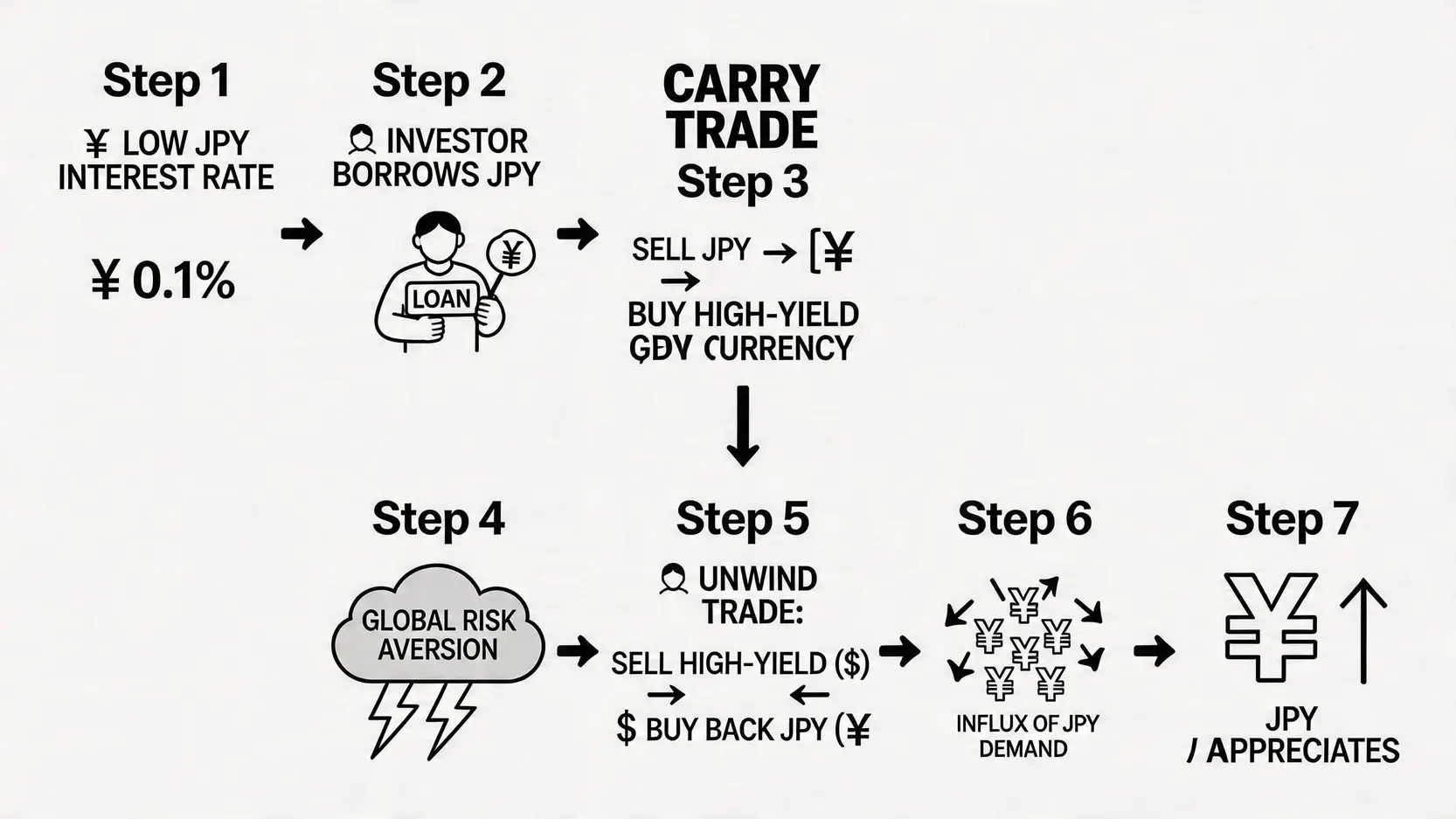
- Safe-Haven Mechanism: Global investors borrow low-cost Japanese yen and convert it into higher-yielding currencies (such as AUD or NZD) to earn interest differentials. During periods of heightened risk aversion, these trades are rapidly unwound, forcing investors to buy back yen to repay loans. This large-scale “unwinding pressure” drives the yen higher during market stress.

Japanese Yen Carry Trade Mechanism as the Core Driver of Its Safe-Haven Status.
- Latest Challenges: As the Bank of Japan gradually exits negative interest rate policies, this traditional mechanism is being tested. Whether the yen will maintain its strong safe-haven status going forward remains a key issue for investors to monitor.
Further Reading (Highly Recommended)
Beginner’s Guide to Gold Investment: Five Channels, Advantages and Risks Explained
Swiss Franc (CHF): The Currency Appeal of a Permanently Neutral Country
The Swiss franc (CHF) is widely regarded as the most traditional safe-haven currency, and its appeal stems from Switzerland itself as a nation.
- Core Advantages: Switzerland is a globally recognized permanently neutral country, allowing it to remain outside most geopolitical conflicts. Combined with its stable banking system, low inflation, low unemployment rate, and substantial gold reserves, the Swiss franc is strongly supported in terms of value. In particular, during political or economic crises in Europe, the Swiss franc is often the preferred safe haven for European capital.
- Potential Intervention: The Swiss franc’s safe-haven status can also create challenges. An excessively strong franc can severely harm Switzerland’s export and tourism sectors. As a result, the Swiss National Bank (SNB) has repeatedly intervened in foreign exchange markets to curb franc appreciation, introducing uncertainty to its upside potential.
Advanced Strategy: Learning “Safe-Haven Currency Rotation” to Capture Profit Opportunities
Understanding the characteristics of a single currency is only the first step. More experienced investors actively rotate between different safe-haven assets depending on the type of crisis. This is known as “safe-haven currency rotation”.
Economic Recession vs Geopolitical Crisis: Currency Selection in Different Types of Turmoil
Not all “crises” are the same. The origin of the shock determines capital flow direction:
- Global economic recession or financial crisis: When the world faces systemic risk, such as the 2008 financial crisis or the early phase of the 2020 pandemic, liquidity tightens globally. In such cases, the US dollar becomes the ultimate safe haven due to its unmatched role as the global reserve currency. Investors sell almost all assets to hold US dollar cash, driving the US dollar index sharply higher.
- Localized geopolitical crisis: When risks are concentrated in specific regions, such as a sovereign debt crisis in Europe or conflict in Eastern Europe, capital tends to flow into nearby but politically stable havens. In such cases, the Swiss franc becomes highly attractive. Similarly, if the crisis is concentrated in Asia, the Japanese yen may benefit from capital repatriation.

In different types of “turmoil”, capital chooses different safe havens.
Understanding this rotation pattern allows investors to select the most suitable safe-haven currency under different market environments, rather than blindly holding only one.
The Role of Gold in Safe-Haven Rotation
When discussing safe-haven assets, gold cannot be ignored. Gold is often referred to as the “ultimate safe-haven asset”, as it is not a liability of any sovereign nation and exists beyond sovereign credit systems.
Gold plays a unique role in safe-haven rotation:
- Hedging currency depreciation: When investors lose confidence in the monetary policies of major economies (especially concerns over US dollar expansion), gold’s store-of-value function becomes highly prominent.
- Relationship with the US dollar: Traditionally, gold is priced in US dollars, and the two often show an inverse correlation. When the US dollar strengthens, gold is typically under pressure, and when the US dollar weakens, gold tends to rise. However, during extreme panic, both gold and the US dollar may rise simultaneously.
- Authoritative view: According to research by the World Gold Council, gold plays an essential role in diversifying portfolio risk, hedging long-term inflation, and preserving value during systemic crises.
Therefore, a complete safe-haven strategy should not only include safe-haven currencies but also allocate a portion to gold to hedge against deeper credit risks.
Further Reading (Highly Recommended)
Bank Forex Spread Explained: Should You Choose Banks or Brokers? Complete Cost-Saving Guide
Frequently Asked Questions About Safe-Haven Currencies (FAQ)
Q: Is the euro also considered a safe-haven currency?
A: The euro (EUR) is a more complex case. As the world’s second-largest reserve currency, it has high liquidity. However, in terms of safe-haven characteristics, it is generally considered a “quasi-safe-haven currency” or a “funding currency”. Since the eurozone consists of multiple countries with uneven economic conditions, its political and economic stability is weaker than that of single, stable countries (such as Switzerland). Therefore, during global crises, its performance is usually weaker than the US dollar, Japanese yen, or Swiss franc. However, in certain situations, it may still exhibit safe-haven characteristics relative to higher-risk emerging market currencies.
Q: Can cryptocurrencies (such as Bitcoin) replace traditional safe-haven currencies?
A: This is a popular but controversial topic. Bitcoin supporters often call it “digital gold”, arguing that its decentralization and limited supply make it an ideal hedge against fiat currency depreciation. However, Bitcoin’s extreme price volatility, regulatory uncertainty, and its high correlation with risk assets during market panic currently make it difficult to function as a reliable safe-haven asset like the US dollar or gold. It can be part of a portfolio, but it still has a long way to go before replacing traditional safe-haven currencies.
Q: How can retail investors buy and sell safe-haven currencies?
A: Retail investors have multiple channels to participate in safe-haven currency trading:
- Forex margin trading: Through forex broker platforms, investors can trade currency pairs using leverage (for example, buying USD/JPY means buying US dollars and selling Japanese yen). This is the most direct and flexible method, but also carries higher risk.
2. Currency ETFs: Exchange-traded funds (ETF) that track specific currency indices, such as ETFs tracking the US dollar index, can be traded on stock exchanges.
3. Bank foreign exchange or foreign currency deposits: Converting local currency into US dollars, Japanese yen, or Swiss francs through banks and holding them in foreign currency accounts. This is the simplest method, but transaction costs (bid-ask spreads) are usually higher.
Q: What economic indicators should be monitored in safe-haven currency rotation strategies?
A: When making safe-haven currency rotation decisions, several key indicators should be closely monitored. First is the VIX index (fear index), which reflects overall market sentiment and risk aversion. Second are central bank interest rate decisions and monetary policy statements, as they directly affect interest rate differentials and carry trade dynamics. In addition, important economic data such as Non-Farm Payrolls (NFP), Gross Domestic Product (GDP) growth, and inflation data (CPI) are crucial for assessing the relative strength of national economies.
Conclusion: Building a Solid Safe-Haven Foundation for Your Investment Portfolio
In summary, understanding the characteristics of different safe-haven currencies is the first step in protecting assets during turbulent times. Whether it is the traditional US dollar, the Japanese yen driven by carry trade dynamics, or the Swiss franc backed by its neutrality status, each has its own unique safe-haven logic. More importantly, mastering the concept of safe-haven currency rotation and learning to identify the type of market crisis allows investors to respond flexibly during periods of volatility and make more optimal asset allocation decisions. It is hoped that this comprehensive guide helps you build a more resilient investment strategy and prepare for future challenges.
Related Articles
-
How Does Hedging Work? Advanced Hedge Fund Strategies and Practical Trading Guide In the rapidly changing financial markets, relying solely on a “buy-and-hold” strategy often makes it difficult to withstand severe market volatility and achieve stable long-term profits. If you have heard Wall Street leaders discuss risk hedging, you are...2026 年 7 月 14 日
-
What Is Hedging? A Risk Management Guide Every Financial Beginner Should Read In the investment market, we often hear the term “hedging”, but what exactly does it mean? Why do professional investors use it? Hedging means adopting strategies to protect assets from adverse price movements. Whether in the stock, foreign...2026 年 7 月 14 日
-
2026 Complete Guide to US Treasury Yields: Trend Analysis, Impact of Surging Yields, and Asset Allocation Strategies In the rapidly changing global financial market, US Treasury yields have long been regarded as the most important benchmark for the risk-free rate. Entering 2026, amid recurring shifts in inflation expectations and dynamic...2026 年 7 月 13 日