Trump’s Middle East Shift: Oil and Gold Price Outlook

Updated: 2026/07/14  |  CashbackIsland

trump mideast policy oil gold linkage

【2026 In-Depth Analysis】Trump’s Major Shift in Middle East Policy: How Will It Trigger a New Round of Correlated Oil and Gold Price Movements?

In 2026, global markets are once again focusing on the Middle East. As the Trump administration makes a significant shift in foreign policy, from maximum pressure on Iran to reshaping relations with Gulf allies, every move is affecting the international energy market. Trump’s shift in Middle East policy has not only directly triggered oil price volatility, but also caused gold, a traditional safe-haven asset, to move in tandem. This complex relationship between oil and gold prices is becoming both a major challenge and an opportunity for investors. This article aims to provide an in-depth analysis of the core changes in Trump’s Middle East policy, reveal how they trigger geopolitical risks in the Middle East, and offer investors oil and gold investment strategies for navigating the current market changes. 


Trump’s Shift in Middle East Policy: What Have the Three Core Changes Altered?

To understand the current market changes, it is essential to first understand the three core shifts in the Trump administration’s Middle East policy. This is not merely a change in style, but a strategic restructuring that has had a profound impact on the global energy landscape and financial stability.

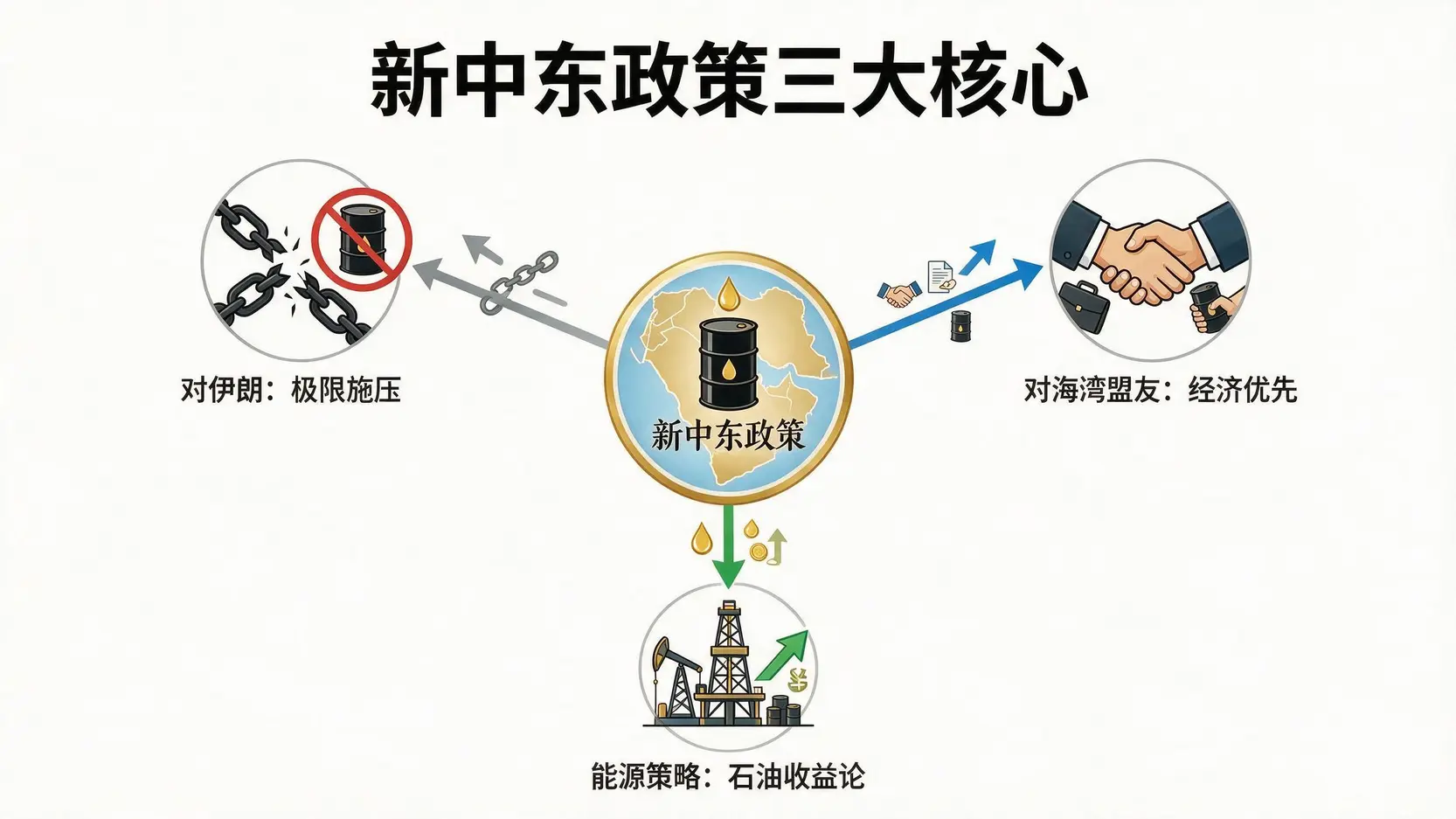
特朗普新中東政策三大核心示意圖,分別是對伊朗的極限施壓、對海灣盟友的經濟優先政策,以及國內的石油收益論能源策略。

Three Core Shifts in the Trump Administration’s Middle East Policy


Iran Policy: The Impact of Moving From Containment to Confrontation

The Trump administration’s strategy toward Iran has shifted from containment and diplomatic mediation to a more confrontational form of “Maximum Pressure 2.0”. This includes:

  • Comprehensive escalation of sanctions: Sanctions on Iranian oil exports, the financial system, and even individuals have not only been restored, but expanded, with the aim of completely cutting off the country’s economic lifeline. This has directly caused the legal supply of Iranian crude oil in the global market to fall sharply.
  • Normalization of military deterrence: The US has increased its military presence in the Persian Gulf, frequently conducted military exercises, and adopted stronger countermeasures against Iran-backed proxy forces. This high-pressure posture has sharply increased the risk of accidental conflict.
  • Dismantling the diplomatic legacy: Previous multilateral agreements have been completely overturned or marginalized, significantly reducing the scope for resolving conflicts through diplomacy and making the market outlook increasingly pessimistic

This shift from containment to confrontation has turned Iran into a bomb that could explode at any moment, with its impact transmitted directly to global oil prices.


Saudi Arabia and Gulf Allies: The Economic-Interests-First “New Europe” Strategy

In sharp contrast to its hard-line approach toward Iran, the Trump administration views Saudi Arabia and other Gulf Cooperation Council (GCC) countries as important “business partners”. The core of its strategy is to “prioritize economic interests”, specifically through:

  • Arms sales and energy contracts: Bilateral relations are strengthened through massive arms sales and energy cooperation agreements. The US is no longer primarily acting as the “world’s police”, but more like a pragmatic businessman seeking direct economic returns.
  • Pressure on OPEC+ production: On the one hand, these countries are treated as allies. On the other hand, the US openly uses its political influence to demand that OPEC+ adjust production according to US economic needs (particularly to curb domestic gasoline prices). This has filled the OPEC+ decision-making process with political maneuvering and increased market uncertainty.
  • Tacit approval of regional actions: Saudi Arabia and other countries are given greater autonomy in regional issues involving Yemen, Qatar, and elsewhere, as long as US core interests are not harmed. This “conditional tolerance” has also intensified internal power competition in the Middle East.

This strategy of turning traditional allies into major customers has made the Middle East’s political landscape more complex, with traditional alliances being replaced by blatant exchanges of interests.


Shift in Energy Strategy: From Strategic Petroleum Reserve Releases to the Oil Revenue Theory

In the past, the US government mainly stabilized domestic oil prices by releasing oil from the Strategic Petroleum Reserve (SPR). However, the Trump administration’s energy strategy has undergone a fundamental change with the introduction of the “Oil Revenue Theory”.

  • Maximizing energy exports: Strong support is being given to the domestic shale oil industry, while regulations on drilling and pipeline construction are being relaxed. The goal is to turn the US into a leading global energy exporter, increase national fiscal revenue through oil and natural gas sales, and use energy as leverage in diplomatic negotiations.
  • Viewing high oil prices as a double-edged sword: Although high oil prices affect consumers, they can also generate enormous economic benefits for the US as a major oil-producing country. As a result, the government is seeking a delicate balance between suppressing oil prices and enjoying the benefits of higher prices, making its policy objectives more difficult to predict.
  • Reinterpreting reduced dependence on Middle Eastern oil: The goal of energy independence is no longer solely to ensure domestic energy security, but also to free the US from the constraints of oil imports when dealing with Middle Eastern affairs, allowing it to adopt a more proactive and forceful diplomatic stance.


Oil Prices’ Direct Reaction: How Does Geopolitics Become a “Catalyst” for Oil Prices?

Trump’s shift in Middle East policy is like adding a catalyst to a pot of oil that is already boiling. Geopolitical risk is no longer background noise, but a core engine directly driving oil prices. Anyone seeking to invest in oil must understand how these risks are transmitted.


Supply Chain Concerns: The US-Iran Conflict and the Risk Premium in the Strait of Hormuz

Around one-fifth of the world’s oil supply must pass through the Strait of Hormuz, making it a critical chokepoint for global energy. As US-Iran relations deteriorate, market concerns about this lifeline are growing.

  • Surging risk premiums: Any military confrontation, vessel seizure, or verbal threat in the region is immediately translated into a “risk premium” in oil prices. Traders buy crude oil futures as a precaution to hedge against the risk of supply disruptions, thereby pushing up spot oil prices.
  • Higher transportation costs: Insurance companies significantly raise war-risk premiums for oil tankers passing through the area, while shipowners may demand higher freight charges. These costs are ultimately reflected in the delivered price of crude oil.

For investors, closely monitoring any unusual developments in the Strait of Hormuz is essential for assessing short-term oil price movements.


Production Maneuvering: OPEC+’s Position and Challenges Under New US Policy

OPEC+ is an alliance consisting of the Organization of the Petroleum Exporting Countries (OPEC) and non-OPEC oil-producing countries led by Russia. Its production decisions have a decisive impact on the global oil market. For more information about this organization, refer to Complete Analysis of Factors Affecting Oil Prices: 2025 Crude Oil Price Trends and OPEC Decisions. Under pressure from new US policies, OPEC+ is facing severe internal challenges.

  • Production cuts to support prices vs. higher output to capture market share: When US sanctions on Iran create a supply gap, some members led by Saudi Arabia may be inclined to increase production to stabilize oil prices, gain market share, and respond to US political demands. However, this may conflict with the interests of members such as Russia, which prefer to maintain high oil prices.
  • US political intervention: The Trump administration frequently pressures OPEC+ production meetings through social media or direct diplomatic channels, forcing the organization to consider not only economic factors, but also complex political concerns.
  • Cracks in internal unity: Each member country has a different fiscal breakeven oil price and varying levels of price tolerance. External political pressure and internal conflicts of interest continue to test the cohesion of the OPEC+ alliance. According to the Short-Term Energy Outlook published by the authoritative US Energy Information Administration (EIA), the global supply-demand balance will continue to be significantly affected by these production struggles over the coming quarters.

Therefore, the outcome of every OPEC+ ministerial meeting has become an important indicator for predicting medium-term oil price trends.


Further Reading (Highly Recommended)

Real-Time International Oil Prices: Understanding the Five Key Factors Affecting Crude Oil Price Trends

Beginner’s Guide to Gold Investment: A Complete Analysis of the Advantages and Disadvantages of Five Major Channels, Investment Benefits, and Risks


Analysis of the Traditional Relationship Between Oil and Gold Prices

Historically, oil and gold prices have shared a subtle and complex relationship. Understanding this relationship is fundamental to building a cross-asset investment portfolio. This is especially important for investors who want to begin investing in gold.

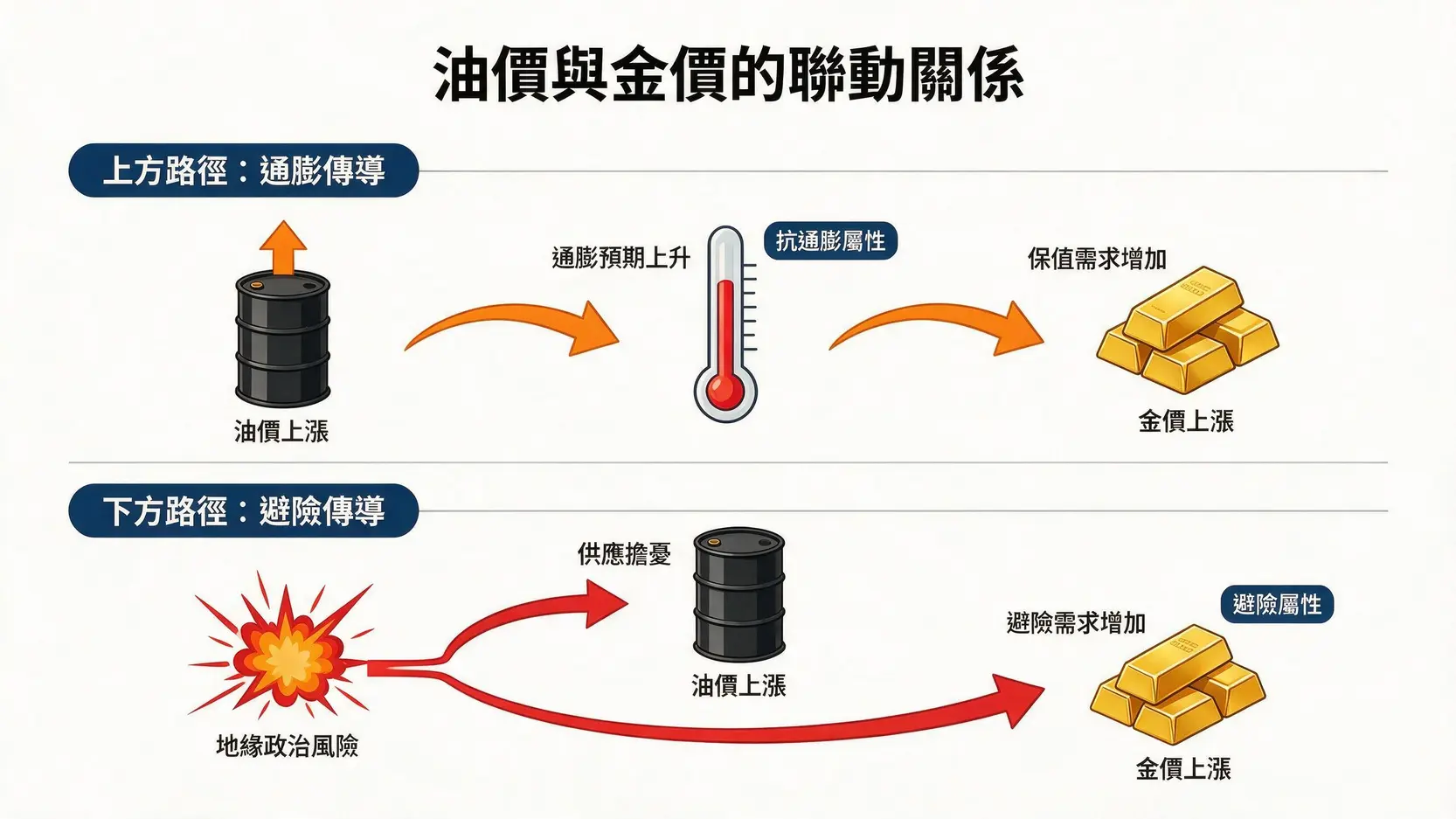
油價與金價聯動機制流程圖,展示了通膨預期和避險情緒兩條傳導路徑。

The Traditional Relationship Between Oil and Gold Prices


Inflation Expectations: How Do High Oil Prices Drive Inflation and Stimulate Gold Demand?

This is the most classic transmission path in the relationship between oil and gold. Oil is the lifeblood of industry, and its price fluctuations broadly affect every level of the economy.

  • Cost-push inflation: Rising oil prices directly increase transportation, manufacturing, and agricultural costs. These costs are eventually passed on to consumers, causing the overall price level, measured by the Consumer Price Index (CPI), to rise.
  • Gold’s inflation-hedging properties: When investors expect future inflation to intensify and the purchasing power of their cash to decline, they seek assets that can preserve value. Because gold has a limited supply and does not belong to any country’s credit system, it is widely recognized as an effective tool for hedging against inflation.
  • Positive cycle: Therefore, continuously rising oil prices → trigger market concerns about future inflation → stimulate demand for gold as a store of value → push gold prices higher.


Safe-Haven Sentiment: Why Does Capital Flow From the Oil Market to Gold During Market Turmoil?

When geopolitical conflict causes oil prices to surge, another mechanism in the oil-gold relationship, safe-haven sentiment, begins to operate.

  • Risk events are triggered: Military conflict or terrorist attacks in the Middle East cause oil prices to rise sharply because of supply concerns, while also severely affecting the stability of global financial markets.
  • Capital seeks a safe haven: In this highly uncertain environment, investors sell risk assets such as stocks and high-yield bonds and instead seek the safest possible shelter. As a time-tested ultimate safe-haven asset, gold naturally becomes the preferred destination for capital.
  • Seesaw effect: At this point, capital flows from risk assets, including oil linked to economic growth, toward safe-haven assets (such as gold). Therefore, we often observe oil and gold prices surging simultaneously during the initial stage of a geopolitical crisis.


Differentiating Insight: New Changes in the Oil-Gold Relationship During the Current “Period of Chaos”

However, it is worth noting that during the current “period of chaos” dominated by Trump’s policies, the traditional relationship between oil and gold does not always hold. New changes and short-term decoupling have even emerged. Investors who cling to conventional thinking may make incorrect judgments.

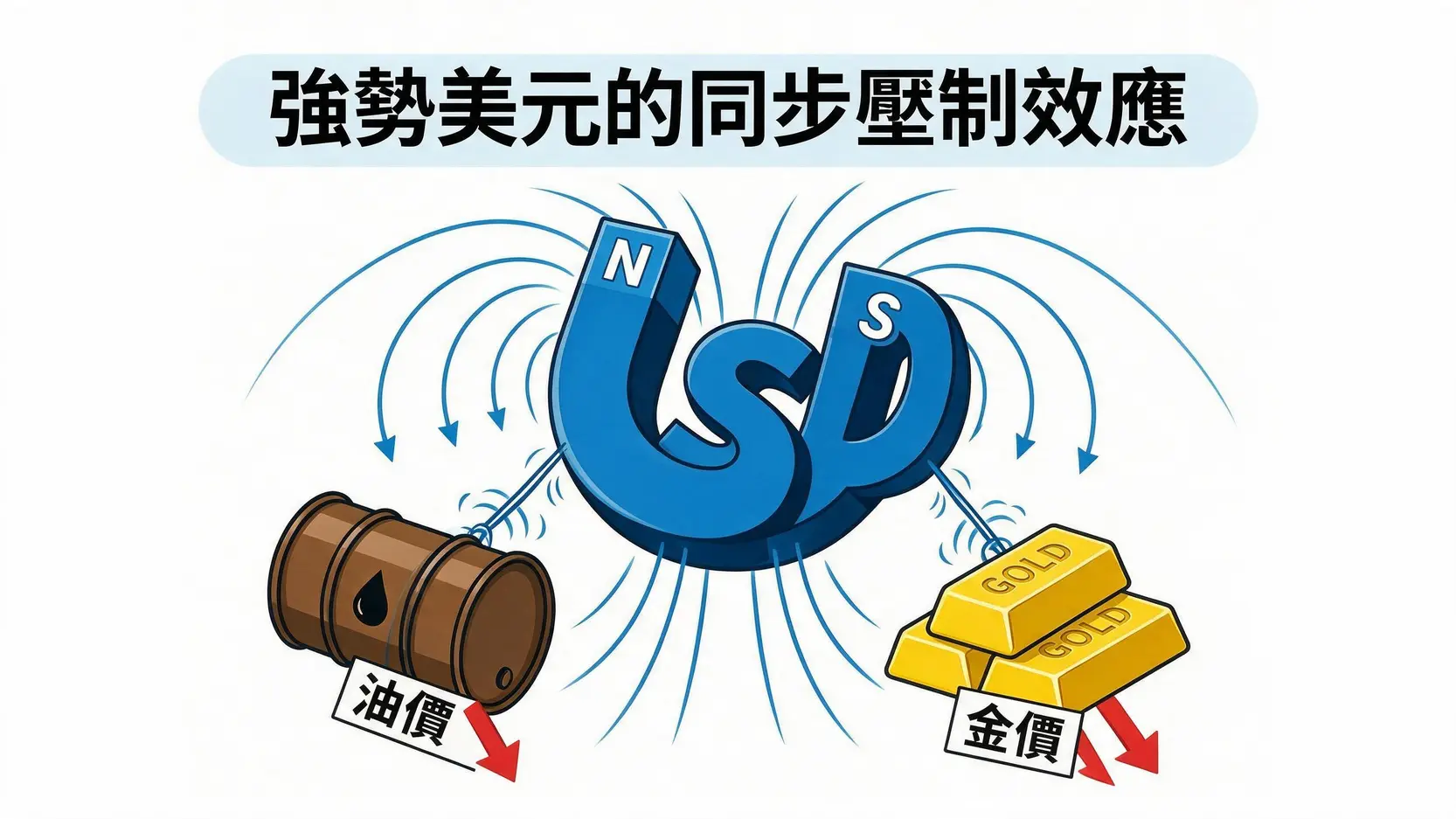
強勢美元對油價和金價的同步壓制效應示意圖,一個巨大的美元符號像磁鐵一樣把石油和黃金往下拉。

The US Dollar Factor: Simultaneous Pressure on Oil and Gold Prices


Short-Term Decoupling: Why Do Military Conflicts Sometimes Cause Gold Prices to Fall?

Conventional wisdom holds that geopolitical conflicts benefit gold. However, in certain extreme situations, gold prices may fall as conflicts escalate. The main reason behind this is a “liquidity crisis”.

  • The dollar reigns supreme (Dash for Cash): When the market falls into extreme panic, investors sell all assets regardless of cost, including stocks, bonds, and even gold, simply to obtain the most liquid asset, US dollar cash. This stampede-like selling driven by the principle that “cash is king” can cause gold prices to fall alongside risk assets in the short term.
  • Margin call pressure: In the derivatives market, when stock prices or other asset prices plunge, many funds and institutional investors face margin call pressure. At such times, highly liquid gold positions that still carry unrealized gains often become the first assets they liquidate to raise funds.

This phenomenon is usually short-lived. Once market panic eases slightly, gold’s safe-haven properties tend to drive a rapid rebound in its price.


Interference From the US Dollar Factor: How Does a Strong Dollar Suppress Both Oil and Gold Prices?

The US dollar is a common external variable affecting both oil and gold prices. Since global crude oil and gold are primarily priced in US dollars, movements in the dollar have a direct “seesaw effect” on both.

  • Pricing effect: When the US dollar appreciates, purchasing gold and oil becomes more expensive for countries using other currencies. This suppresses overall global demand, placing downward pressure on oil and gold prices.
  • Substitution effect: The US dollar is itself a safe-haven asset. When the Federal Reserve adopts tighter monetary policy (such as raising interest rates) and pushes the dollar higher, capital shifts from non-interest-bearing gold into US dollar assets that offer interest income.

Therefore, when analyzing the oil-gold relationship, the movement of the US Dollar Index (DXY) must be taken into account. If Trump’s policies trigger global capital flows back into the US and drive the dollar steadily higher, the upside potential of oil and gold prices may be constrained even amid geopolitical tensions.


Shift in Investor Sentiment: From Pure Safe-Haven Demand to Speculative Demand

In recent years, with the growing popularity of financial derivatives and the faster spread of information, speculative demand has played an increasingly important role in the oil and gold markets.

  • Impact of algorithmic trading: Large numbers of quantitative funds and algorithmic trading systems execute rapid trades based on indicators such as news keywords and market volatility. This amplifies short-term market fluctuations and may sometimes cause prices to deviate from fundamentals.
  • Participation of retail investors: Through instruments such as oil ETFs and gold ETFs, the barrier to market participation for retail investors has been significantly lowered. Their sentiment is more easily influenced by social media and news headlines, which may trigger irrational buying and selling and intensify herd behavior.

This means that current oil and gold prices reflect not only fundamentals, but also a substantial amount of market sentiment and speculative expectations. Analysts need to pay closer attention to positioning reports (such as CFTC positioning data) and market sentiment indicators to gain a more comprehensive understanding of market movements.


Frequently Asked Questions (FAQ)

Q: Will Trump’s policies drive oil prices higher over the long term?

A: Not necessarily. Although his hard-line policy toward Iran and the resulting geopolitical risks are major drivers of higher oil prices in the short term, he is also vigorously promoting increased US shale oil production and pressuring OPEC+ to raise output to curb prices over the long term. This inherent contradiction in his policies makes the long-term outlook for oil prices highly uncertain. Oil prices are more likely to fluctuate sharply within a broad range rather than rise in a single direction.

Q: Is gold still the best safe-haven asset under the current circumstances?

A: Yes, gold’s core status as a safe-haven asset remains unchanged. Although it may decline temporarily under extreme conditions due to liquidity demand, its role as the ultimate store of value with no sovereign credit risk and the ability to hedge against inflation and geopolitical turmoil cannot be replaced by other assets. In a world filled with uncertainty, allocating a portion of assets to gold remains a wise way to diversify risk.

Q: Apart from Middle East policy, what other factors affect the relationship between oil and gold prices?

A: Apart from Middle East policy, the global economic growth outlook, the Federal Reserve’s monetary policy, US dollar exchange rate movements, and the pace of renewable energy development are all important factors affecting the relationship between oil and gold. For example, a global recession would simultaneously suppress oil demand and industrial demand for gold, while a Federal Reserve rate-cutting cycle could drive both oil prices higher (by stimulating the economy) and gold prices higher by (reducing holding costs).

Q: How should ordinary investors invest in oil and gold?

A: Directly trading crude oil futures carries extremely high risks and is not recommended for ordinary investors. More suitable approaches include participating through oil ETFs (such as USO and BNO), or shares of major oil companies (such as Exxon Mobil and Chevron). Gold offers a wider range of options, including physical gold (such as gold bars and coins), gold passbooks, gold ETFs (such as GLD and IAU) and shares of gold mining companies. Beginners are advised to start with gold ETFs (which have lower entry barriers and good liquidity.


Conclusion

In summary, Trump’s shift in Middle East policy is undoubtedly one of the most significant variables affecting global financial markets in 2026. It not only has a profound direct impact on international oil prices through geopolitical risk, but also creates a complex relationship with gold prices through inflation expectations and safe-haven sentiment, sometimes moving in tandem and sometimes decoupling. For investors, understanding the complete transmission chain from “policy shift” to “market linkage” is the key to navigating the current uncertain environment and making informed asset allocation decisions. Going forward, the market will remain focused on developments in US-Iran relations, internal maneuvering within OPEC+, and the direction of the US dollar. Any new development could trigger another round of sharp movements in oil and gold prices. Amid such changes, remaining flexible, conducting in-depth research, and diversifying risk will be the core principles for navigating uncertainty and achieving asset growth.

编者
Evan Lin

Evan Lin

我是Evan Lin,从大学时期开始接触外汇交易,至今已有多年实战经验,熟悉技术分析与EA策略,热衷于研究市场脉动与风险管控,喜欢分享实战经验和交易技巧,和大家一起学习、一起进步!

If you liked this article, please share it!

Related Articles

  • Binance Margin Trading: Cross vs Isolated Guide
    Binance Margin Trading Guide: Differences Between Cross and Isolated Margin Modes and Illustrated Borrowing Instructions Short on funds but expect a particular cryptocurrency to surge? Besides the commonly used futures trading, you can also use “Binance Margin” to borrow funds and purchase spot assets, amplifying your investment returns. This Binance...
    2026 年 7 月 14 日
  • 2026 Euro Forecast: Is Now the Best Time to Buy Euros?
    2026 Euro Exchange Rate Forecast: Is Now the Best Time to Buy Euros? Planning a trip to Europe or considering foreign currency investments? As the world’s second-largest reserve currency, fluctuations in the euro directly affect your currency exchange costs and investment returns. As we enter 2026 and face changes in...
    2026 年 7 月 14 日
  • 2026 US-Iran Conflict: Can Gold Still Be a Safe Haven?
    2026 US-Iran Conflict Escalates: Can Gold Really Serve as a Safe Haven? Understanding the True Relationship Between Gold Prices and War in One Article As geopolitical tensions continue to escalate in 2026, global financial markets are once again overshadowed by uncertainty, instantly igniting investors’ demand for safe-haven assets. The classic...
    2026 年 7 月 14 日
返回顶部