Geopolitical Risk Index: How to Measure Risk Premium

Updated: 2026/04/27  |  CashbackIsland

geopolitical-risk-premium-quantify

How to Quantify Geopolitical Risk? A Complete Guide to Investment Risk Premium Calculation and the Application of Geopolitical Risk Indices

In today’s increasingly complex global environment, geopolitical conflicts have become a key variable affecting investment returns. From the Russia-Ukraine war to tensions in the Middle East, these events are no longer distant news headlines but realities that directly impact your investment portfolio. Many investors feel confused about geopolitical risk premium pricing and do not know how to quantify geopolitical risk and incorporate it into investment decisions. This article provides a clear framework, from understanding the “Geopolitical Risk Index (GPR)” to mastering the specific methods of “investment risk premium calculation”, helping you transform abstract political risk into actionable investment strategies and make more informed financial decisions. 


What Is Geopolitical Risk Premium? Why It Is a Must-Learn Concept for Modern Investors

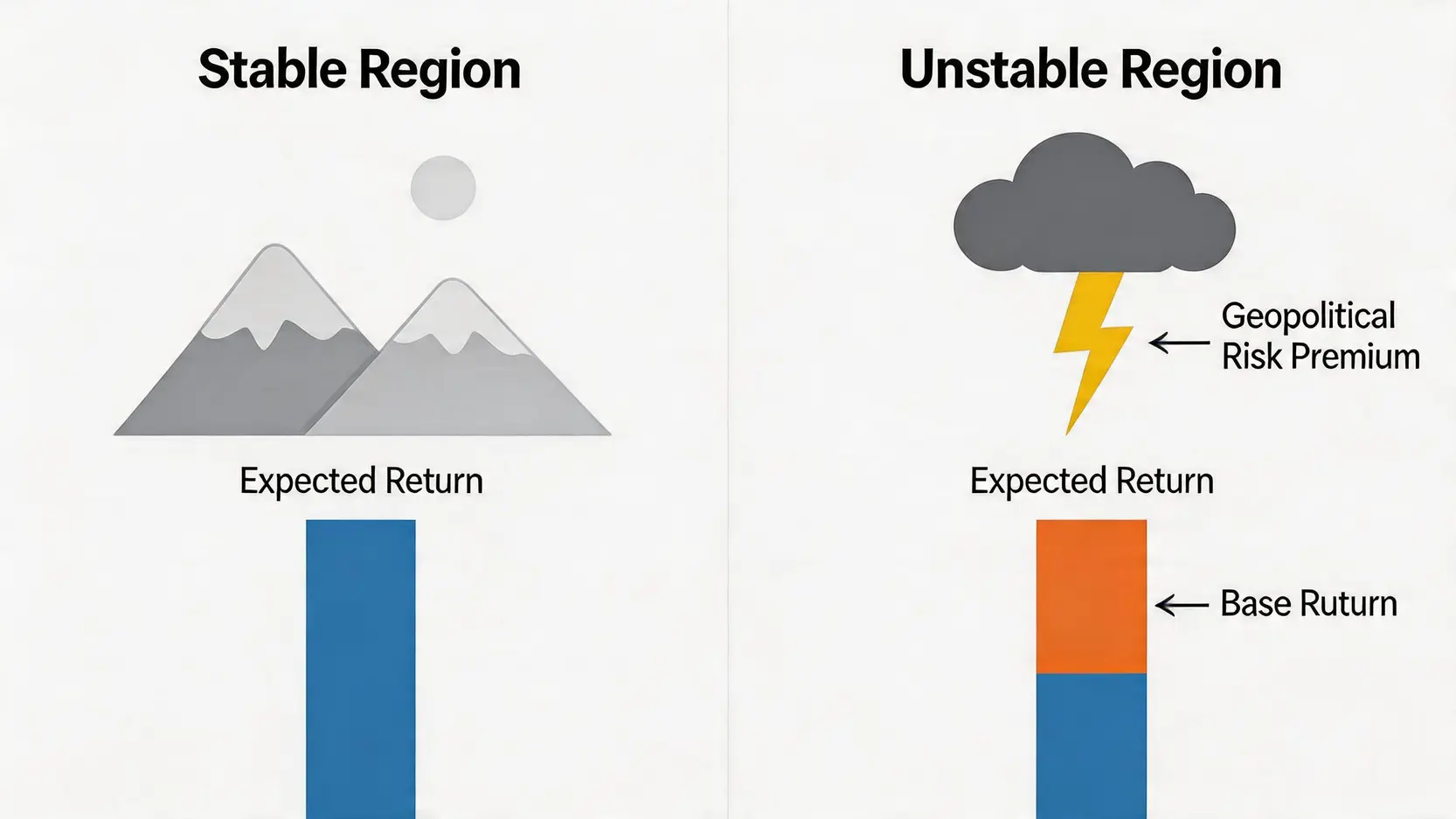
Imagine you have two investment opportunities, one in politically stable Switzerland and another in a politically unstable emerging market. Even if the fundamentals of both companies are identical, you would naturally require a higher expected return from the latter to compensate for additional political uncertainty. This “extra return” is the essence of the geopolitical risk premium.

一张对比图,显示在稳定国家投资的回报与在不稳定国家所需的高额风险溢价回报之比较。

The higher the geopolitical risk, the higher the “risk premium” investors demand to compensate for uncertainty.


Basic Concept: The Intrinsic Link Between Geopolitical Risk and Excess Investment Return

Geopolitical risk premium refers to the additional compensation investors require above the risk-free rate for bearing uncertainty arising from political instability, military conflict, terrorism, or diplomatic tensions in a specific country or region. In simple terms, it is the price the market assigns to “unknowns”.

  • Sources of risk: War, trade disputes, regime changes, terrorist attacks, sanctions, and similar events.
  • Transmission channels: Disruption of supply chains, changes in commodity prices (such as oil), shifts in consumer confidence, and capital outflows.
  • Investor response: Demanding higher returns to offset potential losses, which in turn affects equity valuations, bond yields, and currency exchange rates.

Understanding geopolitical risk premium helps investors identify the balance between risk and opportunity in seemingly chaotic global events, avoiding both panic-driven mispricing of quality assets and underestimation of excessive risk exposure.


Why Quantifying Geopolitical Risk Matters: Market Sentiment and Trends Through the Geopolitical Risk Index (GPR)

Sentiment is subjective, but investment decisions require objective data. This is where the “Geopolitical Risk Index (GPR)” plays a crucial role. Developed by economists Dario Caldara and Matteo Iacoviello at the US Federal Reserve, the GPR is one of the most authoritative tools for quantifying geopolitical risk.

The GPR index works by using automated text analysis to calculate the frequency of risk-related keywords (such as war threats, terrorism, military tensions) in 11 major global newspapers. A higher index value indicates elevated geopolitical risk and heightened market anxiety.

By observing historical trends of the GPR index, investors can:

  • Identify risk peaks: For example, the index spiked significantly during events such as the 9/11 attacks, the Iraq War, and the Ukraine crisis.
  • Gauge market risk sentiment: Rising GPR levels are often associated with stock market declines and increases in safe-haven assets such as gold and the US dollar.
  • Make macro asset allocation decisions: During high-risk periods, investors may reduce exposure to equities and increase allocations to cash or high-quality bonds.

To access the latest GPR data, investors can refer to academic research and official datasets, which provide a solid foundation for analysis.


Further Reading (Highly Recommended)

How to Reduce Investment Risk? Five Risk Management Strategies and Practical Diversification Guide


How to Calculate Geopolitical Risk Premium? Practical Models and Step-by-Step Breakdown

Quantifying geopolitical risk and incorporating it into valuation models is a key step in professional investment. Although there is no perfect formula that can precisely predict the future, we can approximate geopolitical risk premium by adjusting classic financial models. One of the most commonly used tools is the “Capital Asset Pricing Model (CAPM)”.


Core Pricing Tool: Application and Adjustment of the Capital Asset Pricing Model (CAPM)

The traditional CAPM formula is as follows:

Expected Return = Risk-Free Rate + Beta * (Market Expected Return – Risk-Free Rate)

This model tells us that an asset’s expected return depends on its systematic risk relative to the overall market (measured by the Beta coefficient). However, this basic model does not explicitly include country-specific geopolitical risk. Therefore, we need to extend it:

Adjusted CAPM Formula:

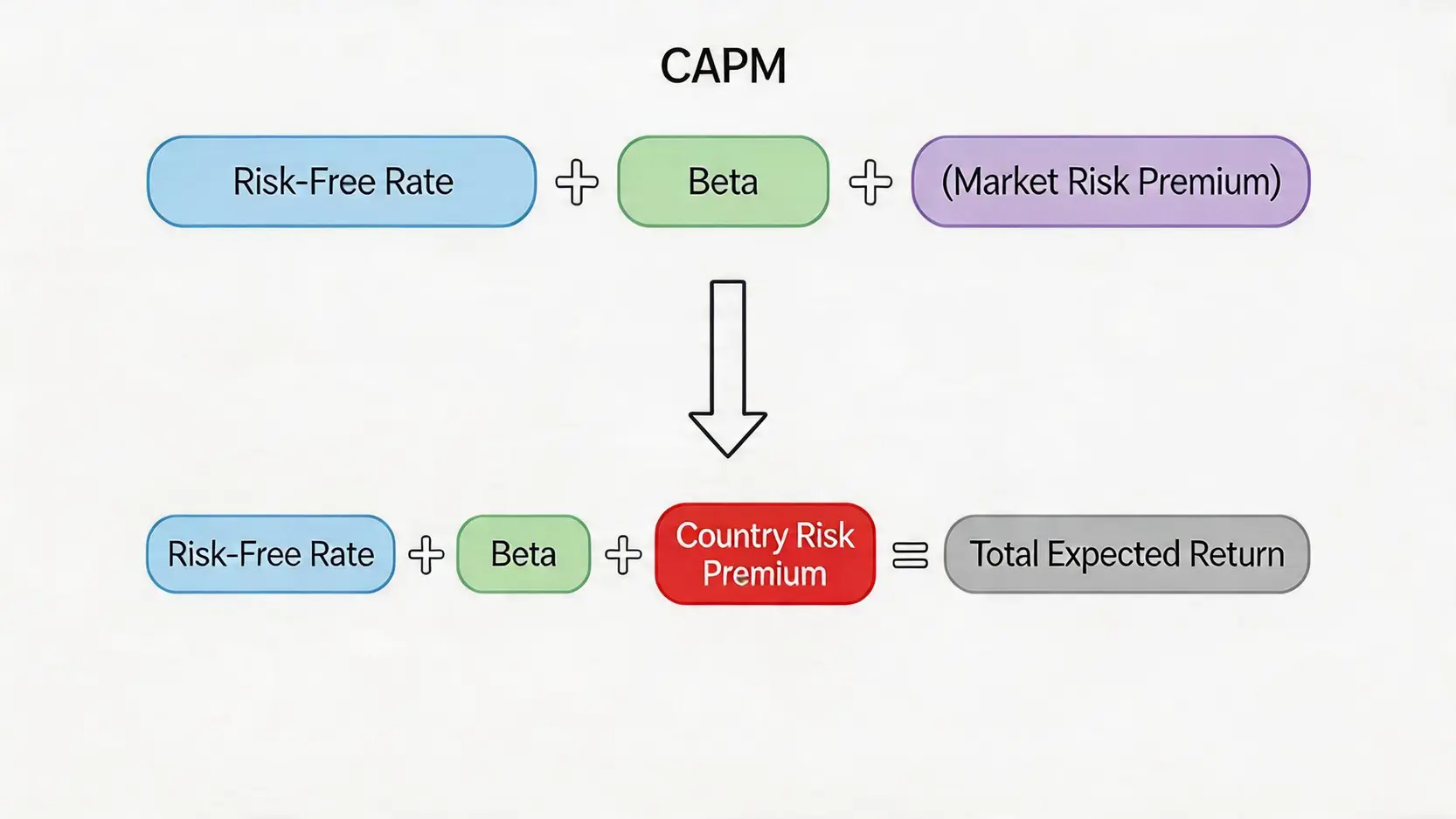
Expected Return = Risk-Free Rate + Beta * (Market Expected Return – Risk-Free Rate) + Country Risk Premium (CRP)

一张图解,展示资本资产定价模型(CAPM)如何加入国家风险溢价(CRP)以计算包含地缘风险的预期回报。

In the adjusted CAPM model, an additional Country Risk Premium (CRP) is added on top of traditional market risk to reflect geopolitical uncertainty.

Here, the Country Risk Premium (CRP) is the key variable used to capture geopolitical risk. It represents the total additional risk required to invest in a specific country (compared to a mature and stable market such as the US), and this includes geopolitical risk.


Key Variable Estimation: How to Derive and Apply Country Risk Premium (CRP) for a Specific Market

Estimating the country risk premium is one of the most challenging parts of investment risk premium calculation. Below are two commonly used methods:

  1. Sovereign Bond Default Spread Method: This is a relatively straightforward approach. It is calculated by subtracting the yield of a US (or German) government bond with the same maturity from the yield of a sovereign bond issued by that country in US dollars (or euros). This spread reflects the market’s pricing of sovereign default risk, which implicitly incorporates an assessment of political and economic stability. 

For example: If Brazil’s 10-year USD bond yield is 8%, while the US 10-year Treasury yield is 4%, the sovereign bond spread is approximately 4%.

  1. Relative Equity Volatility Method: This method, popularized by valuation expert Aswath Damodaran, is more precise. It considers not only the bond market’s view but also incorporates stock market volatility.
    CRP = Sovereign Bond Default Spread * (Annualized Standard Deviation of the Country’s Equity Market / Annualized Standard Deviation of the Country’s Sovereign Bond Market)
    The logic behind this formula is that a country’s stock market is usually more volatile than its bond market, so the volatility ratio is used to adjust the spread, providing a more accurate reflection of the risk faced by equity investors.

In practical application, investors can refer to country risk premium data regularly published by authoritative institutions such as the NYU Stern School of Business, and directly input these values into valuation models, making investment risk premium calculations more aligned with real market conditions.

For example, when evaluating a company located in the Middle East, even if its business is unrelated to oil, you still need to include the country risk premium in the CAPM model to reflect the potential impact of regional conflicts on its operating environment, supply chain, and even legal stability. Just as Middle East conflicts often trigger global oil price volatility, studying crude oil investment fundamentals can also help you better understand how geopolitical risk is transmitted through commodity markets into the global economy. 

Frequently Asked Questions (FAQ)

Q: Where can I find the latest data for the Geopolitical Risk Index (GPR)?

A: The original GPR data and charts are typically available on the personal website of its creator, Dario Caldara, or on relevant research pages of the Federal Reserve Board. In addition, professional financial data providers such as Bloomberg, Reuters, and certain academic research databases also periodically update or reference this data.

Q: Is the calculation of risk premium absolutely precise? What are the limitations?

A: No, it is not absolutely precise. Any model-based calculation has its limitations. First, the CAPM model itself is based on several assumptions (such as market efficiency and rational investors), which may not fully hold in the real world. Second, the estimation of Country Risk Premium (CRP) relies on historical data and may not fully capture sudden “black swan” events. Therefore, the result should be treated as a rational “anchor” rather than absolute truth, and should be combined with qualitative analysis (such as policy direction and leadership behavior) for comprehensive judgment.

Q: Besides equities, how does geopolitical risk affect bond and real estate markets?

A: The impact is significant. In the bond market, rising geopolitical risk can lead to a downgrade in sovereign credit ratings, causing yields to spike (and prices to fall) as investors demand higher compensation for default risk. In the real estate market, prolonged geopolitical instability can deter foreign direct investment (FDI), leading to capital outflows and negatively affecting commercial property and high-end residential demand. Conversely, countries perceived as “safe havens” may benefit from inflows of capital into their real estate markets.

Q: How can individual investors respond to increasingly frequent geopolitical risks?

A: Individual investors can adopt the following strategies to manage risk:

  • Global diversification: Avoid over-concentrating assets in a single country or region by investing in global ETFs or funds to spread geopolitical risk.
  • Allocate safe-haven assets: Include a certain proportion of traditional safe-haven assets such as gold, US dollar, or Swiss franc in the portfolio to provide a buffer during market turbulence.
  • Focus on sector impact: Analyze how different geopolitical events affect specific industries. For example, defense, energy, and cybersecurity sectors may benefit during certain conflicts, while aviation and tourism may be negatively affected.
  • Maintain a long-term perspective: Avoid frequent trading based on short-term political news. Focus on the long-term value of quality assets rather than trying to predict every political crisis outcome.


Conclusion

In summary, understanding and mastering geopolitical risk premium pricing methods is a key skill for navigating today’s volatile markets. This is not merely an academic exercise but a practical strategy that directly affects investment outcomes. By applying tools such as the Geopolitical Risk Index (GPR) for quantitative analysis and incorporating the adjusted Capital Asset Pricing Model (CAPM) for investment risk premium calculation, you can more accurately assess potential returns and hidden risks. Remember, successful investing is not about completely avoiding risk, but about learning how to price it properly. Apply these strategies to your investment analysis process and protect your assets in an uncertain world.

If you liked this article, please share it!

Related Articles

  • Volatility Surface Guide: Skew Trading Strategies
    Practical Applications of Volatility Surfaces: From Options Modeling to Advanced Skew Trading Strategies In options markets, implied volatility is never a flat line. Instead, it forms complex "smile" or "skew" surfaces. For advanced traders, mastering the practical applications of volatility surfaces is equivalent to possessing a lens that reveals market...
    2026 年 6 月 3 日
  • Foreign Capital Flow Model: Track Institutional Money
    Building a Foreign Capital Flow Copy Trading Model: A Stock Market Indicator for Accurately Tracking Institutional Positioning In Asia-Pacific stock markets, foreign capital inflows and outflows often determine the direction of the index. However, simply looking at daily net buy and sell data is no longer enough. Only by building...
    2026 年 6 月 3 日
  • Options Buying Strategies for Extreme Market Risks
    Options Buyer Strategies During Extreme Market Conditions: Black Swan Hedging and Cross-Market Arbitrage During Volatility Surges The most terrifying aspect of financial markets is not a gradual decline, but overnight flash crashes and cross-market capital withdrawals accompanied by volatility surges. In the highly unpredictable global macroeconomic environment of 2026, geopolitical...
    2026 年 6 月 3 日
返回顶部