How Does the Middle East Conflict Affect Gold Prices? A Comprehensive Analysis of the Gold, Oil, and US Dollar Triangle Relationship and Investment Strategies
The ongoing escalation of the Israel–Palestine conflict in the Middle East has sharply increased geopolitical risk, once again drawing global investors’ attention to gold as a traditional safe-haven asset. Whenever international tensions rise, the saying “buy gold in times of turmoil” quickly spreads. However, how exactly does war affect gold prices? How does the relationship between gold and the US dollar differ in this latest Middle East conflict? Many investors are concerned about the future trajectory of gold prices amid the Israel–Palestine conflict, as well as the interconnected movements of oil and the US dollar. This article provides an in-depth breakdown of the relationship between Middle East tensions, oil prices, and gold, analyzes the complex interplay among the three, and offers strategic guidance for gold allocation during periods of instability, helping you find the most stable asset allocation direction in an uncertain market environment.
How Does War Affect Gold Prices? Deconstructing Gold’s Core Safe-Haven Value
To understand the impact of war on gold prices, it is essential to first grasp gold’s core value as a “safe-haven asset”. In financial markets, safe-haven assets refer to those that can maintain or even increase in value during periods of high volatility or uncertainty. Gold’s ability to play this role stems from its thousands of years of historical significance, physical scarcity, and globally recognized value.
Rising Risk Aversion: Why Investors Turn to Gold?
When war or major geopolitical conflict breaks out, market uncertainty reaches extreme levels. Investors fear that traditional financial assets such as stocks and bonds may decline sharply due to economic shocks, corporate profit deterioration, or sovereign debt risks. Driven by panic, capital flows toward safe havens. As a physical asset not issued by any single country or central bank, gold’s value is not tied to any specific economy or policy, making it an ideal hedge against systemic risk. Therefore, surging demand for safety is the most direct driver of rising gold prices. As noted by the financial authority Investopedia, gold plays a significant role in hedging inflation and currency depreciation.
Currency Depreciation Risk: How War Undermines Confidence in Fiat Money?
War is often accompanied by massive fiscal spending. Governments may resort to large-scale money printing to finance military operations, leading to excess money supply, inflation, and a decline in the purchasing power of fiat currency. At the same time, war damages economic fundamentals and weakens international confidence in a country’s currency. In this context, gold’s function as a “store of value” becomes particularly important. Unlike paper currency, gold supply is relatively stable and cannot be created at will, making it a strong safeguard against currency depreciation. Historically, during wartime periods, citizens in many countries have sold local currency to buy gold, clearly reflecting this logic.
Historical Data Review: Gold Performance Across Major Wars
Looking back at major international conflicts over the past decades, gold prices have often surged significantly at the early stage of crisis events. Examples include:
1979 Iranian Revolution and Soviet invasion of Afghanistan: Gold surged from around 300 US dollars per ounce to a historical high of 850 US dollars within one year.
1990 Gulf War: after Iraq invaded Kuwait, gold rose more than 10 percent in a short period.
September 11, 2001 attacks: Gold jumped nearly 6 percent in a single day after the incident.
2022 Russia-Ukraine war: Gold quickly broke above 2000 US dollars per ounce, reaching a new short-term high.
However, it is important to note that the impact of war on gold prices is usually concentrated in the “anticipation and early stages” of conflict. Once the situation becomes clearer or the market digests the risk, gold may experience a correction. Therefore, understanding how war affects gold prices requires a broader macroeconomic perspective, not just short-term reactions.
Middle East Conflict Core: The Triangular Relationship Between Gold, Oil, and the US Dollar
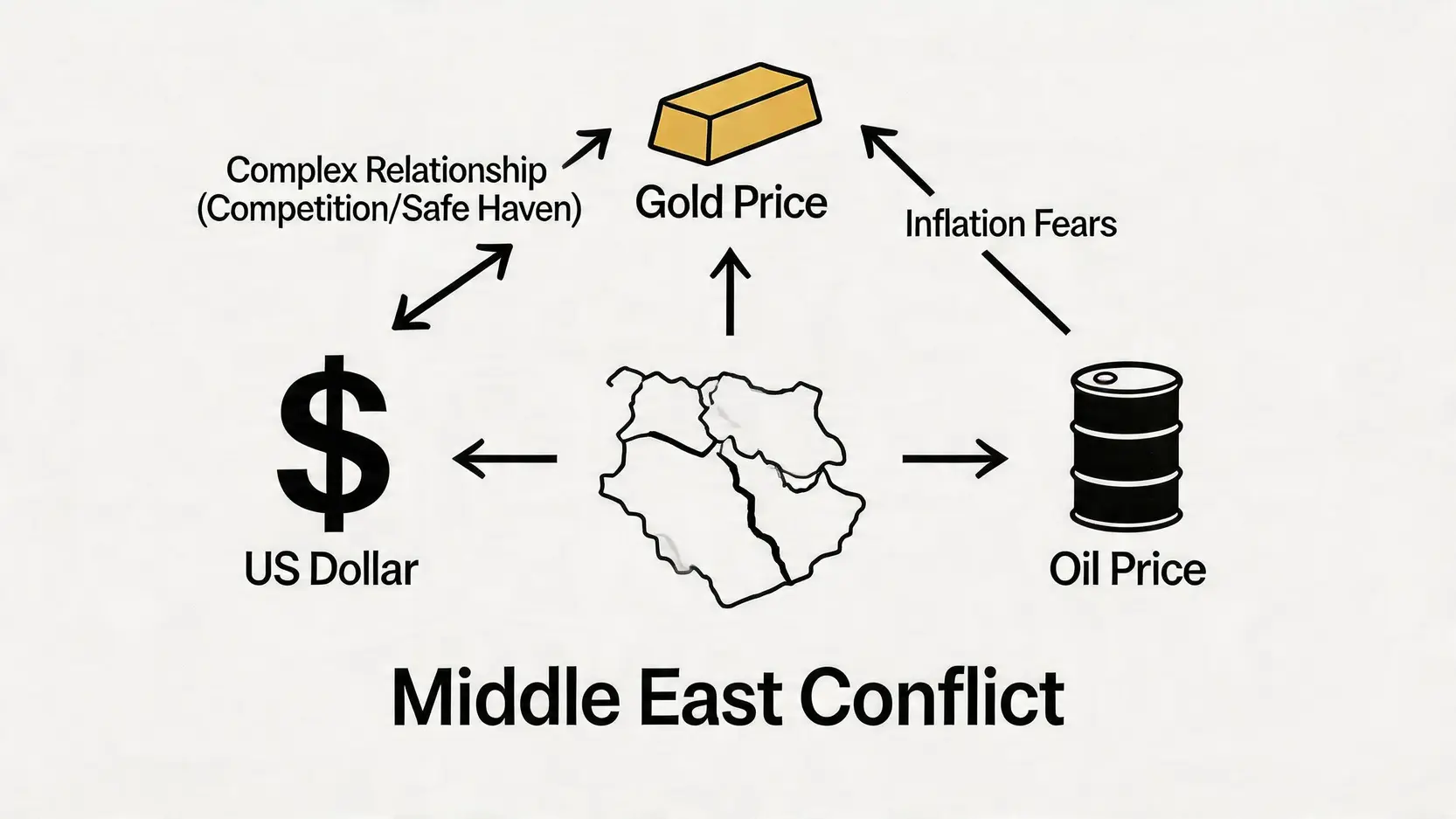
The reason Middle East conflicts have such a strong global market impact is not only due to geopolitics, but also because the region is one of the world’s largest oil-producing areas. When tensions rise, a complex triangular interaction emerges between gold, oil, and the US dollar.
Triangle Relationship Between Gold, Oil, and the US Dollar Triggered by the Middle East Conflict
Oil Prices: How Middle East Tensions Directly Disrupt Global Energy Supply and Drive Prices Higher?
The Middle East accounts for nearly one-third of global oil production and is also a critical choke point for global oil transportation (such as the Strait of Hormuz). Once war breaks out in the region, markets immediately worry about disruptions in crude oil production or transportation, triggering fears of supply shortages. This panic sentiment rapidly drives up international oil prices. For example, during the escalation of the Israel-Palestine conflict, Brent crude prices once surged significantly. Rising oil prices not only directly affect transportation and production costs across countries but also create widespread inflationary pressure.
US Dollar Index: As a Safe-Haven Asset, Is the Relationship Between the US Dollar and Gold Competitive or Synchronized?
The relationship between the US dollar and gold is quite nuanced. On one hand, both are globally recognized safe-haven assets. During crises, international capital may flow into both the US dollar and gold simultaneously. The US dollar is favored due to its status as the global reserve currency and the depth and liquidity of the US Treasury market. In this scenario, a stronger US dollar index places pressure on gold priced in US dollars (making gold more expensive for investors holding other currencies), creating a “competitive relationship”.
On the other hand, if the oil price surge triggered by the Middle East conflict severely impacts the US economy, or leads to massive fiscal deficits due to deep military involvement, it may undermine confidence in the US dollar. In such cases, capital may flow out of the US dollar and into gold, forming a “synchronized upward movement”. Therefore, the relationship between the US dollar and gold depends on the specific transmission impact of the conflict.
Positive Correlation Between Gold and Oil: How Inflation Expectations Drive Both Higher?
The most common linkage pattern in Middle East conflicts is “rising oil prices driving gold prices higher”. The underlying logic is inflation expectations. Oil is the lifeblood of the modern economy, and sharp increases in oil prices almost inevitably transmit into the Consumer Price Index (CPI), fueling global inflation concerns. Since gold is a traditional inflation hedge, investors buy gold to preserve value when they expect inflation to rise. This explains why gold and oil often show a positive correlation when analyzing the relationship of Middle East oil and gold.
Investment Strategy Under the Israel-Palestine Conflict: How to Allocate Gold Assets?
After understanding the linkage between Middle East conflict, gold, oil, and the US dollar, the most important question for investors is how to execute in practice. When facing geopolitical risks such as the Israel-Palestine conflict, gold allocation should consider the following points.
Physical Gold vs Paper Gold: Analysis of the Advantages and Disadvantages of Different Gold Products
Gold investment channels are diverse and can mainly be divided into “physical gold” and “paper gold”. Each has its own advantages and disadvantages, suitable for different investor needs.
Gold Product Types
Product Examples
Advantages
Disadvantages
Physical Gold
Gold bars, gold coins, gold jewelry
✅Actual physical ownership with no counterparty risk
✅ A final store of value in extreme scenarios
❌ High storage and security costs
❌ Wider bid-ask spreads and lower liquidity
Paper Gold
Gold ETFs, gold futures, gold mining stocks
✅ Low transaction costs with high liquidity
✅ No need for physical storage, convenient and efficient
❌ Counterparty risk from issuing institutions
❌ Cannot be redeemed for physical gold (except for some products)
For investors seeking extreme safety and long-term value preservation, holding a small amount of physical gold is reasonable. For most investors who aim to capture gold price movements or conduct asset allocation, trading gold ETFs (such as GLD, IAU) through a brokerage account is a more efficient and cost-effective option.
Gold in a Crisis Portfolio: What Percentage Should Be Allocated?
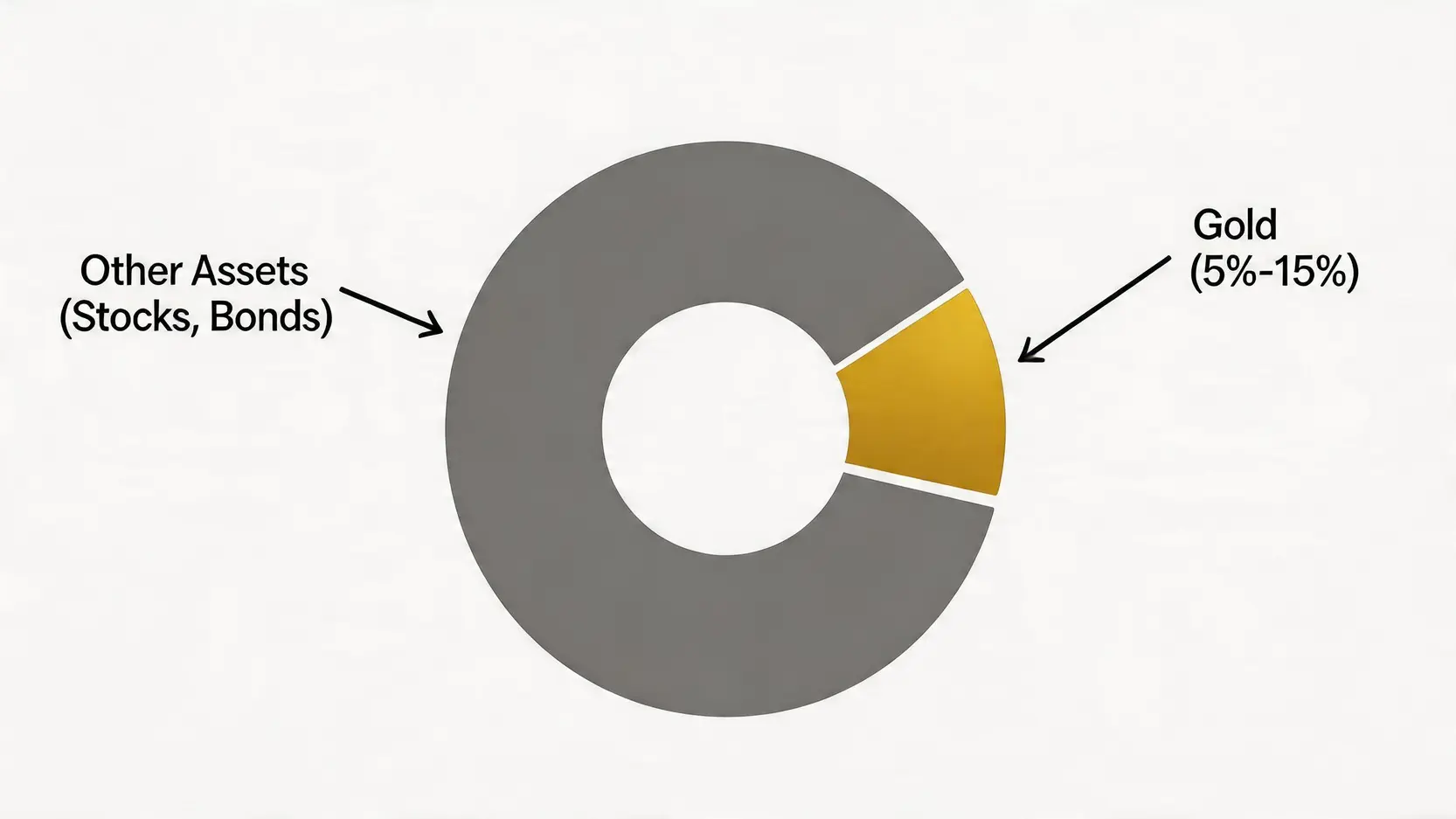
In an investment portfolio, gold should play the role of “insurance” rather than a “primary growth driver”. Generally, in a balanced portfolio, the recommended allocation to gold is between 5% and 15%. This proportion is sufficient to provide a hedge during market turbulence and offset part of the downside risk in equities, without significantly dragging down long-term portfolio returns due to gold’s non-yielding nature. However, the exact allocation should still be adjusted dynamically based on individual risk tolerance and market outlook.
Recommended Gold Allocation: As Portfolio Insurance
Short-Term Trading vs Long-Term Holding: Investment Mindset During Geopolitical Risk
Using geopolitical events for short-term gold trading carries extremely high risk, as related news changes rapidly and gold prices can be highly volatile, making it difficult for most investors to time entries and exits accurately. A more prudent approach is to treat gold as a long-term strategic asset.
Long-term holders: There is no need to frequently trade based on short-term news. Treat gold as part of a core portfolio, periodically review its weight in total assets, and consider gradually increasing positions during significant price pullbacks.
Swing traders: If attempting to capture geopolitical-driven price movements, strict take-profit and stop-loss levels must be set. When tensions ease or risk sentiment declines, lock in profits decisively to avoid “riding volatility cycles”.
Overall, in complex international environments, maintaining discipline and composure is the key to successful investing.
FAQ: Common Questions About Middle East Conflicts and Gold Investment
Q: Besides war, what other factors affect gold prices?
A: Gold prices are influenced by multiple factors. In addition to geopolitical risk, the main drivers include: 1. Global interest rate levels: Especially US real interest rates, which have a highly negative correlation with gold prices. The higher the interest rates, the greater the opportunity cost of holding gold, which is unfavorable for gold prices. 2. US dollar exchange rate: A stronger US dollar usually suppresses gold prices, and vice versa. 3. Inflation levels and expectations: High inflation is beneficial for gold, as it serves as an inflation hedge. 4. Central bank gold reserve policies: Buying and selling actions by global central banks, especially accumulation by emerging market countries, provide important support for gold prices. 5. Physical demand: Demand for jewelry and industrial applications (such as the electronics industry) also affects the supply and demand balance of gold.
Q: If the Israel-Palestine conflict eases, will gold prices immediately drop sharply?
A: There may be short-term profit-taking pressure, leading to a pullback in gold prices. However, whether gold will experience a “sharp decline” depends on changes in other macroeconomic factors alongside the easing of the conflict. For example, if concerns about a global economic recession intensify at that time, or if the US Federal Reserve shifts toward interest rate cuts, gold may remain firm supported by other bullish factors even if geopolitical risks decline. Gold prices are the result of multiple combined forces, and the influence of a single event diminishes over time.
Q: In Taiwan or Malaysia, what channels are available to buy and sell gold?
A: In these regions, gold investment channels are already well developed, mainly including:
Banks: You can open a gold passbook (Gold Passbook) or buy and sell physical gold bars. 2. Jewelry stores: Direct purchase of physical gold such as bars, coins, or jewelry, although bid-ask spreads are usually wider. 3. Brokerage firms: Through sub-brokerage or local brokerage accounts, investors can directly trade gold ETFs listed overseas (such as in the US), which is the most mainstream and cost-efficient method. 4. Futures brokers: Gold futures contracts can be traded, but leverage is higher and risk is greater, making it more suitable for professional investors. 5. CFD trading platforms: Offer gold CFD trading with the ability to go long or short, but investors must be aware of high leverage risk and spread costs.
Q: How volatile is gold? Is it considered a high-risk investment?
A: Gold’s price volatility is generally lower than individual stocks but higher than high-quality government bonds. From a risk perspective, gold is considered a medium-risk asset. Its risk does not come from issuer default (since it has no issuer), but from price fluctuations. However, because its correlation with major asset classes such as stocks and bonds is low and in some periods even negative, including gold in a portfolio can effectively diversify risk and reduce overall portfolio volatility. Therefore, gold does carry its own risks, but within an asset allocation framework, it serves as an important “risk management” tool.
Conclusion
In summary, the Middle East conflict, as a strong geopolitical catalyst, can indeed significantly push gold prices higher in the short term. This reflects the market’s recognition of gold’s timeless safe-haven value. However, investors must clearly understand that gold price trends are not driven by a single factor. Oil price volatility triggered by Middle East tensions, global inflation expectations, and the strength of the US dollar as another core safe-haven asset are all key variables in this great-power market interplay that determine gold prices. In the face of complex and changing international conditions, investors should remain rational and avoid chasing highs or panic selling, treating gold as an indispensable stabilizer in long-term asset allocation rather than a short-term speculative instrument. Only in this way can its true value as a “hero in turbulent times” be fully realized, helping protect your investment portfolio.
Bullish Oil Prices Mean You Should Short USD/CAD? A Complete 2026 Trader’s Guide to the Correlation Between the Canadian Dollar and Crude Oil Introduction When international oil prices surge and the market is filled with “bullish oil price” news, many traders instinctively react by shorting USD/CAD. But does this strategy...
Turn Crisis Into Opportunity: Four Core Strategies for High-Probability Trading Setups Amid Geopolitical Wars Global geopolitical risks have continued to intensify in 2026, from tense confrontations in Eastern Europe to sporadic conflicts in the Middle East. Any geopolitical war could instantly trigger extreme volatility in financial markets. Many investors feel...
【Strategic Allocation Fund Comparison】Fuh Hwa vs. UBS: Understand the Differences, Performance, and Risks of Popular Funds at a Glance! Faced with complex and ever-changing financial markets, are you still struggling with how to build an investment portfolio that can effectively diversify risk and achieve steady growth? A “Global Strategic Allocation...