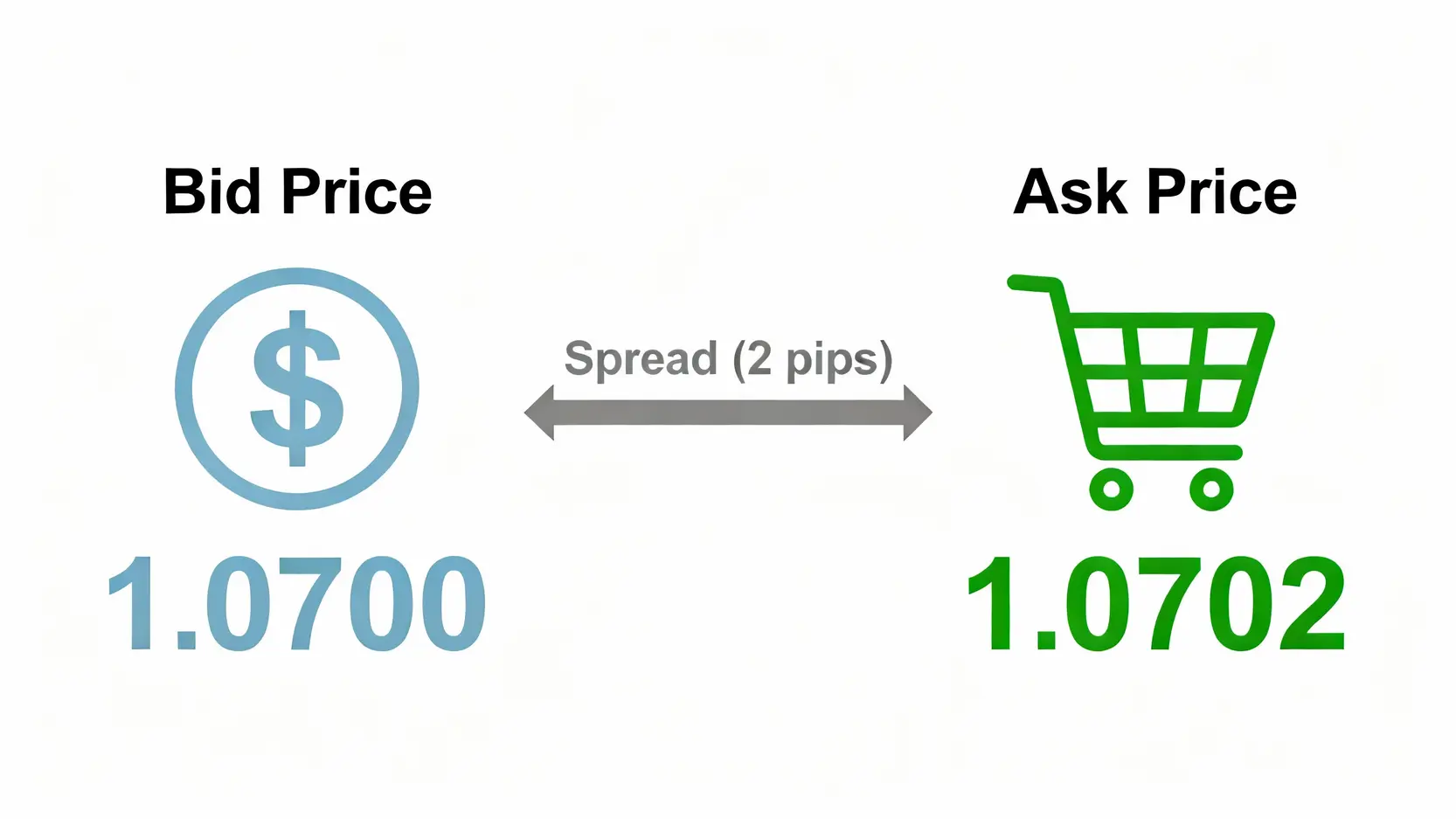
Banks typically offer wider spreads, while professional brokers, in order to remain competitive, provide extremely narrow spreads, directly impacting your trading costs.
Characteristics of Bank Forex Spreads (Using HSBC as an Example)
Traditional banks, such as HSBC, primarily provide forex services to clients with actual currency exchange needs, such as travel, remittances, or international trade. Their forex margin trading services are usually not their core business.
Characteristics of bank spreads:
- Wider spreads: Banks have multiple profit sources, and forex trading is only one component. As a result, they lack strong incentives to offer highly competitive narrow spreads. Their operating costs (including branch networks and a large workforce) are also relatively high, and these costs are passed on through spreads. For major currency pairs (such as EUR/USD), bank spreads may reach dozens of pips, while brokers typically offer spreads of only 1 to 2 pips or even lower.
- Broad client base: Banks mainly serve retail depositors and corporations, providing one-stop financial services. Forex trading is merely an additional service rather than one designed specifically for professional traders.
- Relatively simple tools and platforms: Trading platforms provided by banks are usually basic, lacking advanced features such as professional charting tools and automated trading through Expert Advisors.
Spread Advantages of Professional Forex Brokers
Professional forex brokers operate very differently. Their core business is to provide forex margin trading services. To stand out in a highly competitive market, offering low spreads is one of their primary methods of attracting clients.
Advantages of broker spreads:
- Extremely narrow spreads: Brokers focus exclusively on the forex market and connect to multiple major liquidity providers (often top-tier investment banks) to source the best bid and ask quotes for clients. The intense competitive environment forces them to keep spreads at the lowest possible level, with some platforms offering EUR/USD spreads below 1 pip.
- Designed specifically for traders: Whether it is platform functionality (such as MT4 or MT5), leverage options, trading instruments, or customer service, everything is built around the needs of traders.
- Greater transparency: Many regulated brokers provide different account types, such as ECN accounts, featuring very low spreads with only a fixed commission charged, making trading costs clear and transparent. For a deeper understanding, you can refer to the ultimate guide to forex spread comparison to learn how to select a truly low-cost platform.
Further Reading (Highly Recommended)
【Forex Tutorial 2024】The Ultimate Beginner’s Guide to Investing: Master Forex Trading Skills From 0 to 1!
The Ultimate Guide to Forex Spread Comparison: Slippage and Execution Speed Are the Real Hidden Costs!
【Comparison Table】A Complete Overview of the Advantages and Disadvantages of Banks vs Brokers
| Comparison Item |
Traditional Bank (Such as HSBC) |
Professional Forex Broker |
| Spread (Trading Cost) |
Very Wide (High) |
Very Narrow (Low) |
| Primary Client Base |
Currency Exchange, Remittances, General Depositors |
Professional Forex Margin Traders |
| Trading Platform |
Basic Functionality, Simple Operation |
Professional Functionality (MT4/MT5), Comprehensive Tools |
| Leverage Ratio |
Lower (for example 1:20) |
Flexible, up to 1:500 or Higher |
| Fund Security |
Extremely High, Protected by Reputation |
Depends on the Regulatory Authority, (Strongly Regulated Platforms Should Be Chosen) |
| Convenience |
Very Convenient for Existing Clients |
Online Account Opening, Fast and Convenient |
How to Choose the Most Suitable Trading Platform Based on Your Needs?
After reviewing today’s comparison, the answer is already clear. However, different needs lead to different choices. The key lies in understanding your own investment objectives.
If You Are a Forex Beginner or Have Currency Exchange Needs
If you only occasionally need to exchange foreign currency for travel or remit funds to overseas family members each month, and do not require high trading frequency or professional features, then using your usual bank services may be sufficient. Although bank bid-ask differences are relatively high, they offer convenience and a one-stop solution. There is no need to learn a new trading platform solely for a few currency exchanges per year.
If You Are a Frequent Trader
If your goal is to speculate on forex price fluctuations and become an active trader, then a professional forex broker is your optimal choice. For frequent traders, trading costs are one of the key factors determining success or failure. Choosing a broker that offers extremely low bank forex margin spreads can significantly reduce your trading threshold and enhance your profit potential. Combined with professional charting tools and flexible leverage, you can execute your trading strategies more effectively. For this type of investor, it is recommended to begin with an introduction to forex margin trading to build a solid foundation.
Further Reading (Highly Recommended)
【Forex Tutorial 2024】The Ultimate Beginner’s Guide to Investing: Master Forex Trading Skills From 0 to 1
The Ultimate Guide to Forex Spread Comparison: Slippage and Execution Speed Are the Real Hidden Costs!
Frequently Asked Questions About Bank Forex Spreads (FAQ)
Q: Is the bid-ask difference for bank forex trading fixed?
A: No. Whether with banks or brokers, forex spreads are floating. When market volatility is high (such as during major economic data releases or breaking news), market liquidity may decrease, causing spreads to widen instantly. Overall, however, brokers’ average spread levels are far lower than those of banks.
Q: Why can brokers offer lower spreads than banks?
A: There are several main reasons: 1. Specialized business: Forex trading is a broker’s core business, and their survival depends on offering competitive services. 2. Access to liquidity: Brokers connect with multiple top-tier banks as liquidity providers and aggregate the best available quotes. 3. Operating costs: A broker’s online operating model has far lower costs than banks with physical branch networks. 4. Market competition: The forex broker market is highly competitive, and compressing spreads is a primary way to win clients.
Q: Besides spreads, are there other hidden fees when trading forex?
A: Yes. In addition to spreads, fees you should watch for include overnight interest (Swap/Rollover), commissions (applicable to certain account types such as ECN accounts), deposit and withdrawal fees, and inactive account maintenance fees. A legitimate trading platform will clearly list all fee items.
Q: Will HSBC offer more favorable forex spreads to large-volume trading clients?
A: Possibly. Like most financial institutions, banks may provide more attractive quotes to VIP clients or clients making large-volume trades. Even so, these “discounted” spreads are usually still difficult to match against professional brokers’ standard spreads.
Conclusion
In summary, whether you trade forex through a bank or a broker depends on your trading frequency, capital size, and investment objectives. For small amounts or infrequent spot currency exchange, the convenience of banks still has an advantage. However, if you focus on forex margin trading and pursue lower bank forex margin spreads and higher execution efficiency, professional forex brokers are undoubtedly the more prudent and cost-effective choice. Before making a decision, be sure to carefully compare spreads and other trading conditions across platforms to find the best partner for your forex investment.