Why Hong Kong Stocks Are Under Pressure: 3 Key Factors

Hong Kong Stocks Under Pressure: Who Is Behind It? An Analysis of the Three Major Sources of Pressure on the Hang Seng Index
Hong Kong’s stock market has recently remained subdued, with the Hang Seng Index continuing to trade near its lows, leaving many investors feeling uneasy. Hong Kong stocks are clearly under pressure, while heightened volatility has become the norm. What exactly is driving the weakness in the Hong Kong market? Amid mounting internal and external challenges, how should investors assess the situation and formulate their investment strategies? This article takes an in-depth look at the three core sources of pressure weighing on Hong Kong stocks and explores how investors can navigate today’s volatile market while gaining a more comprehensive understanding of the internal and external factors affecting Hong Kong equities.

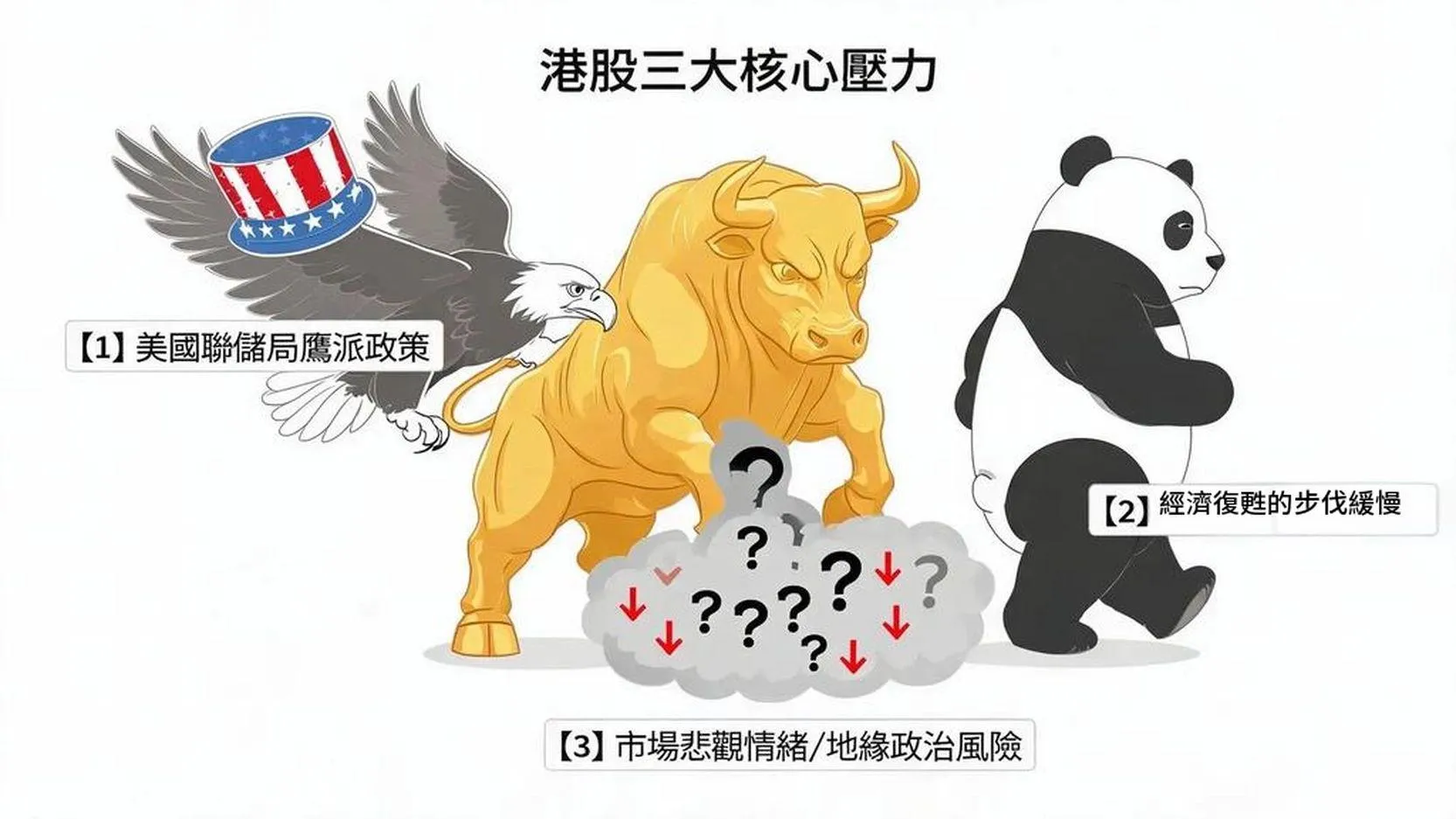
Illustration: The Three Major Pressures Facing the Hong Kong Stock Market
Source of Pressure 1: External Shock, The Federal Reserve’s Hawkish Policy
As an international financial center, Hong Kong is highly sensitive to the US Federal Reserve’s (Fed) monetary policy, which remains one of the key drivers of market liquidity. Since late 2025, the Fed’s increasingly hawkish stance in response to inflationary pressures has continued to weigh on global capital markets, and Hong Kong stocks have naturally been no exception.
Tightening US Dollar Liquidity: Interest Rate Pressure Under the Linked Exchange Rate System
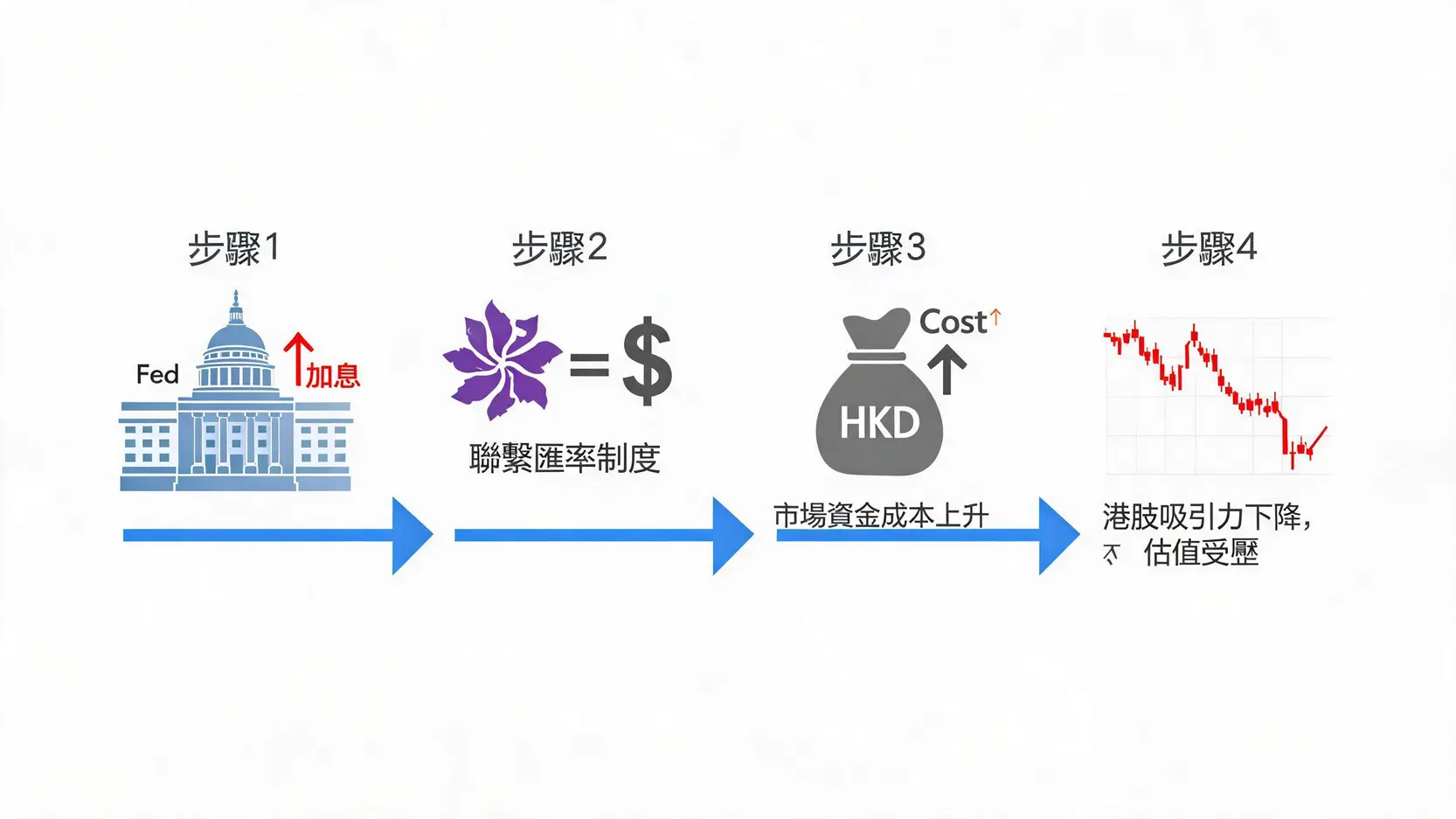
Hong Kong operates under the Linked Exchange Rate System, with the Hong Kong dollar pegged to the US dollar. As a result, when the US enters a rate hiking cycle, the Hong Kong Monetary Authority typically follows with higher interest rates to maintain exchange rate stability. This directly raises funding costs across Hong Kong’s financial markets. For businesses, higher borrowing costs reduce profitability. For the stock market, a higher interest rate environment makes equities less attractive because investors can shift their capital into lower-risk fixed-income assets, such as US dollar time deposits or US Treasury securities, resulting in capital flowing out of equities.

Transmission Mechanism of Federal Reserve Rate Hikes on Hong Kong Stocks
Widening China-US Interest Rate Differential: Rising Risk of Capital Outflows
As US interest rates continue to rise while mainland China maintains a relatively accommodative monetary policy to support economic recovery, the interest rate differential between China and the US has widened significantly. Data shows that yields on 10-year US Treasury securities have surpassed those on 10-year Chinese government bonds. This inverted interest rate differential encourages international hot money to shift from renminbi-denominated assets into US dollar-denominated assets in pursuit of higher returns. As Hong Kong serves as a key gateway for capital entering and leaving mainland China, it naturally faces greater capital outflow pressure, directly weighing on the performance of the Hang Seng Index.
How Higher Risk-Free Interest Rates Suppress Hong Kong Stock Valuations
In finance, US Treasury yields are commonly regarded as the risk-free interest rate and serve as the benchmark for valuing all risk assets. When the risk-free rate rises, the discount rate used to calculate the intrinsic value of equities also increases. Simply put, even if a company’s future earnings outlook remains unchanged, a higher discount rate alone reduces its present valuation. This has an especially significant impact on growth and technology stocks, which represent a substantial portion of the Hong Kong market. This also explains why even minor shifts in the Federal Reserve’s policy stance tend to hit Hong Kong’s technology sector particularly hard.
Further Reading (Highly Recommended)
Source of Pressure 2: Internal Challenges, The Pace of Economic Recovery
Beyond external monetary policy pressure, domestic factors affecting Hong Kong stocks are equally important. Most companies listed in Hong Kong are closely tied to mainland China’s economy, making the mainland’s economic fundamentals the key determinant of the Hong Kong market’s “underlying strength”.
Macroeconomic Data Performance and Market Expectations
The market closely watches mainland China’s key macroeconomic indicators, including GDP growth, the Purchasing Managers’ Index (PMI), total retail sales of consumer goods, and import and export data. According to the latest figures released by the National Bureau of Statistics, although the economy continues to recover overall, the growth rate of certain indicators has fallen slightly short of the market’s earlier optimistic expectations, suggesting that the recovery remains uneven. This “weak recovery” environment has led investors to adopt a more cautious outlook on future corporate earnings growth, limiting the rebound potential of Hong Kong stocks.
The Recovery of Key Sectors (Such as Real Estate and Consumer Spending)
Real estate and consumer spending are two major drivers of mainland China’s economy and also represent important sectors within the Hong Kong stock market. In recent years, ongoing challenges facing mainland property developers have continued to weigh on market confidence. Although policymakers have repeatedly introduced supportive measures, a fundamental recovery across the industry will take time, dragging down the performance of related sectors. At the same time, the pace of the recovery in consumer spending remains a key focus. If consumer spending continues to lack strong momentum, the earnings outlook for sectors such as retail, dining, and tourism will be directly affected, placing further pressure on the broader Hong Kong market.
Corporate Earnings Outlook
Ultimately, the stock market reflects the economy, and corporate earnings remain the foundation of share prices. Against the backdrop of a slower macroeconomic recovery and uncertainty surrounding external demand, market expectations for the earnings of Hong Kong-listed companies in fiscal year 2026 have become increasingly cautious. Many companies have adopted conservative guidance in their earnings reports, further weakening investor confidence. Only when earnings expectations begin to see broad-based upward revisions is the Hong Kong market likely to experience a sustained recovery.
Source of Pressure 3: Market Sentiment and Geopolitics
Beyond economic fundamentals, investor sentiment and geopolitical risks have become important drivers of heightened volatility in Hong Kong stocks. At times, market declines are driven less by economic data than by the spread of fear and uncertainty.
Fragile Investor Confidence
After an extended market downturn, investor confidence has become particularly fragile. Any new development, whether regulatory speculation or concerns over the economic outlook, can quickly trigger another wave of selling. In an environment where confidence is weak, investors tend to move in and out of the market rapidly, making it difficult for sustained buying interest to develop. This sentiment-driven market behavior makes the Hang Seng Index more vulnerable to sharp swings.
The Impact of Geopolitical Risks on Market Sentiment
As an international financial market, Hong Kong is highly sensitive to changes in global geopolitical conditions. Rising tensions between China and the US, regional conflicts, and other geopolitical developments are all viewed as sources of uncertainty that increase the market’s risk premium. When geopolitical risks intensify, international investors may reduce their exposure to Hong Kong equities as part of their global asset allocation decisions, placing additional pressure on the market.
Differentiating Insight: Hong Kong Market Outlook From a Technical Analysis Perspective
Beyond macroeconomic fundamentals, technical analysis can also provide valuable insight into the outlook for Hong Kong stocks. Price charts do not lie. They reflect the collective behavior and psychology of market participants.
Key Support and Resistance Levels for the Hang Seng Index
From a weekly chart perspective, the Hang Seng Index has established temporary support around the 16,000 level. This area represents a previous zone of heavy trading activity and carries both psychological and technical significance. Should this support fail, the index could decline further toward the major psychological level of 15,000. On the upside, resistance lies between 18,000 and 18,500, where several moving averages converge and previous rally highs are located. A convincing breakout above this range would likely require either significant positive news or a strong increase in trading volume. Investors can use these key levels as reference points when assessing market strength.
Interpreting Trading Volume and Market Momentum Indicators
Trading volume represents the market’s “vitality”. One notable characteristic of the Hong Kong market recently has been “declining prices on lower trading volume” and “weak rebounds” accompanied by limited buying interest. This indicates that while selling pressure remains significant during declines, buying support is insufficient. Likewise, rebounds have lacked sustained follow-through from buyers, reflecting cautious market participation. Momentum indicators such as the Relative Strength Index (RSI) have also remained below the neutral 50 level, signaling a persistently weak market. Only when trading volume expands consistently and the index successfully breaks above key resistance levels can the market be considered to have regained strength.
Three Investment Strategies to Consider Amid Increased Volatility in Hong Kong Stocks
With Hong Kong stocks facing pressure while challenges and opportunities coexist, maintaining a calm mindset and a clear investment strategy is essential. The following three approaches may help investors navigate volatile market conditions more effectively.

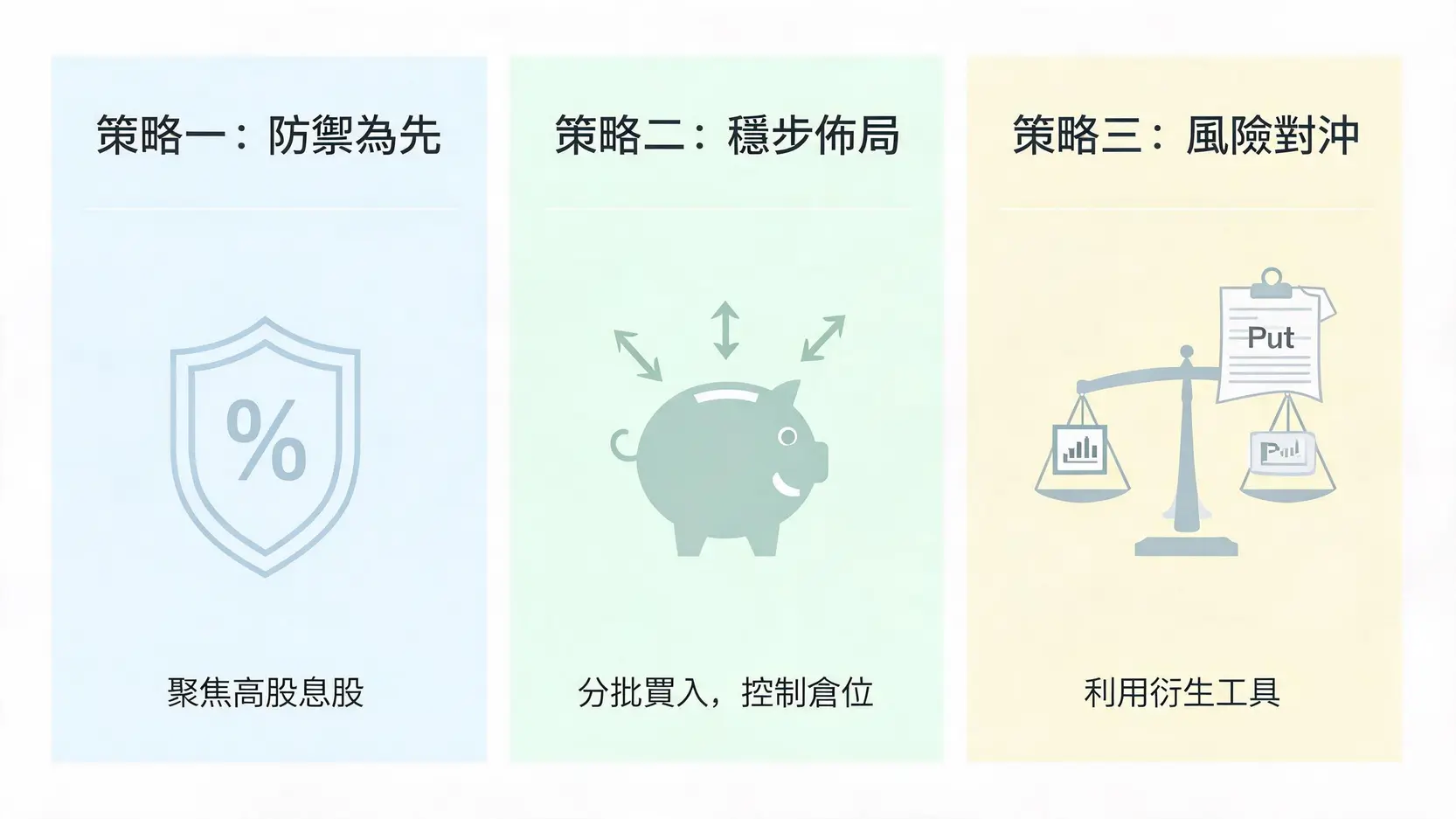
Three Investment Strategies for Volatile Markets
Strategy 1: Focus on High-Dividend and Defensive Sectors
When the market outlook is uncertain, capital naturally seeks safer investments. Companies with stable cash flows and consistent dividend payment records become preferred choices for defensive investors. These businesses (including telecommunications companies, utilities, and certain state-owned banks) not only provide relatively stable dividend income but also tend to experience less share price volatility than the broader market. During bear markets, they generally demonstrate greater resilience. Learning more about dividend reinvestment strategies can also help you accumulate more high-quality assets during market downturns.
Strategy 2: Build Positions Gradually and Manage Position Size
Accurately identifying the market bottom is extremely difficult. Rather than investing all your capital at once, it is generally more prudent to adopt a phased buying strategy. For example, you may establish a price range and invest incrementally whenever the share price declines by a predetermined amount (such as 5% or 10%). This approach helps reduce the average purchase cost while managing risk more effectively, limiting the impact of irrational market declines. At the same time, maintaining an appropriate cash allocation provides both the flexibility to capitalize on exceptional market opportunities and the confidence to remain composed during periods of heightened volatility.
For beginner investors, learning the fundamentals of stock investing and risk management remains the foundation for successfully navigating volatile markets.
Strategy 3: Use Derivatives to Hedge Risk
Investors with sufficient experience may consider using financial derivatives to hedge portfolio risk. For example, if you hold a portfolio of blue-chip stocks but expect the broader market to decline further, you may consider purchasing Hang Seng Index put options or shorting Hang Seng Index futures. If the market falls, profits generated by these derivatives can partially or fully offset losses in your equity portfolio, effectively serving as portfolio insurance. However, it is important to emphasize that derivatives are complex instruments involving substantial risk. Investors should fully understand how these products work before using them.
Further Reading (Highly Recommended)
Frequently Asked Questions About the Hong Kong Stock Market
Q: Is Now a Good Time to Buy the Dip in Hong Kong Stocks?
A: This ultimately depends on your investment perspective. From a valuation standpoint, Hong Kong stocks are trading at historically low levels based on both price-to-earnings (P/E) and price-to-book (P/B) ratios, suggesting attractive long-term investment value. However, the challenge with buying the dip is that market bottoms are typically a range rather than a single point, while the key headwinds weighing on the market (such as Federal Reserve policy and the pace of economic recovery) have yet to fully dissipate. Rather than attempting to identify the exact bottom, it may be more prudent to build positions gradually while maintaining disciplined position sizing to manage the risk of further market volatility.
Q: What Is the Most Important Factor Affecting Hong Kong Stocks?
A: Many factors influence Hong Kong stocks, but they can essentially be distilled into two core drivers: first, global liquidity, which is primarily determined by the US Federal Reserve’s monetary policy; and second, the economic fundamentals of Mainland China. The former determines the market’s “water” (capital), while the latter determines the listed companies’ “boats” (earnings). Only when the “water rises” and the “boats rise with it” can Hong Kong stocks enter a healthy and sustainable bull market. At present, both of these core factors remain headwinds for the Hong Kong stock market.
Q: How Does the Renminbi Exchange Rate Affect Hong Kong Stocks?
A: The renminbi exchange rate affects Hong Kong stocks mainly through two channels. First, sentiment transmission. If the renminbi continues to depreciate, the market may interpret it as a signal of a weakening Mainland economy or capital outflows, undermining investor confidence in Chinese assets and weighing on Hong Kong stocks. Second, corporate earnings. For companies listed in Hong Kong whose primary operations and revenue are denominated in renminbi (such as most Chinese mainland companies), a weaker renminbi can result in foreign exchange losses when profits are translated into Hong Kong dollars for financial reporting, directly reducing reported earnings.
Q: What Should Retail Investors Pay the Most Attention to During Volatile Markets?
A: During periods of heightened market volatility, retail investors should focus primarily on “risk management” and “emotional discipline”. First, avoid using excessive leverage, as sharp short-term price movements could trigger forced liquidation. Second, do not allow market fear to dictate your decisions by chasing rallies or panic selling. Establish a disciplined investment process, define stop-loss levels in advance, and follow them consistently. Finally, continue learning and develop a thorough understanding of the companies you invest in. Value investing remains one of the most effective approaches for navigating both bull and bear markets.
Conclusion
In summary, the current pressure on Hong Kong stocks is the result of multiple factors working together, including tighter external monetary policy, a slower-than-expected recovery in domestic economic fundamentals, and fragile market sentiment, all of which have contributed to increased market volatility. At this stage, investors should remain patient and cautious while developing a deeper understanding of the market’s key underlying challenges. Rather than becoming distracted by short-term fluctuations, it is more prudent to return to the fundamentals of investing by adopting a disciplined defensive strategy, such as focusing on high-quality dividend-paying stocks, maintaining disciplined position sizing, and building positions gradually. This approach can help investors navigate volatile markets more confidently while waiting for conditions to improve.
Related Articles
-
Global Asset Repricing: Why Has Japan’s Property Market Become a Safe Haven for Smart Money Amid Yen Depreciation? What Is “Global Asset Repricing”? Why Has Japan Become the Main Focus? While investment forums around the world are heatedly discussing yen depreciation pressure, the real smart money has already begun positioning...2026 年 6 月 23 日
-
Farewell to Negative Interest Rates! The Truth Behind Japan Meeting Its Inflation Target: Why Has Yen Depreciation Pressure Increased Instead of Easing? The Japanese economy is staging an extremely contradictory drama: after waiting for thirty years, it has finally welcomed the long-awaited Japan inflation, yet the market’s response has been...2026 年 6 月 23 日
-
A Complete Analysis of Central Bank Policy Shifts: From YCC to QT, Decoding the BOJ and the Fed’s Next Move The Bank of Japan (BOJ) and the US Federal Reserve (Fed), two giants of the global financial markets, are seeing their diverging monetary policy directions become the core force driving...2026 年 6 月 23 日