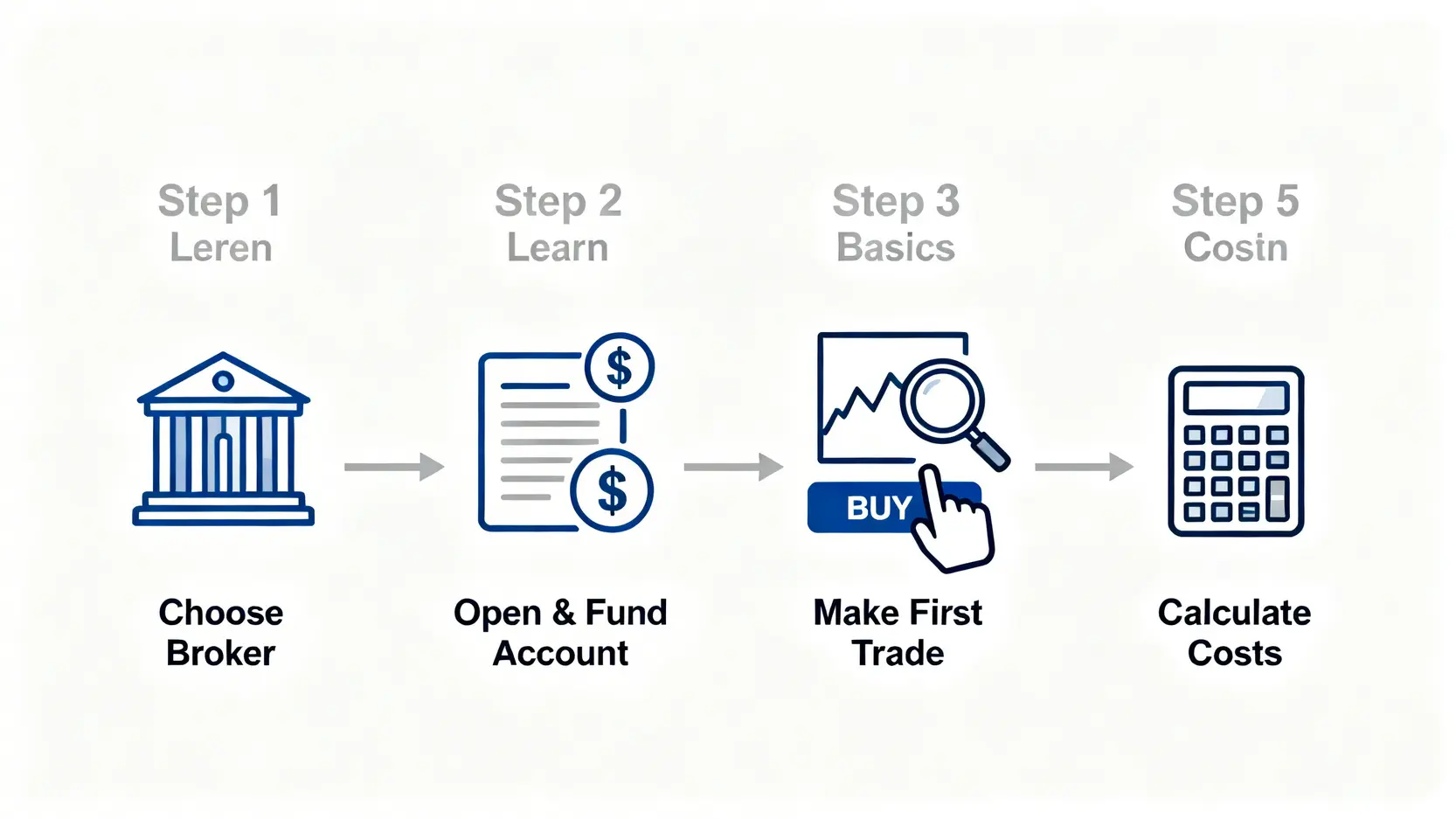
Five Steps for Beginners: Follow the process and easily complete your first stock trade.
Further Reading (Highly Recommended)
Hong Kong Stock Short Selling Guide: How to Borrow Shares to Short Hong Kong Stocks? 5 Step Tutorial, Risks, and Broker Guide
Selected 200+ Essential “Stock English” and “Stock Market Terminology in English”: A Must Have Guide for Investors
Step 1: Choose the Hong Kong Stock Account That Suits You Best (Includes 2026 Brokerage Comparison)
A good trading partner can make your investment journey far more efficient. When choosing a securities account, do not look only at “commission free” offers. Platform stability, functionality, trading speed, and customer service are equally important. The current market mainly consists of two categories: new internet brokers and traditional banks. Each has its own advantages and disadvantages. A detailed Hong Kong stock account recommendation comparison will be provided later.
Step 2: Prepare Documents, Complete Account Opening, and Deposit Funds
Most brokerage firms now support online account opening, making the process very fast and convenient. Generally, the following documents are required:
- Identity document: Hong Kong Permanent Identity Card.
- Proof of address: Bank statement, utility bill, or similar document issued within the past three months.
After completing identity verification and filling in the required information, you can deposit funds. The most convenient and fastest method is through the “Faster Payment System” (FPS), which is almost instantly credited, ensuring that you do not miss any investment opportunities.
Step 3: Learn Basic Market Monitoring Skills and Order Instructions
After logging into the trading platform, you will see numerous numbers and charts. Do not panic. Beginners only need to understand a few core concepts:
- Bid/Ask: The “Bid” is the highest price buyers in the market are willing to pay, while the “Ask” is the lowest price sellers are willing to accept.
- Volume: Displays the number of shares traded within a specific period and is an important indicator of market activity.
- Order instructions:
- Market Order: Executes immediately at the best available market price. The advantage is speed, but the disadvantage is that the execution price may be uncertain and could deviate from expectations.
- Limit Order: Specifies the highest price you are willing to pay when buying or the lowest price you are willing to accept when selling. The order will only execute when the market reaches or improves upon your specified price. This allows better control over costs.
Step 4: Execute Your First Hong Kong Stock Trade
Everything is ready, and you can now make your first trade! Suppose you want to buy Tencent Holdings (0700.HK):
- Search for the stock code “0700” or the name “Tencent” in the trading app.
- Enter the trading page and select “Buy”.
- Enter the price you want to buy at (if using a limit order) and the quantity (Note that Hong Kong stocks are traded in “lots”, and one lot of Tencent is 100 shares).
- Confirm the order details and submit the trading instruction.
- After the transaction is successfully completed, you officially become a shareholder of Tencent!
Step 5: How to Calculate Trading Costs and Actual Returns
Stock trading is not cost free. Understanding the various fees allows you to calculate your real returns accurately. The main costs of trading Hong Kong stocks include:
- Brokerage commission: The service fee charged by the brokerage firm. Internet brokers are usually lower and may even offer commission free promotions.
- Platform fee: Some brokers charge per trade or monthly to maintain the trading system.
- Government and exchange charges:
- Stamp Duty: Charged by the government at 0.1% of the transaction amount.
- Trading Levy: Charged by the Securities and Futures Commission (SFC) at 0.0027% of the transaction amount.
- Trading Fee: Charged by the Hong Kong Exchanges and Clearing (HKEX) at 0.00565% of the transaction amount.
To learn the most authoritative and up to date fee standards, you can refer to the official Hong Kong Exchanges and Clearing securities trading fee page.
2026 Hong Kong Stock Account Recommendations and Commission Comparison
Choosing a Hong Kong stock account that is low cost, feature rich, and secure is a key step in stock investment for beginners. The following section analyzes several core dimensions and compares popular options in the market.
Comparison Dimensions: Commission, Platform Fees, Welcome Offers, and Security
- Commission and platform fees: Directly affect your trading costs, especially for investors who trade frequently.
- Welcome offers: Including commission free trading, cash vouchers, stock rewards, and other benefits that provide additional starting capital for beginners.
- Functionality and experience: Whether the app is smooth and user friendly, the speed of market quotes, and whether chart analysis tools are comprehensive.
- Security: Whether the broker is regulated by the Securities and Futures Commission (SFC) in Hong Kong and whether it provides sufficient investor protection.
Analysis of Popular Brokerage Accounts (For example: Futu, Huasheng, Tiger)
In recent years, internet brokers represented by Futu Securities, Huasheng Securities, and Tiger Brokers have risen rapidly. With highly competitive pricing and powerful app features, they have become the preferred choice for many investors.
| Broker |
Hong Kong Stock Commission |
Platform Fee |
Key Features |
| Futu Securities (Futu) |
Usually offers “lifetime commission free” or limited time commission free promotions |
HK$15/order |
Comprehensive features, active investor community “Niuniu Circle”, provides in depth market data |
| Valuable Capital Securities (Valuable Capital) |
Offers competitive commission free plans |
HK$15/order |
Simple interface, provides intelligent investment advisory services, suitable for beginners |
| Tiger Brokers |
Focuses on low commissions and commission free promotions |
HK$15/order |
Powerful US stock trading features, provides 24 hour global financial news |
*Note: The above fees and promotions are for reference only. For the latest information, please refer to the official announcements of each brokerage.
Traditional Bank Account Analysis (For example: HSBC, BOCHK, Hang Seng)
Traditional banks such as HSBC, Bank of China (Hong Kong) (BOCHK), and Hang Seng Bank (Hang Seng) also provide securities trading services. Their greatest advantage is strong credibility, and it is convenient for existing banking customers to integrate their accounts, while fund transfers are also more direct.
However, the securities trading commissions and platform fees of traditional banks are generally higher than those of internet brokers, and the functions and user experience of their trading systems are relatively traditional. For investors who pursue low costs and efficient trading, internet brokers may be a better choice.
FAQ: Common Questions for Beginner Stock Trading
Q: How much money is needed at minimum to buy stocks?
A: The minimum investment required depends on how much one “lot” of the stock you want to buy costs. Hong Kong stocks are traded in “lots”, and each stock has a different lot size (such as 100 shares, 500 shares, or 1,000 shares). For example, if a stock is currently priced at HK$10 and one lot is 1,000 shares, buying one lot would require HK$10 x 1,000 = HK$10,000 (excluding transaction fees). There are also stocks in the market where one lot costs only a few hundred Hong Kong dollars.
Q: What fees are involved when trading Hong Kong stocks?
A: The main fees include the “commission” and “platform fee” charged by the brokerage, as well as the “Stamp Duty” (0.1%), “Trading Levy” (0.0027%), and “Trading Fee” (0.00565%) charged by the government and the exchange. Even if a brokerage offers commission free trading, the latter three fees still need to be paid.
Q: What is a monthly stock investment plan? Is it suitable for beginners?
A: A monthly stock investment plan is a fixed schedule investment method where investors set a specific date each month and use a fixed amount of money to buy a designated stock. This method is similar to “dollar cost averaging”, which helps smooth out short term market fluctuations without needing to time market entry. It is very suitable for beginners with limited capital who want to invest steadily over the long term and is a good way to develop saving and investing habits.
Q: Are stock accounts safe?
A: As long as you choose a licensed brokerage regulated by the Securities and Futures Commission (SFC) in Hong Kong, your asset safety is protected. According to regulations, brokerages must keep clients’ securities and funds in separate trust accounts that are completely segregated from company assets. In addition, Hong Kong has an “Investor Compensation Fund”. If a licensed brokerage becomes insolvent due to default, eligible investors can receive compensation of up to HK$500,000.
Conclusion
In summary, stock investment is an effective way to grow wealth, but it is not effortless gambling. As long as you clearly understand the two core principles of “how to make money from stocks”, strictly follow the five steps in the beginner stock trading guide, and take time to compare and choose a low cost Hong Kong stock account with good service, even beginners can steadily begin their stock investment journey. The market is full of opportunities. Take action now and add momentum to your financial future.