HK Stock Short Selling Guide: 5 Steps & Brokers

Updated: 2026/03/03  |  CashbackIsland

【港股沽空教學】如何借貨沽空港股?5步教學、風險及券商全攻略

【Hong Kong Stock Short Selling Tutorial】How to Borrow Shares to Short Sell Hong Kong Stocks? A 5-Step Guide, Risks, and Complete Broker Overview

When the stock market outlook is uncertain or you expect a particular stock to decline, have you considered taking the opposite position to generate profit instead of merely selling your holdings to lock in gains? “Hong Kong stock short selling” is precisely such a strategy. However, many beginner investors hesitate upon hearing “borrow-and-short selling tutorial“, as the process appears complex and carries higher risk. This article provides a comprehensive practical guide, explaining in detail how to short sell Hong Kong stocks, from fundamental concepts and operational steps to risk management and broker selection, enabling you to fully understand this advanced investment strategy and identify profit opportunities even in a declining market. 


What Is Hong Kong Stock Short Selling? Understand the Basic Principles in One Article

Hong Kong stock short selling, also known as selling short or going short, is an investment strategy adopted when an investor expects a stock price to decline. Unlike the traditional approach of “buy first, sell later”, the core operation of short selling is “sell first, buy later“, profiting from the price difference as the stock declines.


The Basic Principle of Short Selling: Sell High First, Buy Low Later to Earn the Price Difference

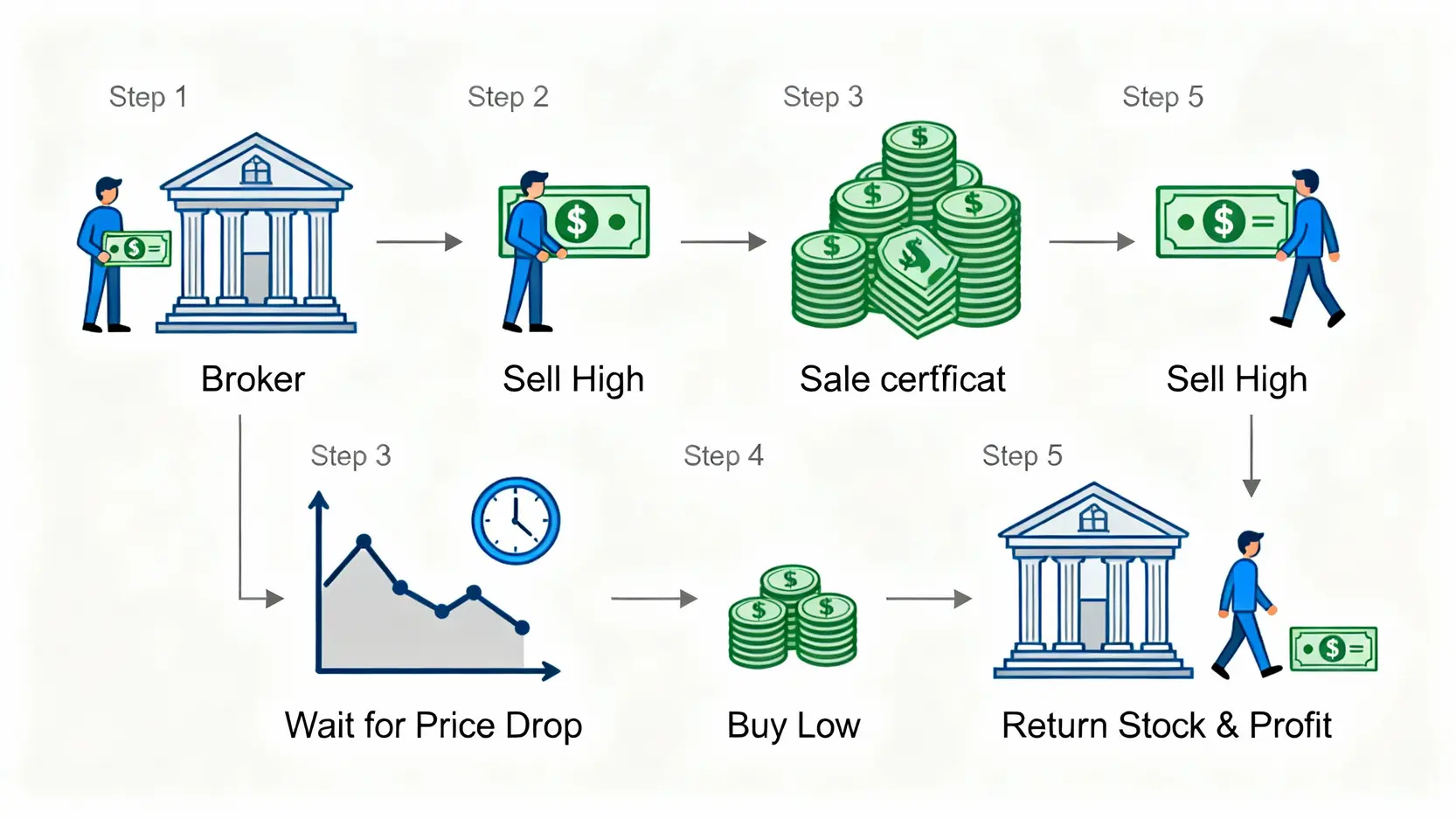
The logic of short selling is straightforward. Suppose you expect Company A’s share price to fall from its current level of HKD 100. You would proceed as follows:

  1. Borrow shares: You do not own shares of Company A, so you first borrow 1,000 shares from a brokerage firm.
  2. Sell at a high price: You immediately sell the 1,000 shares in the market at HKD 100 per share, receiving HKD 100,000 in cash.
  3. Wait for the price to decline: As expected, Company A’s share price falls to HKD 80.
  4. Buy back at a lower price: You then repurchase 1,000 shares at HKD 80 per share, for a total cost of HKD 80,000.
  5. Return the shares and realize profit: You return the 1,000 shares to the brokerage firm, completing the transaction. Your profit is the proceeds from the sale minus the repurchase cost (HKD 100,000 minus HKD 80,000 equals HKD 20,000) after deducting borrowing interest and transaction fees.

港股沽空流程圖,展示了從券商借入股票、高價賣出、等待股價下跌、低價買回、到最後歸還股票並賺取差價的五個步驟。

Illustration of Short Selling Profit Mechanism: Borrow Shares, Sell High, Then Buy Back at a Lower Price to Return Them and Capture the Price Difference.

This process of “sell high first, buy low later” is the core of short selling profit generation.


Why Must You “Borrow Shares” First? Regulatory Requirements for Short Selling in Hong Kong

In Hong Kong, all lawful short selling transactions must follow the principle of “borrow before selling“. This means that before placing a sell order, the investor must sign a “Securities Borrowing and Lending Agreement” with the broker and confirm that a sufficient number of shares have been successfully borrowed. Selling shares in the market without having borrowed them in advance is known as “naked short selling”, which is illegal in Hong Kong.

The Securities and Futures Commission imposes strict regulations to maintain market order and prevent systemic risks arising from settlement failures. Therefore, ensuring compliance with the required procedures is a crucial step before conducting any Hong Kong stock short selling transaction. For more details on relevant regulations, refer to the official information provided by the Securities and Futures Commission

How to Short Sell Hong Kong Stocks? Five Core Steps of Borrow-and-Short Selling

After understanding the fundamental principles, the actual operation is not as daunting as it may seem. The following is a complete borrow-and-short selling tutorial, covering the five core steps from account opening to closing the position.


Step 1: Choose and Open a Brokerage Account That Supports Short Selling

Not all brokerage accounts support short selling. You must open a “margin account“, commonly known as a “margin trading account”. This type of account allows investors to borrow funds or securities from the broker and is the foundation for conducting short selling transactions. When selecting a broker, priority should be given to reputable and well-established platforms that provide Hong Kong stock short selling services.


Step 2: Sign the “Securities Borrowing and Lending Agreement” and Understand the Cost Structure

After opening a margin account, you must separately sign a “Securities Borrowing and Lending Agreement” (SBLA). This document outlines in detail the rights and obligations of both parties, including borrowing interest rates, margin requirements, and the broker’s handling procedures under specific circumstances (such as trading suspension or forced recall of shares). Before signing, it is essential to read the agreement carefully and fully understand all associated costs of short selling, which mainly include:

  • Borrowing interest: Calculated based on the market value of the borrowed shares and the number of borrowing days, this is the primary cost of short selling.
  • Trading commissions and related charges: Similar to ordinary stock transactions, including brokerage commission, stamp duty, trading fees, and other applicable charges.


Step 3: Check the Designated Short Selling List and Borrowing Rates

Not all Hong Kong stocks are eligible for short selling. The Hong Kong Exchanges and Clearing (HKEX) regularly publishes a list of “Designated Securities Eligible for Short Selling”. Typically, only stocks with larger market capitalization and higher liquidity are included. You can check the latest list directly through your broker’s trading platform or on the HKEX website. At the same time, the availability and borrowing rates vary by stock. Popular short selling targets (meaning stocks with high demand for borrowing) often carry higher borrowing costs and may even become unavailable for borrowing.


Step 4: Execute the Short Selling Order (Place the Order)

After completing the above preparations, you may execute the short selling transaction. In the trading system, select the stock you wish to short, enter the price and quantity. The most critical step is to ensure that the order type is correctly selected as “sell” or “short sell“, and that the system properly recognizes it as a short selling order (which is usually indicated by a specific marker). Once successfully executed, your position will appear as a negative share quantity (for example -1,000 shares), indicating that you hold a short position in that stock.


Step 5: Buy Back the Shares to Close the Position (Return the Shares)

When the stock price declines to your target level, or when you determine that the trend is about to reverse, you should “close the position”. Closing a short position involves “buying” back the same number of shares. Once the purchase order is successfully executed, the broker’s system will automatically use the repurchased shares to return the previously borrowed shares, completing the entire short selling process. Your final profit or loss will be settled after the position is closed. 

Further Reading (Highly Recommended)

2026 Complete Guide to US Stock CFD Trading: Platform Comparison, Pros and Cons, and Beginner Tutorial!

Is Averaging Down a Lifesaver? 2025 Latest Guide: Averaging Calculator and Full Analysis of Pros and Cons 

Major Risks and Key Considerations of Hong Kong Stock Short Selling

Although Hong Kong stock short selling can serve as a potential profit tool, its risks are significantly higher than traditional stock trading. Before engaging in actual transactions, you must fully understand and assess the following three major risks.


Risk 1: Theoretically Unlimited Losses (Share Prices Can Rise Without Limit)

This is the most critical risk of short selling. When you buy a stock, the maximum loss occurs if the price falls to zero, meaning you lose your entire principal. However, when you short sell a stock, its price can theoretically rise without limit. If the share price rises instead of falling, your losses will continue to expand, with no upper bound. For example, if you short sell at $10 and the price rises to $50, your loss is $40 per share; if it rises to $100, your loss becomes $90 per share, with no ceiling.

做多與做空風險對比圖。左側顯示買入股票,最大虧損為本金,而盈利潛力無限。右側顯示沽空股票,最大盈利為股價跌至零,但虧損潛力理論上是無限的。

Risk Comparison: Buying Stocks Has Limited Loss Potential, Short Selling Stocks Has Unlimited Loss Potential.


Risk 2: “Short Squeeze” Risk

When a heavily shorted stock suddenly surges due to positive news or other catalysts, a “short squeeze” may occur. Short sellers rush to buy back shares to cut losses, and this wave of forced buying further drives the price upward, creating a vicious cycle. As a result, short sellers may suffer substantial losses within a short period of time. The GameStop (GME) incident in early 2021 in the US market remains one of the most classic examples of a short squeeze.


Risk 3: Borrowing Costs, Interest, and Dividend Payments

Short selling is not cost free. You must pay interest on the borrowed shares, and if the holding period is extended, interest expenses will gradually erode your potential profit. In addition, if the company declares dividends during the borrowing period, under the agreement, the short seller must compensate the lender by paying an amount equivalent to the “dividend”. This substitute dividend payment is an often overlooked but meaningful cost.


Comparison and Selection of Popular Hong Kong Short Selling Brokers

Choosing a suitable short selling platform is crucial to successfully executing your strategy. As brokerage services and fee structures vary, investors should evaluate and compare platforms based on the following key factors before making a decision.


Broker A: Feature and Fee Analysis

When comparing brokers, the primary focus should be the stock borrowing interest rate. Different brokers, and even different stocks within the same broker, may have significant differences in borrowing costs. Secondly, trading platform stability and functionality are essential. A professional trading platform should provide clear short selling indicators, real-time margin level monitoring, and efficient trade execution. Lastly, the quality of customer service is equally important. During periods of high market volatility, the ability to promptly contact support and resolve issues can be critical. 

Broker B: Shortable Stock Pool and Borrowing Rate Comparison

Large brokerage firms typically offer a broader pool of shortable stocks, providing investors with more options. Some smaller or discount brokers may charge lower commissions, but the number of stocks available for short selling could be very limited, or the borrowing rates for popular stocks may be extremely high. It is advisable to consult the broker in advance regarding the detailed list of shortable securities and the approximate range of borrowing rates before opening an account.


How to Choose the Right Short Selling Platform

In summary, selecting a short selling platform should involve a comprehensive evaluation of the following factors:

  • Interest rates and fees: Look for brokers with competitive borrowing rates and commissions.
  • Availability of shortable stocks: Ensure the broker offers a sufficient selection, especially for the stocks you are interested in.
  • Platform stability: Fast execution speed and system reliability are crucial to avoid disruptions at critical moments.
  • Fund security: Choose a licensed broker regulated by the Securities and Futures Commission in Hong Kong with a strong reputation.

Before making a decision, consider reviewing professional brokerage account comparison analyses to understand the strengths and weaknesses of different platforms, allowing you to select the one that best aligns with your trading needs. 

Hong Kong Stock Short Selling Frequently Asked Questions (FAQ)

Q: Must I borrow shares before short selling? What is “naked short selling”?

A: Yes. In Hong Kong, all lawful short selling transactions must follow the principle of “borrow before selling”. You must first successfully borrow the shares from your broker before selling them in the market. “Naked short selling”, which refers to selling shares without having borrowed them beforehand, is strictly prohibited under Hong Kong law and may result in severe penalties.

Q: How is short selling interest calculated?

A: Short selling interest is typically calculated on a daily basis. The formula is: Daily interest = (Number of borrowed shares × Closing price of the day) × Annualized interest rate / 365 days.The annualized rate is determined by the broker based on market supply and demand for that stock. Stocks with higher borrowing demand generally carry higher interest rates. Please refer to your broker for the specific applicable rate.

Q: Can all Hong Kong stocks be short sold? How can I check the latest list?

A: No. Only stocks included in the Hong Kong Exchanges and Clearing “Designated Securities Eligible for Short Selling” list can be short sold. This list is updated periodically. Investors may check the latest list via the official HKEX website or directly within the trading applications of major brokerage firms.

Q: What should I do if the stock price rises instead of falls after I short sell?

A: If the stock price rises after you initiate a short position, your account will show a floating loss. You should immediately reassess the situation and set a clear “stop loss level”. Once the price reaches your stop loss threshold, you should decisively buy back the shares to close the position and limit further losses. Holding onto a losing short position may result in a margin call or even forced liquidation, potentially leading to greater financial damage.


Conclusion

In summary, Hong Kong stock short selling is a high risk, high potential return investment tool that functions as a double edged sword. Its core lies in accurately anticipating price declines and strictly adhering to the “borrow before selling” rule. It is not suitable for all investors, especially those with low risk tolerance or limited experience. Before attempting any borrow-and-short selling operation, you must thoroughly understand its mechanics, potential risks (particularly the possibility of unlimited losses) and implement disciplined capital management and stop loss strategies. This comprehensive Hong Kong short selling guide aims to provide a clear and practical reference to strengthen your investment strategy toolkit.

If you liked this article, please share it!

Related Articles

  • Volatility Surface Guide: Skew Trading Strategies
    Practical Applications of Volatility Surfaces: From Options Modeling to Advanced Skew Trading Strategies In options markets, implied volatility is never a flat line. Instead, it forms complex "smile" or "skew" surfaces. For advanced traders, mastering the practical applications of volatility surfaces is equivalent to possessing a lens that reveals market...
    2026 年 6 月 3 日
  • Foreign Capital Flow Model: Track Institutional Money
    Building a Foreign Capital Flow Copy Trading Model: A Stock Market Indicator for Accurately Tracking Institutional Positioning In Asia-Pacific stock markets, foreign capital inflows and outflows often determine the direction of the index. However, simply looking at daily net buy and sell data is no longer enough. Only by building...
    2026 年 6 月 3 日
  • Options Buying Strategies for Extreme Market Risks
    Options Buyer Strategies During Extreme Market Conditions: Black Swan Hedging and Cross-Market Arbitrage During Volatility Surges The most terrifying aspect of financial markets is not a gradual decline, but overnight flash crashes and cross-market capital withdrawals accompanied by volatility surges. In the highly unpredictable global macroeconomic environment of 2026, geopolitical...
    2026 年 6 月 3 日
返回顶部