CAD & Oil Prices: 3 Investment Strategies Guide

Updated: 2026/04/24  |  CashbackIsland

cad-oil-price-relationship-strategy

Full Analysis of the CAD–Oil Price Relationship: Understanding Crude Oil Prices and Mastering 3 Investment Strategies for the Canadian Dollar

Want to invest in the Canadian dollar but constantly confused by fluctuations in international crude oil prices? When oil prices rise, are you unsure whether it is the right time to buy CAD? You are not the only investor facing this confusion. There is a close and inseparable relationship between the Canadian dollar and oil prices. A deep understanding of the CAD and oil price relationship is the first key step in building a successful CAD investment strategy. When crude oil price movements impact the Canadian dollar, understanding the underlying patterns allows you to identify opportunities earlier than others. This article will provide a complete breakdown of their correlation, explain the specific channels through which oil prices affect CAD, and present three practical investment strategies to help you navigate the foreign exchange market more clearly. 


Why Are the Canadian Dollar and Oil Prices So Closely Linked? The Truth Behind Commodity Currencies

The close relationship between the Canadian dollar (CAD) and oil prices is fundamentally rooted in Canada’s economic structure. Canada is not only a developed economy but also a resource-rich country, which gives the Canadian dollar its unique “commodity currency” characteristic.


Canada’s Economic Backbone: A Major Global Oil Exporter

Canada is one of the world’s leading oil producers and exporters, with some of the largest proven oil reserves globally, particularly in Alberta’s oil sands. This means:

  • Export income: Crude oil exports are one of Canada’s most important sources of foreign exchange revenue. When international oil prices rise, Canada’s total export value increases significantly, bringing in substantial foreign currency inflows.
  • Economic engine: The energy sector is a key pillar of the Canadian economy, contributing significantly to GDP, creating large-scale employment, and supporting related industries across the supply chain.

As a result, any fluctuation in oil prices directly affects the overall economic pulse of Canada.


What Is a Commodity Currency? Why Is CAD a Typical Example?

A “commodity currency” refers to a currency whose value is highly correlated with the prices of the country’s major exported commodities (such as oil, natural gas, metals, or agricultural products). The Canadian dollar is one of the most representative examples, alongside the Australian dollar (iron ore, coal) and the New Zealand dollar (dairy, timber).

For CAD, the most important linked commodity is crude oil. When oil prices strengthen, markets generally expect stronger economic performance in Canada, which supports the appreciation of the Canadian dollar. Conversely, when oil prices weaken, CAD often faces downward pressure.


Historical Data Insight: Correlation Between CAD and WTI Crude Oil

Over long-term historical charts, the Canadian dollar (often observed through the inverse movement of USD/CAD) shows a strong positive correlation with West Texas Intermediate (WTI) crude oil prices. In other words:

  • When WTI oil prices rise, CAD typically strengthens, leading to a decline in USD/CAD.
  • When WTI oil prices fall, CAD typically weakens, leading to a rise in USD/CAD.

This strong correlation provides investors with a useful framework for forecasting CAD movements by monitoring oil price trends.

加元兌美元匯率與 WTI 西德州原油價格走勢的高度正相關性折線圖

Historical data shows that CAD value (blue line) and WTI oil prices (green line) move with a high degree of correlation.


Further Reading (Highly Recommended)

2026 Forex Trading Beginner Guide: Master Risk Management and Broker Selection for Stable Profits!

Futures Technical Analysis Tutorial: RSI and MACD Dual Indicator Strategy to Improve Trading Win Rate


How Oil Prices Affect the Canadian Dollar? 3 Key Transmission Channels

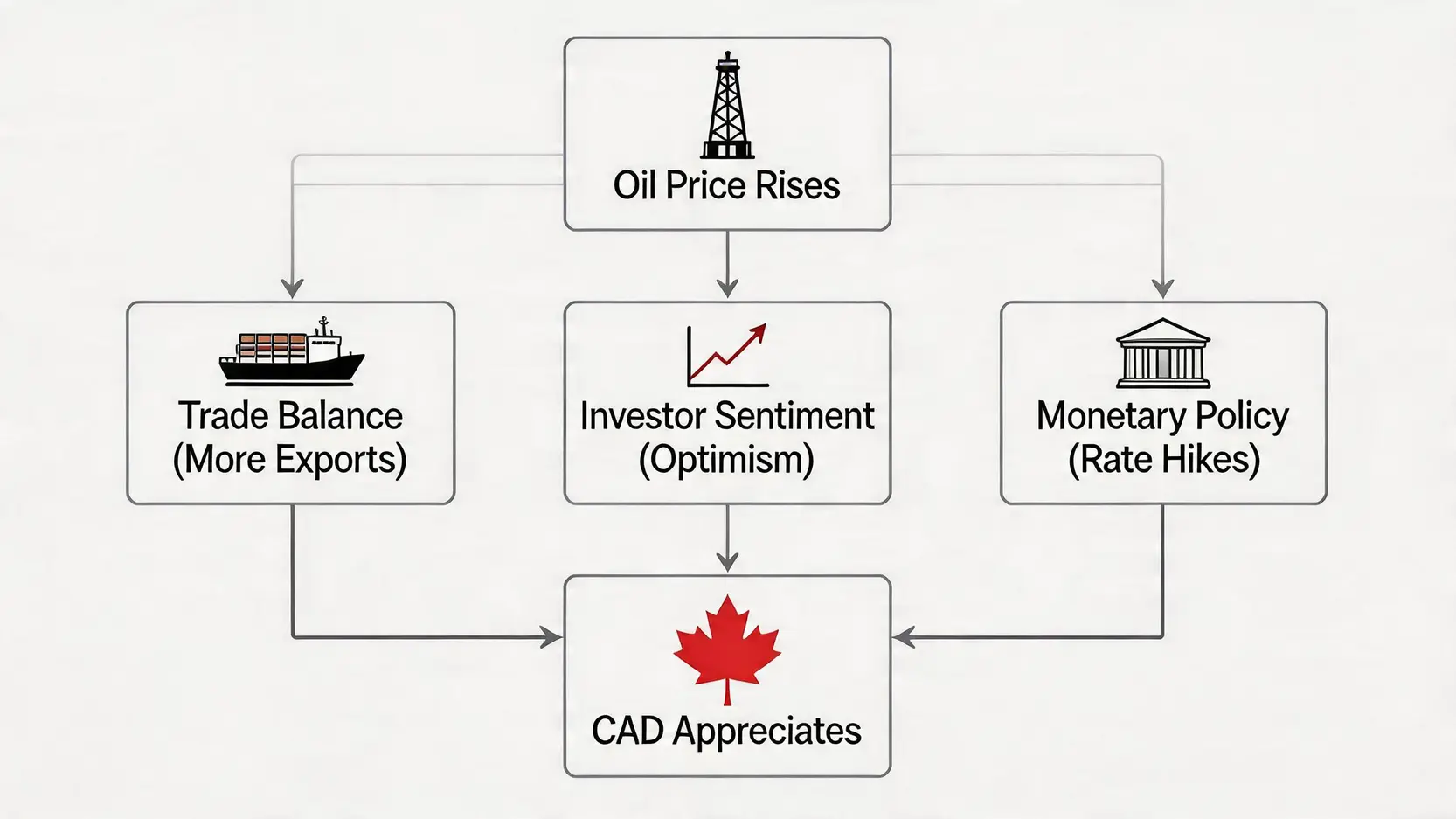
After understanding the correlation between the Canadian dollar and oil prices, we need to further explore the specific channels through which oil prices influence the CAD exchange rate. This can mainly be explained from three levels:


Channel 1: Direct Impact Through Trade Balance and Foreign Exchange Inflows

This is the most direct and core transmission channel. When international oil prices rise, the same volume of crude oil exports can generate more foreign currency (mainly USD). This leads to:

  • Widening trade surplus: Canada’s trade balance improves as export revenue far exceeds import expenditure.
  • Increased USD inflows: A large amount of USD flows into Canada.
  • Rising demand for CAD: In order to invest in Canada, pay taxes, and cover wages, these incoming USD funds must be converted into CAD, increasing demand for the Canadian dollar and driving its appreciation.


Channel 2: Changes in Investor Sentiment and Market Expectations

Financial markets are driven by expectations. Changes in oil prices influence global investors’ outlook on Canada’s economic prospects.

  • When oil prices rise: Investors expect higher profits for Canadian energy companies, improved government fiscal revenue, and stronger overall economic growth. This optimistic sentiment attracts international capital into Canadian equities and bonds, further increasing demand for CAD.
  • When oil prices fall: Markets worry about a potential slowdown or recession in the Canadian economy, leading to capital outflows and selling pressure on CAD-denominated assets, which weakens the currency.


Channel 3: Indirect Impact on Bank of Canada (BOC) Monetary Policy

Oil price fluctuations affect Canada’s inflation and economic growth, which in turn influence the Bank of Canada’s interest rate decisions.

  • During high oil price periods: Rising oil prices may increase transportation and production costs, putting upward pressure on inflation. To control inflation, the BOC may adopt a tightening monetary policy by raising interest rates. Higher interest rates attract global capital seeking higher returns, which is supportive for CAD.
  • During low oil price periods: Falling oil prices may weaken economic growth or even trigger deflationary risks. The BOC may cut interest rates to stimulate the economy. Lower interest rates reduce CAD’s attractiveness, leading to depreciation. For deeper insight into the central bank’s decision-making, you can refer to its monetary policy reports.

油價上漲影響加元升值的 3 個傳導途徑流程圖:貿易平衡、投資者情緒與央行政策。

Oil prices influence the Canadian dollar through three major channels: trade, investor sentiment, and central bank policy.


[CAD Investment Strategies] How to Trade Using Oil Price Information?

After understanding the linkage between CAD and oil prices, investors can apply this relationship in real trading strategies. Below are three commonly used CAD investment strategies based on crude oil price impact.


Strategy 1: Trend-Following Strategy – Trading USD/CAD Based on Oil Trends

This is the most basic and intuitive strategy. The core idea is to identify the future trend of oil prices and trade USD/CAD accordingly.

  • When oil prices are expected to rise: CAD is likely to strengthen, and USD/CAD is likely to fall. Investors may consider selling (shorting) USD/CAD.
  • When oil prices are expected to fall: CAD is likely to weaken, and USD/CAD is likely to rise. Investors may consider buying (going long) USD/CAD.

Practical tip: Use technical analysis tools such as trend lines and moving averages from forex trading education to identify WTI crude oil trends and find optimal entry points. 

Strategy 2: Correlation Hedging Strategy – Using CAD and Energy Assets for Risk Management

For investors holding Canadian energy stocks or related ETFs, CAD can serve as an effective hedging tool.

  • Scenario: You hold shares of a Canadian oil company, and your main risk is a sudden drop in oil prices, which would negatively affect both stock prices and dividend income.
  • Hedging action: To offset this risk, you can simultaneously buy (go long) USD/CAD in the forex market. If oil prices fall, your stock position may lose value, but your long USD/CAD position will benefit from CAD depreciation, partially or fully offsetting the losses.


Strategy 3: Data-Driven Strategy – Combining Oil Prices with Canadian Economic Data

Professional traders never rely on a single indicator. Combining oil price analysis with macroeconomic data provides a more complete trading framework.

For example, if oil prices are rising strongly, you should not immediately short USD/CAD. Instead, monitor upcoming Canadian economic indicators such as employment reports or inflation (CPI).

  • If data is strong: Strong economic data confirms the positive impact of rising oil prices, increasing the probability of a successful USD/CAD short trade.
  • If data is weak: Even if oil prices rise, weak domestic data may limit CAD gains or create temporary divergence. In this case, it may be better to stay on the sidelines or reduce position size.


Important Considerations: Other Factors Affecting the Canadian Dollar

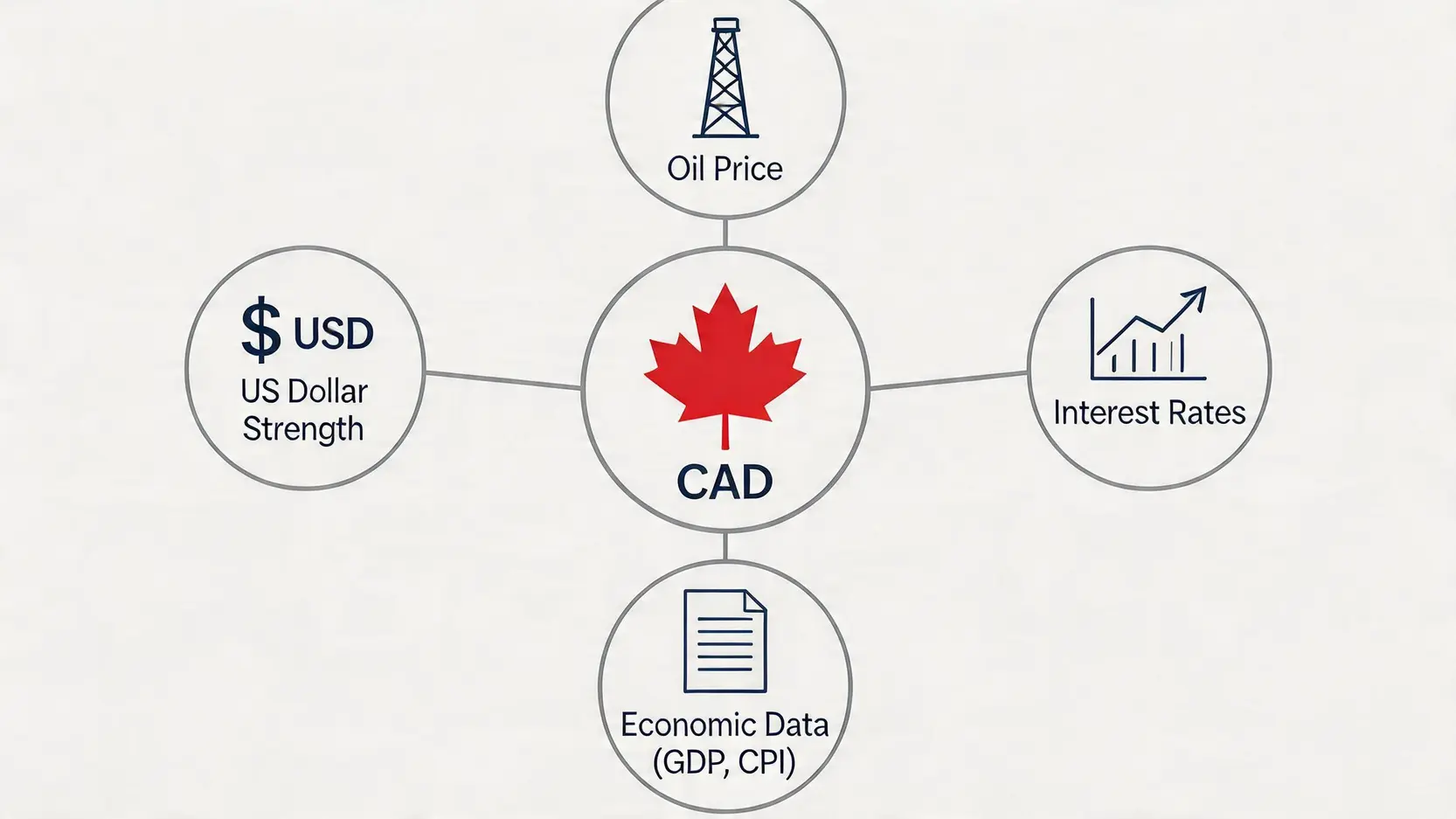
Although the CAD–oil price relationship is strong, treating them as identical would be dangerous. Crude oil is a major driver of CAD, but not the only one. When forming CAD investment strategies, the following factors must also be considered:


US Dollar Index (DXY) Strength

USD/CAD is a currency pair, meaning its price depends not only on CAD (the numerator) but also on USD (the denominator). The US Dollar Index measures USD against a basket of major currencies. Sometimes, even if oil prices rise (positive for CAD), a strong USD driven by robust US economic data can still push USD/CAD higher.


Interest Rate Differentials Between Canada and the US

Capital flows toward higher returns. The interest rate difference between the Bank of Canada (BOC) and the Federal Reserve (Fed) is a key driver of USD/CAD. If BOC rates are higher than Fed rates, it attracts capital into Canada, supporting CAD. The opposite is also true. Monitoring central bank decisions and policy statements is essential.


Canada’s Domestic Economic Data (e.g., Employment, GDP)

Beyond oil and US factors, Canada’s own economic health is fundamental to CAD valuation. Key indicators include:

  • Employment reports: Reflect labor market strength.
  • Gross Domestic Product (GDP): Measures overall economic growth.
  • Consumer Price Index (CPI): Inflation data that influences central bank policy.

These indicators directly affect market confidence in the Canadian dollar.

影響加元匯率的四大核心因素示意圖:原油價格、利率差異、經濟數據和美元強弱。

Multiple factors influence CAD exchange rates, and while oil is critical, it is not the only driver.


Frequently Asked Questions (FAQ)

Q: If oil prices rise, will the Canadian dollar definitely appreciate?

A: Not necessarily. In most cases, rising oil prices provide support for the Canadian dollar, but this is not a 100% rule. If stronger negative factors appear at the same time, such as a sharp rise in global risk aversion causing the US dollar to surge, or a severe domestic economic issue in Canada, the Canadian dollar may still weaken even in a rising oil price environment. Therefore, a comprehensive analysis is required.

Q: What are the potential risks of trading the Canadian dollar (USD/CAD)?

A: The main risks include: 1) sharp and unpredictable fluctuations in crude oil prices; 2) sudden shifts in US monetary policy leading to large USD volatility; 3) weaker-than-expected Canadian economic data; 4) global geopolitical risks or financial crises, all of which can create high uncertainty for USD/CAD.

Q: Besides oil prices, what other indicators should I watch to forecast CAD movements?

A: In addition to WTI crude oil prices, you should closely monitor: 1) interest rate differentials between the US and Canada; 2) the trend of the US Dollar Index (DXY); 3) Canada’s monthly employment reports, GDP, and CPI data; 4) the Bank of Canada (BOC) interest rate decisions and post-meeting statements.

Q: Which crude oil benchmark is most relevant for trading CAD?

A: Although Brent crude oil is an important global benchmark, West Texas Intermediate (WTI) is more relevant for CAD traders. This is because WTI is the key pricing benchmark in North America and has a closer and more direct relationship with Canada’s oil exports and pricing structure.


Conclusion

In summary, a deep understanding of the CAD–oil price relationship is an essential requirement for all Canadian dollar investors. As Canada is one of the world’s major oil exporters, fluctuations in crude oil prices directly affect its economic performance and currency value, which is the core logic behind how oil price movements influence CAD. This article has explained the transmission mechanism between the two and introduced three core CAD investment strategies: trend-following, risk hedging, and data-driven decision-making. Sophisticated investors should use oil analysis as a foundation, while also combining US dollar strength, central bank policy, and economic data for a comprehensive judgment, in order to more accurately capture every investment opportunity in the dynamic foreign exchange market. 

If you liked this article, please share it!

Related Articles

  • How Hedging Works: Hedge Fund Strategies & Trading Guide
    How Does Hedging Work? Advanced Hedge Fund Strategies and Practical Trading Guide In the rapidly changing financial markets, relying solely on a “buy-and-hold” strategy often makes it difficult to withstand severe market volatility and achieve stable long-term profits. If you have heard Wall Street leaders discuss risk hedging, you are...
    2026 年 7 月 14 日
  • What Is Hedging? A Beginner’s Risk Management Guide
    What Is Hedging? A Risk Management Guide Every Financial Beginner Should Read In the investment market, we often hear the term “hedging”, but what exactly does it mean? Why do professional investors use it? Hedging means adopting strategies to protect assets from adverse price movements. Whether in the stock, foreign...
    2026 年 7 月 14 日
  • 2026 US Treasury Yield Guide: Trends & Strategies
    2026 Complete Guide to US Treasury Yields: Trend Analysis, Impact of Surging Yields, and Asset Allocation Strategies In the rapidly changing global financial market, US Treasury yields have long been regarded as the most important benchmark for the risk-free rate. Entering 2026, amid recurring shifts in inflation expectations and dynamic...
    2026 年 7 月 13 日
返回顶部