Futures Technical Analysis: RSI & MACD Guide

Futures Technical Analysis Tutorial: RSI and MACD Dual Indicator Application to Improve Trading Win Rate
Do you often feel confused in futures trading, watching prices fluctuate without knowing when to enter or exit? Trading purely based on intuition is often the beginning of losses. This complete futures technical analysis tutorial will guide you through two core indicators: RSI and MACD. From RSI futures application for identifying overbought and oversold conditions to MACD futures trading analysis of trend momentum, this guide helps you build a clear trading logic and find reliable signals in complex markets.
Fundamentals of Futures Technical Analysis: Why It Is a Must-Learn for Traders?
Before diving into RSI and MACD, we must first establish a consensus: why is technical analysis an essential skill in futures trading? The answer lies in two key characteristics of futures: high leverage and short timeframes.
Technical Analysis vs Fundamental Analysis: What Matters More in Futures Trading?
Fundamental analysis focuses on supply and demand, macroeconomic data, and policy changes. It helps determine the “intrinsic value” of an asset and identify long-term trends. However, futures traders often engage in intraday or short-term swing trading, holding positions for days, hours, or even minutes. In such a short timeframe, the influence of fundamentals is relatively limited.
This is where technical analysis shows its advantage. It focuses on “price behavior” and “trading volume”, using historical charts to predict future price movements. It assumes that all information (including fundamentals) is already reflected in price, meaning we only need to read the chart to understand market sentiment and buying or selling strength, which is crucial for fast decision-making in futures trading.
Candlestick Charts Basics: The First Step to Reading Market Sentiment
Candlestick charts are the foundation of technical analysis. Each candle contains four key data points: open, close, high, and low. It visually reflects the battle between buyers and sellers:
- Bullish candle (usually red or green): Closing price is higher than opening price, indicating buyer dominance and optimistic sentiment.
- Bearish candle (usually green or black): Closing price is lower than opening price, indicating seller dominance and pessimistic sentiment.
- Upper wick: Price attempted to rise but faced selling pressure.
- Lower wick: Price fell but found buying support.
Learning how to read the strength of individual candlesticks and understand multi-candle patterns (such as morning star, evening star, and engulfing patterns) is the starting point of all technical analysis. This helps you sense shifts in market sentiment before indicators even generate signals. For deeper learning on candlesticks, you can refer to this article: A Complete Guide to Golden Cross and Death Cross: Essential Candlestick Chart Technical Analysis for Beginners.
RSI Indicator Deep Dive: A Powerful Tool for Identifying Overbought and Oversold Conditions
After mastering the basics of candlesticks, the next step is to introduce technical indicators to quantify market conditions. The first is the Relative Strength Index (RSI), a classic momentum indicator that excels at identifying whether the market is “overheated” or “oversold”.
What Is RSI? Calculation Principles and Parameter Settings Explained
RSI (Relative Strength Index), known in Chinese as 相对强弱指数, was created by technical analysis master Welles Wilder. Its core principle is to compare the relative strength of average price gains versus average price losses over a given period, in order to determine momentum strength. RSI values range from 0 to 100.
- Calculation principle: In simple terms, if recent upward movements are significantly stronger than downward movements, RSI will be higher; conversely, if downward pressure is stronger, RSI will be lower.
- Parameter settings: The most common setting is a 14-day period, meaning RSI calculates price data over the past 14 trading periods. For short-term traders, the parameter can be reduced to 6 or 9 for higher sensitivity; for long-term traders, it can be extended to 21 or 24.
RSI Futures Application: Using the >70 Overbought and <30 Oversold Zones to Identify Trading Opportunities
The most direct application of RSI is using overbought and oversold zones to identify potential counter-trend trading opportunities. This is especially effective in RSI futures applications, as futures markets are highly volatile and often overreact in the short term.
- Overbought zone: When RSI is above 70, it indicates that the market has risen too quickly in the short term, and bullish momentum may be overextended, with a risk of correction at any time. At this stage, avoid chasing long positions; traders without positions may wait for sell signals, while long-position holders may consider partial profit-taking.
- Oversold zone: When RSI is lower than 30 indicates that the market has fallen too sharply in the short term, and bearish pressure may be exhausted, with a potential rebound ahead. At this stage, avoid chasing shorts; traders without positions may look for buying opportunities, while short-position holders may consider partial covering.
Note: in strong trending markets (such as strong bull or bear markets), RSI may remain in overbought or oversold zones for an extended period, known as “indicator distortion”. Therefore, relying solely on these zones is risky, and they should be combined with other signals.
Key Reversal Signal: Practical RSI Divergence Analysis
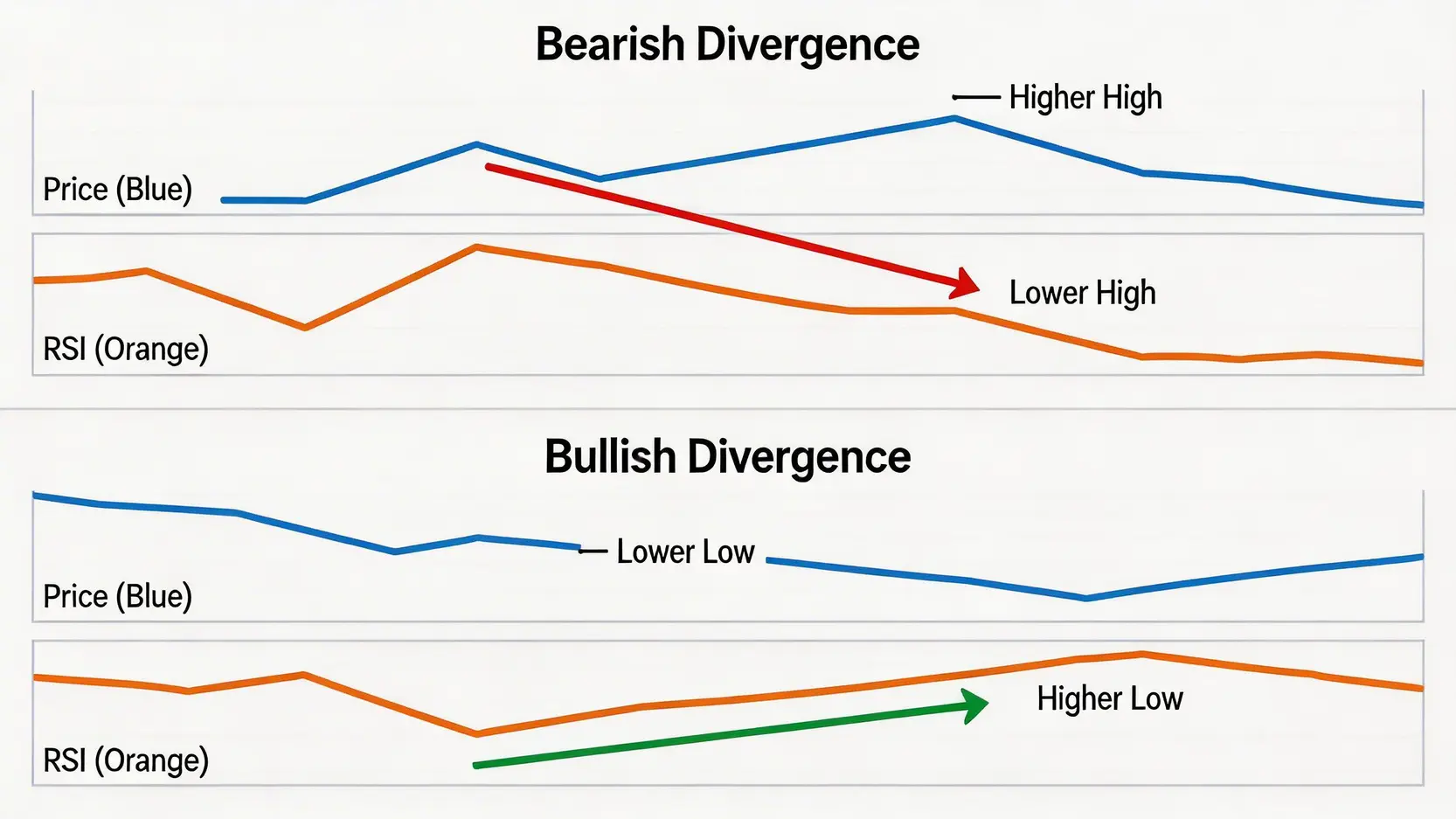
Compared to overbought and oversold levels, RSI divergence is a more reliable trend reversal signal. Divergence refers to a “mismatch” between price movement and indicator movement.
- Bearish divergence: Price makes a “new high”, but RSI fails to make a “new high” and instead trends downward. This indicates that although price is still rising, momentum is weakening, signaling a strong warning for potential selling or shorting.
- Bullish divergence: Price makes a “new low”, but RSI fails to make a “new low” and instead trends upward. This indicates that although price is still falling, downside momentum is fading, signaling a potential buying or long opportunity.

RSI divergence is a key signal for identifying trend reversals.
In futures trading, capturing RSI divergence often allows you to stay one step ahead of the market and seize the critical moment when a trend is about to reverse.
MACD Practical Application: Understanding Trend and Momentum
If RSI is good at capturing “turning points”, then MACD (Moving Average Convergence Divergence) is an expert in determining “trend direction and strength”. It is a trend-following indicator that helps traders align with the market trend.
MACD Components: The Meaning of DIF, MACD Line, and Histogram (OSC)
For beginners, the three sets of data on the MACD chart may seem confusing, but their relationship is actually quite simple. A standard MACD consists of three components:
- Fast line (DIF): Usually calculated as the 12-day EMA (Exponential Moving Average) minus the 26-day EMA. It is more sensitive to recent price movements.
- Slow line (DEM or MACD line): The 9-day EMA of the DIF line. It is smoother and represents the average trend of DIF.
- Histogram (Histogram or OSC): Calculated as “fast line minus slow line.” It visually shows the degree of divergence between the fast and slow lines and represents the strength of market momentum.
MACD Futures Tutorial: Practical Significance of Golden Cross and Death Cross
In MACD futures trading, the golden cross and death cross are the most fundamental and important trading signals, representing trend initiation or reversal.
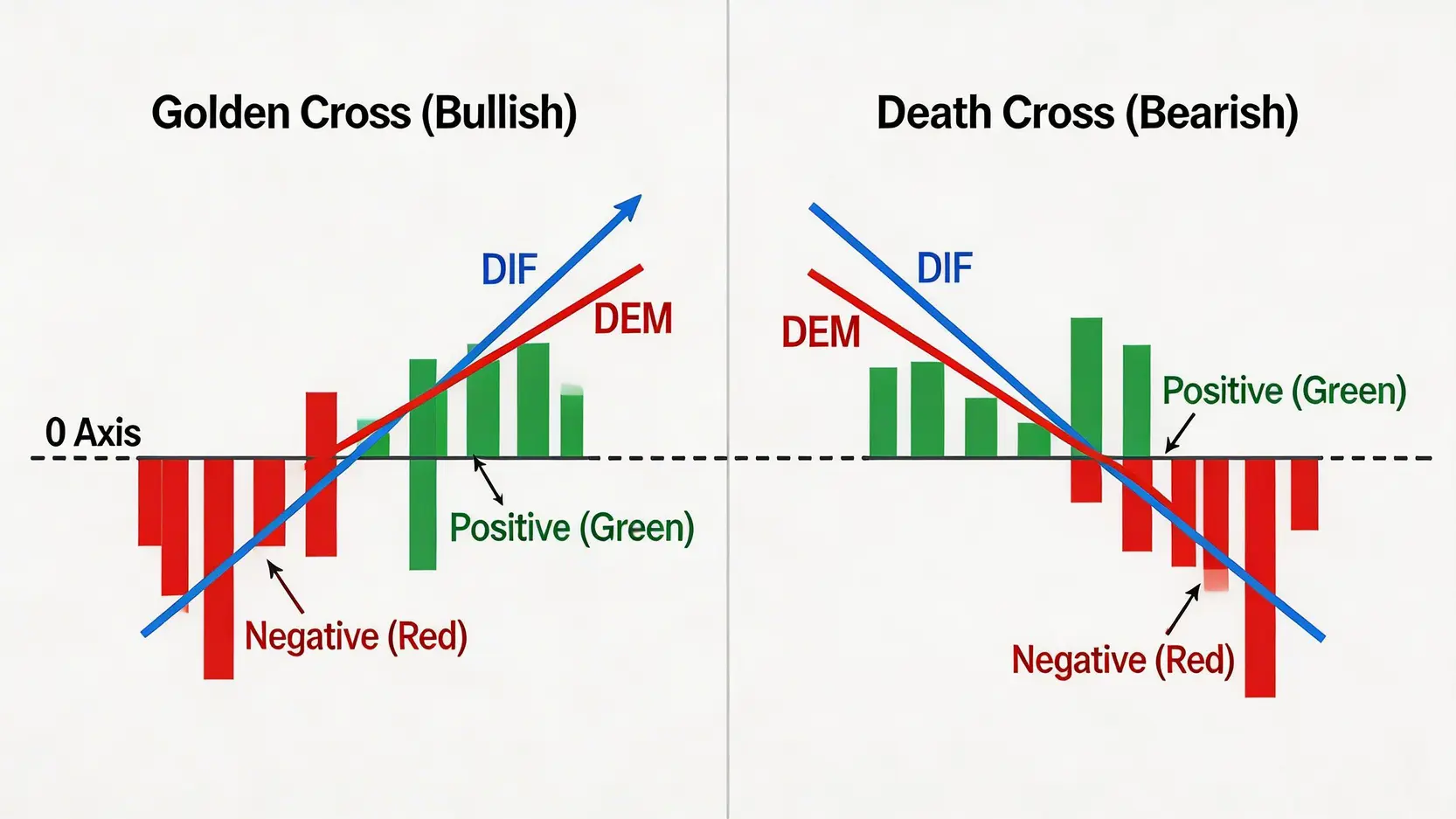
- Golden Cross: When the fast line (DIF) crosses above the slow line (DEM) from below, the histogram turns from negative to positive. This is a clear bullish signal, indicating that short-term momentum has become stronger than long-term momentum, and the market may enter an upward trend, making it an ideal buy or long entry opportunity.
- Death Cross: When the fast line (DIF) crosses below the slow line (DEM) from above, the histogram turns from positive to negative. This is a clear bearish signal, indicating weakening short-term momentum and a potential downward trend, making it a reference point for selling or shorting.

Golden crosses are buy signals, while death crosses are sell signals.
To further understand golden cross applications, you can read this article: MACD Golden Cross Explained in Stocks: 3 Stock-Picking Strategies to Avoid False Signals. The same concepts also apply to futures markets.
How to Use the Histogram to Assess Market Momentum Strength and Shifts
In addition to crossover signals, changes in the histogram itself also contain valuable trading information. It is an excellent tool for measuring market momentum:
- Histogram above the zero line: indicates a bullish market structure. Expanding bars indicate strengthening upward momentum; shrinking bars suggest weakening momentum and potential pullback risk.
- Histogram below the zero line: indicates a bearish market structure. Expanding bars indicate strong downward momentum; shrinking bars (moving toward the zero line) suggest fading bearish momentum and a possible rebound.
Observing the histogram shifting from “long to short” can often reveal early signs of momentum change before crossover signals appear.
Further Reading (Highly Recommended)
RSI + MACD Combined Strategy: Improve Your Trading Win Rate
Using either indicator alone has its limitations. RSI performs well in ranging markets but can become less effective in strong trends, while MACD excels in trending markets but may generate false signals in sideways conditions. Therefore, combining both indicators for mutual confirmation is a common professional strategy that significantly improves decision-making quality.
Dual Confirmation: How to Combine RSI and MACD Signals to Filter False Breakouts and Find Optimal Entry Points
The core idea of the combined strategy is: “use RSI to identify reversals, and MACD to confirm trends”. By using a dual confirmation mechanism, many market noises can be filtered out, allowing trades to be executed only at higher-probability setups.

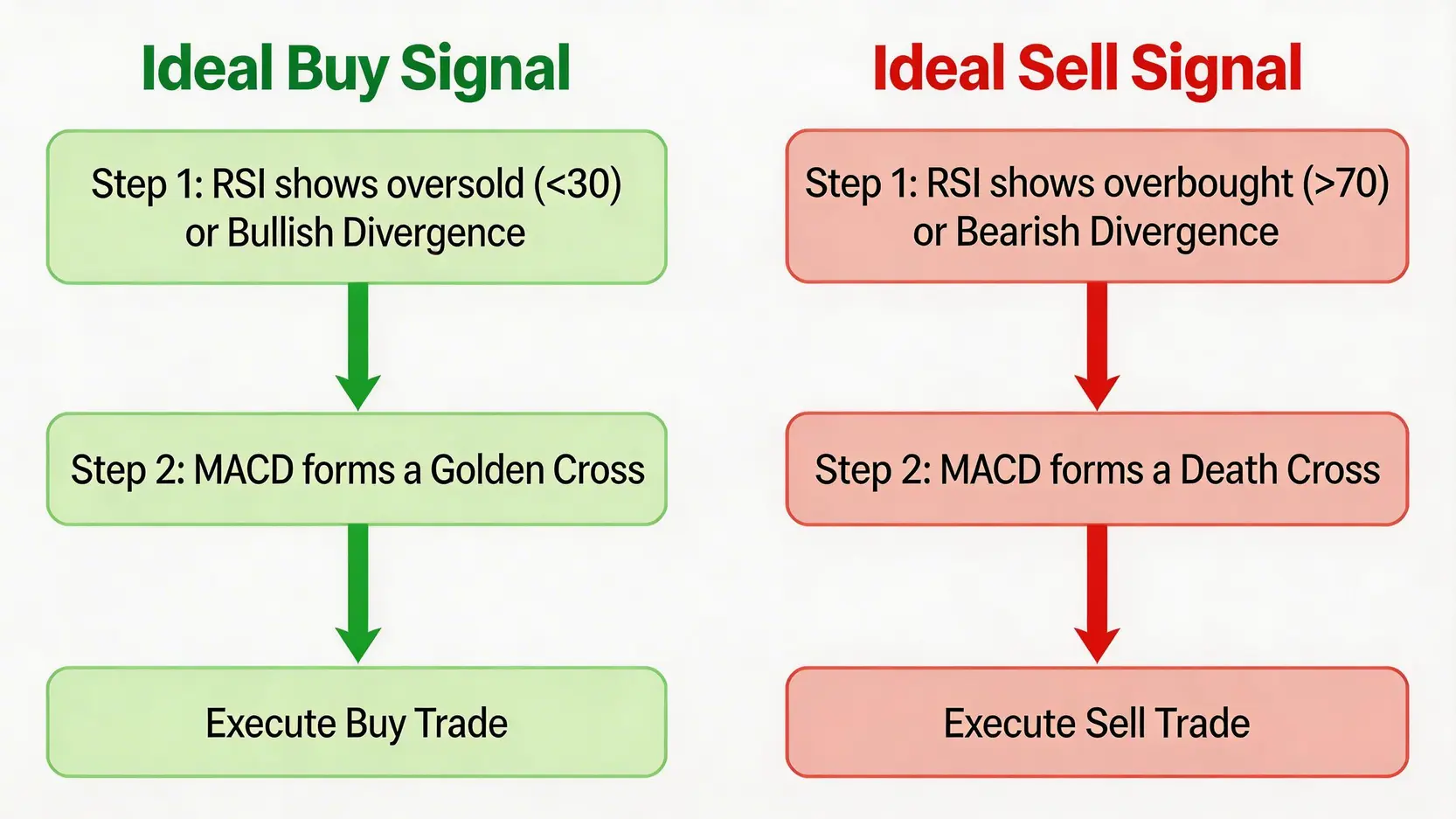
A combined RSI and MACD confirmation strategy can effectively filter noise and improve trading win rate.
Ideal long entry example:
- First confirmation (RSI): Wait for a downtrend where RSI enters the oversold zone below 30 or shows bullish divergence. This indicates fading downward momentum and potential reversal.
- Second confirmation (MACD): Wait for a golden cross to appear, with the histogram turning from negative to positive. This confirms that bearish momentum has shifted to bullish momentum.
- Execution: Enter a long position only when both conditions are met.
Ideal short entry example:
- First confirmation (RSI): Wait for an uptrend where RSI enters an overbought zone above 70 or shows bearish divergence.
- Second confirmation (MACD): Wait for a death cross, with the histogram turning from positive to negative.
- Execution: Enter a short position only after both confirmations.
Practical Case Study: Applying RSI and MACD Strategy on a Real Futures Chart
Let’s take a hypothetical example using a 5-minute chart of the “Micro Nasdaq Futures (NQ)”:
Suppose NQ experiences a sharp drop and forms a new intraday low at point A. At this moment, RSI fails to make a new low and instead forms a higher low, showing clear “bullish divergence” (first confirmation).
We do not enter immediately. Instead, we continue to observe. Although price rebounds slightly, MACD remains below the zero line and has not crossed yet. About 15 minutes later, as buying pressure increases, the MACD fast line finally crosses above the slow line, forming a “golden cross” (second confirmation).
At or near the closing price of the candle where the golden cross occurs, this becomes a high-probability long entry point. This is because we have captured both the exhaustion of downward momentum (RSI divergence) and confirmation of upward trend formation (MACD golden cross). Compared to using a single indicator, this combined approach significantly improves stability and reliability.
FAQ: Futures Technical Analysis
Q: Is it enough to only use RSI and MACD for future technical analysis?
A: RSI and MACD are a very powerful and complementary combination that can form the foundation of a complete trading system. However, no indicator is perfect. Advanced traders often combine additional tools to increase analytical dimensions, such as using “moving averages (MA)” to identify long-term support and resistance levels, “Bollinger Bands” to observe volatility and relative price positioning, or “trading volume” to confirm trend strength. For beginners, however, mastering the RSI + MACD combination is far more effective than learning many indicators without deep understanding.
Q: How should RSI and MACD parameters be set? Is there a standard answer?
A: There is no standard answer. The optimal parameters depend on your trading timeframe and the characteristics of the instrument. The most common settings (RSI 14, MACD 12,26,9) are designed for daily charts. If you are a short-term trader using 5-minute or 15-minute charts, you may shorten the parameters (such as RSI 9, MACD 6,13,5) to increase sensitivity. Conversely, for swing trading, longer parameters may be more suitable. It is recommended to backtest different settings in a demo account based on your trading style, market, and timeframe to find the most suitable combination.
Q: What should I do when indicators become less effective or fail?
A: Indicator degradation (for example, RSI staying above 80 during a strong bull trend) is a normal condition in strong trending markets and should not be traded against. When indicators fail (for example, a divergence appears but price continues in the original direction), the first priority is to strictly execute stop-loss discipline. This reminds us that technical analysis is a probability-based tool, not a perfect forecasting system. Failures are part of trading. The key is proper risk management to ensure that a single loss does not significantly impact overall capital. It is also important to check whether major news events or a non-trending market condition may have influenced price behavior.
Q: Does this strategy apply to all futures products?
A: Yes, the underlying logic of the RSI and MACD combination strategy (momentum and trend) is applicable to most liquid futures instruments, including index futures (such as the Hang Seng Index and S&P 500), commodity futures (such as gold and crude oil) and currency futures. However, since different instruments have varying volatility and active trading hours, you may need to fine-tune indicator parameters or stop-loss and take-profit settings to suit the “characteristics” of each instrument.
Q: Can technical analysis guarantee profits?
A: No. Technical analysis is a powerful tool to improve “win rate” and “risk-reward performance”, but it is not a crystal ball that guarantees profits. The market is always uncertain. Successful trading requires a combination of a high-probability analytical system, strict risk management (stop-loss), and disciplined trading psychology. All three are essential. Never assume that any single indicator or strategy can lead to instant wealth.
Conclusion
In summary, future technical analysis is not a mysterious form of prediction, but a systematic and data-driven discipline. Through this guide, you have learned the core applications of RSI and MACD, from identifying overbought and oversold conditions, detecting divergences, to capturing trend signals such as golden crosses and death crosses. The key to success lies in continuous practice and turning knowledge into real trading experience. It is recommended that you immediately use a demo account to apply the RSI futures application and MACD trading strategies you have learned, and gradually build your own stable trading system. Remember, continuous learning and disciplined execution are the long-term foundations for success in the futures market.
Related Articles
-
Practical Applications of Volatility Surfaces: From Options Modeling to Advanced Skew Trading Strategies In options markets, implied volatility is never a flat line. Instead, it forms complex "smile" or "skew" surfaces. For advanced traders, mastering the practical applications of volatility surfaces is equivalent to possessing a lens that reveals market...2026 年 6 月 3 日
-
Building a Foreign Capital Flow Copy Trading Model: A Stock Market Indicator for Accurately Tracking Institutional Positioning In Asia-Pacific stock markets, foreign capital inflows and outflows often determine the direction of the index. However, simply looking at daily net buy and sell data is no longer enough. Only by building...2026 年 6 月 3 日
-
Options Buyer Strategies During Extreme Market Conditions: Black Swan Hedging and Cross-Market Arbitrage During Volatility Surges The most terrifying aspect of financial markets is not a gradual decline, but overnight flash crashes and cross-market capital withdrawals accompanied by volatility surges. In the highly unpredictable global macroeconomic environment of 2026, geopolitical...2026 年 6 月 3 日