CNY vs CNH Guide: Spread, Arbitrage & FX Risk

Updated: 2026/04/23  |  CashbackIsland

cny-cnh-spread-arbitrage-risk

CNY vs CNH Full Guide: A Complete Overview of the Onshore–Offshore RMB Spread, Arbitrage Opportunities, and Exchange Rate Risk

Are you confused by the difference between “onshore RMB (CNY)” and “offshore RMB (CNH)”? Watching the fluctuation in the onshore–offshore RMB exchange rate spread without knowing how to capture potential CNY–CNH arbitrage opportunities, or even worrying about the hidden RMB exchange rate risks? Whether you are an importer/exporter, an investor, or simply interested in RMB, understanding the difference between these two is essential. This article will clearly explain their fundamental distinctions, uncover the trading logic behind the spread, and provide practical risk management strategies to help you navigate the complex foreign exchange market. 


Basic Concept: What Are Onshore RMB (CNY) and Offshore RMB (CNH)?

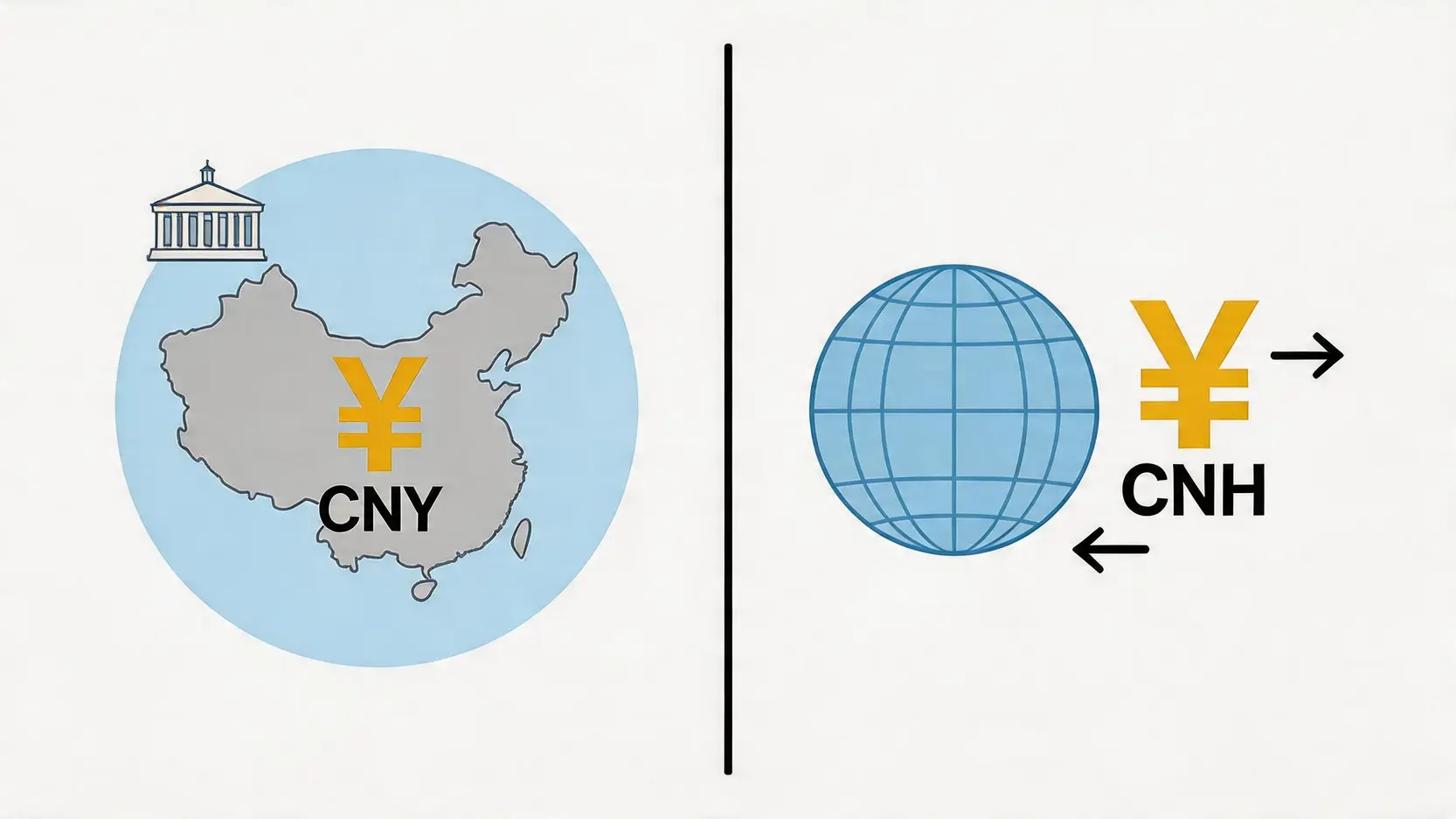
First, it is important to understand that RMB actually operates under two different “codes” at the same time. Although they are fundamentally the same currency, they are traded under completely different markets and rules, which is the core reason behind the price spread and arbitrage opportunities.在岸人民幣(CNY)與離岸人民幣(CNH)的市場區隔示意圖,顯示了受管制的在岸市場與自由的離岸市場。

Core Difference Between Onshore (CNY) and Offshore (CNH) Markets: Control vs. Freedom


Onshore RMB (CNY): Definition, Market and Regulatory Features

Onshore RMB, with the code CNY (Chinese Yuan), refers to RMB circulating and traded within mainland China. Its characteristics can be summarized as follows:

  • Main market: China mainland interbank foreign exchange market.
  • Price formation: Strictly regulated by the People’s Bank of China (PBoC). Before each trading day opens, the central bank announces a “RMB central parity rate”, and the spot exchange rate is only allowed to fluctuate within a 2% band above or below this midpoint.
  • Trading restrictions: Transactions must be backed by real trade or investment purposes, and both individuals and companies are subject to strict annual foreign exchange quotas. Capital account conversions are heavily controlled to prevent large-scale capital inflows or outflows.
  • Liquidity: Primarily reflects China’s domestic economic conditions and policy direction.


Offshore RMB (CNH): Definition, Main Trading Markets (e.g., Hong Kong), and Pricing Mechanism

Offshore RMB, with the code CNH (Chinese Yuan Offshore), refers to RMB traded outside mainland China. It was initially introduced in Hong Kong to promote RMB internationalization and has since expanded to financial centers such as Singapore, London, and Taiwan.

  • Main market: Hong Kong is the largest and most important offshore RMB trading center, with other markets also becoming increasingly active.
  • Price formation: The CNH exchange rate is primarily driven by free market supply and demand, with limited direct intervention from the People’s Bank of China. Therefore, its price more accurately reflects global expectations of China’s economy, international risk sentiment, and offshore RMB supply and demand.
  • Trading restrictions: Trading is relatively free, not subject to mainland China’s capital controls, allowing investors greater flexibility in conversion, investment, and trading.
  • Liquidity: Mainly influenced by international investor sentiment and global macroeconomic events.


Visual Comparison: CNY vs CNH Core Differences Table

To help you better understand the differences between the two, we have compiled the following comparison table:

Comparison Item Onshore RMB (CNY) Offshore RMB (CNH)
Trading Location Mainland China Outside mainland China (e.g. Hong Kong, Singapore, London)
Regulatory Authority People’s Bank of China (PBoC), State Administration of Foreign Exchange (SAFE) Primarily regulated by local financial regulators (e.g. Hong Kong Monetary Authority)
Exchange Rate Formation Mechanism Managed floating exchange rate system (based on central parity rate with fluctuation band limits) Free-floating exchange rate determined by market supply and demand
Main Influencing Factors China’s macroeconomic policies, central bank intervention

International investor sentiment, global capital flows, offshore RMB supply and demand

Degree of Trading Freedom Relatively low, subject to capital account controls Relatively high, no capital controls


Core Question: Why Does a Spread Exist Between Onshore and Offshore RMB?

After understanding the basic differences between the two, the reason for the exchange rate spread becomes clear. The onshore–offshore RMB price gap mainly arises from fundamental differences in regulatory policies and market participants between the two markets, which can be summarized into the following two key factors: 

Policy Factors: The People’s Bank of China’s Central Parity Rate and Foreign Exchange Controls

The price of CNY is firmly “anchored” within a controlled range by the central bank. The daily RMB central parity rate announced by the People’s Bank of China sets a benchmark for the market, preventing extreme exchange rate volatility. This policy intervention makes the movement of CNY relatively stable and predictable. At the same time, strict foreign exchange controls restrict the free flow of capital, effectively creating a “firewall” between the onshore and offshore markets, preventing funds from freely moving across markets to eliminate price discrepancies. 

Market Factors: Offshore Supply and Demand Dynamics and Investor Sentiment

The price of CNH, on the other hand, acts as a more accurate reflection of international market sentiment. When overseas investors are optimistic about China’s economic outlook, they tend to buy RMB assets, pushing CNH higher. Conversely, when negative news emerges or global risk aversion rises, investors may sell RMB assets, causing CNH to depreciate. These sentiment-driven fluctuations are often more volatile than in the onshore market. As a result, when domestic and overseas sentiment diverge, the spread between CNH and CNY can widen significantly.

For example, if international markets broadly expect the RMB to depreciate, offshore investors may heavily sell CNH, causing CNH (against USD) to decline. However, due to central bank intervention and capital controls in the onshore market, the depreciation of CNY may be more moderate or even stable. In this case, CNH becomes “cheaper” than CNY, resulting in a negative spread (CNY > CNH).


Profit Core: Full Analysis of CNY–CNH Arbitrage Opportunities

Where there is a spread, there is arbitrage potential. The so-called CNY–CNH arbitrage opportunity refers to exploiting exchange rate differences between the onshore and offshore RMB markets by buying low and selling high to earn profits. This requires traders to operate across two segmented markets. 

Basic Principle of Arbitrage and Common Models

The core principle of arbitrage is simple: Buy in the lower-priced market and sell in the higher-priced market.

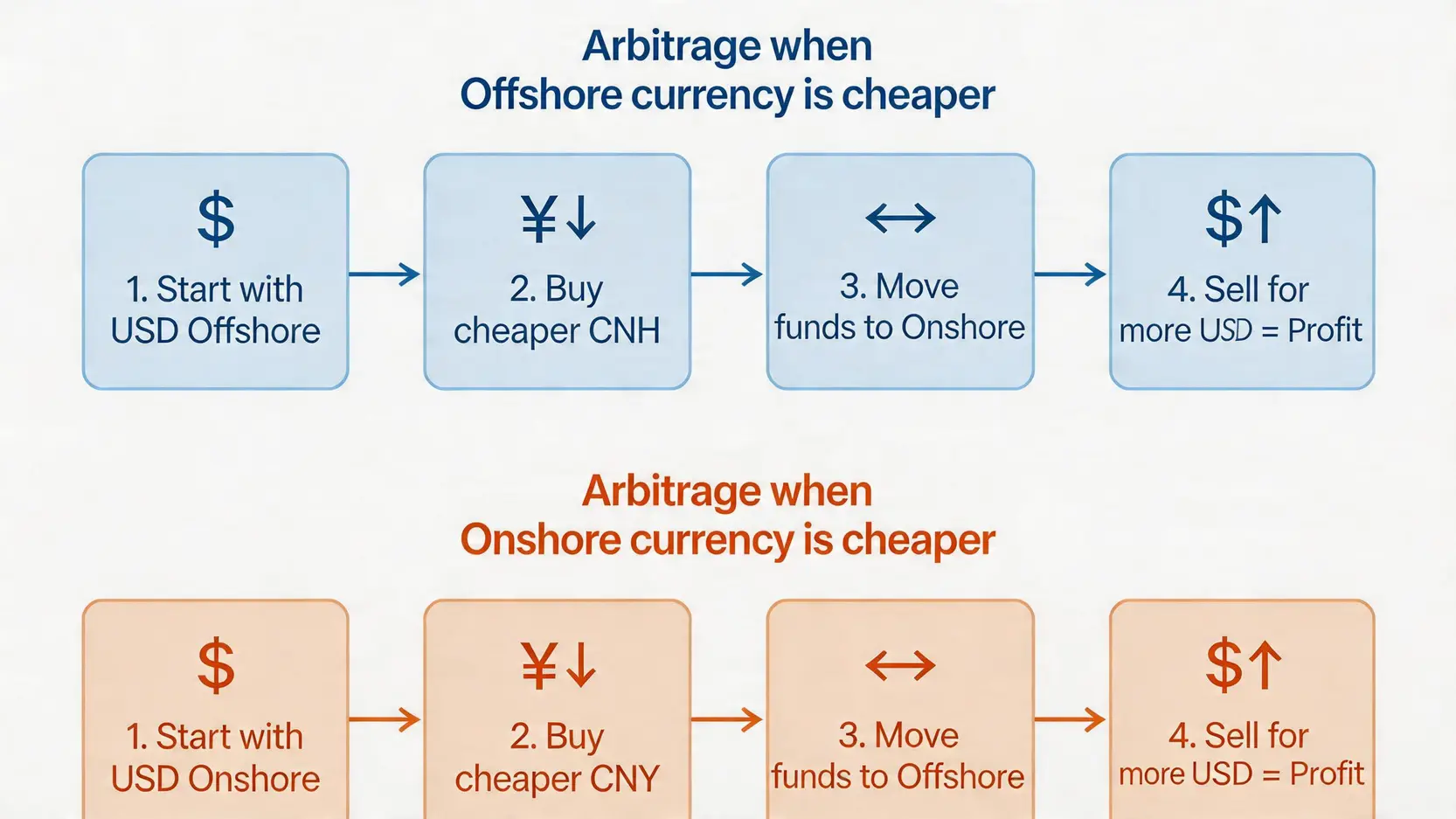
在岸與離岸人民幣套利流程圖,展示當 CNH 便宜或 CNY 便宜時,資金如何流動以賺取價差利潤。

Basic CNY/CNH Arbitrage Process: Buy Low, Sell High

  • When CNH < CNY (offshore RMB is cheaper): Arbitrageurs buy cheaper CNH in the offshore market using USD, then transfer the RMB through compliant channels (such as cross-border trade settlement) into the onshore market and convert it back into USD. Since CNY is priced higher onshore, the resulting USD amount will exceed the initial capital, generating low-risk or risk-free profit.
  • When CNH > CNY (offshore RMB is more expensive): The process is reversed. USD is used in the onshore market to buy cheaper CNY, which is then transferred offshore and sold for CNH, resulting in more USD.


Three Common Onshore–Offshore RMB Arbitrage Strategies Explained

Although the principle is straightforward, real-world execution involves complex cross-border capital arrangements. Below are several arbitrage strategies commonly used by institutional investors:

  1. Cross-Border Trade Settlement Arbitrage (Most Common):
    This is the most classic and compliant method. For example, when an import/export company needs to make an overseas USD payment, and CNH is cheaper than CNY, it can buy RMB (CNH) at a lower USD cost in Hong Kong and then settle it through trade channels to pay domestically, effectively reducing FX costs. Conversely, when receiving USD export proceeds, if CNH is stronger, the company can convert USD into CNH offshore and repatriate it for a higher RMB return.
  2. Non-Deliverable Forward (NDF) Arbitrage:
    NDF is a financial derivative traded in offshore markets that allows investors to speculate on future onshore CNY exchange rates without physical delivery of principal, settling only the price difference at maturity. Arbitrageurs exploit pricing differences between expected onshore CNY rates in the NDF market and actual forward rates, mainly operated by banks and hedge funds.
  3. Cross-Border ETF and RQFII/QFII Quota Arbitrage:
    Institutions can use Qualified Foreign Institutional Investor (QFII) or RMB Qualified Foreign Institutional Investor (RQFII) quotas to invest offshore RMB directly into onshore equity or bond markets. When spreads widen, capital flows through these channels can indirectly capture arbitrage opportunities.


Further Reading (Highly Recommended)

Arbitrage Trading Strategy Cheat Sheet: Full Breakdown of 5 Major Arbitrage Opportunities and Core Formulas

Foreign Exchange Trading Risk Management: How Senior Traders Hedge Risk and Achieve Stable Returns


Attention! Potential Costs and Limitations of Arbitrage Trading

There is no such thing as a free lunch. Arbitrage trading may seem risk-free, but in reality it is not.

  • Transaction Costs: Includes bank fees, wire transfer fees, bid–ask spreads, and other charges. These costs can erode arbitrage profits. Only when the spread between the two markets is large enough to cover all costs does arbitrage become meaningful.
  • Time Lag Risk: Cross-border fund transfers take time. During this period, exchange rates may move unfavorably, causing expected profits to shrink or even turn into losses.
  • Policy Risk: Foreign exchange policies in China are not fixed. Regulators may introduce new measures at any time to curb abnormal cross-border capital flows, potentially disrupting arbitrage channels.
  • Quota Restrictions: For individuals and most companies, strict foreign exchange quotas and capital controls are the biggest barriers to participating in arbitrage.


Risk Management: How to Avoid RMB Exchange Rate Risk?

For ordinary companies and investors who cannot participate in arbitrage, understanding the difference between CNY and CNH is mainly about effectively managing potential RMB exchange rate risk. Exchange rate fluctuations can have a direct impact on your assets and profits. 

Impact on Businesses: FX Gains and Losses in Import and Export Trade

For import and export companies, exchange rate risk is an unavoidable part of operations.

  • Importers: If goods are imported and priced in USD, RMB depreciation means more RMB is required to purchase the same amount of USD, increasing import costs and eroding profits.
  • Exporters: If goods are exported and priced in USD, when RMB appreciates, the USD received will convert into fewer RMB, resulting in foreign exchange losses.


Impact on Investors: Value Fluctuations of RMB-Denominated Assets

For overseas investors holding RMB-denominated assets (such as stocks, funds, or deposits), exchange rate fluctuations directly affect asset value in their home currency. For example, a Taiwanese investor buys a RMB-denominated fund. Even if the fund’s net asset value rises by 5%, if the RMB depreciates by 6% against the New Taiwan Dollar during the same period, the overall return may still result in a loss after conversion. This is why exchange rate risk must be taken into account in cross-border investments.


Practical Tools: Hedging Methods Such as Forward Contracts and Futures

In the face of exchange rate volatility, the market provides various financial instruments to hedge risk (Hedge) and lock in future exchange rates in advance, thereby reducing uncertainty. Common methods include:

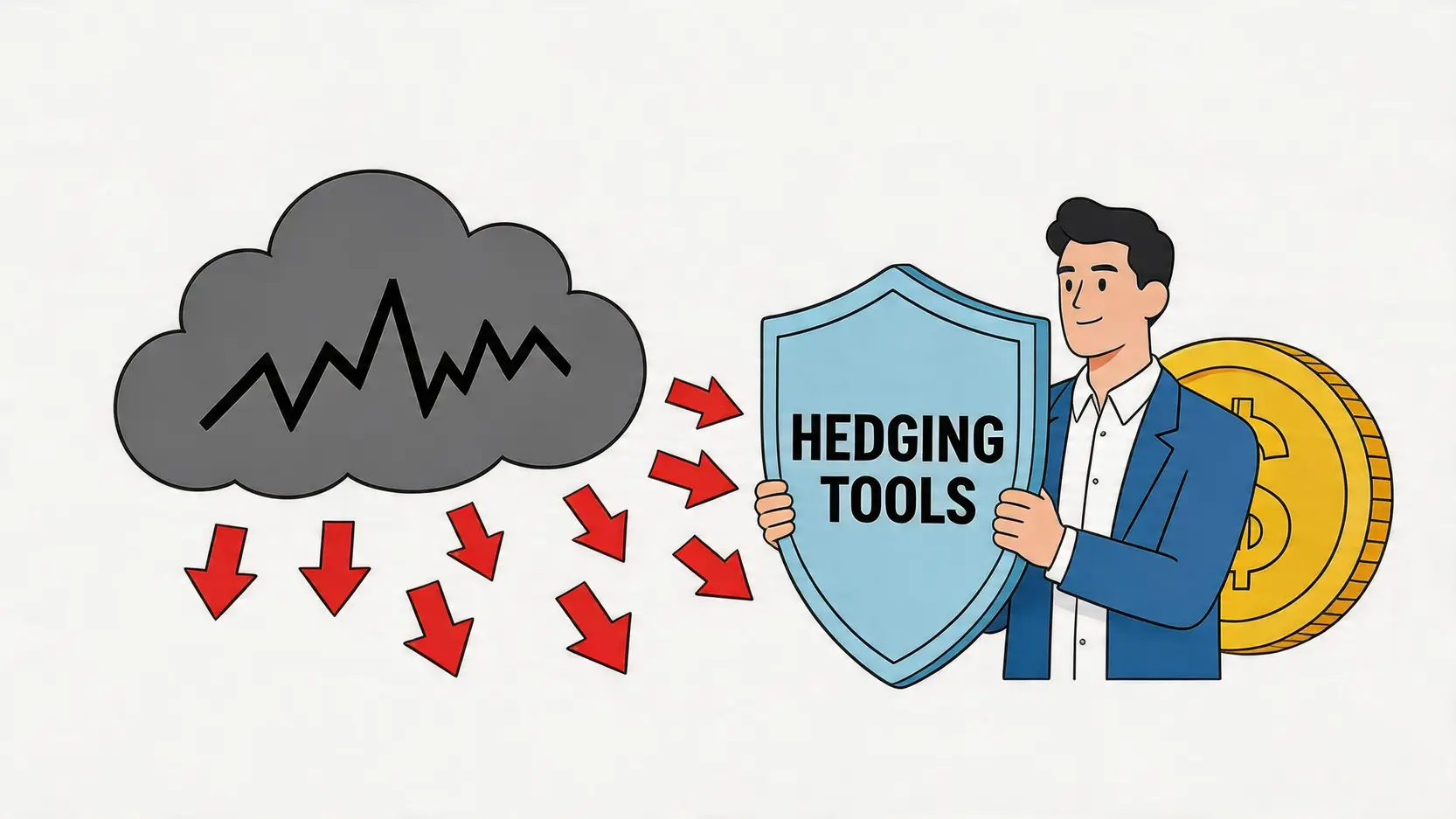
企業使用遠期合約等對沖工具來規避人民幣匯率風險的概念圖。

Using Financial Instruments to Hedge FX Risk and Lock in Corporate Profit

  • Forward Contracts (Forward Contracts): A contract signed with a bank agreeing to exchange a specified amount of foreign currency at a predetermined exchange rate on a future date. This is suitable for companies with clear foreign currency inflows or outflows, as it allows them to lock in costs or revenues in advance.
  • Foreign Exchange Futures (Futures): Standardized forward contracts traded on exchanges. They offer better liquidity, but contract size and maturity dates are fixed, making them less flexible.
  • Foreign Exchange Options (Options): Give the holder the “right”, but not the “obligation” to buy or sell a currency at a predetermined price in the future. After paying a premium, investors can lock in the worst-case exchange rate while still benefiting from favorable market movements, offering greater flexibility. Learning more about foreign exchange trading risk management techniques can help you navigate the market more steadily.


Further Reading (Highly Recommended)

Arbitrage Trading Strategy Cheat Sheet: Full Breakdown of 5 Major Arbitrage Opportunities and Core Formulas

Foreign Exchange Trading Risk Management: How Senior Traders Hedge Risk and Achieve Stable Returns


Frequently Asked Questions (FAQ)

Q: Can individuals participate in CNY/CNH arbitrage?

A: In theory, yes, but in practice it is extremely difficult. The main obstacles are China’s strict capital controls and individual annual foreign exchange quotas (typically USD 50,000). This makes it very hard for individuals to move funds between the two markets in a large-scale and timely manner to capture small spreads. Therefore, CNY/CNH arbitrage is mainly played by institutional investors.

Q: What is the normal range of the spread?

A: During stable market conditions, the spread between the two is usually very small, often just a few dozen to around 100 pips. However, when the market experiences significant volatility, especially when expectations for China’s economy shift sharply overseas, the spread can widen to several hundred or even over a thousand pips. There is no absolute “normal” range, as the spread reflects the degree of divergence in expectations between the two markets.

Q: How does RMB internationalization affect the CNY and CNH spread?

A: In the long run, as RMB internationalization progresses and China’s capital markets gradually open up, the “firewall” between the onshore and offshore markets will slowly be dismantled, allowing smoother capital flows. This will help narrow the long-term spread between the two and make CNY and CNH movements more aligned. However, before full liberalization, any policy changes can still trigger sharp short-term fluctuations in the spread.

Q: Should I exchange CNY or CNH? Which is more cost-effective?

A: It depends on your location and purpose. If you are outside mainland China (such as Hong Kong or Taiwan), you will generally deal with offshore RMB (CNH). If you need to transfer funds into mainland China, then you will need to pay attention to the CNH rate. Whether it is “more cost-effective” depends on the current spread, meaning whether CNH is trading at a discount or premium to CNY. However, for most individuals, since it is difficult to switch between the two markets, they usually have to accept the quoted price available in their local market.


Conclusion

In summary, effectively understanding the onshore–offshore RMB exchange rate spread and managing RMB exchange rate risk is an essential skill in today’s global investment and trade environment. CNY represents the tightly regulated mainland China market, while CNH reflects a freer offshore market driven by international sentiment. The spread between the two not only creates arbitrage opportunities for sophisticated institutions, but also reveals hidden exchange rate risks for businesses and investors. Understanding these core differences is the first step toward identifying opportunities, avoiding risks, and making more informed financial decisions.

编者
Evan Lin

Evan Lin

我是Evan Lin,从大学时期开始接触外汇交易,至今已有多年实战经验,熟悉技术分析与EA策略,热衷于研究市场脉动与风险管控,喜欢分享实战经验和交易技巧,和大家一起学习、一起进步!

If you liked this article, please share it!

Related Articles

  • Binance Margin Trading: Cross vs Isolated Guide
    Binance Margin Trading Guide: Differences Between Cross and Isolated Margin Modes and Illustrated Borrowing Instructions Short on funds but expect a particular cryptocurrency to surge? Besides the commonly used futures trading, you can also use “Binance Margin” to borrow funds and purchase spot assets, amplifying your investment returns. This Binance...
    2026 年 7 月 14 日
  • 2026 Euro Forecast: Is Now the Best Time to Buy Euros?
    2026 Euro Exchange Rate Forecast: Is Now the Best Time to Buy Euros? Planning a trip to Europe or considering foreign currency investments? As the world’s second-largest reserve currency, fluctuations in the euro directly affect your currency exchange costs and investment returns. As we enter 2026 and face changes in...
    2026 年 7 月 14 日
  • Trump’s Middle East Shift: Oil and Gold Price Outlook
    【2026 In-Depth Analysis】Trump’s Major Shift in Middle East Policy: How Will It Trigger a New Round of Correlated Oil and Gold Price Movements? In 2026, global markets are once again focusing on the Middle East. As the Trump administration makes a significant shift in foreign policy, from maximum pressure on...
    2026 年 7 月 14 日
返回顶部