Turkish Lira 2026: Trends, Risks & Investment Guide

【2026 Latest】Is the Turkish Lira Worth Investing In? 5 Major Volatility Causes, Exchange Rate Trends, and Full Risk Analysis
In recent years, the Turkish Lira (TRY) has become a global focus for investors, both loved and feared, due to its extreme exchange rate volatility and once exceeding 40% ultra-high interest rates. Many investors are attracted by its astonishing deposit yields and dream of earning arbitrage profits, while also feeling deep concern about its continuously weakening currency value. What exactly are the causes of Turkish Lira volatility? Faced with such a turbulent market, in-depth analysis of TRY exchange rate trends and clear risk awareness are essential prerequisites before making any investment decision. This article will provide a comprehensive analysis and objectively assess the investment risks of the Turkish Lira, helping you see through the uncertainty before allocating capital to high-risk assets.
Why Is the Turkish Lira So Volatile? A Deep Dive Into 5 Core Causes
The Turkish Lira’s exchange rate chart is often described as a “free fall” example. This long-term and severe depreciation is not accidental, but the result of intertwined political, economic, and social factors within the country. Understanding these fundamental causes is the first step in assessing investment risk.
Non-Traditional Monetary Policy: Counter-Cyclical Rate Cuts Under High Inflation
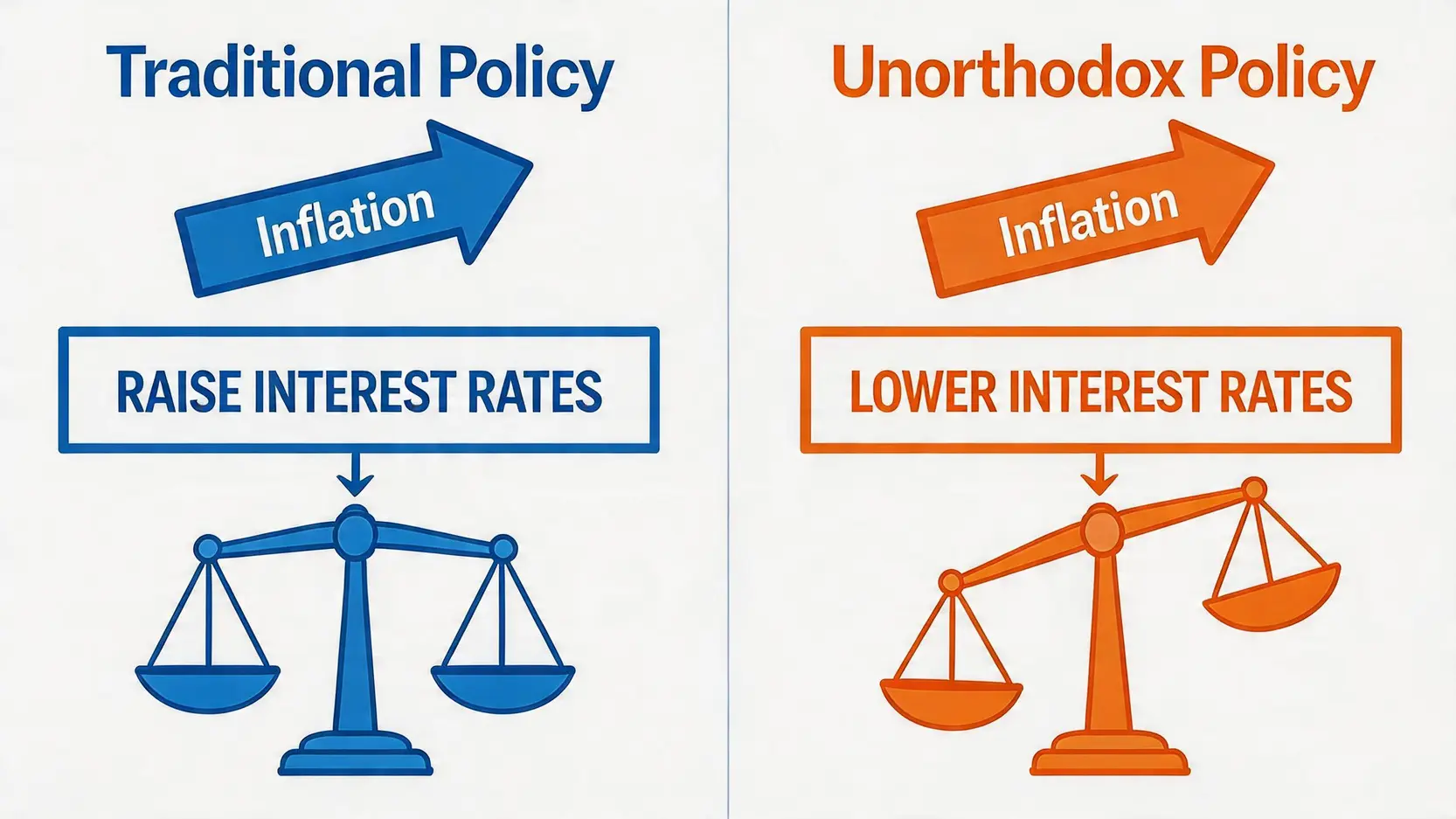
In traditional economics, the most direct way to combat high inflation is to raise interest rates. However, under President Recep Tayyip Erdoğan, Turkey has long adopted an “unorthodox” monetary policy, arguing that “high interest rates are the root of all evil” and that rate cuts stimulate economic growth and suppress inflation. This approach, contrary to mainstream economic theory, led to rate cuts even when inflation surged to multi-decade highs, severely damaging market confidence in the lira and triggering large-scale capital outflows.

Traditional vs Non-Traditional Monetary Policy Comparison Diagram
Political Intervention and Central Bank Independence Crisis
The stability of a country’s currency depends to a large extent on the independence and credibility of its central bank. However, the decisions of the Turkish central bank have long been subject to direct intervention from the political leadership. In recent years, any central bank governor attempting to implement orthodox interest rate hikes to stabilize the exchange rate was often quickly replaced. This “replace if you do not comply” approach has rendered the independence of the Central Bank of the Republic of Turkey largely nominal, and its monetary policy credibility has fallen to rock bottom. Investors are unable to trust that the central bank will take the necessary measures to defend the value of the lira.
Persistent High Inflation and Loss of Public Confidence
When the purchasing power of a domestic currency erodes at an alarming rate, people naturally seek store-of-value assets. Decades of high inflation in Turkey have caused local residents to lose confidence in the lira. Many households and businesses tend to convert their savings into strong foreign currencies such as the US dollar or the euro. This “dollarization” phenomenon further intensifies selling pressure on the lira, creating a vicious cycle. When domestic citizens are selling their own currency, foreign investors become even more reluctant to hold it.
Insufficient Foreign Reserves and External Debt Pressure
A country needs sufficient foreign exchange reserves to withstand external shocks and intervene in the foreign exchange market. Turkey’s foreign reserves have long remained under pressure, and after excluding currency swap agreements with other countries, its net foreign reserves have at times turned negative. This means the central bank has very limited “ammunition” to defend the exchange rate. In addition, Turkey has a large amount of external debt denominated in foreign currencies. Every depreciation of the lira significantly increases its repayment burden, further raising market concerns about default risk.
Geopolitical Risk and Tense International Relations
Turkey is located at the crossroads of Europe and Asia, and its geopolitical environment is extremely complex. Relations with Western countries such as the United States and the European Union have experienced periodic tensions. In addition, its involvement in regional conflicts such as Syria and Libya adds further uncertainty to its economic outlook. Any escalation in geopolitical tensions can become a trigger for a sell-off in the lira, further worsening an already fragile exchange rate environment.
Further Reading (Highly Recommended)
Swiss Franc Exchange Rate Guide: 2026 CHF Outlook and HKD Investment Strategy
Turkish Lira Exchange Rate Trend Analysis and Future Outlook
Looking back and forward, the Turkish Lira’s trajectory has been full of dramatic turning points and challenges. Understanding its historical path and current policy changes is key to determining its future direction.
Review of the Past Decade’s Depreciation Trend: A “Perfect Storm”
From 2015 to 2023, the Turkish Lira’s USD exchange rate experienced an “epic” depreciation. Over this period, the five major negative factors reinforced each other and created a nearly irreversible “perfect storm”. The exchange rate fell from around 2 to 3 lira per USD to over 20 lira per USD, resulting in more than 90% currency value loss. For long-term holders of lira-denominated assets, this has been a disaster.
Key Factors in 2026: Can New Economic Policies Reverse the Downtrend?
However, a key turning point came after the 2023 elections. In an effort to rescue a collapsing economy, the Turkish government appointed a new economic team and made a 180-degree policy shift back toward orthodox economic principles. The central bank began an aggressive tightening cycle, raising policy rates from single digits to above 40%, demonstrating strong determination to combat inflation. While this shift may put short-term pressure on economic growth, it is a necessary step to rebuild market confidence.
Entering 2026, the market’s key focus is on:
- Policy sustainability: Whether the new tight monetary policy can continue without being interrupted by political intervention is the most critical factor determining lira stability.
- Inflation control: Whether aggressive rate hikes can effectively suppress entrenched inflation is a key measure of policy success.
- Capital flows: Whether higher interest rates will attract international capital back into Turkey will directly affect foreign reserves and exchange rate stability.
Although depreciation pressure on the lira may ease in the short term, its long-term structural problems remain. Even if policy is normalized, its recovery path is expected to be uneven and prolonged.
Opportunities and Critical Risks of Investing in the Turkish Lira
Faced with such an extreme market, risk and opportunity always coexist. An interest rate as high as 40% may sound attractive, but the hidden risks behind it can also lead investors to lose their entire capital.
【Opportunity】The Appeal of High-Interest Carry Trades
The main attraction of investing in the Turkish Lira comes from the so-called “carry trade”. In simple terms, investors borrow a low-interest currency (such as the Japanese yen or Swiss franc), then convert it into the high-interest Turkish Lira and deposit it in local banks to earn the interest rate differential. In an ideal scenario, if the lira exchange rate remains stable or even appreciates, investors can achieve a dual return from both “interest” income and “exchange rate gains”, resulting in extremely attractive returns.
【Risk】The Trap of Exchange Rate Depreciation Eroding Profits
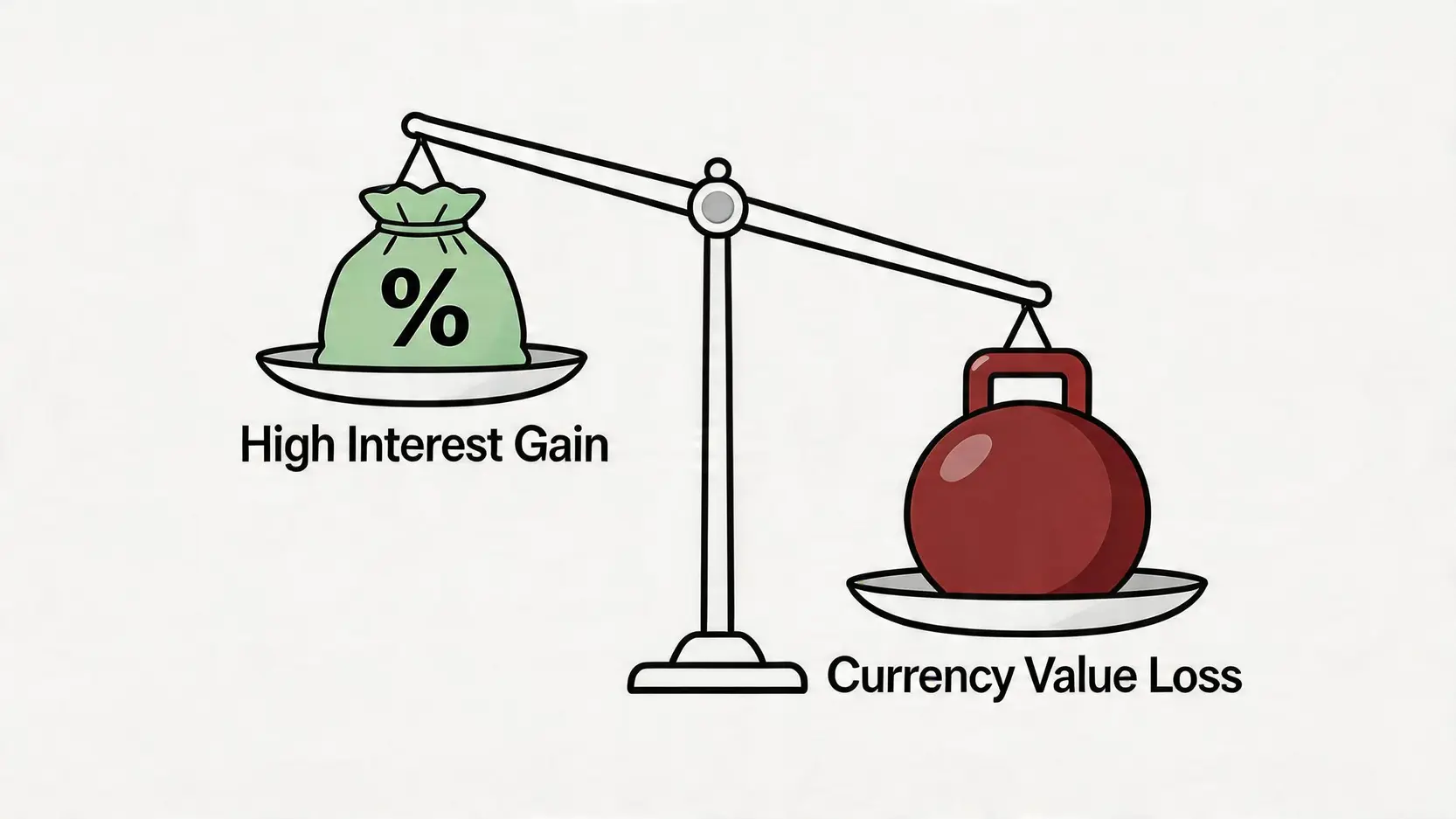
However, the biggest enemy of carry trades is exchange rate risk. The history of the Turkish Lira shows that its rate of depreciation often far exceeds what high interest rates can compensate for.

Lira Investment Risk: Earning Interest but Losing on Exchange Rates
For example:
Assume you convert 10,000 USD into 300,000 lira at the beginning of the year (exchange rate 1:30) and place it in a 40% annual fixed deposit. After one year, your principal and interest will become 300,000 × (1 + 40%) = 420,000 lira. That looks like a strong gain, right?
But if during that year the lira depreciates to 1:40 against the US dollar, converting back will give you 420,000 / 40 = 10,500 USD. Nominally, you only made a profit of 500 USD. If the exchange rate depreciates further to 1:45, you would only receive approximately 420,000 / 45 ≈ 9,333 USD. After a full year of effort, not only do you fail to make money, you may even lose your principal.
This is the most critical risk of investing in the Turkish Lira: earning interest but losing on exchange rate movements.
Risk Management Advice for Investors
If you still wish to capture high-yield opportunities in the lira, the following risk management practices are essential:
- Extreme diversification: Never allocate a large portion of your assets to a single high-risk currency. The lira should only represent a very small part of your portfolio.
- Timing: Closely monitor Turkey’s central bank policy direction and political environment. Entry is more favorable when policy is stable and inflation shows a clear downward trend.
- Stop-loss levels: Define an exchange rate stop-loss before entering a position. Once the level is breached, exit immediately to prevent further losses.
- Hedging tools: If possible, consider using derivatives such as foreign exchange options to partially hedge your lira exposure.
FAQ: Common Questions About Investing in the Turkish Lira
Q: Is it possible to invest in the Turkish Lira now?
A: It depends on your risk tolerance. As of 2026, Turkey is in the early stage of returning to orthodox monetary policy, which brings some positive signals to the market. However, deep structural economic issues remain unresolved, and political risk is still present. This is a highly speculative and extremely high-risk investment, not a stable one. It is only suitable for experienced investors who can tolerate the potential loss of their entire capital, and only with a very small allocation.
Q: Does lira depreciation make Turkey a good travel destination?
A: Yes. For holders of strong currencies (such as the US dollar, euro, or Hong Kong dollar), the depreciation of the lira means your money has “greater purchasing power” locally. The same budget can afford higher-quality accommodation, dining, and shopping, making it relatively more cost-effective from a travel consumption perspective.
Q: What is the main risk of earning high interest from lira deposits?
A: The most important and critical risk is “exchange rate risk”. The high interest earned in lira may be completely offset by the depreciation of the currency itself, potentially leading to capital loss. Historical data shows that annual lira depreciation often exceeds its deposit interest rate, which is a core risk that must not be ignored.
Conclusion
In conclusion, investing in the Turkish Lira is a high-risk, high-potential-return extreme game. The severe volatility of the Turkish lira is rooted in deep structural political and economic issues and cannot be easily resolved in the short term. Although the current return to orthodox monetary policy has brought some positive signals to the TRY exchange rate trend analysis, the future path remains highly uncertain. For ordinary investors, before committing real capital, it is essential to fully understand all aspects of the investment risks of the Turkish Lira and to have a clear and sober awareness of their own risk tolerance. Viewing the lira as a window to observe extreme cases in emerging markets may be more rational than treating it as a reliable investment instrument.
Related Articles
-
Practical Applications of Volatility Surfaces: From Options Modeling to Advanced Skew Trading Strategies In options markets, implied volatility is never a flat line. Instead, it forms complex "smile" or "skew" surfaces. For advanced traders, mastering the practical applications of volatility surfaces is equivalent to possessing a lens that reveals market...2026 年 6 月 3 日
-
Building a Foreign Capital Flow Copy Trading Model: A Stock Market Indicator for Accurately Tracking Institutional Positioning In Asia-Pacific stock markets, foreign capital inflows and outflows often determine the direction of the index. However, simply looking at daily net buy and sell data is no longer enough. Only by building...2026 年 6 月 3 日
-
Options Buyer Strategies During Extreme Market Conditions: Black Swan Hedging and Cross-Market Arbitrage During Volatility Surges The most terrifying aspect of financial markets is not a gradual decline, but overnight flash crashes and cross-market capital withdrawals accompanied by volatility surges. In the highly unpredictable global macroeconomic environment of 2026, geopolitical...2026 年 6 月 3 日