Why Is the US Dollar So Strong? 4 Key Drivers

Updated: 2026/06/22  |  CashbackIsland

why-usd-is-strong

Why Is the US Dollar So Strong? Uncovering the Four Core Forces Behind the “Strong Dollar”

Against a backdrop of growing global economic uncertainty and rising geopolitical risks, the “US dollar holding the market up” has become almost the norm in financial markets. Many investors instinctively attribute the US dollar’s strength to interest rate hikes by the US Federal Reserve (Fed), but that is only part of the story. The US dollar’s dominance stems from the multiple critical roles it plays within the global financial system, which explains why the reasons behind its strength are far more complex than interest rate policy alone. This article takes an in-depth look at the four structural pillars supporting the US dollar’s dominance, from monetary policy and economic fundamentals to its irreplaceable role as a safe-haven currency, providing a comprehensive analysis of how a strong US dollar affects your investment portfolio and the global economy. 


Pillar 1: Interest Rates and Interest Rate Differentials, The Global Capital Compass

Capital is like water. It always flows toward places that offer higher returns with lower risk. Interest rates are the most direct measure of investment returns. One of the primary reasons the US dollar has maintained its long-term strength is its significant interest rate and interest rate differential advantage, which attracts global capital.


Federal Reserve Monetary Policy: How It Guides Global Capital Flows

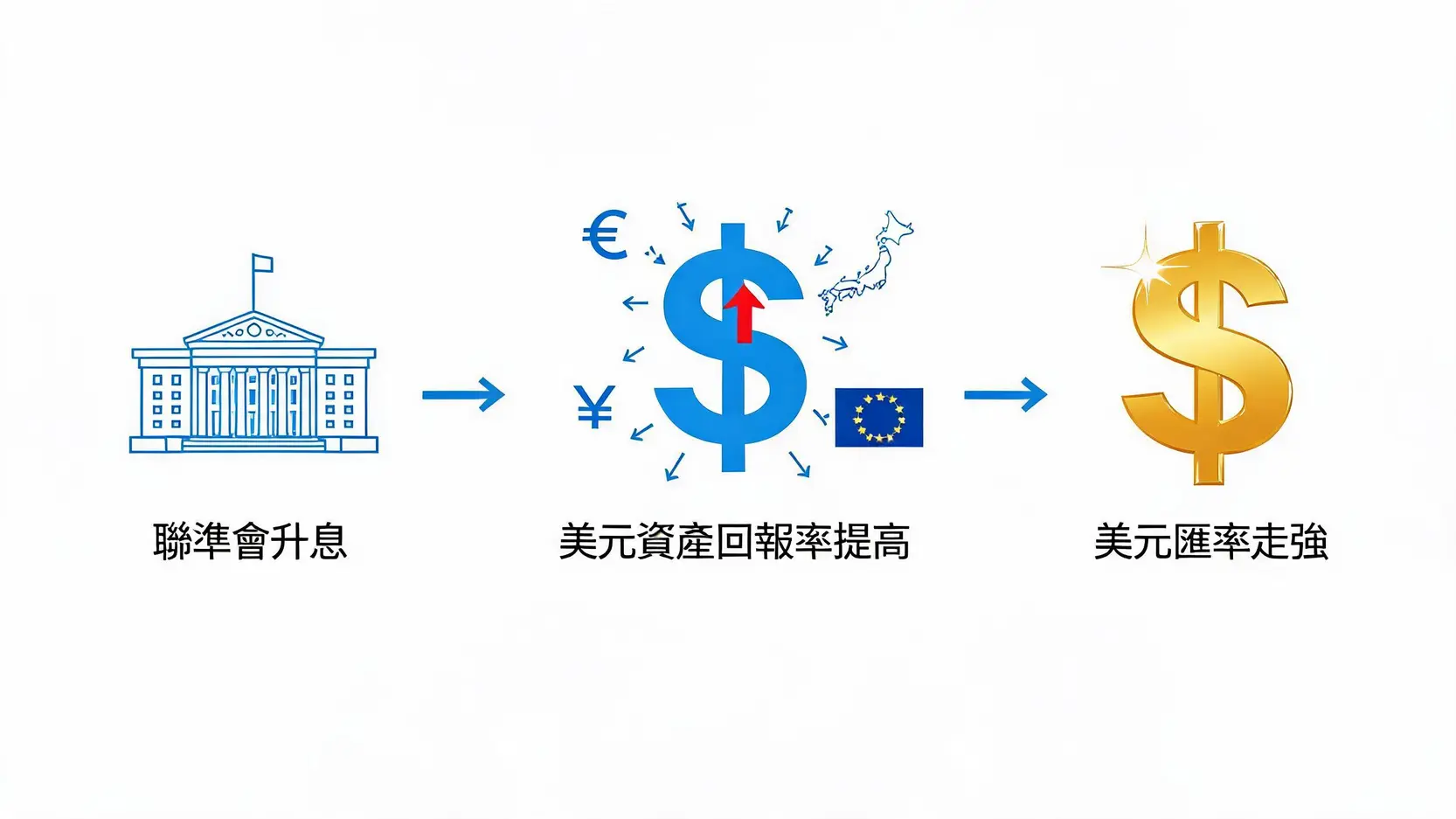
As the world’s most influential central bank, every move made by the US Federal Reserve (Fed) captures the market’s attention. When the Fed adopts a tightening monetary policy (such as raising interest rates or reducing its balance sheet), the returns on US dollar-denominated assets increase. This sends a clear signal to global investment institutions, pension funds, and even individual investors: “It’s more rewarding to keep your money in the US!”

聯準會升息引導全球資金流向美元資產,推升美元匯率的流程圖。

The Federal Reserve’s interest rate decisions are the first step in attracting global capital inflows and driving the US dollar higher.

  • Interest Rate Hiking Cycle: Following the aggressive rate hiking cycle that began in 2022, the Federal Reserve has continued to keep interest rates at relatively elevated levels through 2026 to contain potential inflationary pressures. As a result, US dollar deposits, US Treasury securities, and other US dollar-denominated assets offer significantly higher yields than those in other developed economies.
  • Expectation Management: Every public speech by the Fed Chair and every set of minutes from Federal Reserve policy meetings helps shape market expectations. As long as the market expects US interest rates to remain “Higher for Longer”, capital will continue flowing into US dollar assets, supporting the US dollar.


Comparing Interest Rate Differentials With Other Major Central Banks (ECB, BOJ)

The US dollar’s strength is driven not only by high US interest rates but also by the interest rate differential relative to other major currencies. When the gap between US interest rates and those of other major economies (such as the Eurozone and Japan) widens, the US dollar becomes significantly more attractive.

We can illustrate this with a simple comparison table:

Central Bank Benchmark Interest Rate Range (As of Q2 2026) Monetary Policy Stance Impact on the US Dollar
US Federal Reserve (Fed) ~5.00% – 5.25% Hawkish Hold, Maintaining Higher Interest Rates Continues to Support the US Dollar
European Central Bank (ECB) ~3.00% – 3.50% Dovish Shift, Considering Rate Cuts Relative Weakness in the Euro, Supporting the US Dollar
Bank of Japan (BOJ) ~0.00% – 0.25% Highly Accommodative, Gradual Normalization Persistent Pressure on the Japanese Yen, Reinforcing the US Dollar

As shown in the table above, the wide interest rate differential has made “carry trades” increasingly popular. Investors borrow low-interest currencies, such as the Japanese yen or the relatively lower-yielding euro, convert them into US dollars, and purchase US Treasury securities to earn the interest rate spread. When this strategy is widely adopted, it further increases demand for the US dollar, creating a positive feedback loop.


Pillar 2: The Relative Resilience of the US Economy, A Magnet for Investment

Interest rates provide the incentive, but a country’s economic fundamentals ultimately determine whether capital is willing to remain there over the long term. Compared with the economic challenges facing Europe and Asia, the “relative resilience” demonstrated by the US economy in the post-pandemic era has become the second major pillar supporting the US dollar.


Examining US Economic Fundamentals Through GDP, Employment, and Consumer Spending

Despite slowing global economic growth, several key US economic indicators continue to perform strongly:

  • Gross Domestic Product (GDP): US GDP growth continues to outperform most developed economies, demonstrating the strength and resilience of the economy.
  • Strong Labor Market: The unemployment rate has remained near historic lows, while nonfarm payrolls have repeatedly exceeded market expectations, reflecting robust labor demand.
  • Stable Consumer Spending: Personal consumption, which accounts for roughly 70% of the US economy, has remained resilient. Even in a high interest rate environment, US consumers continue to demonstrate solid spending power, providing strong support for corporate earnings.


How Technological Innovation and Corporate Profitability Attract Investment

The US is not only the world’s largest economy but also the global leader in technological innovation. US companies, particularly those in artificial intelligence, cloud computing, and semiconductors, possess world-leading profitability and pricing power. For investors seeking long-term capital appreciation, the US equity market (especially the Nasdaq) remains an almost irreplaceable destination for US dollar-denominated investments. This also explains why overseas capital continues flowing into the US stock market even during periods of global economic uncertainty, creating sustained demand for the US dollar.


Further Reading (Highly Recommended)

Safe-Haven Asset Comparison: What Should You Invest in During an Economic Recession? Gold, the US Dollar, the Japanese Yen…

When Is the Best Time to Buy US Dollars? Experts Explain Three Key Indicators for Timing Your Currency Exchange


Pillar 3: The US Dollar’s Status as the World’s Safe-Haven Currency, The Final Destination During Market Turmoil

Whenever a black swan event strikes and market panic spreads, an interesting pattern emerges. Regardless of where the crisis originates, capital ultimately flows into the US dollar. This unique position as the world’s ultimate safe-haven asset forms the third pillar behind the US dollar holding the market up.

一張描繪美元作為避險資產的示意圖,在市場動盪時資金紛紛湧入。

When Market Panic Emerges, the US Dollar Is Often Viewed as the Safest Safe Haven.


The “Cash Is King” Effect During Rising Geopolitical Risks

From the Russia-Ukraine war and conflicts in the Middle East to rising tensions in the Asia-Pacific region, every surge in geopolitical risk prompts global investors to instinctively sell higher-risk assets, such as equities and emerging market currencies, in favor of what they perceive to be the safest assets. Under this “risk-off environment”, “Cash Is King” becomes the prevailing market mindset, and the US dollar is universally recognized as that “king”. Investors believe that regardless of what happens, the US government and the Federal Reserve have both the ability and the willingness to maintain financial system stability.


US Dollar Liquidity: Why Is the US Dollar Lifeblood of the Global Financial System?

The US dollar’s safe-haven status is not based solely on confidence. It is also supported by its unmatched “liquidity”. Liquidity refers to an asset’s ability to be bought or sold quickly without significantly affecting its market price.

  • Trading Depth: The US dollar is the most actively traded currency in the global foreign exchange market, accounting for nearly 90% of all transactions. Regardless of when or how much US dollar liquidity is required, there are always sufficient counterparties available.
  • Breadth of Assets: The world’s largest and deepest capital market, the US Treasury market, is denominated in US dollars. Central banks, sovereign wealth funds, and major institutional investors around the world all hold US Treasury securities as core reserve assets.

During periods of extreme market stress, the world can even experience a “US dollar shortage”, as everyone simultaneously seeks to hold US dollars, causing global US dollar liquidity to tighten. In such situations, the Federal Reserve may establish swap lines with other major central banks to inject US dollar liquidity into global markets, further reinforcing the US dollar’s central role in the international financial system.


Pillar 4: The Structural Advantage of the Petrodollar System and Global Trade Settlement

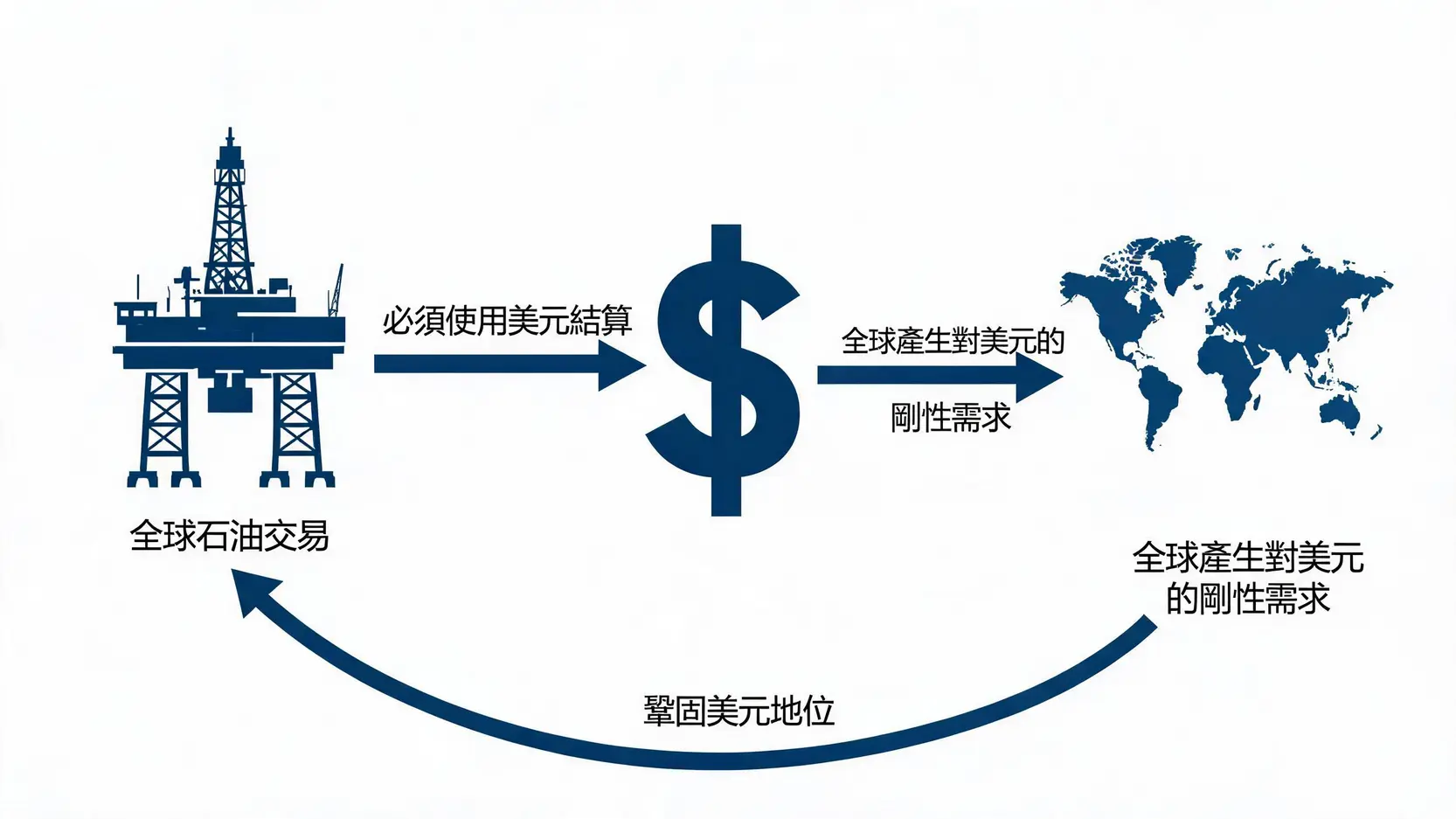
The first three pillars explain “why capital wants to flow into the US dollar”. The fourth pillar, the global financial infrastructure centered on the petrodollar system, explains “why the world must use the US dollar”. This represents a deeper structural advantage and serves as the strongest foundation of US dollar dominance.

石油美元體系循環圖,解釋石油交易如何創造對美元的持續需求。

The Petrodollar System Creates Constant Structural Demand for the US Dollar.


What Is the Petrodollar? How Does It Reinforce the US Dollar’s Dominance?

The petrodollar system refers to an unwritten arrangement under which the world’s major oil-exporting countries (particularly those in the Middle East), price and sell oil in US dollars. This means that any country wishing to import oil must first obtain US dollars to complete the transaction. As a result, the system creates a continuous source of global structural demand for the US dollar. Although discussions of “de-dollarization” have become more common in recent years, the vast majority of globally traded commodities, particularly energy products, continue to be priced and settled in US dollars. This fundamental structure is unlikely to change in the near future.


The Impact of Pricing Major Global Commodities (Such as Crude Oil and Gold) in US Dollars

Oil is not the only commodity priced in US dollars. Gold, copper, soybeans, and many other globally important commodities are also quoted and traded internationally in US dollars. This creates a direct consequence: movements in the US dollar directly influence commodity prices. When the US dollar strengthens, these commodities become more expensive for countries using other currencies, potentially reducing demand and pushing commodity prices lower. The opposite occurs when the US dollar weakens. This inverse relationship between the “US dollar and commodities” means that any business involved in international trade must closely monitor movements in the US dollar.


The SWIFT System and the Dominant Role of the US Dollar in Global Payments

The transmission of cross-border payment information primarily relies on a system known as SWIFT (Society for Worldwide Interbank Financial Telecommunication). Although SWIFT itself is politically neutral, the fact that most major clearing banks are located in the US gives US dollar-denominated cross-border transactions a significant advantage in terms of efficiency and cost. This also allows the US to impose financial sanctions on specific countries or entities by excluding them from the US dollar settlement system, further highlighting the US dollar’s dominant position in global payments.


The Double-Edged Sword of a Strong US Dollar: Its Impact on the Global Economy

Although the “US dollar holding the market up” reflects its remarkable strength, a strong US dollar is a double-edged sword for the global economy. Its effects can be both positive and negative, with dramatically different consequences for different economies.


Impact on Emerging Markets: Debt Pressure and Capital Outflows

Emerging markets are among the biggest victims of a strong US dollar. Many emerging market governments and corporations have accumulated substantial US dollar-denominated debt. When the US dollar appreciates, they must exchange more of their local currency to repay the same amount of US dollar debt, significantly increasing their debt burden and, in some cases, even triggering sovereign debt crises. At the same time, a strong US dollar and higher US interest rates act like a magnet, drawing capital out of emerging markets and back into the US, resulting in capital outflows and placing simultaneous pressure on both local equity and currency markets.


Impact on the US: Export Competitiveness and Import Prices

A strong US dollar is not entirely beneficial for the US economy either.

  • Disadvantages: A stronger US dollar makes US-produced goods more expensive in overseas markets, reducing the international competitiveness of exporters (such as Boeing and General Motors) and potentially widening the trade deficit.
  • Advantages: A stronger US dollar lowers the cost of imported goods, helping to reduce domestic inflationary pressure. This is one reason why the US government tends to be more tolerant of a strong US dollar during periods of elevated inflation.


Further Reading (Highly Recommended)

2025 Guide to Investing in the US Dollar: Understand Four Major US Dollar Investment Strategies in One Article! Includes 30+…

Safe-Haven Currency Rotation Strategy: Which Currency Should You Buy During Times of Uncertainty? A Complete Guide to the US Dollar, Japanese Yen, and Swiss Franc


Conclusion

In summary, the phenomenon of the “US dollar holding the market up” is not driven solely by the Federal Reserve’s interest rate policy. Rather, it is rooted in the combined strength of four solid pillars: a significant interest rate advantage, resilient economic fundamentals, an irreplaceable safe-haven status, and structural advantages deeply embedded within the global trading system. Understanding these four pillars not only helps us assess the US dollar’s long-term outlook but also provides a deeper appreciation of its central role in the global economy. For investors, whether or not they trade currencies directly, understanding the direction of the US dollar is equivalent to holding the key to global asset rotation and is an essential part of making informed investment decisions. 

Frequently Asked Questions (FAQ) About the US Dollar Holding the Market Up

Q: What Is the US Dollar Index (DXY)? How Is It Calculated?

A: The US Dollar Index (DXY) is a composite index that measures the value of the US dollar against a basket of six major currencies (the euro, Japanese yen, British pound, Canadian dollar, Swedish krona, and Swiss franc). It functions like a “weighted average index for the US dollar”. The index is calculated using the weighted geometric average of these six exchange rates, with the euro carrying the largest weighting at 57.6%. When the DXY rises, it indicates that the US dollar is strengthening against the basket of currencies as a whole. Conversely, when it falls, the US dollar is weakening.

Q: How Does a Stronger US Dollar Affect the Taiwan Dollar?

A: In general, when the US dollar strengthens globally, the Taiwan dollar (TWD) tends to weaken. As Taiwan is an export-oriented economy, foreign capital flows have a significant influence on its exchange rate. A stronger US dollar encourages capital to flow out of emerging markets, including Taiwan, and back into the US, creating selling pressure on the Taiwan dollar and causing the TWD/USD exchange rate to depreciate (for example, moving from 31 to 32). However, intervention by the Central Bank of Taiwan and US dollar selling by Taiwanese exporters can also influence short-term exchange rate movements.

Q: How Can Investors Profit From Trends in the US Dollar?

A: Investors have several ways to participate in US dollar trends. The most direct approach is exchanging currency through banks by purchasing US dollar cash or opening a US dollar deposit account. Another option is investing in ETFs that track the US Dollar Index (such as UUP, which is listed on the US stock market). Investors can also trade currency futures involving the US dollar (such as EUR/USD or USD/JPY). For investors with a higher risk tolerance, leveraged forex trading provides greater exposure. Understanding the indicators that help identify the best time to exchange currencies is essential.

Q: Will the US Dollar’s Dominant Position Be Challenged or Replaced in the Future?

A: This is a long-term and complex issue. In recent years, as China’s economy has grown, there have been increasing calls for the internationalization of the renminbi, while the euro has long been viewed as a potential competitor. However, challenging the US dollar’s dominance requires far more than matching the US in economic and military strength. More importantly, it requires building an asset market comparable to the US Treasury market, one that offers similar depth, breadth, credibility, and free capital flows. At present, neither the renminbi nor the euro has reached that stage. Therefore, for the foreseeable future, the US dollar’s central position remains difficult to challenge.

If you liked this article, please share it!

Related Articles

  • Japan Investment Risks: 5 Hidden Risks Beyond the Yen
    Essential Reading on Japan Investment Risks: Five Potential Risks You May Not Know Besides Yen Depreciation Driven by the historic depreciation of the yen, global capital is flowing into Japan with unprecedented enthusiasm. Both the stock market and the real estate market are showing a thriving picture. The market is...
    2026 年 6 月 23 日
  • Gold Price Outlook 2026: Will the Bull Market Continue?
    Will the Gold Price Bull Market Continue? 2026 XAUUSD Trend Analysis, Experts Reveal Three Key Drivers Recently, gold prices have repeatedly hit new highs, and the market is actively debating whether gold has entered a new historic gold price bull market. Many investors are both excited and concerned, wondering how...
    2026 年 6 月 23 日
  • XAUUSD Trading Guide: Trends & Beginner Strategies
    Ultimate Guide to Trading XAUUSD Trends: From Candlestick Teaching to Practical Strategies for Stable Profits for Beginners XAUUSD (spot gold against the US dollar), as one of the world’s most popular trading instruments, offers abundant profit opportunities through its sharp price fluctuations, but also comes with considerable risk. Many beginners...
    2026 年 6 月 23 日
返回顶部