K-Shaped Recovery: Impact & Investment Insights

What Is a K-Shaped Recovery? Understanding Its Economic Impact and 5 Investment Insights Amid Wealth Inequality
Do you feel that even though overall economic data shows growth, life pressure is increasing, while the wealth of the affluent seems to be accelerating? This is very likely the “K-shaped recovery” phenomenon the world is currently experiencing. This concept is not only a headline in financial news, but also a reality that affects your wallet. This article will provide an in-depth explanation of the meaning of K-shaped recovery, explore how it creates significant K-shaped economic impacts, and extract key investment insights from the growing wealth inequality, helping you make informed decisions in this challenging era.
What Exactly Is a K-Shaped Recovery? Understand Economic Polarization at a Glance
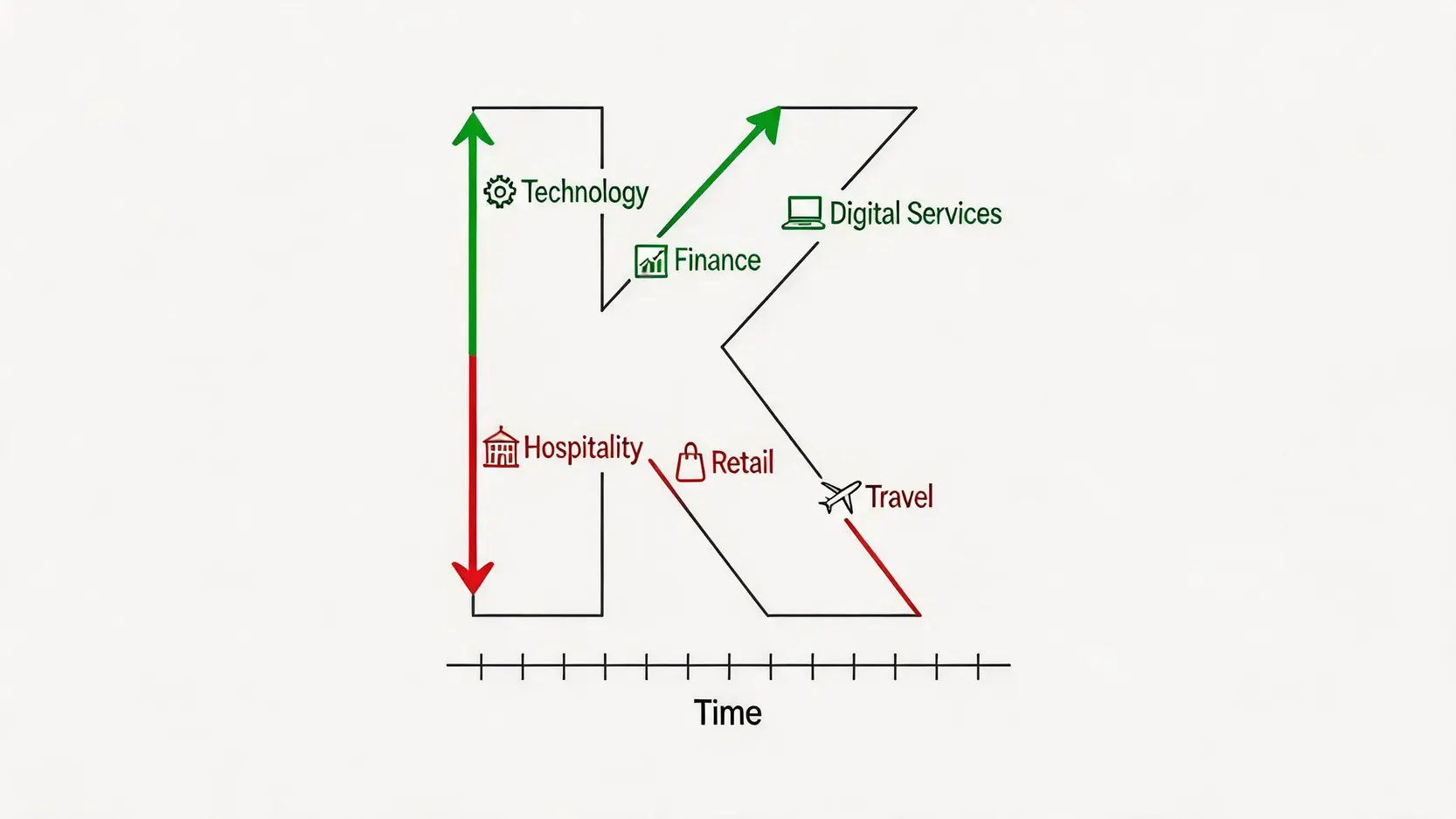
A “K-shaped recovery” refers to a post-recession situation where different industries, companies, and social groups recover at extremely divergent speeds. Just like the letter “K”, the economy splits into two completely different paths: One moves upward, representing rapid growth in sectors such as technology and finance, as well as among the wealthy; the other moves downward, representing continued decline or stagnation in traditional service industries, small and medium-sized enterprises, and middle- to lower-income groups. This trend of economic polarization is key to understanding the current global economic landscape.

The K-shaped recovery vividly illustrates the two completely different paths of “upward” and “downward” movement within the economy.
Further Reading (Highly Recommended)
The Two Branches of K: Why Are Some Industries Rising While Others Are Falling?
The divergence in a K-shaped recovery is not accidental and is driven by multiple factors:
- Upward trend (upper part of the K):
- Technology and digitalization: The pandemic accelerated demand for remote work, e-commerce, and cloud services, leading to strong growth in tech giants and related industries.
- Financial markets: Monetary easing policies from central banks have driven large capital inflows into stock and financial markets, rapidly increasing wealth for asset holders in the affluent class.
- High-skilled labor: Knowledge-based and technical workers are less constrained by location and may even benefit from rising demand and wages.
- Downward trend (lower part of the K):
- Traditional service industries: Sectors such as food and beverage, tourism, retail, and entertainment, which rely heavily on physical interaction, have been severely hit by lockdowns and social distancing measures.
- Small and medium-sized enterprises: Compared to large corporations, SMEs have weaker cash flow and are less able to withstand prolonged economic shocks.
- Low-skilled labor: Frontline workers in the service sector and blue-collar workers face risks of pay cuts, unpaid leave, or unemployment, leading to livelihood difficulties.
Key Differences Between V-Shaped, U-Shaped, L-Shaped, and K-Shaped Recoveries
To better understand the K-shaped recovery, we can compare it with other common economic recovery patterns:

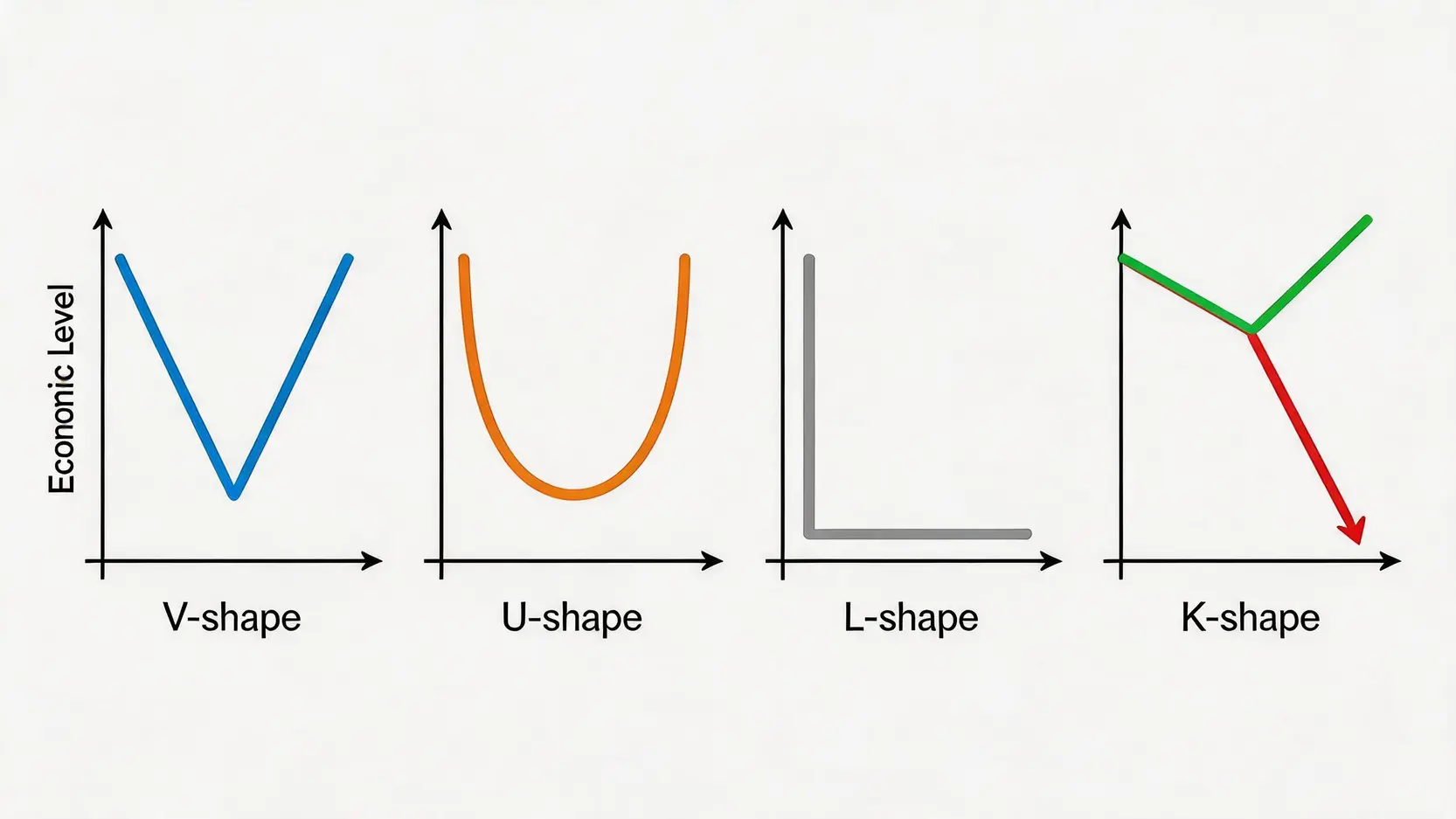
Visual comparison of different economic recovery patterns (V, U, L, K).
| Recovery Pattern | Characteristics |
Description |
| V-shaped recovery | Rapid decline, rapid rebound | The economy experiences a brief and sharp downturn, followed by a quick recovery back to pre-recession levels. It is the most ideal recovery pattern. |
| U-shaped recovery | Slow bottoming, gradual rebound | The economy goes through a prolonged recession period before beginning a slow recovery. |
| L-shaped recovery | Sharp decline, prolonged stagnation | After an economic collapse, the economy fails to recover to its previous level for a long period of time, representing the worst-case scenario. |
| K-shaped recovery | Structural divergence, widening inequality | Unlike the previous types, the K-shaped recovery does not describe a single overall direction of the economy, but rather a split condition where “one part moves upward while another moves downward”. This unevenness in economic recovery is its most fundamental characteristic. |
The 3 Major Impacts of a K-Shaped Economy: How Economic Divergence Affects Our Wealth?
The impact of a K-shaped economy goes far beyond macroeconomic data. It has penetrated every aspect of our lives and brings profound challenges to personal wealth planning.
Industrial Impact: Rapid Growth in Tech and Finance vs. the Struggles of Traditional Services
The most immediate impact comes from the industrial side. In the upper arm of the K, companies such as semiconductors, software services, and fintech not only see their stock prices repeatedly reach new highs, but also strengthen their leading positions by controlling key technologies and market channels. In contrast, traditional industries in the lower arm of the K, such as airlines and brick-and-mortar retailers, face survival crises marked by layoffs and bankruptcies. This structural shift means that the once-stable job market and business models are being disrupted.
Social Impact: Widening Wealth Inequality and Challenges Facing the Middle Class
When wealth disproportionately flows to a small number of individuals and companies, wealth inequality inevitably worsens. Soaring asset prices (such as stocks and real estate), make the rich richer, while stagnant wage growth and rising inflation erode the real purchasing power of the middle and lower classes. The middle class faces immense pressure of “falling behind if not advancing”, having to cope with rising living costs on one hand, while fearing being eliminated by the new economic wave on the other, leading to widespread anxiety.
Financial Markets: Decoupling Between the Stock Market and the Real Economy
“Why is the economy so bad, yet the stock market keeps rising?” This is a common question in a K-shaped recovery. The reason is that stock market gains are mainly driven by large technology and financial stocks, whose strong performance masks the difficulties of many small and medium-sized enterprises. At the same time, loose monetary policies from central banks inject high liquidity into the market, with funds flowing into a small number of high-quality assets, creating a decoupling between financial market prosperity and real economic weakness. This decoupling makes it even harder for those not participating in asset investment to share in the gains of economic growth.
Investment Insights Under Wealth Inequality: 5 Wealth-Enhancing Opportunities in a K-shaped Economy
Faced with the challenges of a K-shaped economy, complaining is useless. Adjusting investment mindset and proactively positioning are the key. The following five investment insights can help you stay grounded and find opportunities for wealth growth in this era of divergence.

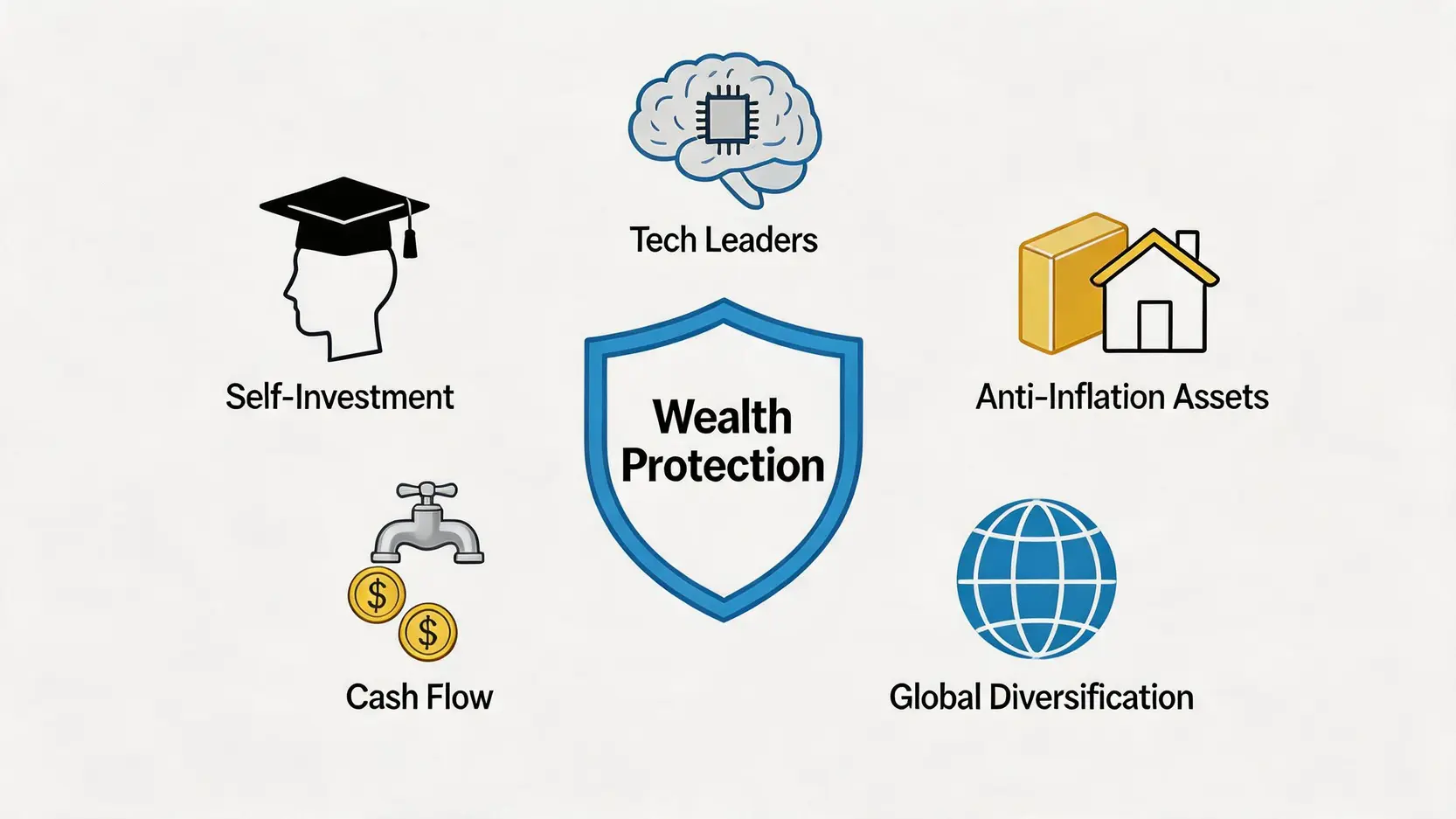
In a K-shaped economy, adopting a diversified investment strategy is key to protecting and growing wealth.
Strategy 1: Focus on Leading Companies and Innovative Technologies in the Upper K
Follow the trend. The direction of the K-shaped recovery is already clear. Rather than resisting it, it is better to align with it. Investment portfolios should focus on industries in the upper arm of the K, such as artificial intelligence (AI), cloud computing, electric vehicles, and fintech leaders. These companies not only possess strong moats but also continuously expand market share through ongoing innovation, serving as long-term growth engines.
Strategy 2: Allocate Assets with Inflation-Resistant Properties (Such as Real Estate and Gold)
A shield against currency devaluation. To stimulate the economy, governments continue to print money, making inflation a long-term trend. It is essential to allocate part of your assets to instruments that preserve value. For example, prime-location real estate, physical gold, and inflation-linked bonds (such as green bonds with inflation protection and stable dividend features) are traditional tools to hedge against declining purchasing power. These assets can help protect overall wealth during rising prices.
Strategy 3: Emphasize Cash Flow and the Value of Defensive Sectors
Stability is key; cash flow is lifeblood. In times of economic uncertainty, stable cash flow is crucial for both companies and individuals to weather difficulties. In investing, focus on sectors with strong cash flow and stable dividends, such as utilities, consumer staples, and healthcare. These businesses have relatively inelastic demand and are less affected by economic cycles, providing steady dividend returns and improving portfolio stability.
Strategy 4: Diversify and Invest in Markets at Different Stages of Recovery Globally
Do not put all eggs in one basket. The K-shaped recovery progresses unevenly across the world. Some emerging markets may be at different stages of recovery or possess unique growth drivers. Through global asset allocation, risks from a single market can be effectively diversified while capturing growth opportunities across regions. Investing in ETFs that cover different countries and industries is a convenient way to achieve global diversification.
Strategy 5: Enhance Personal Value by Investing in Knowledge and Skills
The best investment is investing in yourself. In a K-shaped economy, gaps in knowledge and skills directly translate into income inequality. Rather than worrying about being left behind, actively invest in yourself. Learn new skills, obtain professional certifications, and master digital tools to become the talent needed in the upper arm of the K. This is an irreplaceable asset and the strongest foundation for navigating future uncertainties.
Further Reading (Highly Recommended)
Frequently Asked Questions (FAQ) on K-shaped Recovery
Q: How long will a K-shaped economy last?
A: There is currently no definitive answer, but most economists believe it may be a medium- to long-term phenomenon. This is because the drivers of K-shaped divergence, such as technological transformation, restructuring of globalization, and monetary policy, are structural in nature and difficult to reverse in the short term. Investors should be prepared for long-term adaptation.
Q: Which industries benefit the most in a K-shaped recovery?
A: The industries in the upper arm of the K that benefit the most mainly include semiconductors, cloud services, artificial intelligence (AI), electric vehicles and new energy, financial technology (FinTech), telemedicine, and biotechnology. These sectors typically have high technological barriers and strong market demand.
Q: How should ordinary people respond to the impact of a K-shaped economy?
A: In addition to the investment strategies mentioned earlier, individuals can act on two fronts. First, “defense”, by building an emergency savings fund, reducing unnecessary debt, and maintaining financial health. Second, “offense”, by continuously learning new skills, enhancing irreplaceability in the workplace, and starting disciplined investments early in high-quality assets in the upper arm of the K.
Q: What role does the government play in addressing a K-shaped recovery?
A: The government plays a crucial role. Ideally, through fiscal policies (such as tax reforms and subsidies) as well as social welfare policies, the government should provide a safety net for groups in the lower arm of the K, and through education and vocational training, help workers adapt to the needs of the new economy, thereby easing social tensions and promoting more balanced development.
Conclusion
In summary, understanding the meaning of a K-shaped recovery and its economic impact is essential. This is not only an economic concept but also a reality that affects each of us. Faced with the challenge of widening wealth inequality, we must adjust our investment mindset and adopt more flexible and diversified strategies. From focusing on trending industries and allocating inflation-resistant assets to emphasizing cash flow and global positioning, every step is aimed at building a more resilient wealth structure in an uncertain future. It is hoped that the five key investment insights provided in this article can help you navigate economic uncertainty and achieve steady wealth growth. Take action now, review your investment portfolio, and prepare for the future.
Related Articles
-
How Does Hedging Work? Advanced Hedge Fund Strategies and Practical Trading Guide In the rapidly changing financial markets, relying solely on a “buy-and-hold” strategy often makes it difficult to withstand severe market volatility and achieve stable long-term profits. If you have heard Wall Street leaders discuss risk hedging, you are...2026 年 7 月 14 日
-
What Is Hedging? A Risk Management Guide Every Financial Beginner Should Read In the investment market, we often hear the term “hedging”, but what exactly does it mean? Why do professional investors use it? Hedging means adopting strategies to protect assets from adverse price movements. Whether in the stock, foreign...2026 年 7 月 14 日
-
2026 Complete Guide to US Treasury Yields: Trend Analysis, Impact of Surging Yields, and Asset Allocation Strategies In the rapidly changing global financial market, US Treasury yields have long been regarded as the most important benchmark for the risk-free rate. Entering 2026, amid recurring shifts in inflation expectations and dynamic...2026 年 7 月 13 日