Green Bonds Guide: Yield, Pricing & Redemption

Complete Guide to Green Bonds: Interest Payment Yield Calculation, Secondary Market Pricing, and Redemption at Maturity
Many Hong Kong residents hold Green Bonds, but still have questions about how to calculate actual interest payment returns, whether to sell in the secondary market, and most importantly, the green bond redemption process at maturity. As a relatively stable investment instrument linked to inflation, understanding its mechanism is key to maximizing returns. This article provides a one-stop guide, offering a detailed explanation of how to calculate green bond interest payment returns, the pricing dynamics of green bonds in the secondary market, and how they are handled at maturity, helping you make the most informed investment decisions.
Core Returns of Green Bonds: How to Calculate Interest Payments?
The most attractive feature of green bonds lies in their interest payment mechanism. They provide a minimum guaranteed rate while allowing investors to benefit from inflation, offering a stable cash flow. To accurately calculate returns, you must first understand their interest structure.
Green Bond Interest Payment Mechanism Explained (Linked to Inflation)
Interest on green bonds is paid every six months, and the interest rate is determined by two key components:
- Floating rate return: Linked to the year-on-year change in Hong Kong’s Composite Consumer Price Index (CPI). In simple terms, it is based on the arithmetic average of the CPI over the most recent six months. The higher the inflation, the higher the interest rate. You can check the latest official data on the Hong Kong Census and Statistics Department website.
- Fixed rate return (minimum guaranteed rate): A minimum guaranteed rate is set at issuance. For example, the green bond issued in 2023 (stock code: 4273.HK) has a minimum guaranteed rate of 4.75%.
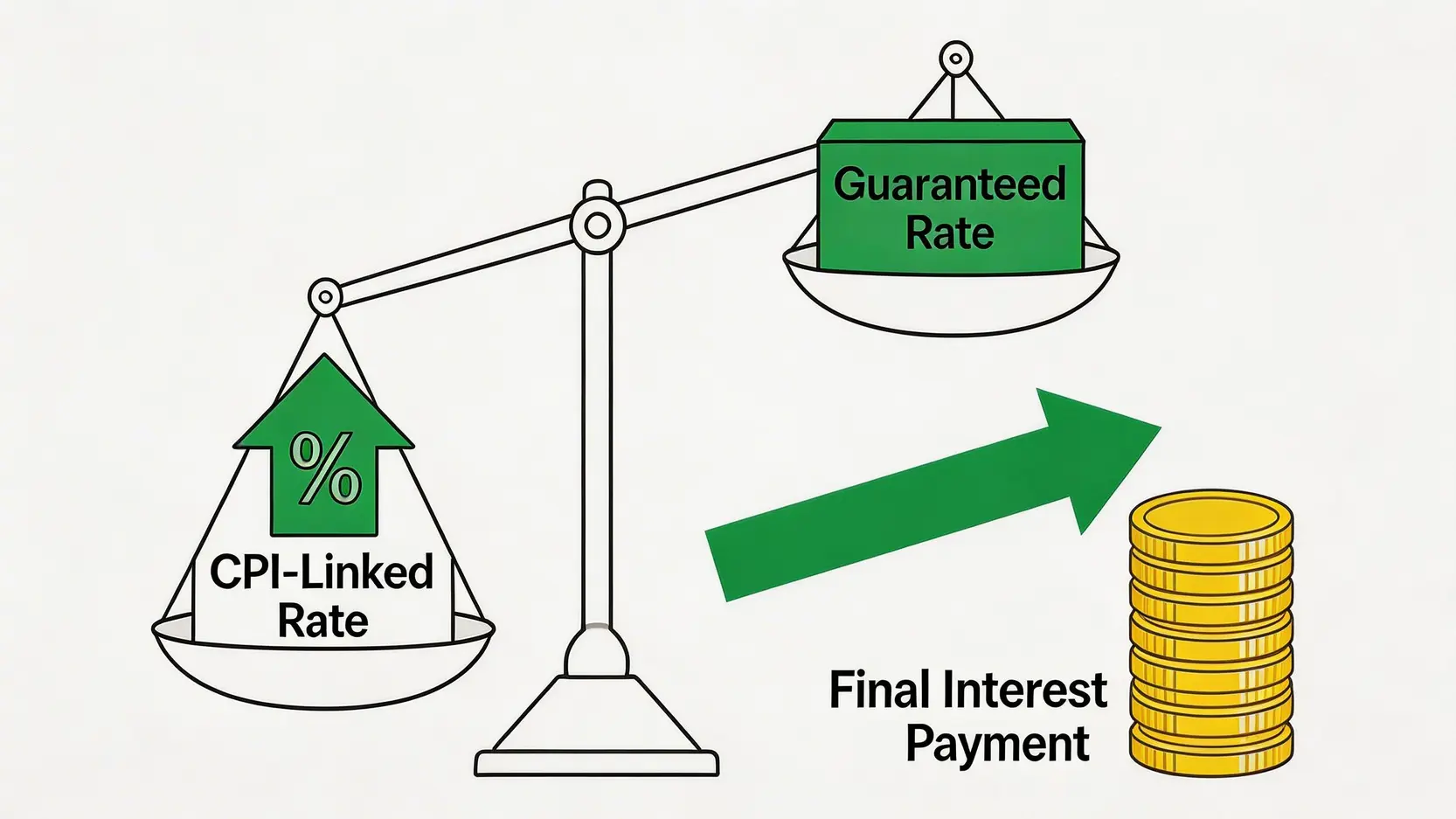
At each interest payment, the higher of the two rates will be applied. This structure ensures that even in a low-inflation or deflationary environment, investors can still receive an attractive guaranteed return.

Green bond interest mechanism: the higher of the inflation-linked “floating rate” and the “minimum guaranteed rate” is applied for interest payments.
Historical Interest Payment Dates and Yield Overview
To provide investors with a clearer understanding of returns, the following summarizes the interest payment record of the retail Green Bond (4273.HK) for reference:
| Interest Payment Date | Annual Interest Rate | Interest per Lot (HK$10,000) |
| April 1, 2024 |
4.75% |
HK$237.5 |
| October 1, 2024 | 4.75% | HK$237.5 |
| April 1, 2025 | 4.75% | HK$237.5 |
| October 1, 2025 | 4.75% | HK$237.5 |
| April 1, 2026 | 4.75% | HK$237.5 |
Note: The interest rates in the table above are for illustrative purposes only. The actual interest rate will depend on the prevailing inflation data. As inflation has been below 4.75% in recent years, the minimum guaranteed rate is applied.
Practical Example: How to Calculate the Interest You Are Entitled To?
The interest calculation formula is straightforward:
Interest received = Principal x Annual interest rate x Half-year period (0.5)
Assuming you hold 5 lots of Green Bonds (that is a principal of HK$50,000) and the applicable annual interest rate is 4.75%, the interest you will receive is:
HK$50,000 x 4.75% x 0.5 = HK$1,187.5
This amount will be automatically credited to your designated bank account on the interest payment date, making the process very convenient.
Take Profit Early or Cut Losses? A Guide to Trading Green Bonds in the Secondary Market
Although most people view Green Bonds as long-term income-generating instruments, they can actually be traded on the Hong Kong Exchange (HKEX) just like stocks. This provides investors with additional flexibility, but also comes with the risk of price fluctuations. Understanding how Green Bond prices move in the secondary market is essential for making informed trading decisions.
How to Check Real-Time Green Bond Prices in the Secondary Market?
Checking real-time secondary market prices for Green Bonds is very convenient and no different from checking stock prices:
- Securities broker apps or websites: Log in to your trading platform and enter the Green Bond code (for example: 4273) to view real-time bid prices, ask prices, and transaction records.
- Financial information websites: Major financial websites (such as Google Finance and Yahoo Finance) also provide real-time quotes.
Bond prices are typically quoted per 100 units of face value. For example, a quoted price of 101.5 yuan means that for every 100 units of face value, the bond is trading at 101.5 yuan in the market.
Steps and Key Considerations for Trading Green Bonds in the Secondary Market
The process of trading Green Bonds in the secondary market is identical to buying and selling stocks:
- Log in to the trading platform: Open your bank or securities account.
- Enter the trade order: Input the bond code, desired buy or sell price, and quantity.
- Confirm the transaction: Verify the details and submit the order.
Key considerations:
- Transaction costs: Trading Green Bonds incurs fees similar to stock trading, such as brokerage commissions, transaction levies, and platform fees. These costs will affect your final return.
- Accrued interest: When buying bonds in the secondary market, the buyer typically needs to pay the seller “accrued interest”, which is the interest accumulated from the last interest payment date to the settlement date. Conversely, the seller will receive this amount.
- Liquidity: Although Green Bonds are tradable, their trading volume is much lower than that of popular blue-chip stocks, and it may take longer to execute trades at your desired price.
Price Fluctuation Risk: Will You Incur Losses When Selling Green Bonds?
The answer is yes. The price of Green Bonds in the secondary market is mainly influenced by market interest rate expectations. Generally, when market interest rates rise, bond prices fall; when market interest rates decline, bond prices rise.
If your selling price in the secondary market is lower than your purchase price (typically 100 yuan), you may incur a loss even after accounting for interest received. Therefore, before selling, you should carefully calculate the “total return” (including capital gain or loss plus interest received) to determine whether the transaction is worthwhile.
What Happens When a Bond Reaches Maturity? A Detailed Guide to the Redemption Process
For investors who do not want to bear the price fluctuation risk of the secondary market, “holding to maturity” is the simplest and most stable strategy. Understanding the redemption process of Green Bonds at maturity allows you to plan your funds with greater peace of mind.
Definition and Process of Green Bond Redemption at Maturity
“Redemption at maturity” refers to the issuer (the Hong Kong government), buying back the bond from the holder at 100% of its face value (that is HK$10,000 per lot) on the specified maturity date. The entire process is fully automated, and investors do not need to take any action.
You only need to ensure that your bank or securities account holding the bonds remains active. Upon maturity, both the principal and the final interest payment will be automatically credited to your account.
When Will the Principal and Final Interest Be Credited After Maturity?
According to the issuance terms, the principal and the final interest payment are usually credited to the investor’s designated account on the maturity date or within a few business days thereafter. The exact timing depends on the internal settlement process of the bank or broker you are using.
Hold to Maturity vs Sell in the Secondary Market: Which Is More Cost-Effective?
This is a key decision point that depends on your investment objectives and market conditions. The following is a simple comparison:

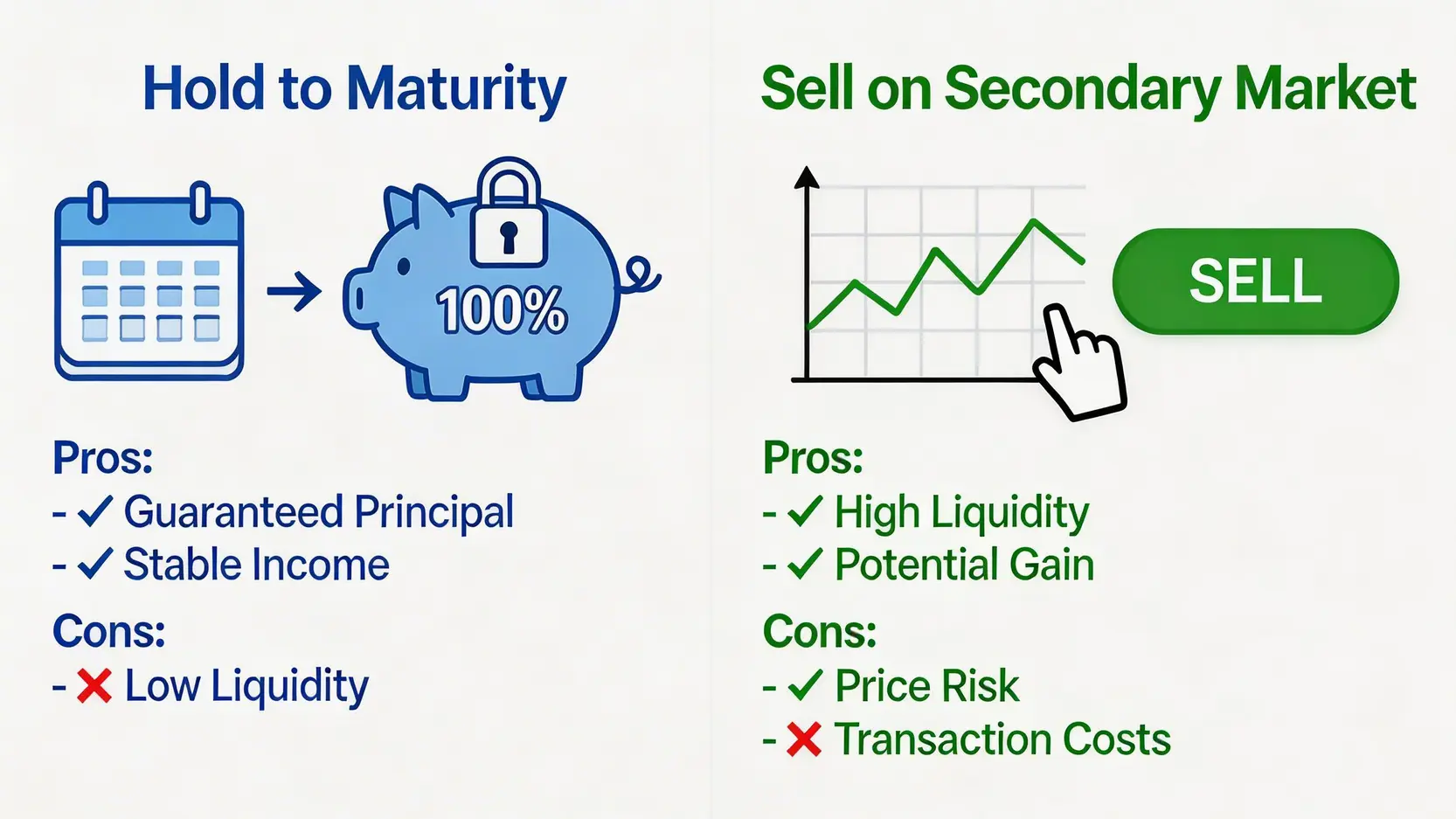
Investment Strategy Decision Point: Holding to maturity ensures principal protection, while selling in the secondary market offers flexibility but carries price risk.
Hold to maturity
- Advantages: Guaranteed return of 100% principal, no price fluctuation risk, and full receipt of all interest, suitable for conservative investors seeking stable returns.
- Disadvantages: Funds are locked until the maturity date, resulting in limited flexibility.
Sell in the secondary market
- Advantages: Can liquidate at any time with high flexibility; if the market price is above 100, you can lock in profits early and realize capital gains.
- Disadvantages: Exposure to price decline risk, and selling below the purchase price may result in losses; transaction costs are also incurred.
In general, if market interest rates decline and push up Green Bond prices in the secondary market (for example to 102 or 103), selling early to lock in profits may be a good option. Conversely, if the price is below 100 and you do not have urgent liquidity needs, holding to maturity to earn stable interest and recover the full principal is undoubtedly the wiser choice.
Frequently Asked Questions (FAQ)
Can Green Bonds be redeemed early? Are there any fees?
Investors cannot request the issuer (the Hong Kong government) to redeem the bonds before maturity. The only way to “exit early” is to sell them to other investors in the secondary market. This will involve standard securities trading fees, but there is no additional “early redemption fee”.
If the Green Bond price in the secondary market falls below 100 yuan, does it mean a loss?
A: Not necessarily. A price below 100 yuan in the secondary market only means that selling “at that moment” would result in a capital loss. However, if you continue to hold the bond, you can still receive interest payments that are above inflation or guaranteed, and recover 100% of the principal at maturity. A price below 100 yuan may actually present an opportunity for buyers, as it implies a higher “yield to maturity”.
If I miss the subscription period, can I still buy Green Bonds in the secondary market?
Absolutely. After issuance, Green Bonds are listed and traded on the Hong Kong Exchange. Any investor with a securities account can buy them in the secondary market during trading hours, just like stocks.
Do I need to pay tax on interest income from Green Bonds?
No. For Hong Kong residents, interest income from bonds issued by the Hong Kong government (including Green Bonds) is tax-exempt. This is one of their key advantages.
What is the ticker code for Green Bonds?
Each issuance of Green Bonds has its own unique code. For example, the retail Green Bond issued in 2023 and maturing in 2026 is listed on the Hong Kong Exchange under the code “4273”.
Conclusion
In summary, Green Bonds are a highly attractive and stable investment instrument that effectively combines capital protection, inflation hedging, and steady interest income. Whether you plan to hold them to maturity for stable cash flow or seek trading opportunities from price fluctuations in the secondary market, fully understanding the interest payment calculation methods, the factors affecting secondary market prices, and the redemption mechanism at maturity is key to maximizing investment returns. We hope this comprehensive guide helps you manage your Green Bond investments more effectively and make decisions that best align with your financial goals.
Related Articles
-
[Second Half of 2026] Complete Japanese Yen Outlook Forecast: The Ultimate Currency Exchange Strategy for Investors and Travelers Following record-breaking market interventions, the future outlook for the Japanese yen is filled with both uncertainty and opportunity. Will the yen regain its strength, or will it fall to new lows? This...2026 年 6 月 5 日
-
How Significant Is the Impact of the Geopolitical Risk Premium on Taiwan Stocks? Understanding the Risks, Opportunities, and Investment Strategies In an increasingly globalized world, Taiwan's stock market is influenced not only by economic fundamentals but is also constantly exposed to complex geopolitical risks. From tensions in cross-strait relations to...2026 年 6 月 5 日
-
The Fourth Largest Net Buy in History! Foreign Investors Snap Up NT$62.7 Billion of Taiwan Stocks, Revealing Three Key Signals Behind Stocks and the Currency Rising in Tandem Taiwan's stock market staged a stunning rally, surging more than 900 points in a single day with trading volume reaching extraordinary levels....2026 年 6 月 5 日