Gold Investment Guide: Compare 5 Popular Options

The Complete Guide to Gold Investment Channels: Comparing the Pros, Cons, and Costs of 5 Major Options Including Physical Gold, Gold Savings Accounts, ETFs, and Futures
Want to hop aboard gold’s fast track for inflation protection and safe-haven investing, but feel overwhelmed by the many available gold investment channels? For many people, buying gold means visiting a jewelry store to purchase gold bars or jewelry, only to worry about storage issues and wide buy-sell spreads. Others consider financial products but find themselves torn “between physical gold and gold savings accounts”, or unfamiliar with recommended gold ETFs. In reality, different gold investment vehicles are designed for entirely different investors and strategies.
This article provides a comprehensive breakdown of the five most popular gold investment channels from the perspective of an experienced investor: from traditional physical gold to convenient gold savings accounts, flexible gold ETFs and gold funds, and finally high-leverage gold futures and CFDs. We will examine the advantages, disadvantages, trading costs, and potential risks of each option, helping you build a clear investment roadmap and quickly identify the approach that best suits your needs. Whether you are a beginner seeking long-term wealth preservation or an experienced investor looking to profit from price movements, you will find the answers here.
Conservative Wealth Preservation: The Stable Choices of Physical Gold and Gold Savings Accounts
For investors new to gold investing or those with lower risk tolerance, physical gold and gold savings accounts offer the most straightforward and relatively stable entry points. Their core concept is simple: “owning gold”. The primary objective is wealth preservation and protection against currency depreciation rather than generating short-term trading profits.
Physical Gold (Gold Bars and Jewelry): Tangible Security and Hidden Costs
Physical gold, including gold bars, bullion, coins, and jewelry, is the oldest form of gold investment. Its greatest appeal lies in the comfort of “owning a tangible asset”. There is no counterparty risk, and it is an asset you physically possess.
- Advantages:
-
-
- Highest Level of Asset Ownership: The gold is in your possession and is not affected by the failure of any financial institution.
- Globally Recognized Value: Gold is considered a hard asset worldwide and enjoys excellent liquidity across countries.
- No Ongoing Management Fees: After purchase, there are no recurring charges beyond any storage costs you choose to incur.
-
- Disadvantages:
-
- Wide Buy-Sell Spreads: The gap between the ask price (seller’s quote) and the bid price (buyer’s quote) is typically wider especially for jewelry, where craftsmanship and design costs are included. When selling, only the gold value is typically considered, resulting in spreads that may exceed 10%. Gold bars generally have narrower spreads, but these often range between 1% and 5%.
- Storage and Security Costs: Investors must consider theft risks when storing gold at home or the additional expense of renting a bank safety deposit box.
- Lower Liquidity: Transactions are less convenient than financial products, requiring visits to jewelry stores or banks during business hours.
- Authentication Concerns: Purity verification may be required when selling, adding complexity to the transaction process.
In summary, physical gold is best suited for investors who place a high value on direct ownership and intend to hold gold for many years or even decades as a “long-term reserve” asset.
Gold Savings Accounts: Digitalized Physical Gold and the Ideal Choice for Small Investors
A Gold Savings Account can be viewed as a “digital gold custody service”. Investors purchase gold through a bank, and the quantity of gold owned is recorded in the account. However, physical gold is not delivered to the investor. This eliminates storage and security concerns, making it one of the most popular small-scale gold investment channels in Taiwan.
Using the Bank of Taiwan Gold Savings Account as an example, the system operates as follows:
- Advantages:
-
-
- Very Low Entry Barrier: Investors can purchase as little as one gram of gold at a time, making it ideal for dollar-cost averaging and cost diversification.
- Convenient Trading: Gold can be bought and sold through online banking or mobile applications during trading hours, offering significantly greater liquidity than physical gold.
- No Storage Concerns: The bank handles storage, eliminating worries about theft or damage.
- Convertible Into Physical Gold: Once sufficient gold has been accumulated, investors can pay a small service fee to convert their holdings into designated physical gold bars.
-
- Disadvantages:
-
- Transaction Costs: There is still a spread between the buying and selling prices. Although it is smaller than that of physical gold, frequent trading can still erode profits. In addition, withdrawing physical gold requires an additional “physical withdrawal processing fee”.
- Limited Trading Hours: Transactions can typically only be conducted during banking hours, unlike foreign exchange or cryptocurrency markets that operate around the clock.
- No Direct Physical Possession: Although conversion is possible, the holdings remain book-entry assets and are subject to the operational risk of the bank (albeit minimal in Taiwan).
Gold savings accounts are ideal for investors seeking a long-term, systematic way to accumulate gold without the burden of physical storage. They remain one of the simplest and most accessible ways to begin investing in gold.
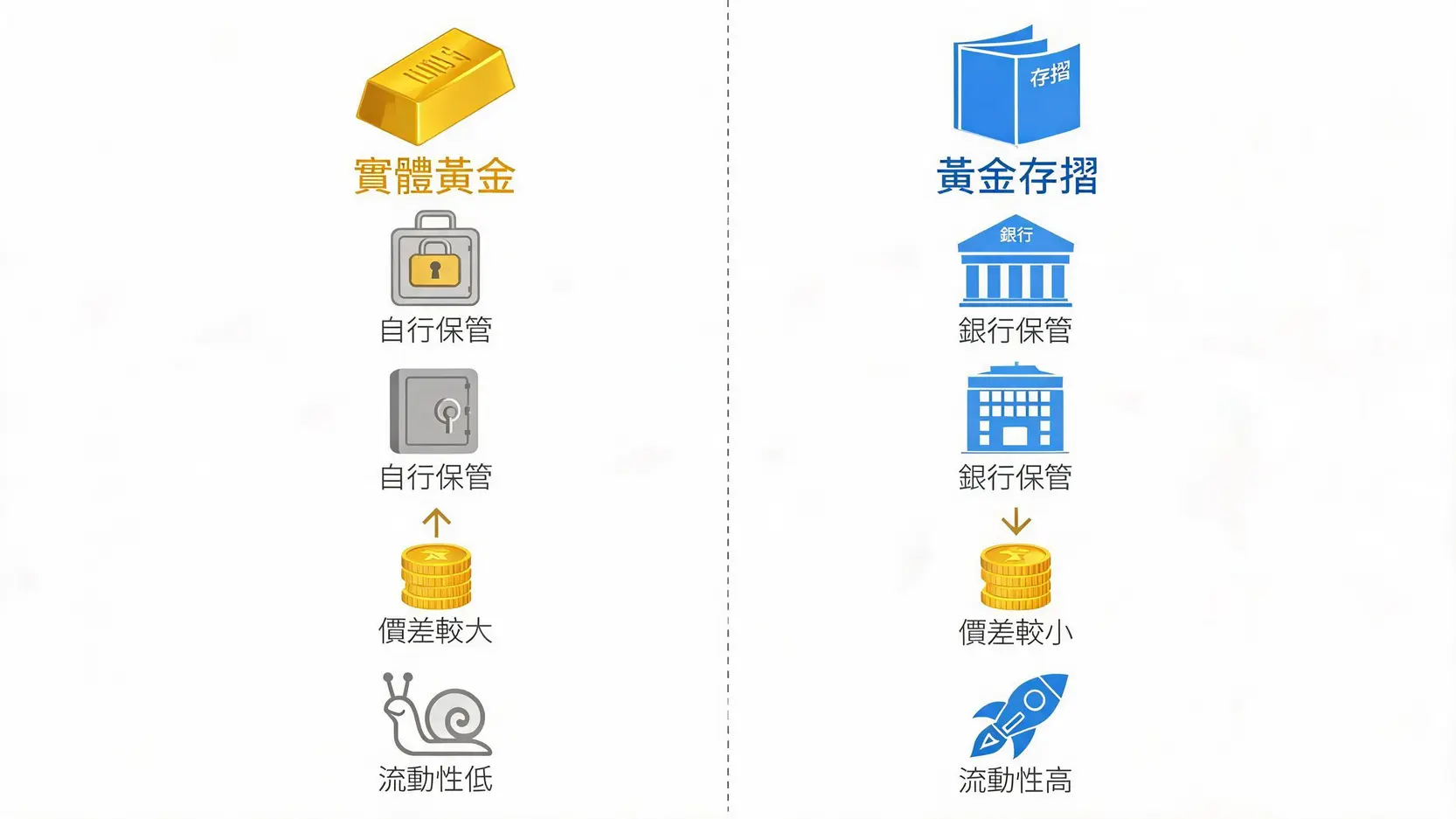
A Quick Comparison: Physical Gold vs. Gold Savings Accounts – Which Is Right for You?
Further Reading (Highly Recommended)
Flexible Trading: Capturing Market Opportunities With Gold ETFs and Gold Funds
If your goal is to participate more actively in gold price movements rather than simply holding gold over the long term, gold ETFs and gold funds may be better suited to your needs. These products trade like stocks, offering high liquidity and transparent costs, making them attractive to investors with some market experience.
Gold ETFs: Trading Gold Like a Stock
A Gold ETF (Exchange-Traded Fund) is a fund designed to track the spot price of gold. Fund providers typically purchase physical gold to back the ETF and issue standardized shares that trade on stock exchanges. Buying a gold ETF effectively means indirectly owning physical gold.
In Taiwan, the most well-known gold ETF is Yuanta S&P Gold (00635U), while internationally, one of the most representative products is SPDR Gold Shares (GLD).
- Advantages:
-
-
- Extremely Convenient Trading: Anyone with a brokerage account can buy and sell gold ETFs during market hours, just like trading stocks. Liquidity is excellent.
- Low Trading Costs: Compared with the spreads associated with gold savings accounts, ETF trading costs mainly consist of brokerage commissions and securities taxes. Bid-ask spreads are typically very small, making ETFs suitable for swing trading.
- Transparent Holdings: The fund’s gold reserves are disclosed regularly, providing a high level of transparency.
-
- Disadvantages and Considerations:
-
- Management Fees (Expense Ratio): Fund managers charge annual management fees deducted from net asset value. This represents a hidden cost for long-term investors. For example, GLD charges approximately 0.4% annually.
- Tracking Error: Due to management fees and operational factors, ETF performance may not perfectly replicate spot gold prices, resulting in slight deviations.
- Currency Risk: Investors purchasing overseas gold ETFs (such as GLD) are exposed not only to gold price fluctuations but also to exchange rate movements between the US dollar and their local currency.
Gold ETFs are among the most efficient and cost-effective gold investment channels available today. They are particularly suitable for investors who want to incorporate gold into a diversified portfolio while retaining the flexibility to trade strategically. For a deeper understanding of the advantages of gold ETFs, additional analysis may be helpful.
Gold Funds: Investing in Gold Miners Rather Than Gold Itself
Gold Funds differ fundamentally from Gold ETFs. Instead of investing directly in gold, they primarily invest in shares of “companies involved in gold mining”, refining, and production. Their performance therefore depends not only on gold prices but also on company management, production costs, and overall market sentiment.
- Advantages:
-
-
- Potential Leverage Effect: When gold prices rise, mining companies’ profits may increase at a faster rate, potentially resulting in share price gains that exceed the performance of gold itself.
- Risk Diversification: Investing in a basket of mining stocks reduces company-specific operational risks.
-
- Disadvantages:
-
- Higher Volatility: Gold mining stocks are generally far more volatile than spot gold. When gold prices decline, mining stocks may experience even larger losses.
- Not Perfectly Correlated With Gold Prices: Factors such as corporate management decisions, labor disputes, environmental regulations, and production costs can cause mining stock performance to diverge from gold prices.
- Higher Management Fees: As actively managed funds, gold funds generally charge higher fees than passive gold ETFs.
Choosing a gold fund is more akin to investing in the broader gold industry rather than making a pure safe-haven gold investment. These products are better suited for investors who can tolerate higher levels of risk and possess a deeper understanding of equity markets.
Leveraged Speculation: The Double-Edged Sword of Gold Futures and Contracts for Difference (CFDs)
For professional traders seeking high returns and possessing a strong risk tolerance, gold futures and Contracts for Difference (CFDs) offer the opportunity to amplify profits through leverage. However, it is important to remember that leverage is a double-edged sword. The same mechanism that magnifies gains can also create substantial losses.
Gold Futures and CFDs: Leverage, Trading Costs, and Potential Risks
Gold futures are standardized contracts traded on futures exchanges, where buyers and sellers agree to trade a specified quantity of gold at a predetermined price on a future date. Gold CFDs, on the other hand, are financial derivatives that allow traders to speculate on gold price movements without actually owning physical gold.
The defining characteristic of both instruments is “leverage”. For example, through CFD trading, you may only need to deposit US$1,000 in margin to control a gold position worth as much as US$20,000 (equivalent to 20x leverage).
- Advantages:
-
-
- Extremely Efficient Capital Utilization: Leverage allows traders with relatively small amounts of capital to participate in significant market movements, creating the potential for high returns.
- Long and Short Trading Opportunities: Whether the market rises or falls, traders can profit if their market view is correct. Positions can be opened both long (buy) and short (sell).
- Nearly 24-Hour Trading: Gold is a global market, and CFD platforms typically offer almost round-the-clock trading access, enabling traders to react to developments from any region.
-
- Potential Risks:
-
- Significant Loss Potential: Leverage magnifies losses to the same degree that it magnifies gains. A relatively small adverse market move can result in the loss of the entire margin deposit and, in some cases, create negative account balances.
- Complex Trading Costs: Costs may include spreads (bid-ask differences), overnight financing charges (holding costs for positions kept overnight), and commissions, making the overall cost structure more complicated.
- High Level of Expertise Required: Successful trading requires accurate market analysis, strict risk management, and disciplined capital allocation. These products are not suitable for beginner investors.
Gold futures and CFDs are tools designed for professional short-term traders rather than long-term investors. Unless you fully understand how they work and the risks involved, you should avoid using them. Investors interested in CFDs are encouraged to first develop a solid understanding of the fundamentals.
A Visual Overview of the 5 Major Gold Investment Channels

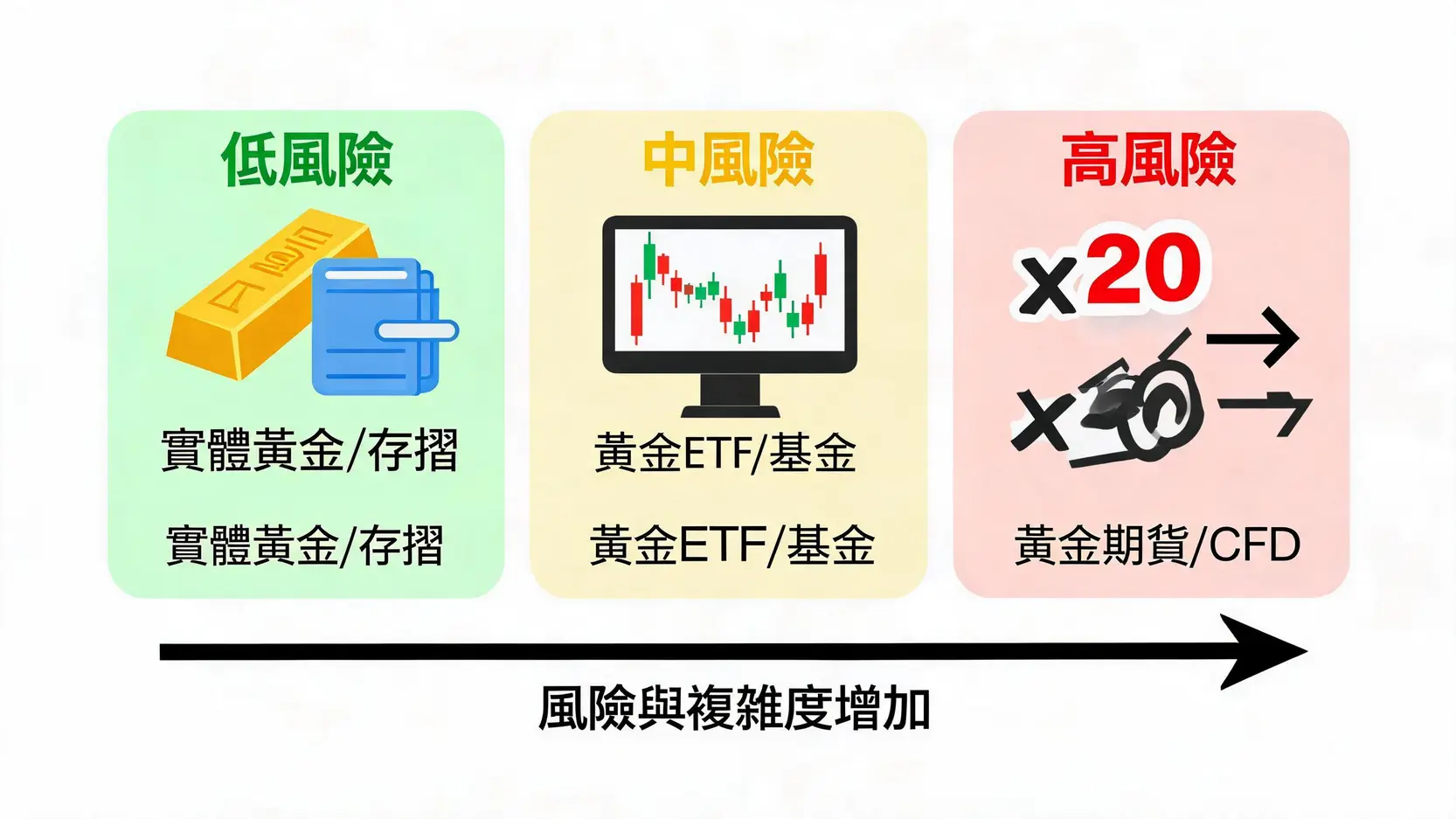
The Gold Investment Spectrum: Five Levels Ranging From Wealth Preservation to High-Leverage Trading
To help you better understand the differences between these five gold investment channels, we have compiled the following comprehensive comparison framework. Based on your investment objectives, risk tolerance, and available capital, you can quickly identify the option that best suits your needs.
[Comparison Summary Table] Suitable Investor Profile / Trading Costs / Liquidity / Risk Level / Leverage Ratio
| Investment Channel | Suitable Investor Profile | Trading Costs | Liquidity | Risk Level | Leverage Ratio |
| Physical Gold | Extremely Conservative Investors, Long-Term Holders, and Those Seeking Direct Asset Ownership | High (Wide Buy-Sell Spreads, Storage Costs) | Low | Low (Price Fluctuation Risk Only) | 1x |
| Gold Savings Account | Small Investors, Dollar-Cost Averaging Investors, and Those Who Do Not Want to Store Physical Gold | Moderate (Buy-Sell Spreads, Withdrawal Fees) | Moderate | Low | 1x |
| Gold ETF | Investors With Brokerage Accounts Seeking Low Costs and High Liquidity | Low (Transaction Taxes/Commissions, Management Fees) | High | Moderate | 1x (Some Leveraged Versions Available) |
| Gold Fund | Equity Investors Who Can Tolerate High Volatility and Research Gold Mining Stocks | Moderate to High (Management Fees, Subscription/Redemption Fees) | High | High | 1x |
| Gold Futures/CFDs | Professional Short-Term Traders With Extremely High Risk Tolerance | Low to Moderate (Spreads, Commissions, Overnight Financing Charges) | Extremely High | Extremely High | High (Above 10x) |
Further Reading (Highly Recommended)
Frequently Asked Questions (FAQ) About Gold Investment Channels
Q: Which gold investment channel is recommended for small investors?
A: For investors with limited capital, the most recommended channels are “Gold Savings Accounts” and “Gold ETFs”. Gold Savings Accounts allow purchases in units of one gram, making it possible to effectively diversify price risk through dollar-cost averaging and gradually accumulate gold assets with minimal pressure. Gold ETFs are traded in “shares”, with similarly low entry barriers, relatively lower transaction costs, and better liquidity, making them highly suitable for small investors familiar with stock trading.
Q: What should investors pay attention to when buying Gold ETFs?
A: When buying Gold ETFs, there are three main points to consider: first is the “Expense Ratio”, which is a cost that continuously erodes returns when held over the long term, so the lower the better. Second is “Tracking Error”, which refers to how closely the ETF’s net asset value follows international gold prices. The smaller the error, the better the tracking performance. Third is “Currency Risk”. If you buy an overseas-issued, US dollar-denominated Gold ETF, such as GLD, you need to consider exchange rate fluctuations between the US dollar and your local currency, as this may affect your final return.
Q: What is the fundamental difference between a Gold Savings Account and physical gold?
A: The most fundamental difference lies in “ownership” and “convenience”. Physical gold is an asset you truly hold in your hands, giving you absolute ownership, but it also comes with issues such as storage, security, and inconvenient buying and selling. A Gold Savings Account places the ownership and custody of gold with the bank in exchange for transaction convenience and a lower entry threshold. What you own is a claim against the bank (convertible into gold), rather than directly holding the gold itself.
Q: Are Gold Futures/CFDs suitable for beginners?
A: Absolutely not. Gold Futures and CFDs are financial derivatives traded with high leverage, which means your potential profits and losses can both be magnified dozens of times. Even a small adverse market movement may result in the complete loss of your margin. These instruments require extremely strong market analysis skills and rigorous risk management techniques. They are the domain of professional traders, and beginner investors should keep their distance.
Q: Is investing in gold mining company stocks the same as investing in gold?
A: No. This is a common misunderstanding. Although investing in gold mining stocks is somewhat related to gold prices, you are investing in a “company”. The company’s share price is affected by multiple factors, including gold prices, mining costs, operating efficiency, financial condition, political risks, and overall stock market sentiment. Its volatility is far higher than gold itself, and its risk profile is closer to individual stock investing rather than precious metals as a safe-haven asset.
Conclusion
In summary, there is no absolute “best” gold investment channel, only the “most suitable”. Before investing any capital, you must first clarify your investment objective: Is it for long-term wealth preservation and inflation protection? Or is it to capture short-term price differences and trade flexibly?
- For extremely conservative investors who pursue asset security, holding physical gold or opening a Gold Savings Account and steadily accumulating over time can be a stable choice.
- For investors familiar with the market who pursue cost efficiency and liquidity, Gold ETFs are undoubtedly one of the most efficient tools available today.
- For experienced professional traders with extremely high risk tolerance, Gold Futures and CFDs provide a platform for magnifying trading results.
No matter which path you choose, be sure to thoroughly study its trading rules, cost structure, and potential risks. Only then can gold truly become that stable and brilliant golden light in your investment portfolio, helping protect your assets.
Related Articles
-
Global Asset Repricing: Why Has Japan’s Property Market Become a Safe Haven for Smart Money Amid Yen Depreciation? What Is “Global Asset Repricing”? Why Has Japan Become the Main Focus? While investment forums around the world are heatedly discussing yen depreciation pressure, the real smart money has already begun positioning...2026 年 6 月 23 日
-
Farewell to Negative Interest Rates! The Truth Behind Japan Meeting Its Inflation Target: Why Has Yen Depreciation Pressure Increased Instead of Easing? The Japanese economy is staging an extremely contradictory drama: after waiting for thirty years, it has finally welcomed the long-awaited Japan inflation, yet the market’s response has been...2026 年 6 月 23 日
-
A Complete Analysis of Central Bank Policy Shifts: From YCC to QT, Decoding the BOJ and the Fed’s Next Move The Bank of Japan (BOJ) and the US Federal Reserve (Fed), two giants of the global financial markets, are seeing their diverging monetary policy directions become the core force driving...2026 年 6 月 23 日