Gold CFD Trading Guide: From Account to First Trade

Beginner’s Guide to Gold CFD Trading: A Complete 5-Step Illustrated Guide From Opening an Account to Placing Your First Trade
Step 1: Understand Gold CFDs (XAUUSD)
Before entering the world of Gold CFD trading, the first step is to understand its fundamentals. Many people are attracted by the fact that you can ”trade without owning physical gold“, but how does this actually work? The key lies in the concept of a “Contract for Difference (CFD)“.
What Is a Contract for Difference (CFD)? Why Don’t You Need to Own Physical Gold?
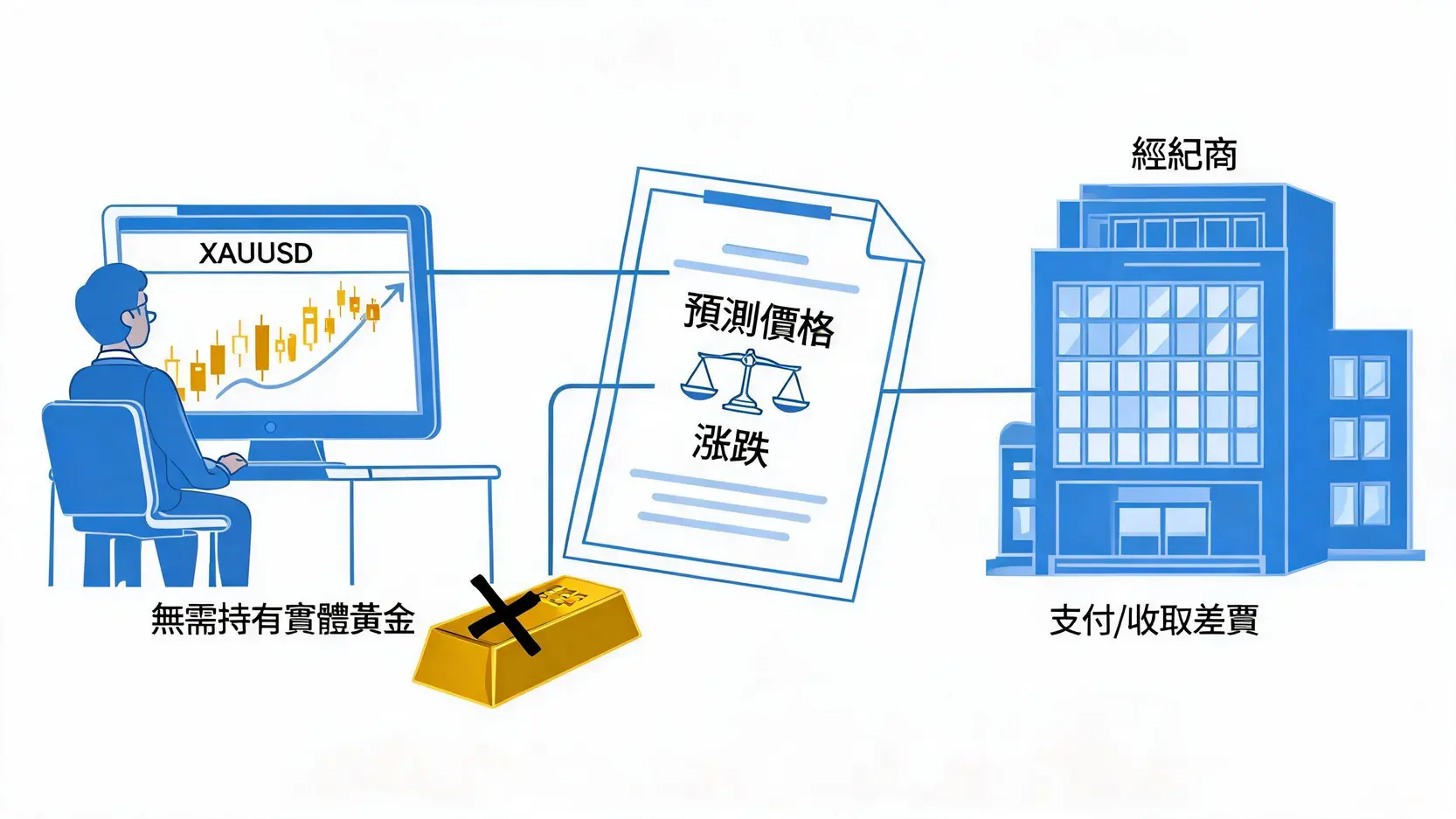
A Contract for Difference (CFD) is a financial derivative that allows investors to speculate on the price movements of an asset (such as gold, forex, or stocks) without actually owning the underlying asset. In simple terms, you are not trading the gold itself, but rather a contract that “tracks the price movement of gold”.
When you buy (go long on) a Gold CFD, you are entering into an agreement with the broker that if the price of gold rises between the time you open and close your position, the broker will pay you the price difference. Conversely, if the price falls, you will pay the difference to the broker. Selling (going short) works in the opposite way. This is why trading Gold CFDs eliminates concerns such as storage, transportation, or insurance for physical gold. Everything is conducted online, allowing you to focus solely on price movements.

Contract for Difference (CFD) Mechanism: You are trading a contract based on price movements, not the physical asset.
The Three Key Advantages of Gold CFD Trading: Leverage, Long and Short Trading, and Flexible Trading Hours
Now that you understand what Gold CFDs are, let’s look at why they attract so many investors, especially those with smaller amounts of capital. The appeal mainly comes from three key advantages:
- Leverage: This is one of the most attractive features of CFDs. You can use a relatively small amount of capital (known as “margin”), to control a position worth many times more. For example, with 1:20 leverage, you may only need a margin of US$1,000 to trade US$20,000 worth of gold. While this increases your potential profits, it is important to remember that it also magnifies your potential losses.
- Long and Short Trading: Traditional gold investments (such as buying gold bars), only generate profits when gold prices rise. Gold CFDs offer much greater flexibility. If you expect gold prices to increase, you can “go long” (Buy). If you expect prices to fall, you can “go short” (Sell). Whether the market is bullish or bearish, there are opportunities to profit.
- Flexible Trading Hours: The global gold market operates almost 24 hours a day. Gold CFD trading is typically available from early Monday morning (when the Asian market opens) until late Friday night (when the US market closes), allowing you to take advantage of market movements across different time zones according to your own schedule. This makes it especially suitable for working professionals and part-time traders.
Step 2: How to Choose a Safe and Regulated Gold CFD Trading Platform
Choosing the right trading platform is just as important as analyzing the market. An unsafe or unregulated platform may put your funds at risk. When selecting a Gold CFD trading platform, the following factors should be carefully reviewed.
The Importance of Regulatory Licenses (Such as ASIC and FCA)
This is the first and most important filter when evaluating a platform. While there are many financial regulators around the world, not all licenses offer the same level of credibility. Top-tier regulators generally require stricter client fund protection measures and greater transparency. Before choosing a platform, make sure it is regulated by at least one of the following leading authorities:
- Financial Conduct Authority (FCA): The FCA is widely recognized as one of the world’s strictest financial regulators, with rigorous requirements for broker capital adequacy and client fund segregation.
- Australian Securities and Investments Commission (ASIC): ASIC is also a top-tier international regulator that enforces strict standards on the conduct of financial services providers.
A platform that holds multiple top-tier regulatory licenses generally offers greater reliability. You can verify a broker’s regulatory status directly on the official websites of these regulatory authorities by searching for the company name or license number.
Further Reading (Highly Recommended)
Comparing Trading Costs: Spread and Overnight Interest (Swap Fee)
Trading costs have a direct impact on your overall profitability. The main costs associated with Gold CFD trading include:
- Spread: The spread is the difference between the platform’s “bid price” and “ask price”. It serves as the broker’s primary source of revenue and represents your indirect trading cost. The narrower the spread, the more favorable it is for traders. On most major platforms, Gold spreads typically range from 15 to 30 pips.
- Overnight Interest (Swap Fee): If you hold a position beyond the server’s daily settlement time (typically 5:00 p.m. US Eastern Time), you will either pay or receive overnight interest. This is because leveraged trading essentially involves borrowing funds from the broker. Long Gold positions generally incur overnight interest charges, while short positions may earn interest, depending on the prevailing interest rate environment. For traders who hold positions over a longer period, this is a cost that should not be overlooked.
Comparison of Major Trading Platforms
There are many well-known Gold CFD trading platforms available, each offering its own strengths. Below is a brief comparison of three widely recognized platforms to help you make an initial assessment.
| Platform | Primary Regulator | Key Features | Suitable For |
| IG Markets | FCA, ASIC, FINMA | One of the world’s largest CFD brokers, a publicly listed company with an extensive product range and a highly stable trading platform. | All types of traders, especially investors seeking a one-stop platform with a wide range of trading products. |
| OANDA | FCA, ASIC | A well-established forex broker known for its powerful charting tools, low spreads, and transparent pricing. | Traders who rely on technical analysis and prioritize fast trade execution. |
| Mitrade | ASIC, CIMA | A clean and user-friendly interface offering a variety of innovative trading tools, making it beginner-friendly. | Beginners and users who prefer mobile trading. |
Step 3: Illustrated Guide to Opening an Account, Funding It, and Placing Your First Trade
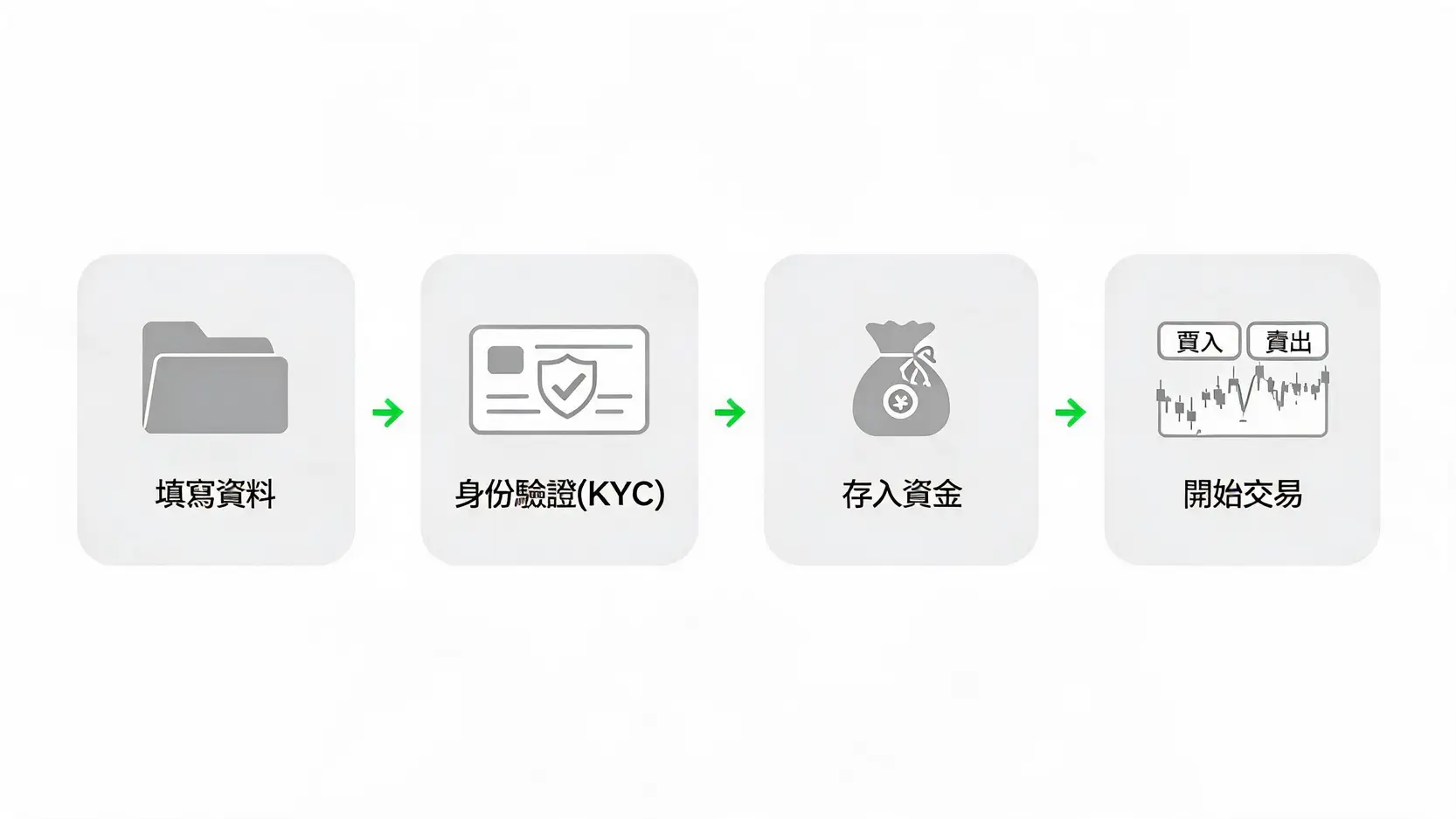
Once you have chosen your preferred platform, the next step is to open an account. Today, most regulated platforms offer a fully online account opening process, making it quick and convenient. The process can generally be divided into three stages:

From opening an account to placing your first trade, the entire process can be completed in just four simple steps.
Online Account Opening and Identity Verification Process
Prepare your identification documents and follow the instructions on the platform’s website. In most cases, the application can be completed within 10 to 15 minutes.
- Fill in Your Basic Information: Visit the official website and click “Register” or “Open an Account”. Enter your name, email address, phone number, country of residence, and other personal information.
- Complete the Questionnaire: Regulatory requirements require platforms to understand their clients’ financial background and trading experience. You will be asked to complete a questionnaire with multiple-choice questions. Simply answer them truthfully.
- Upload Verification Documents (KYC): This is the most important step, known as the “Know Your Customer” (KYC) process. You will typically need to upload two types of documents:
- Proof of Identity: Usually a clear photo of your passport, national ID card, or driver’s license.
- Proof of Address: A utility bill, bank statement, or government-issued letter dated within the last three months that clearly shows your name and residential address.
- Wait for Approval: After submission, the platform’s compliance team will review your application. Approval may take anywhere from a few hours to one or two business days. Once approved, you will receive a confirmation email.
Funding Methods (Credit Card and Bank Wire Transfer)
Once your account has been approved, you will need to deposit funds before you can start trading. Most major platforms offer several convenient funding methods:
- Credit/Debit Card: This is the fastest option, with deposits typically credited instantly. Major cards such as Visa and Mastercard are commonly accepted.
- Bank Wire Transfer: Transfer funds directly from your bank account to the broker’s designated account. Processing usually takes one to five business days, and banks may charge transfer fees. This method is generally more suitable for larger deposits.
- E-Wallets: Some platforms support e-wallets such as Skrill and Neteller, providing another fast and convenient funding option.
Note: To comply with anti-money laundering regulations, most platforms require “withdrawals to be made using the same method as the original deposit”. For example, if you deposit US$1,000 using a credit card, the first US$1,000 withdrawn will be refunded to that credit card. Any profits above that amount can then be withdrawn using another method (such as a bank wire transfer).
Trading Interface Overview and Order Placement (Market Orders vs. Limit Orders)
After logging into the trading platform, you will see an interface containing charts, price quotes, and various trading tools. Although the layout differs between platforms, the core functions are largely the same.
To place a Gold CFD trade, follow these basic steps:
- Find “Gold” or its symbol “XAUUSD” in the product list.
- Click the “Buy” or “Sell” button to open the order window.
- In the order window, configure your trading parameters. The two most important settings are:
- Order Type:
- Market Order: Executes your trade immediately at the best available market price. The advantage is speed, while the disadvantage is that the execution price may differ slightly from the quoted price during periods of rapid market movement (due to slippage).
- Limit Order: Allows you to specify your desired execution price. For example, if you want to buy Gold when the price falls to $2,340, you can place a Buy Limit Order at $2,340. The order will only be executed if the market reaches or improves upon that price.
- Volume/Lot Size: Determines the size of your trade. Under standard contract specifications, one lot of Gold CFDs represents 100 ounces of gold. Most platforms also support smaller trade sizes, such as 0.1 lots or even 0.01 lots, allowing investors with smaller amounts of capital to manage risk more precisely.
- Order Type:
- (Optional) Set your Stop Loss and Take Profit prices.
- Once everything has been confirmed, click the order button, and your first trade will be successfully placed!
Practical Gold CFD Trading Example and Profit/Loss Calculation
Theory alone is never enough. Let’s walk through a practical example to understand how Gold CFD margin and profit/loss calculations work, giving you a clearer understanding of how trading operates.
Example: Going Long (Buy) Gold, How to Calculate Margin and Leverage
Assume the current Gold (XAUUSD) market quote is $2,350.00 / $2,350.30 (Bid/Ask). You expect the gold price to rise and decide to go long.
- Trading Platform Leverage: 1:20 (or a 5% margin requirement)
- Trade Direction: Buy
- Opening Price: $2,350.30 (As the buyer, you enter at the ask price.)
- Trade Size: 0.1 lots (Equivalent to 10 ounces of gold)
Now, let’s calculate how much “deposit”, or margin, is required for this trade.
- Calculate the Contract Value:
Contract Value = Opening Price × Trading Volume
Contract Value = $2,350.30 per ounce × 10 ounces = $23,503 - Calculate the Required Margin:
Required Margin = Contract Value ÷ Leverage (or × Margin Requirement)
Required Margin = $23,503 ÷ 20 = $1,175.15
This means you only need US$1,175.15 in your account to control a Gold position worth more than US$20,000. This is the power of leverage.
Example: Closing the Trade After the Price Rises, How to Calculate Profit
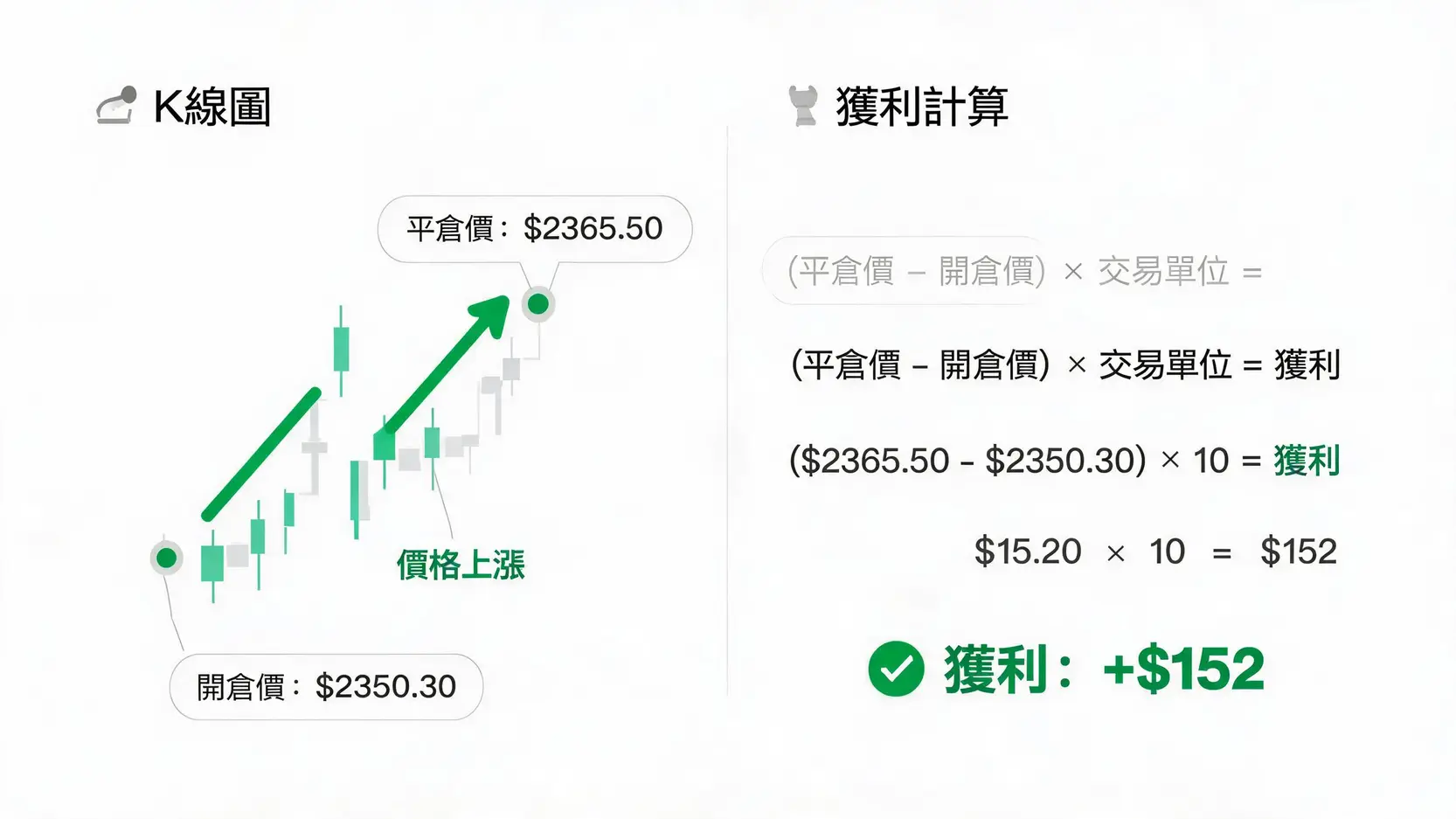
A few hours later, the market moves in your favor, and the Gold quote reaches $2,365.50 / $2,365.80. You decide to close your long position and take profit.
- Closing Price: $2,365.50 (Since you are selling to close your long position, you use the bid price.)
Now calculate your gross profit (excluding spreads and overnight interest).
- Calculate the Price Difference:
Price Difference = Closing Price – Opening Price
Price Difference = $2,365.50 – $2,350.30 = $15.20 per ounce - Calculate the Profit:
Profit = Price Difference × Trading Volume
Profit = $15.20 per ounce × 10 ounces = $152
Congratulations! By using approximately US$1,175 in margin, you earned a profit of US$152 on this trade. Conversely, if the price had fallen by the same amount, you would have incurred a loss of US$152.

Trading Profit and Loss Calculation: Profits are generated from the difference between the buying and selling prices.
Glossary: What Is Forced Liquidation (Margin Call)?
Forced liquidation, commonly referred to as a “margin call” is a risk management mechanism that every beginner must understand and respect. It occurs when the market moves against your position and your account “equity” falls below a specified threshold (known as the “maintenance margin level”). To prevent further losses for both you and the platform, your open positions will be closed automatically.
Using the example above, if your account balance is only US$1,200, then once your losses approach US$25 (US$1,200 – US$1,175.15 = US$24.85), your available margin will be almost exhausted, bringing your account very close to forced liquidation. Therefore, you should never trade with an account that is fully or heavily leveraged. Always maintain sufficient excess funds to withstand normal market fluctuations. This is the first lesson in risk management.
Further Reading (Highly Recommended)
Frequently Asked Questions (FAQ) About Gold CFD Trading
Q: Is Gold CFD trading legal?
A: In most regions, including Taiwan and Malaysia, Gold CFD trading through properly regulated international brokers is legal. The key is to choose a platform regulated by top-tier authorities such as the UK’s FCA or Australia’s ASIC, as mentioned earlier. These regulators help ensure the safety of your funds and the fairness of the trading environment. Be sure to avoid platforms that are unregulated or only hold weak regulatory licenses from small offshore jurisdictions.
Q: How Much Money Do I Need to Trade Gold CFDs?
A: There is no fixed answer, but thanks to leverage and mini lot sizes, the entry threshold is relatively low. In theory, you can start with just a few hundred US dollars. However, from a risk management perspective, it is not advisable to trade with only the minimum amount required. A healthier starting capital is generally at least US$1,000 to US$3,000. This allows you to trade smaller positions, such as 0.01 lots, while maintaining sufficient margin to withstand normal market fluctuations and reduce the risk of forced liquidation.
Q: What Do XAU and USD Represent in XAUUSD?
A: These are standardized financial market codes. Under the ISO 4217 international standard, “XAU” is the currency code for gold, where “X” indicates that the asset is not issued by any specific country, and “AU” is the chemical symbol for gold, Aurum. “USD” is the currency code for the US dollar. Therefore, “XAUUSD” clearly represents the price of gold quoted in US dollars.
Q: What Is the Difference Between Gold CFDs and Gold Futures?
A: Both are financial derivatives, but the primary differences lie in their contract specifications and trading venues. Gold CFD contracts are typically offered by brokers, with flexible contract sizes and no expiration date (unless they are a specific contract type). Gold futures, on the other hand, are traded on centralized futures exchanges (such as the CME) with standardized contract specifications and fixed expiration and settlement dates. In general, Gold CFDs are better suited for retail investors with smaller amounts of capital who prefer short- to medium-term trading.
Conclusion
Gold CFD trading undoubtedly provides modern investors, especially those with smaller amounts of capital, with a low-barrier and highly flexible way to participate in the gold market. It allows you to profit from price movements without owning physical gold, while leverage offers the potential for attractive returns. However, higher returns always come with higher risks. Leverage is a double-edged sword. It can amplify your profits, but it can also magnify your losses.
Through this beginner’s guide, you should now have a comprehensive understanding of Gold CFDs, including the concept, platform selection, account opening process, and practical calculations. Before committing real funds, it is highly recommended that you first practice with the platform’s demo account to become familiar with order placement and market behavior. Most importantly, develop your own trading discipline and risk management strategy. This is the key to mastering Gold CFDs as a powerful trading instrument and navigating the markets with confidence.
Related Articles
-
Essential Reading on Japan Investment Risks: Five Potential Risks You May Not Know Besides Yen Depreciation Driven by the historic depreciation of the yen, global capital is flowing into Japan with unprecedented enthusiasm. Both the stock market and the real estate market are showing a thriving picture. The market is...2026 年 6 月 23 日
-
Will the Gold Price Bull Market Continue? 2026 XAUUSD Trend Analysis, Experts Reveal Three Key Drivers Recently, gold prices have repeatedly hit new highs, and the market is actively debating whether gold has entered a new historic gold price bull market. Many investors are both excited and concerned, wondering how...2026 年 6 月 23 日
-
Ultimate Guide to Trading XAUUSD Trends: From Candlestick Teaching to Practical Strategies for Stable Profits for Beginners XAUUSD (spot gold against the US dollar), as one of the world’s most popular trading instruments, offers abundant profit opportunities through its sharp price fluctuations, but also comes with considerable risk. Many beginners...2026 年 6 月 23 日