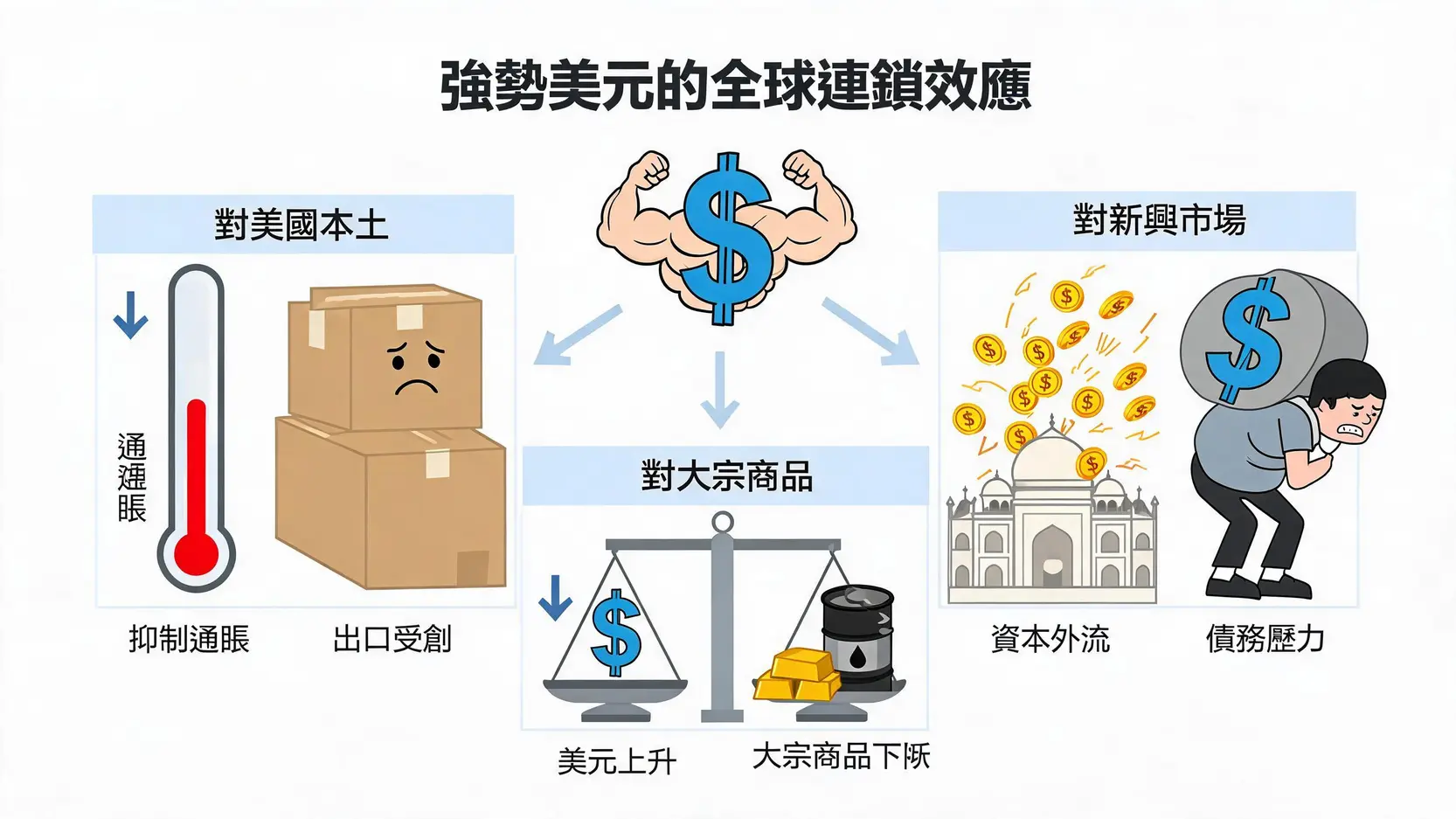
A Stronger US Dollar Acts Like a Global Economic Stress Test, With Different Regions Experiencing Very Different Outcomes.
Impact on the US: Lower Inflation but Weaker Exports
For the US itself, a stronger dollar is a double-edged sword. On the positive side, stronger purchasing power makes imported goods and services cheaper, helping reduce domestic inflation. This benefits both consumers and businesses that rely on imported products. On the negative side, US exports become more expensive in international markets, reducing the competitiveness of American exporters (such as Boeing and Coca-Cola). This may lead to weaker overseas sales, affecting corporate earnings and employment.
Impact on Emerging Markets: Capital Outflows and Debt Concerns
Emerging markets are often the biggest victims of a stronger US dollar, primarily for two reasons.
- Capital Outflows: As mentioned earlier, higher US interest rates act like a magnet for global capital. This can trigger substantial capital outflows from emerging markets (such as Southeast Asia and Latin America), causing simultaneous declines in their stock markets, foreign exchange markets, and bond markets.
- Debt Burdens: During years of low interest rates, many emerging market governments and corporations accumulated substantial US dollar-denominated debt. When the US dollar appreciates, they must use a larger amount of their now weaker local currencies to repay the same amount of US dollar debt, significantly increasing repayment pressure and, in extreme cases, raising the risk of sovereign debt crises. For a more detailed discussion, refer to Emerging Market Turmoil? Three Strategies for Managing External Debt and Capital Outflow Risks.
Impact on Commodities: Why Are Gold and Crude Oil Under Pressure?
Most globally traded commodities, including gold, silver, crude oil, and copper, are priced in US dollars. A stronger US dollar puts downward pressure on commodity prices through two mechanisms.
- Purchasing Cost Effect: For buyers using currencies other than the US dollar, a stronger dollar makes commodities more expensive, reducing demand.
- Opportunity Cost Effect: This is particularly important for gold, which does not generate interest income. When US dollar deposits and bonds offer attractive yields, the opportunity cost of holding gold increases. Investors often shift from gold into US dollar assets. Consequently, the US Dollar Index and gold prices generally exhibit a negative correlation.
Further Reading (Highly Recommended)
Emerging Market Turmoil? Three Strategies for Managing External Debt and Capital Outflow Risks
Differentiating Insight: The Unique Impact of a Stronger US Dollar on Hong Kong
While the stronger US dollar has affected markets around the world, Hong Kong’s Linked Exchange Rate System creates a unique transmission mechanism. Understanding this is essential for anyone investing in Hong Kong stocks or following Hong Kong’s economy.
The Role of the Hong Kong Dollar Under the Linked Exchange Rate System
Hong Kong operates the Linked Exchange Rate System, under which the Hong Kong dollar is pegged to the US dollar within a fixed trading band of HK$7.75 to HK$7.85 per US dollar. This means that, to maintain exchange rate stability, Hong Kong’s monetary policy must closely follow that of the US. When the US raises interest rates, the Hong Kong Monetary Authority (HKMA) typically follows suit to prevent widening interest rate differentials from triggering significant capital outflows from the Hong Kong dollar system and undermining the currency peg. Consequently, a stronger US dollar is often accompanied by higher interest rates in Hong Kong.
The Impact on Hong Kong Stock Market Liquidity
A high interest rate environment is generally unfavorable for the stock market. On one hand, rising borrowing costs reduce corporate profitability. On the other hand, investors face higher financing costs (such as margin interest), reducing their willingness to invest in equities. More importantly, following US rate hikes tightens market liquidity, commonly referred to as “liquidity withdrawal”. As the cost of capital increases, less money flows into the stock market. This places considerable pressure on the Hang Seng Index, which has significant exposure to technology and growth stocks, potentially leading to lower valuations.
The Implications for Trade and Tourism
Because the Hong Kong dollar is pegged to the US dollar, a stronger US dollar also means that the Hong Kong dollar appreciates against many non-US currencies (such as the renminbi, Japanese yen, and euro). This has direct implications for Hong Kong’s trade and tourism sectors.
- Imports: Goods imported from non-US regions (such as Japan and Europe), become cheaper, benefiting importers and consumers.
- Exports and Re-exports: Hong Kong’s exports and re-export services become more expensive, reducing their price competitiveness.
- Tourism: For international visitors (particularly those from non-US regions), traveling to and spending in Hong Kong becomes more expensive, potentially reducing tourist arrivals. Conversely, Hong Kong residents traveling overseas (for example to Japan or Thailand), benefit from “greater purchasing power”.
Investment Strategies: How to Position Yourself During a Strong US Dollar Cycle
Rather than remaining passive during a period of US dollar strength, investors should reassess their asset allocation and adapt their portfolios accordingly. The following are several broad strategic considerations.
Assets That May Benefit: Identifying Structural Opportunities
- US Dollar Cash or High-Yield US Dollar Time Deposits: This is the most direct strategy. Holding US dollar cash or placing funds in high-yield US dollar time deposits allows investors to benefit from both currency appreciation and higher interest rates.
- US Financial Stocks: Banks, insurance companies, and other financial institutions often benefit from higher interest rates because expanding net interest margins (NIM) improve profitability.
- Export-Oriented Non-US Companies: Examples include automobile manufacturers and advanced industrial companies in Japan and Europe. These businesses generate sales in overseas markets (particularly the US) while reporting earnings in their domestic currencies. A stronger US dollar increases the value of their US dollar revenue when translated back into local currency, boosting reported earnings.
Assets Under Pressure: Areas to Approach With Caution
- Emerging Market Currencies and Assets: As discussed earlier, emerging markets are among the hardest hit during periods of US dollar strength. Investors should remain cautious regarding emerging market currencies, equities, and bonds because of the risks associated with capital outflows and rising debt burdens.
- US Dollar-Denominated Debt: Non-US companies with substantial US dollar liabilities, especially those generating most of their revenue domestically, face increased repayment pressure and elevated financial risk.
- Commodities and Gold: Although gold possesses safe-haven characteristics, its performance often weakens when both the US dollar and interest rates are rising. Investors should consider the higher opportunity cost of holding gold and avoid becoming excessively concentrated in the asset.
Frequently Asked Questions (FAQ) About a Strong US Dollar
Q: The US dollar is strengthening. Should I immediately convert all my money into US dollars?
A: Going “all-in” is not recommended. While holding US dollars is one possible strategy, any investment decision should be based on the principle of diversification. Concentrating all your funds in a single currency exposes you to the risk of that currency depreciating in the future. A more prudent approach is to moderately increase the proportion of US dollar-denominated assets in your portfolio based on your financial situation and risk tolerance, such as through US dollar time deposits, US stocks, or related ETFs, rather than simply converting all your cash into US dollars.
Q: How long will the US dollar remain strong?
A: That depends on several macroeconomic factors, with the key drivers being the Federal Reserve’s monetary policy path and the relative performance of the global economy. Generally, as long as US interest rates maintain a significant advantage over those of other major economies (such as the eurozone and Japan) and global risk aversion remains elevated, the US dollar will continue to find support. The market generally views potential turning points as the Federal Reserve clearly signaling interest rate cuts, or a strong global economic recovery (particularly in Europe and China) which could prompt capital to flow out of the US dollar and into higher-growth regions.
Q: How does a strong US dollar affect technology stocks?
A: The impact is twofold. For large multinational technology companies (such as Apple, Microsoft, and Google), a significant portion of their revenue comes from overseas markets. A stronger US dollar means that revenue earned in euros, Japanese yen, and other foreign currencies translates into fewer US dollars in their financial statements. This is known as a “currency headwind”, which can weigh on earnings. However, if a strong US dollar reflects a stronger US economy relative to the rest of the world, these companies’ domestic businesses may remain robust. Therefore, the impact should be assessed comprehensively rather than generalized.
Q: If the US dollar appreciates, will gold prices definitely fall?
A: In most cases, they are negatively correlated, but not always. Both the US dollar and gold are considered safe-haven assets. During a typical economic cycle, when the US dollar strengthens because of higher interest rates, the opportunity cost of holding gold (a non-yielding asset) increases, putting downward pressure on gold prices. However, during extreme risk-off events, such as severe geopolitical crises or a loss of confidence in the global financial system, investors may flock to both the US dollar and gold simultaneously, resulting in the rare scenario where both rise together. Therefore, evaluating gold prices requires considering not only the US dollar, but also real interest rates, inflation expectations, and geopolitical risks.
Conclusion
Overall, a strong US dollar is a double-edged sword that influences global financial markets. Behind it lies the complex interplay between US economic policy and global capital flows. It creates opportunities for some investors, such as holding US dollar-denominated assets or investing in export-oriented companies that benefit from exchange rate advantages. At the same time, it poses significant challenges for emerging markets and entities carrying US dollar-denominated debt. For prudent investors, the key is to understand the underlying drivers and transmission mechanisms of this macroeconomic trend, then adjust investment strategies according to their portfolio and risk preferences to mitigate risks, protect assets, and capture potential opportunities in the current macroeconomic environment.