Powell Speech Trading Guide: Fed Rates & Strategy

Decoding Trading from Powell’s Speech: Impact of the Federal Reserve Interest Rate Decisions, Dovish and Hawkish Analysis, and a Complete Practical Guide
Every time Federal Reserve Chair Jerome Powell steps up to the podium, global financial markets hold their breath. Stocks and foreign exchange markets immediately experience significant volatility. Do you often feel confused by Powell’s “dovish” or “hawkish” remarks and unsure how to position your trades? To precisely master the skill of decoding Powell’s speeches for trading, you must deeply understand the impact of Federal Reserve interest rate meetings and clearly distinguish the policy direction. This article will fully decode Powell’s remarks, provide a detailed dovish and hawkish analysis, and offer three major tactical strategies to help you learn “how to trade with Powell” and stay in control amid market volatility.
Quickly Understand Dovish and Hawkish Positions: Decoding Powell’s Stance in Depth
In financial markets, “dovish” and “hawkish” are terms used to describe the monetary policy stance of central bank officials. Understanding the true meaning of these two terms is the first step to interpreting Powell’s speeches and anticipating the Federal Reserve’s future direction.
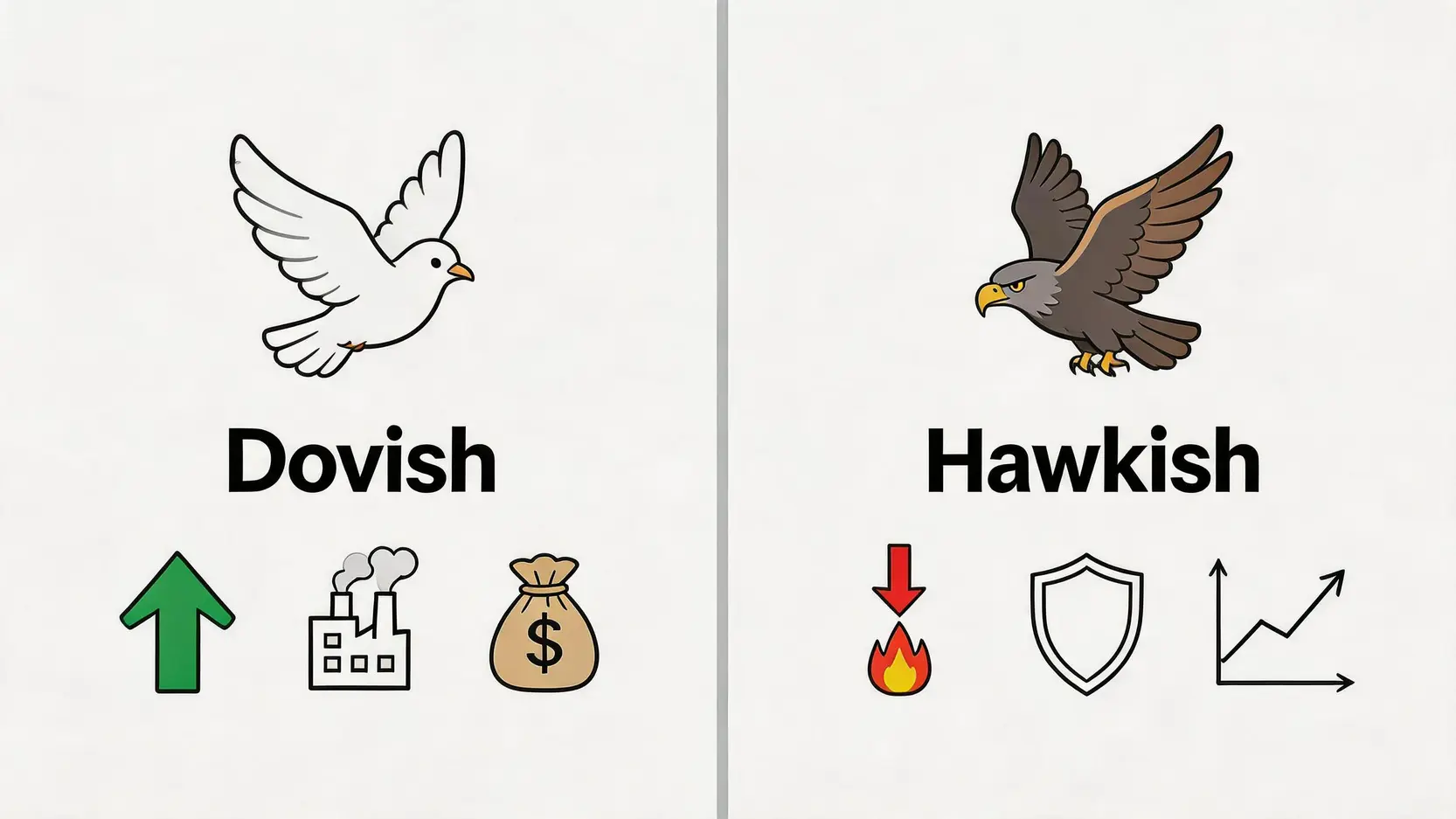
What is Dovish? What Impact Does It Have on the Market?
As the name suggests, Dovish represents a soft and accommodative policy stance. When Federal Reserve officials, especially Chair Powell, take a dovish tone, it means they are more inclined to stimulate economic growth through loose monetary policy, even if it may bring inflation risks.
- Policy stance: Favors interest rate cuts, maintaining low interest rates, and implementing monetary easing (QE), with higher tolerance for inflation.
- Key focus: Prioritizes reducing unemployment and stimulating economic activity.
- Market impact:
- Stocks: Generally positive. Lower interest rates reduce corporate borrowing costs and encourage investors to allocate funds into higher-risk equities for returns, especially technology and growth stocks.
- US dollar: Tends to weaken. Increased money supply and lower interest rates reduce the attractiveness of the currency.
- Bonds: Prices rise. When interest rates fall, existing bonds with higher yields become more valuable.
- Commodities: Generally positive. A weaker US dollar makes USD-priced commodities (such as gold and crude oil) cheaper for foreign buyers, potentially increasing demand.
What Is Hawkish? What Impact Does It Have on the Market?
In contrast to dovish, hawkish represents a firm and aggressive policy stance. When Powell’s remarks lean hawkish, it indicates that controlling inflation is the top priority, even if it comes at the cost of short-term economic growth.
- Policy stance: Favors interest rate hikes, maintaining high interest rates, and reducing the balance sheet (QT), with a strong stance against inflation.
- Key focus: Prioritizes controlling and reducing inflation levels to maintain price stability.
- Market impact:
- Stocks: Generally negative. High interest rates increase corporate financing costs and make risk-free savings or bonds more attractive, leading to potential capital outflows from equities.
- US dollar: Tends to strengthen. Higher interest rates attract international capital inflows, pushing up the currency.
- Bonds: Prices fall. When interest rates rise, existing bonds with lower yields become less attractive.
- Commodities: Generally under pressure. A stronger US dollar raises commodity prices in other currencies, while expectations of economic slowdown may reduce demand.

Dovish vs. Hawkish Policy Stance Overview
How to Judge the Current Direction from Powell’s Word Choice?
Powell’s wording is extremely cautious, and every word may contain subtle implications. Investors can identify shifts in his stance by analyzing how he describes key economic data and signals. Below are some common clues for interpretation:
| Indicators | Dovish-leaning wording | Hawkish-leaning wording |
| Inflation | “Inflation is making good progress toward the 2% target (making good progress)”, “transitory”, “supply chain driven” | “Inflation is still too high”, “persistent”, “broad-based price pressures” |
| Employment | “Signs of softening in the labor market”, “job growth is solid but sustainable” | “The labor market is extremely tight”, “strong job growth” |
| Economic Growth (GDP) | “Growth below trend”, “increased uncertainty in the economic outlook” | “Economic activity is expanding at a solid pace”, “resilient consumption” |
Federal Reserve Interest Rate Meeting Full Analysis: How Interest Rate Decisions Affect Your Investment Portfolio?
The Federal Reserve’s interest rate decision is its most important monetary policy tool, directly influencing global capital flows and asset pricing. Understanding how rate hike and rate cut cycles impact different asset classes is the foundation of strategic positioning. Many beginners entering the market can start with a stock investment beginner guide to understand basic market operations and rules.
Impact of a Rate Hike Cycle: Which Assets Benefit? Which Are Under Pressure?
When the Federal Reserve enters a rate hike cycle to combat inflation, the cost of capital rises, leading to a repricing of asset values.
- Benefiting assets:
- US dollar: Higher interest rates attract capital inflows, and the US Dollar Index usually strengthens.
- Bank stocks: Rising interest rates expand net interest margins (NIM), supporting profitability.
- Value stocks: In a stable rate hike environment, reasonably valued stocks with stable cash flows tend to perform better.
- Pressured assets:
- Growth stocks/technology stocks: Their valuations are heavily dependent on discounted future cash flows, and rising interest rates can lead to significant valuation compression.
- Real estate: Higher borrowing costs weaken demand in the property market.
- Gold: Gold does not generate yield. Rising interest rates increase the opportunity cost of holding gold, while a stronger US dollar also puts downward pressure on prices.
Impact of a Rate Cut Cycle: How Should Investment Strategy Shift?
When the economy shows signs of slowing, the Federal Reserve may begin a rate cut cycle to stimulate growth. Increased liquidity typically raises investors’ risk appetite.
- Benefiting assets:
- Growth stocks/technology stocks: Lower interest rates provide valuation support, making them standout performers in rate cut cycles.
- Bonds: Falling interest rates lead to rising bond prices, making them direct beneficiaries.
- Real Estate Investment Trusts (REITs): Higher dividend attractiveness and lower financing costs.
- Pressured assets:
- US dollar: Lower interest rates reduce its attractiveness, and the US Dollar Index usually weakens.
- Bank stocks: Narrowing net interest margins may affect profitability.

How Do Rate Hikes and Rate Cuts Affect Your Assets?
Further Reading (Highly Recommended)
2026 Federal Reserve Interest Rate Meeting Schedule Overview
The Federal Open Market Committee (FOMC) of the Federal Reserve holds eight regular meetings per year, approximately once every six weeks. The statements released after each meeting and Powell’s press conferences are key market focus points. Below is the 2026 meeting schedule (investors should refer to official announcements for confirmation):
| Meeting Month | Expected Date | Whether the Summary of Economic Projections (SEP) is Released |
| January | 27–28 |
No |
| March | 16–17 | Yes (includes dot plot) |
| April | 27–28 | No |
| June | 15–16 | Yes (includes dot plot) |
| July | 27–28 | No |
| September | 21–22 | Yes (includes dot plot) |
| November | 2–3 | No |
| December | 14–15 | Yes (includes dot plot) |
How to Trade with Powell? Three Major Tactical Trading Strategies
After understanding the basic concepts, the next step is to turn knowledge into action. The following are three trading strategies across different time horizons to help you better navigate market volatility driven by Federal Reserve interest rate meetings.
Strategy 1: Pre Meeting Expectation Trading (Positioning for Market Expectations)
Before the FOMC meeting, the market forms a general expectation based on recent economic data (such as CPI and nonfarm payrolls). The core of this strategy is to assess the gap between the final outcome and market expectations.
- Analyze market consensus: Use tools such as the CME FedWatch Tool to understand how the market is pricing the probability of rate hikes or cuts.
- Form your own view: Combine the latest inflation and employment data to build your own expectation of potential Federal Reserve action.
- Positioning: If you expect the Federal Reserve outcome to be more “hawkish” than the market expects (for example the market expects no hike but you believe there will be a hike), you can position short trades in advance (such as shorting index futures) or buying US dollars. Conversely, if you expect a more “dovish” outcome, you can take long positions.
- Risk management: This strategy is based on betting on expectation gaps and carries higher risk. Always set a stop loss.
Strategy 2: Post Meeting Statement Interpretation and Immediate Reaction (Capturing Short Term Volatility)
This strategy is suitable for short term traders who can monitor the market in real time. The core is to quickly interpret the FOMC statement and Powell’s press conference to capture sharp price movements.
- Focus on key wording: Pay close attention to changes in wording compared to the previous meeting, especially descriptions of inflation and employment.
- Listen to the press conference Q&A: Powell sometimes reveals more information in his responses than in the official statement. Pay attention to his answers regarding future policy paths and inflation outlook.
- Follow the trend: Market volatility is extremely high in the first few minutes after the statement. Wait for a clear direction and then trade in the direction of the trend. For example, if the market interprets the tone as dovish and equities rally sharply, you can follow the move with long positions and use a trailing stop loss.
Strategy 3: Long Term Trend Positioning (Following the Monetary Policy Direction)
For long term investors, there is no need to focus on short term fluctuations of each meeting. Instead, focus on the broader macro monetary policy direction set by the Federal Reserve, commonly summarized as “Don’t fight the Fed”.
- In a tightening cycle: When the Federal Reserve is clearly in a rate hike and quantitative tightening (QT) path, increase allocation to defensive assets such as utilities and consumer staples, or hold more cash and short term bonds, while reducing exposure to high risk growth stocks.
- In an easing cycle: When the Federal Reserve shifts toward rate cuts and quantitative easing (QE), increase exposure to risk assets such as technology stocks, discretionary consumer stocks, and emerging market equities.
Understanding long term trends requires deep market insight and the use of various analytical tools to support decision making.
Conclusion
In summary, successfully trading alongside Powell’s rhythm requires a deep understanding of the macro impact of Federal Reserve meetings, accurate interpretation of dovish or hawkish positioning, and the application of flexible trading strategies. From decoding every word in Powell’s press conference, to understanding how rate decisions affect different asset classes, to building your own short, medium, and long term trading plans, every step is crucial. We hope this complete guide helps you decode Powell’s speeches and turn every FOMC meeting into an investment opportunity. Start positioning now and prepare for the next wave of market volatility!
FAQ: Common Questions About Powell’s Speeches and Federal Reserve Interest Rate Meetings
Q: How much can one sentence from Powell affect the market?
A: The impact is extremely significant. As one of the most powerful central bank governors in the world, Powell’s remarks, even a single word change, can trigger tens of billions or even hundreds of billions of dollars in capital flows within seconds. This is because his words directly influence global interest rate expectations, and interest rates are the anchor for pricing all assets. Algorithmic trading systems instantly scan his prepared remarks and press conference Q&A. Any signal that deviates from expectations can trigger automated buy or sell orders, causing sharp market volatility.
Q: Will Hong Kong interest rates fully follow US rates? What does this imply for the property market?
A: Not completely synchronized, but highly correlated. Due to Hong Kong’s linked exchange rate system, the Hong Kong dollar is pegged to the US dollar. To maintain exchange rate stability, the Hong Kong Monetary Authority’s base interest rate generally follows changes in the US federal funds rate. This will be transmitted to the Hong Kong Interbank Offered Rate (HIBOR), and HIBOR is the pricing benchmark for most Hong Kong mortgage loans. Therefore, US rate hikes push up Hong Kong mortgage rates, increasing housing repayment burdens and putting pressure on the property market. Conversely, US rate cuts help reduce mortgage costs and provide support to the property market.
Q: Besides Powell, which other Federal Reserve officials’ speeches should be followed?
A: While the Chair’s remarks are the most important, the views of other officials should not be overlooked, especially those with permanent voting rights. Key figures to watch include the Vice Chair of the Federal Reserve and the President of the New York Fed (who also serves as the Vice Chair of the FOMC). In addition, presidents of other regional Federal Reserve Banks (such as St. Louis and San Francisco) rotate voting rights. Their public speeches, especially when their stance significantly differs from the Chair, can also influence market expectations.
Q: What is the “Dot Plot”?
A: The “Dot Plot” is a chart released by the Federal Reserve after quarterly meetings (March, June, September, December). It shows anonymous projections from each FOMC member regarding the future level of the federal funds rate over the next few years. The market uses changes in the median dot to assess the overall internal view of the Federal Reserve on the future path of rate hikes or cuts, making it a critical reference for forecasting monetary policy direction.
Related Articles
-
A Complete Analysis of Central Bank Policy Shifts: From YCC to QT, Decoding the BOJ and the Fed’s Next Move The Bank of Japan (BOJ) and the US Federal Reserve (Fed), two giants of the global financial markets, are seeing their diverging monetary policy directions become the core force driving...2026 年 6 月 23 日
-
Have Yen Appreciation Expectations Been Established? A Complete Analysis of 2026 Investment Bank Forecasts, Revealing the Key Turning Point Mainstream View: Why Does the Market Generally Expect the Yen to Appreciate in 2026? After a long period of historic depreciation, the market has seen a significant shift in expectations for...2026 年 6 月 23 日
-
When Will the Bank of Japan’s Next Rate Hike Arrive? 2026 Expert Forecasts and Investor Response Strategies Decision-Making Basis for the Bank of Japan’s Future Interest Rate Policy The Bank of Japan ended its eight-year negative interest rate policy in early 2026, sending a shockwave through global financial markets. The...2026 年 6 月 23 日