FVG Trading Ultimate Guide: From Fair Value Gaps to Precise Entries, Master the Core of SMC in 5 Steps
Are you often missing the best entry timing, or feeling confused by various terms in SMC (Smart Money Concepts) such as FVG and Imbalance? Many traders face the same challenge, watching price surge past their eyes without knowing how to enter. This article will provide a clear and in-depth explanation of the powerful trading tool “Fair Value Gap (FVG)”, from its core definition, how to use the FVG indicator, to specific entry strategies, guiding you step by step on how to use FVG for entries and accurately capture market opportunities like a professional trader.
What is a Fair Value Gap (FVG)? Unpacking the Secret of Market Imbalance
Before diving deeper into how to use the FVG indicator, we must first understand its essence. FVG is not a random chart signal, but a reflection of inefficiency in market microstructure, revealing the movements of large institutional funds.
Core Definition of FVG: The “Vacuum Zone” in Price Charts
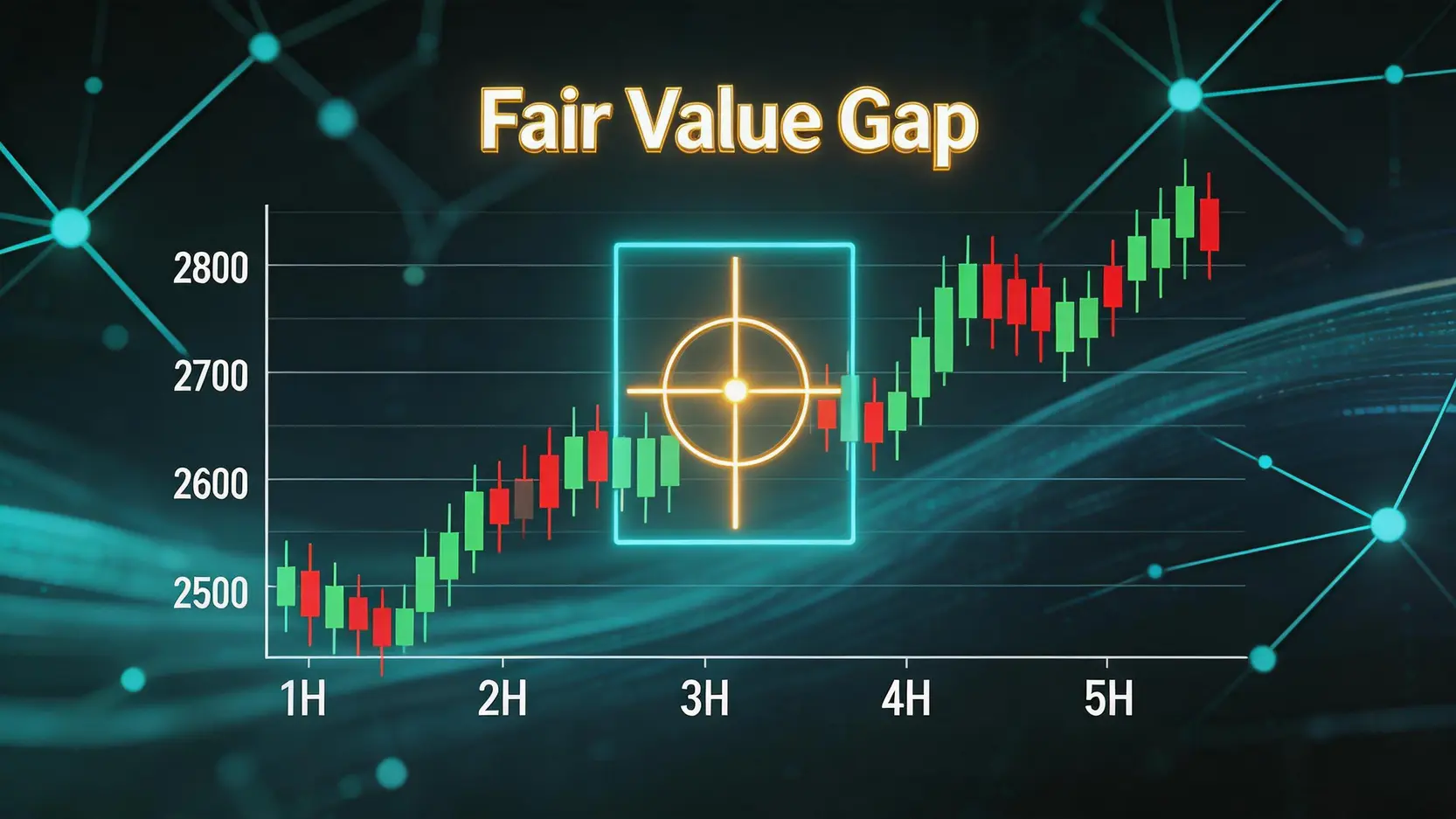
Fair Value Gap (FVG) refers to a specific formation on a price chart composed of three candlesticks. When the body (or wick) of the middle candle does not overlap with the wicks of the first and third candles, the resulting “price vacuum” or “gap” area is the FVG. Simply put, this is a region where only one-sided orders (buy or sell) were executed rapidly, causing a temporary “unfair” pricing in the market.
Sign of a Strong Trend: The formation of an FVG usually indicates that the market has experienced a strong one-sided move in a short period, where buying or selling pressure far exceeds the opposite side.
Potential Price Magnet Zone: The market has a natural tendency to return and “fill” these gaps created by inefficiency. Therefore, FVG often becomes a target zone for future price retracements.
Why Does FVG Form? Institutional Footprints of Smart Money (SMC)
The formation of FVG is closely related to “Smart Money Concept” (SMC). SMC refers to the capital of large institutions such as banks and hedge funds. Due to their massive order sizes, they cannot execute trades like retail traders at any time, and often need to create liquidity or exploit market inefficiencies to execute their orders. When major bullish or bearish news occurs, institutions rapidly enter the market with market orders, and large buy or sell orders flow in instantly, causing price to jump and leaving behind an FVG. This gap is like a “footprint” left by institutions in the market, revealing the price levels they are interested in.
FVG vs Imbalance: Clarifying the Difference Between Imbalance and FVG
When learning SMC concepts, traders often confuse FVG with Imbalance. Although the two are closely related and both involve market imbalance, there are subtle differences in definition and application. Understanding the difference between Imbalance and FVG allows for more precise market interpretation.
Imbalance (Market Imbalance) as a Broad Concept
Imbalance is a broader concept referring to any situation where buying and selling forces are unequal. When buying pressure significantly exceeds selling pressure, or vice versa, price moves rapidly in one direction, which is defined as Imbalance. Essentially, FVG is a specific, clear, and tradable form of Imbalance. Market inefficiency is the underlying cause of these phenomena.
Buyside Imbalance and Sellside Imbalance in Practical Application
Imbalance can be divided into two types based on direction, which is crucial for predicting market movement:
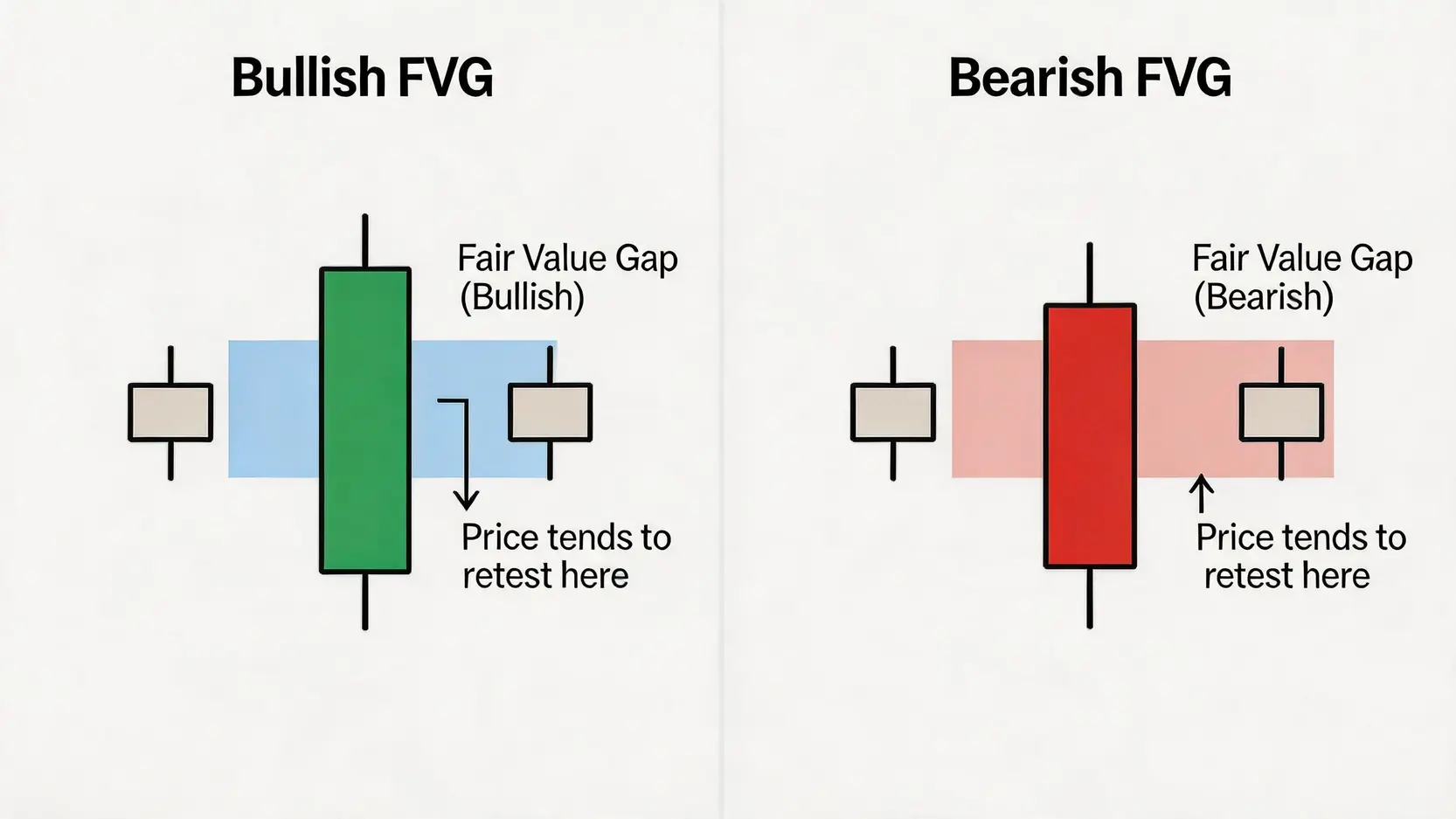
Buyside Imbalance: When price rises strongly and gaps appear between consecutive bullish candles, it indicates extremely strong buying pressure where buyers continuously chase higher prices while selling supply is insufficient. The gap formed in this case is a bullish FVG, and the market tends to retest this area before continuing upward.
Sellside Imbalance: When price drops sharply and gaps appear between consecutive bearish candles, it indicates panic selling where sellers dominate while buyers show weak absorption. The gap formed in this case is a bearish FVG, and the market tends to rebound to this area before continuing downward.
In summary, all FVGs are Imbalances, but not all Imbalances appear in a standard FVG structure. FVG provides a more defined and clearly bounded imbalance zone, allowing traders to build more precise strategies.
How to Identify FVG on a Chart? The 3-Candle Recognition Method
Identifying FVG is the first and most critical step in using it for trading. Fortunately, the process is very straightforward and only requires observing three consecutive candlesticks. By mastering this technique, you can quickly locate these high-value trading zones on any market chart.
Bullish FVG and Bearish FVG 3-Candle Identification Method
Bullish FVG (Bullish FVG) Identification Technique and Example
An effective bullish FVG is formed by three candlesticks in a strong upward trend. It signals an explosion of buyer strength and provides a potential pullback buying zone.
Step 1: Identify a large bullish candle with a relatively long body (we refer to it as the 2nd candle).
Step 2: Observe the high of the candle before it (the 1st candle).
Step 3: Observe the low of the candle after it (the 3rd candle).
Identification: If the high of the 1st candle is lower than the low of the 3rd candle, then the gap between the high of the 1st candle and the low of the 3rd candle is the bullish FVG.
This gap represents a situation where the market failed to efficiently match sell orders during a rapid price rally, leaving behind an unfilled price area. In the future, price is likely to return to test this zone as support.
Bearish FVG (Bearish FVG) Identification Technique and Example
Conversely, a bearish FVG appears in a strong downward trend, signaling that sellers are dominating the market and providing traders with a potential reversal shorting opportunity.
Step 1: Identify a large bearish candle with a relatively long body (the 2nd candle).
Step 2: Observe the low of the candle before it (the 1st candle).
Step 3: Observe the high of the candle after it (the 3rd candle).
Identification: If the low of the 1st candle is higher than the high of the 3rd candle, then the gap between the low of the 1st candle and the high of the 3rd candle is the bearish FVG.
This gap indicates that during a panic-driven selloff, the market lacked sufficient buy-side absorption, creating a “vacuum” in price. When price later rebounds, this area often acts as strong resistance.
How to Use FVG for Entries? 4 Practical Trading Strategies
Once an FVG is identified, the next step is how to use FVG for entries. Simply entering a trade when seeing a gap is reckless. A mature trader treats FVG as a high-probability “area of interest” and combines it with other analytical tools to build a structured trading plan. Below are four proven practical strategies.
Strategy 1: Using FVG as a “Magnet Zone” for Price Retests
This is the most basic and direct FVG indicator application. The market has a tendency to fill inefficiencies, so FVG acts like a magnet pulling price back into the zone. Traders can look for entries when price enters the FVG area.
Bullish FVG Application: When price retraces down into a bullish FVG zone, it can be considered a potential buy opportunity. Entering the gap means the market is filling prior buy-side inefficiency.
Bearish FVG Application: When price pulls back up into a bearish FVG zone, it can be considered a potential sell opportunity. Entering the gap means the market is testing prior sell-side pressure.
Strategy 2: Combining Order Blocks for High-Probability Entries
Combining FVG with Order Blocks is a powerful approach in SMC trading. An Order Block is the last opposing candle before a trend reversal, representing institutional accumulation or distribution zones. If an FVG appears near an Order Block, the validity of the zone is significantly strengthened.
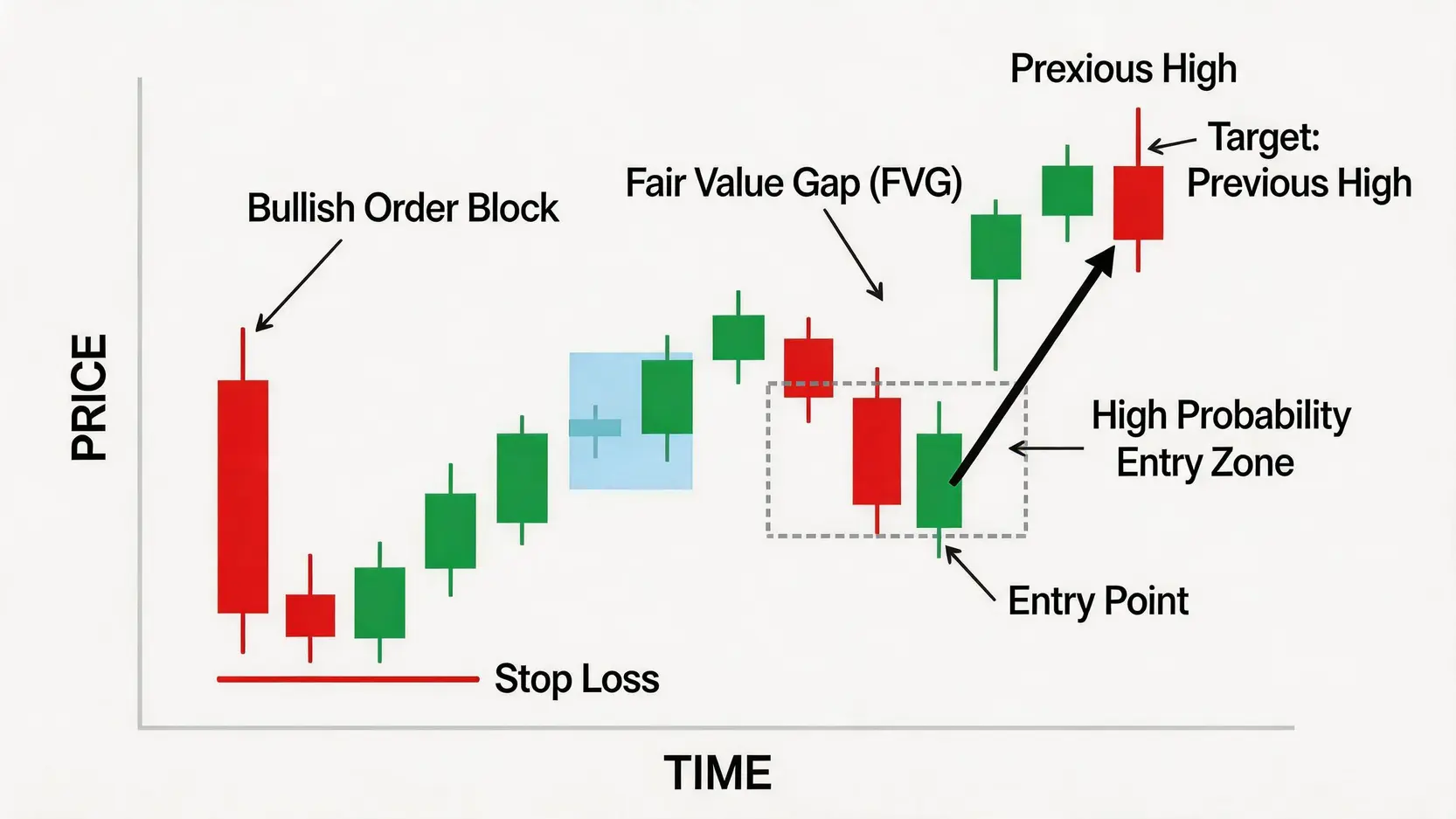
High-Probability Buy Setup: In an uptrend, look for a bullish FVG located just above a Bullish Order Block (Bullish OB). When price pulls back and simultaneously reaches the Order Block and enters the FVG zone, it is a strong buy signal.
High-Probability Sell Setup: In a downtrend, look for a bearish FVG located just below a Bearish Order Block (Bearish OB). When price retraces upward and simultaneously touches the Order Block and enters the FVG zone, it is an excellent sell signal.
FVG Combined With Order Blocks (Order Block) High-Probability Buy Setup
Strategy 3: Using the Upper and Lower Boundaries of FVG for Stop Loss and Take Profit
FVG not only provides entry signals, but its clearly defined boundaries also serve as natural reference points for risk management.
Stop Loss Setup:
For buy trades (bullish FVG), the stop loss can be placed outside the lower boundary of the FVG, or more conservatively, below the lowest point of the 2nd candle that forms the FVG.
For sell trades (bearish FVG), the stop loss can be placed outside the upper boundary of the FVG, or above the highest point of the 2nd candle.
Take Profit Setup:
The take profit target can be set at higher-timeframe liquidity pools (such as previous highs/lows) or the next opposite FVG zone.
Let’s integrate the above concepts into a complete bullish trade setup:
Market Structure Analysis: First, confirm that the market is in an uptrend (price continuously forming higher highs and higher lows).
Identify Key Zones: After a strong upward move, locate a clear bullish FVG. At the same time, check whether there is a valid bullish order block near the FVG.
Wait for Price Retest: Patiently wait for price to retrace into the confluence zone of the FVG and order block. Do not chase the market.
Confirm Entry Signal: When price enters the zone, switch to a lower timeframe (e.g. from the 4-hour chart to the 15-minute chart) and look for reversal signals such as Market Structure Shift (MSS) or Break of Structure (BOS).
Execution and Management:
Entry: Enter long after confirmation of the signal.
Stop Loss: Place the stop loss below the order block or below the lowest point of the FVG.
Take Profit: Set the first take profit target at the previous high, and the second target at higher liquidity zones.
Frequently Asked Questions (FAQ) About FVG Trading
Q: Will FVG always be filled?
A: Not necessarily. Although the market has a strong tendency to fill FVGs, it does not happen 100% of the time. In extremely strong trends, price may break away without filling the gap, creating what is known as a “Breakaway Gap”, which itself signals strong momentum. Therefore, traders must always consider market structure rather than assuming every FVG will be filled.
Q: Is the FVG indicator applicable to cryptocurrency, forex, or stock markets?
A: FVG, as a price action and market microstructure tool, is applicable to all liquid markets, including forex, cryptocurrencies, indices, futures, and stocks. Wherever institutional participation exists, inefficiencies caused by large order execution will appear. In more volatile and 24-hour markets (such as forex and crypto), FVGs may appear more frequently and clearly.
Q: What is an Inverse FVG and how is it used?
A: An Inverse FVG is an advanced concept. When a price fully breaks through an FVG and closes on the opposite side, its role can reverse. For example, a bullish FVG (originally a support zone) that is strongly broken may become resistance when price retests it. The same applies in reverse. This reflects the principle of support and resistance flipping, allowing traders to capture reversal or continuation opportunities.
Q: Does FVG work on all timeframes?
A: Yes, FVG appears on all timeframes, from 1-minute charts to monthly charts. However, its significance varies. Higher timeframes (such as daily or weekly) generally produce more important FVGs, as they reflect larger institutional imbalances and create stronger support or resistance zones. Traders typically use higher timeframe FVGs to define bias and key levels, then refine entries on lower timeframes.
Conclusion
In summary, Fair Value Gaps (FVG) are not just chart patterns, but key insights into institutional order flow and market inefficiency. They provide traders with a deeper perspective on why price moves. Through the 3-candle identification method, entry strategies combined with order blocks, and risk management using FVG boundaries introduced in this article, you can integrate FVG indicator usage into your trading system and significantly improve entry precision and trade planning quality. Now open your chart, identify your first FVG, and begin your SMC trading progression journey!
Does Gold Always Rise When the Fed Cuts Rates? Understanding the Complete Relationship Between Interest Rates and Gold Prices Through 3 Key Perspectives A popular market saying goes: "When the Fed cuts rates, gold rises." This phrase has become almost a standard answer for gold investors. But what is the...
Has Gold Reached Its Peak? Can You Still Buy Gold in 2026? 3 Key Risks and a Decision-Making Framework Every Investor Must Understand Before Investing As gold prices continue to hit new highs, are you also struggling with the age-old question: "Can you still buy gold?" Market sentiment is running...
Gold Short-Term Trading Strategies: Illustrated Guide to 3 High-Probability Techniques Used by Professional Traders Faced with gold's intense price volatility, short-term trading has become a popular choice for those seeking quick profits. However, without a solid gold short-term trading strategy, trading is little more than gambling. The market is flooded...