Will the Yen Appreciate? 2026 Forecast & Key Turning Point

Updated: 2026/06/23  |  CashbackIsland

jpy-forecast-2026-appreciation

Have Yen Appreciation Expectations Been Established? A Complete Analysis of 2026 Investment Bank Forecasts, Revealing the Key Turning Point

Mainstream View: Why Does the Market Generally Expect the Yen to Appreciate in 2026?

After a long period of historic depreciation, the market has seen a significant shift in expectations for the yen’s future trend. Entering 2026, yen appreciation expectations have gradually become the mainstream consensus, with the core driving force behind this coming from the expected policy shifts of the world’s two major economies. In the past, because the Bank of Japan (BOJ) maintained ultra-loose monetary policy, while the US Federal Reserve (Fed) aggressively raised interest rates to fight inflation, the huge interest rate differential between the two made the carry trade of “selling yen and buying US dollars” extremely popular, becoming the main reason behind the yen’s continued decline. However, looking ahead to the second half of 2026 through 2027, this fundamental logic is being broken. The market is broadly focused on central bank policy shifts and possible US rate cuts, making them key to judging the 2026 yen exchange rate forecast. To gain a deeper understanding of how the forex market works, you can refer to this article: [Forex Beginner’s Guide] Investing for Beginners from 0 to 1, Understand the Basics of Forex Trading! 


Core Logic: Expected Narrowing of the US-Japan Interest Rate Differential

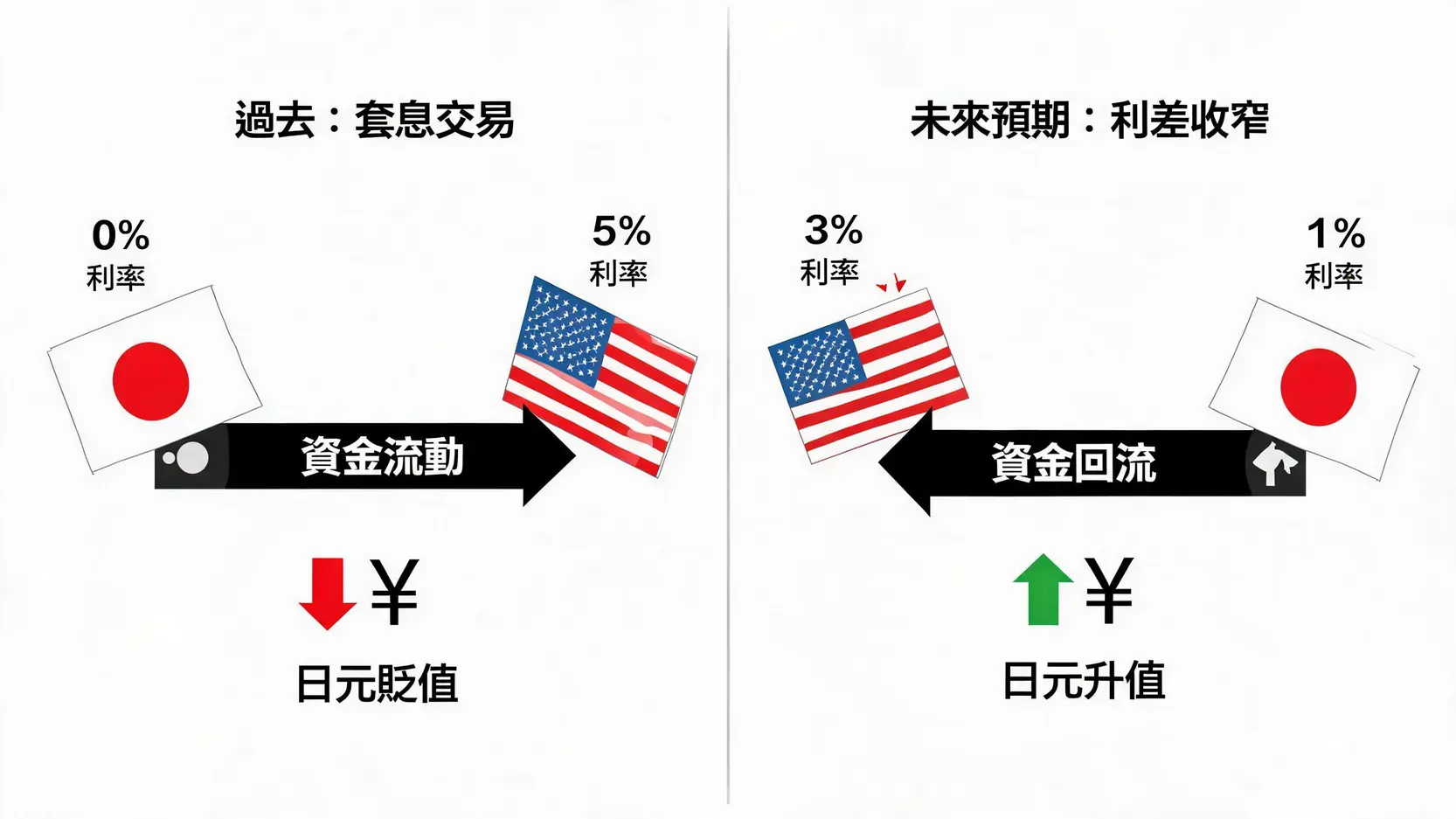
In the short term, exchange rate movements depend on expectations; in the long term, they depend on fundamentals. The current market expectation for yen appreciation is built on the basis that the “US-Japan interest rate differential will narrow”. This means investors expect the future interest advantage from holding US dollars to decline relative to the yen. This would significantly reduce the appeal of the US dollar and could trigger a large-scale unwinding of carry trades, meaning selling US dollars and buying back yen, thereby pushing up the yen exchange rate.

美日利差與日元走勢關係圖,展示套息交易如何導致日元貶值,以及未來利差收窄預期如何推動日元升值。

Figure One: US-Japan Interest Rate Differential Reversal and the Logic of Yen Appreciation


Catalyst One: The Bank of Japan’s (BOJ) Gradual Monetary Policy Normalization

The Bank of Japan officially ended its negative interest rate policy in early 2026 and gradually exited its large-scale asset purchase program, marking the end of an era. Although the BOJ remains cautious and emphasizes that it will maintain accommodative financial conditions, the direction of policy normalization has already been established. The market expects that as Japan’s domestic inflation stabilizes above the 2% target and wages continue to grow, the BOJ will take further rate hike actions between the second half of 2026 and 2027. Every Bank of Japan monetary policy meeting has become a market focus, and any hawkish remarks may become a strong catalyst for yen appreciation. 

Catalyst Two: The US Federal Reserve (Fed) May Begin a Rate Cut Cycle

In contrast to Japan, after a strong rate hike cycle, inflation in the US has shown signs of cooling. The market generally expects that, in order to avoid an excessive economic slowdown, the US Federal Reserve (Fed) may begin cutting rates as early as the end of 2026 or the beginning of 2027. Once the Fed confirms the start of a rate cut cycle, the US dollar’s strong position will be challenged, and the US-Japan interest rate differential will begin narrowing from the US side. This will be one of the most critical factors pushing the USD/JPY exchange rate lower.


View Summary: Target Levels for USD/JPY by Major Investment Banks at the End of 2026

Based on the views of multiple authoritative financial institutions, we can see a general trend: most are optimistic that the yen will move onto an appreciation track from 2026 to 2027. However, there are clear differences among investment banks regarding the “magnitude” and “speed” of appreciation. Below, we summarize them into three scenarios:

Scenario Representative Investment Banks (Example) End-2026 USD/JPY Target Level Range

Core View

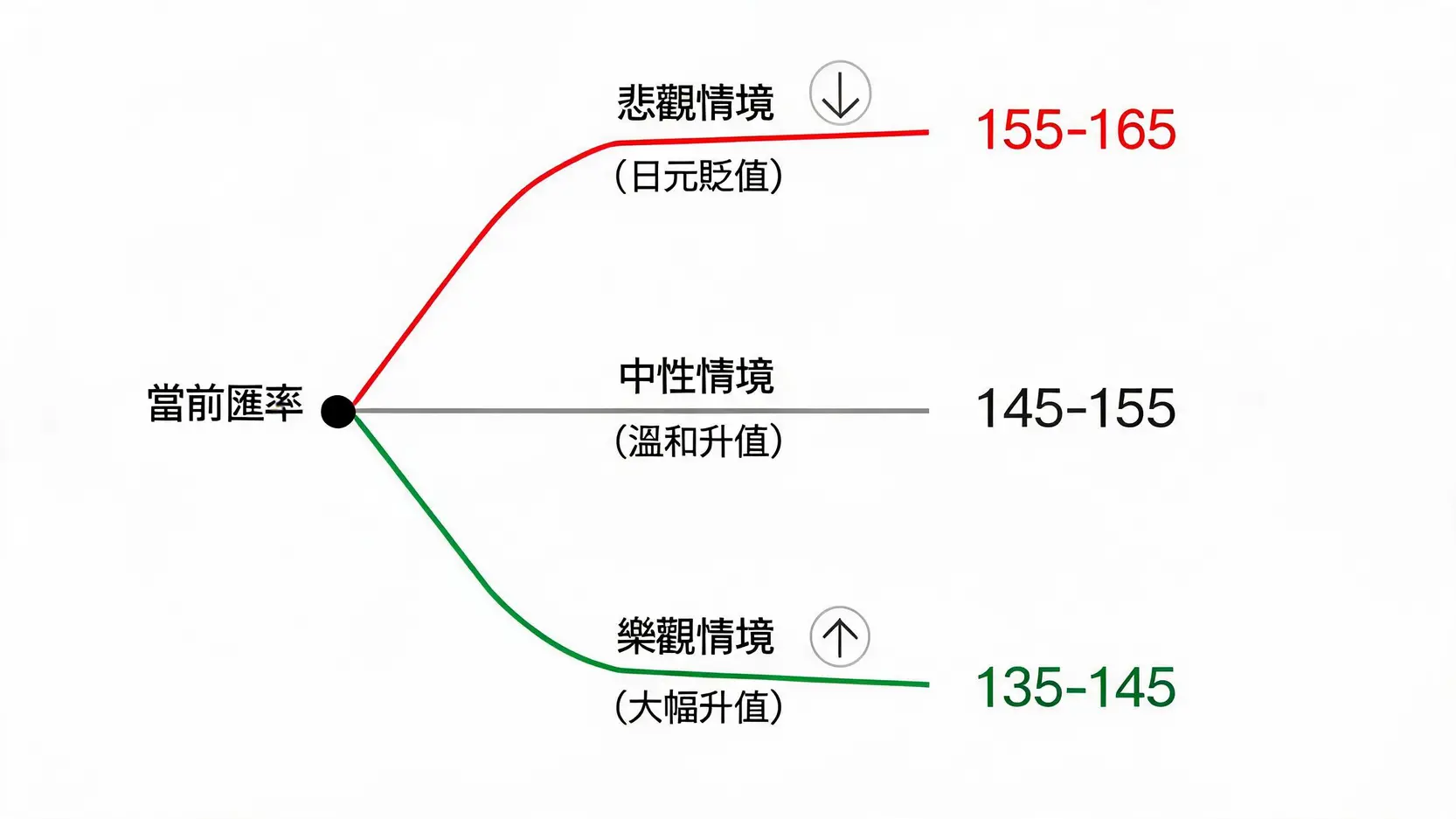
Optimistic Scenario (Sharp Yen Appreciation) Goldman Sachs (Goldman Sachs), Morgan Stanley (Morgan Stanley) 135 – 145 The BOJ raises rates faster than expected, and the Fed’s rate cut cycle begins smoothly, causing the interest rate differential to narrow rapidly.
Neutral Scenario (Moderate Yen Appreciation) UBS (UBS), Nomura (Nomura) 145 – 155 The BOJ adopts gradual rate hikes, while the Fed cuts rates as expected. The exchange rate returns to fundamentals, but the process is relatively moderate.
Pessimistic Scenario (Continued Yen Depreciation or Flat Movement) HSBC (HSBC), Fukuoka Financial Group 155 – 165 or higher The BOJ adopts gradual rate hikes, while the Fed cuts rates as expected. The exchange rate returns to fundamentals, but the process is relatively moderate.

2026年底美元兌日元匯率的三種預測情境圖,包括樂觀、中性和悲觀情境下的目標價位區間。

Figure Two: Three Scenario Forecasts for the USD/JPY Exchange Rate at the End of 2026


Optimistic Scenario Forecast (Sharp Yen Appreciation): Views From Goldman Sachs, Morgan Stanley, and Others

Investment banks with optimistic views believe that the resilience of Japan’s economy and continued inflationary pressure will force the Bank of Japan to tighten faster than the market expects. They predict that the BOJ may raise rates multiple times within the year. At the same time, if US economic data weakens as expected, Fed rate cuts will pave the way for yen appreciation. Under this scenario, the USD/JPY exchange rate may fall below 145 by the end of 2026, or even move toward 140 or lower.


Neutral Scenario Forecast (Moderate Yen Appreciation): Views From UBS, Nomura, and Others

This is the most common view in the market. Most analysts believe that the Bank of Japan will be very cautious and avoid raising rates too quickly, which could impact the economy. It may raise rates once every one to two quarters. The Fed’s rate cut path will also be gradual. Therefore, the narrowing of the US-Japan interest rate differential will be a slow process. In this case, the yen will show moderate, stepwise appreciation, and the USD/JPY year-end target level may fall within the range of 145 to 155.


Pessimistic Scenario Forecast (Continued Yen Depreciation or Flat Movement): Views From HSBC and Others, and Their Reasons

Although it is a minority view, the possibility of a pessimistic scenario should not be ignored. Some analysts, such as strategists from Fukuoka Financial Group, have warned that if Japan’s domestic economic recovery falls short of expectations, or if government debt pressure becomes too great, the BOJ may become hesitant on the path toward monetary policy normalization. On the other hand, if US inflation proves more stubborn than expected, the Fed will be forced to maintain high interest rates for longer, or even completely rule out rate cuts in 2026. In this case, the huge US-Japan interest rate differential will continue to exist, and the yen may not only fail to appreciate, but may even test levels above 160 again. Some views even suggest that it may depreciate to 165. For forex investors, understanding different market scenarios and response strategies is crucial. You can learn risk management through the 2026 Forex Trading Beginner’s Guide

Extended Reading (Strongly Recommended)

[Forex Beginner’s Guide] Investing for Beginners from 0 to 1, Understand the Basics of Forex Trading!

2026 Forex Trading Beginner’s Guide: Master Risk Management and Broker Selection for Steady Profits!


Differentiated Highlight: Beyond the Mainstream Script, What “Black Swan” Events Could Appear in 2026?

Financial markets are always full of uncertainty. In addition to the above projections based on monetary policy, investors must also stay alert to some “black swan” events that could overturn all forecasts.

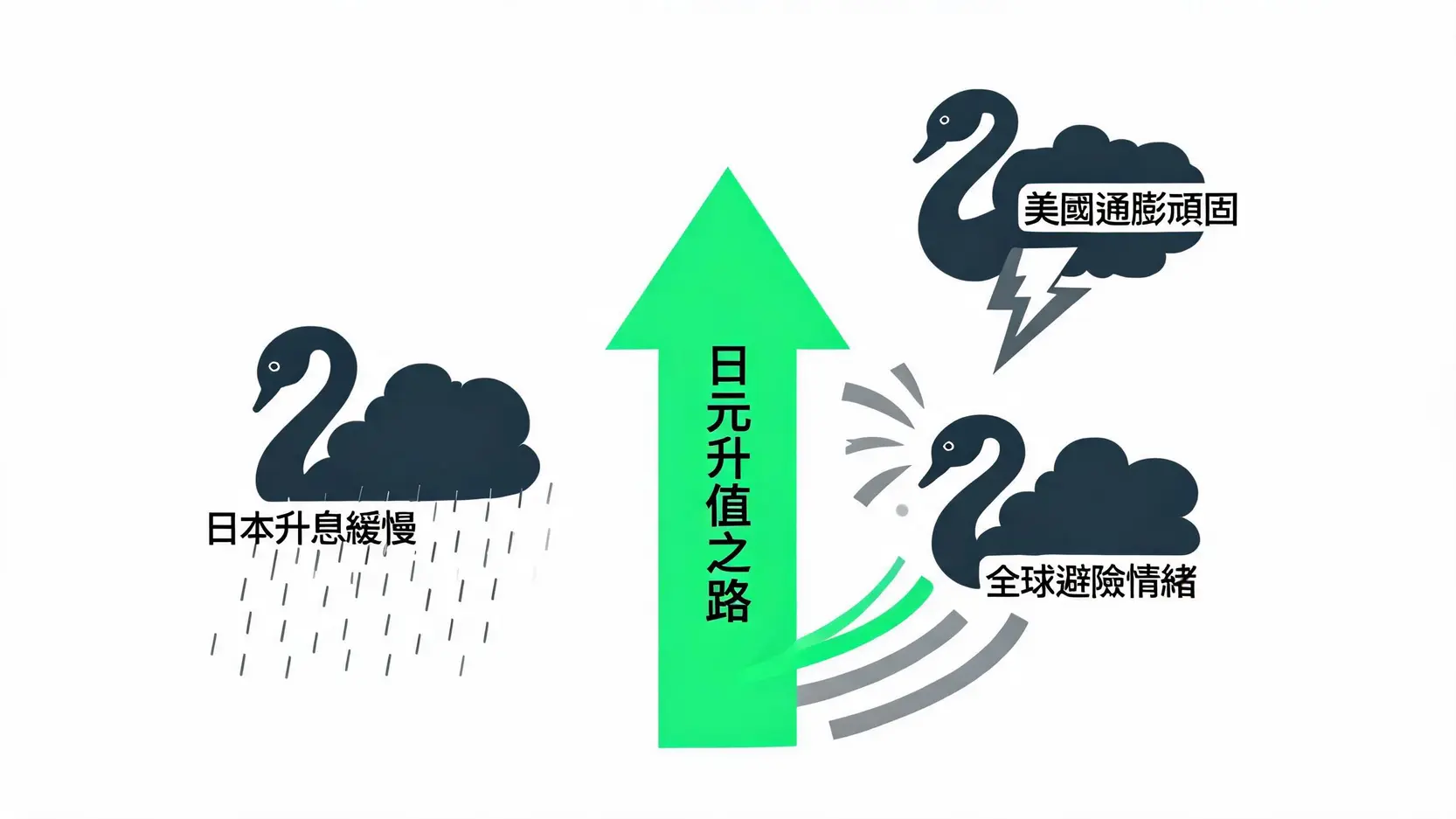
威脅2026年日元升值的三大黑天鵝風險事件:日本央行升息緩慢、美國通膨頑固、全球避險情緒飆升。

Figure Three: Potential “Black Swan” Events Threatening the Yen Appreciation Path


Risk One: The Bank of Japan Raises Rates Much More Slowly Than Market Expectations

This is the biggest risk facing yen bulls. Japan’s economy has been accustomed to a low-interest-rate environment for decades, and tightening too quickly could trigger a wave of corporate bankruptcies and turmoil in the real estate market. If economic data deteriorates, the BOJ is very likely to choose to delay or pause rate hikes, which would greatly disappoint the market and lead to another wave of yen selling.


Risk Two: US Inflation Remains Stubborn, and the Fed’s Rate Cut Timeline Is Repeatedly Delayed

This is another key variable. If energy prices surge again, or if services inflation remains high, the Fed’s battle against inflation will be forced to continue for longer. A persistently hawkish Fed means the strong US dollar will continue, making the yen’s appreciation path much more difficult.


Risk Three: A Global Economic Recession or Geopolitical Risks Cause Safe-Haven Demand for the US Dollar to Surge Again

When global markets experience turbulence, such as a large-scale economic recession or serious geopolitical conflicts (such as wars or trade wars), capital often flows into the US dollar, which is regarded as the safest asset. In this “Risk-Off” mode, regardless of the US-Japan interest rate differential, the US dollar may appreciate significantly against all currencies, including the yen.


Frequently Asked Questions (FAQ)

Q: For ordinary tourists, when might it be most cost-effective to exchange yen in 2026?

A: Based on current mainstream forecasts, the yen may enter an appreciation channel from the second half of 2026 to 2027. In theory, exchanging currency earlier may be more cost-effective. However, exchange rate forecasts involve significant uncertainty, so it is recommended not to exchange the entire budget at once. You can adopt a “phased buying” strategy, such as exchanging some money every month from now on, or exchanging some when the exchange rate sees a larger pullback (such as when USD/JPY rebounds). This can diversify risk and average out currency exchange costs. Completing the exchange within one to two months before traveling is sufficient.

Q: If I want to invest in the yen, what time points are worth watching in 2026?

A: Investors should closely monitor the following key time points:

  • Bank of Japan (BOJ) monetary policy meetings: Held eight times a year. The post-meeting statement and governor’s press conference are the most direct clues for judging its policy direction.
  • US Federal Reserve (FOMC) meetings: Also held eight times a year. Its interest rate decisions and economic projections directly affect the US dollar trend.
  • Key economic data release dates in Japan and the US: Examples include the Consumer Price Index (CPI), Gross Domestic Product (GDP), and employment reports. These data points are the basis for central bank decisions.

Especially around BOJ meetings, or when the US releases key inflation data, exchange rates usually experience larger fluctuations, which may create potential trading opportunities.

Q: How credible are these investment bank forecasts? How should I refer to them?

A: Investment bank forecasts are based on complex economic models and the judgment of professional analysts, so they have high reference value, but they are by no means 100% accurate. Investors are advised to view these forecasts as “scenario analysis” rather than a “destiny script”. The key is to understand the “logic and assumptions” behind each forecast. For example, what kind of interest rate differential assumptions are yen-bullish forecasts based on? What are the reasons for bearish yen views? Only by understanding these can you judge whether the underlying logic has changed when the market moves beyond expectations, and flexibly adjust your own strategy instead of blindly following target levels.

Q: If the yen depreciates instead of appreciating and touches above 160, how should I respond?

A: This is exactly where risk management becomes important in trading. For speculative traders, a clear stop-loss point should be set when establishing long positions (meaning buying yen). Once the exchange rate moves against expectations and touches the stop-loss level, the position should be closed decisively to prevent losses from expanding indefinitely. For those with actual currency exchange needs (such as studying abroad or traveling), if they are worried that the yen may continue to depreciate, they may also consider exchanging part of the amount first to lock in costs. Never put all funds into a one-directional bet.


Conclusion

Overall, the core driver of the yen exchange rate in 2026 will be the process in which the “asynchrony between US and Japanese monetary policies” moves from divergence toward convergence. The market’s general expectation for appreciation is built on the basis that the Bank of Japan will continue promoting monetary policy normalization and the US Federal Reserve will eventually begin a rate cut cycle. Although moderate appreciation is the high-probability scenario, investors must remain clear-headed and closely monitor various risk events that may break expectations, such as hesitation by the Bank of Japan, stubborn US inflation, or sudden global crises. When referring to forecasts from major investment banks, they should be treated as a scenario analysis tool, and investors should combine them with their own risk tolerance to flexibly adjust their investment and currency exchange strategies, so they can respond to the unpredictable foreign exchange market.

编者
Evan Lin

Evan Lin

我是Evan Lin,从大学时期开始接触外汇交易,至今已有多年实战经验,熟悉技术分析与EA策略,热衷于研究市场脉动与风险管控,喜欢分享实战经验和交易技巧,和大家一起学习、一起进步!

If you liked this article, please share it!

Related Articles

  • Why Japan Property Is Attracting Global Investors
    Global Asset Repricing: Why Has Japan’s Property Market Become a Safe Haven for Smart Money Amid Yen Depreciation? What Is “Global Asset Repricing”? Why Has Japan Become the Main Focus? While investment forums around the world are heatedly discussing yen depreciation pressure, the real smart money has already begun positioning...
    2026 年 6 月 23 日
  • Japan Ends Negative Rates: Why Is the Yen Still Weak?
    Farewell to Negative Interest Rates! The Truth Behind Japan Meeting Its Inflation Target: Why Has Yen Depreciation Pressure Increased Instead of Easing? The Japanese economy is staging an extremely contradictory drama: after waiting for thirty years, it has finally welcomed the long-awaited Japan inflation, yet the market’s response has been...
    2026 年 6 月 23 日
  • YCC to QT: BOJ & Fed Policy Shift Analysis
    A Complete Analysis of Central Bank Policy Shifts: From YCC to QT, Decoding the BOJ and the Fed’s Next Move The Bank of Japan (BOJ) and the US Federal Reserve (Fed), two giants of the global financial markets, are seeing their diverging monetary policy directions become the core force driving...
    2026 年 6 月 23 日
返回顶部