Gold Price Forecast 2026: HK Gold ETF Investment Guide

Gold Price Trend Forecast: A 2026 Beginner’s Guide to Gold Investing and Comparison of Hong Kong Gold ETFs
Amid heightened global economic uncertainty and inflationary pressure, gold prices continue reaching new highs, once again reinforcing gold’s status as the king of safe-haven assets. Many investors are watching closely and asking whether now is the perfect time to enter the market. This article provides a complete guide to gold price trend forecasts and beginner gold investing strategies, analyzing the key macroeconomic factors affecting gold prices, comprehensively comparing the advantages and disadvantages of seven major gold investment channels including physical gold, paper gold, and gold ETFs, while also offering an in-depth comparison of the most popular Hong Kong gold ETFs. The goal is to help you develop the most stable and suitable gold investment strategy for 2026. Whether you are a beginner investor or an experienced market participant, you will find valuable insights here.
2026 Gold Price Trend Forecast: Is Now a Good Time to Buy Gold?
To determine the right time to invest in gold, you must first understand the driving forces behind gold price fluctuations. As a non-yielding asset, gold prices are mainly influenced by the global macroeconomic environment. Investors should avoid blindly chasing rising prices and instead conduct rational analysis in order to remain stable in a volatile market.
5 Key Factors Affecting Gold Prices
Gold price movements are not random, but driven by several core global economic indicators. Understanding these factors is equivalent to holding the key to forecasting gold price trends:
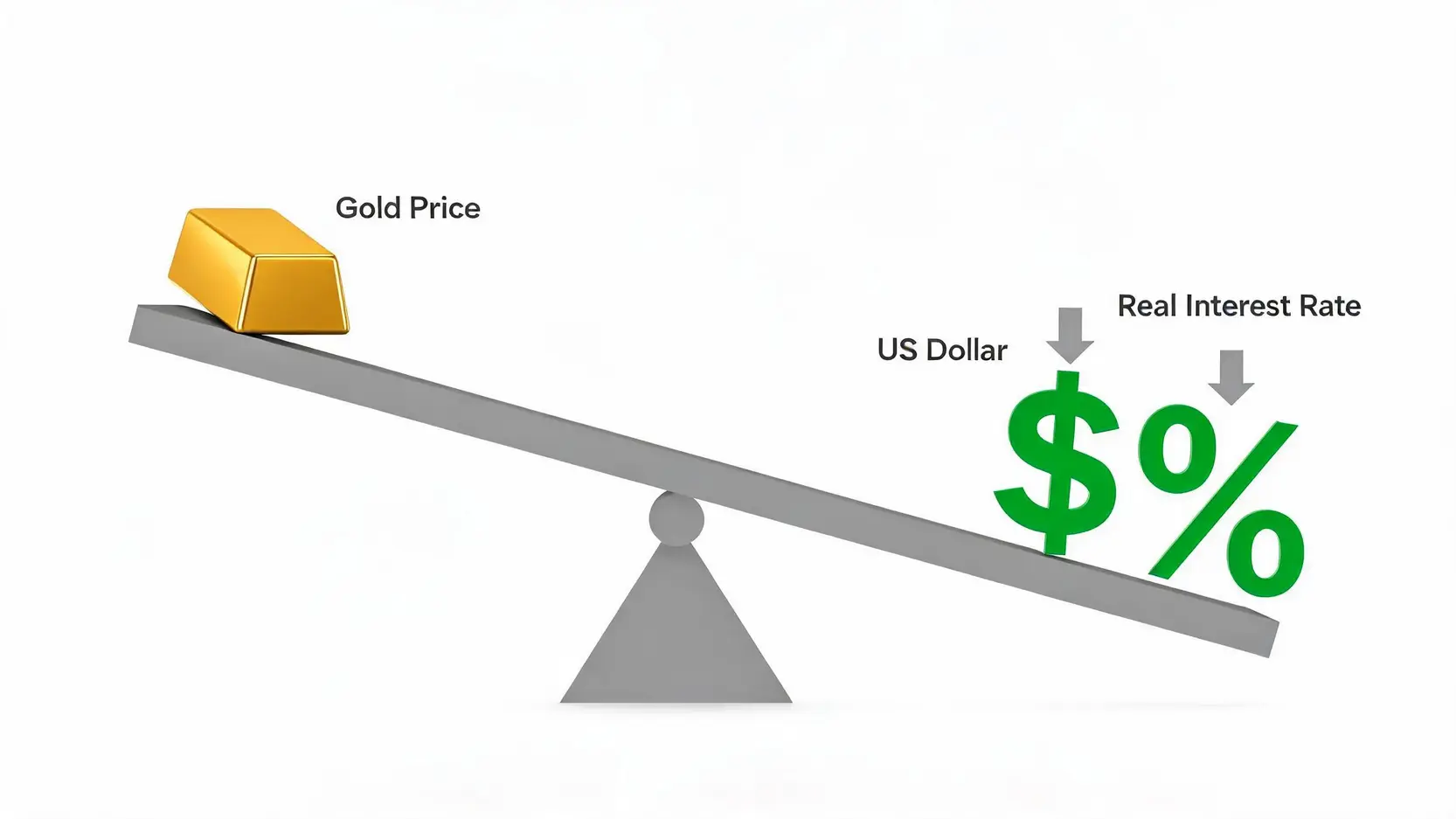
- US dollar exchange rate: Gold is priced in US dollars, and the two usually show a “negative correlation”. When the US dollar strengthens, the cost of purchasing gold becomes relatively higher, suppressing gold prices. Conversely, when the US dollar weakens, gold prices gain upward momentum.
- Real interest rates: Real interest rates = nominal interest rates – inflation. Gold itself does not generate interest, so when real interest rates rise, the “opportunity cost” of holding gold increases (because capital can shift into high-yield products), creating pressure on gold prices. In contrast, during negative or low interest rate periods, gold becomes significantly more attractive.
- Geopolitical risks: Whenever international tensions rise, such as wars, trade conflicts, or political instability, market safe-haven sentiment rapidly intensifies. At such times, gold, as the globally recognized “safe haven”, attracts substantial capital inflows, pushing prices higher.
- Central bank demand: Central banks around the world are major buyers in the gold market. To diversify foreign exchange reserves and hedge against currency depreciation, many central banks continuously increase their gold holdings. According to data from the World Gold Council, central bank demand is an important force supporting gold prices.
- Inflation: When prices continue rising, the purchasing power of currencies is eroded. Due to its limited supply and stable value, gold has historically been regarded as one of the best tools for hedging against inflation. In high-inflation environments, investing in gold can effectively preserve asset value.

Gold prices typically show a seesaw-like “negative correlation” with the US dollar and real interest rates.
Combined Institutional Forecasts: Long-Term Gold Value and Potential Risk Analysis for 2026-2030
Based on analyses from multiple leading international financial institutions (such as Goldman Sachs and UBS), the market generally maintains an optimistic outlook on gold’s long-term value. Looking ahead to 2026-2030, global de-dollarization trends, ongoing geopolitical tensions, and the possibility of monetary easing policies adopted by central banks to address debt issues all provide strong upward support for gold prices. Many analysts predict that gold prices have the potential to challenge US$3,000 per ounce or even higher levels.
However, investing in gold is not without risk. Investors should remain cautious about several potential risks:
- More aggressive-than-expected monetary tightening: If major global economies adopt more aggressive interest rate hikes to combat inflation, real interest rates could rise sharply, placing heavy pressure on gold prices.
- Significant strengthening of the US dollar: If the US economy significantly outperforms other major economies and attracts global capital inflows, a strong US dollar could suppress gold price performance.
- Declining risk-aversion sentiment: If international tensions unexpectedly ease and market safe-haven demand declines, capital may flow out of gold and back into risk assets such as stocks.
Further Reading (Highly Recommended)
Gold Investing for Beginners: A Comprehensive Analysis of 7 Gold Investment Channels
After understanding gold price trends, the next step is selecting the investment method that best suits your needs. The market offers a wide variety of gold investment tools, ranging from physical gold that you can hold in your hand to financial derivatives, each with its own strengths and weaknesses. Below is a comprehensive analysis of the most mainstream investment channels.
Physical Gold vs. Paper Gold vs. Gold ETFs: An Overview Comparison Table of Advantages and Disadvantages
To provide a clear overview at a glance, we have organized the common gold investment channels into the table below for easy comparison:
| Investment Channel | Advantages | Disadvantages | Suitable Investors |
| Physical Gold (Gold Bars/Gold Grains) | ✅ Tangible Ownership
✅ No Counterparty Risk ✅ Can Be Passed Down Through Generations |
❌ High Transaction Costs (Wide Spreads)
❌ Storage and Security Concerns ❌ Lower Liquidity |
High-Net-Worth Investors Seeking Maximum Safe-Haven Protection and Long-Term Holdings |
| Gold Jewelry | ✅ Combines Decorative and Collectible Value |
❌ Very Low Investment Value (Includes High Craftsmanship Costs) ❌ Extremely Wide Buy-Sell Spreads ❌ Difficult to Standardize Purity |
Consumers and Collectors Primarily Focused on Personal Use or Collecting |
| Paper Gold (Gold Passbook Account) | ✅ Convenient Trading
✅ Eliminates Physical Storage Concerns ✅ Low Entry Barrier |
❌ Cannot Be Redeemed for Physical Gold
❌ Subject to Bank Default Risk ❌ Restricted Trading Hours |
Beginners Who Prefer Small-Scale Investments Through the Banking System |
| Gold ETFs | ✅ Extremely Low Trading Costs
✅ Very High Liquidity (Similar to Stocks) ✅ Prices Closely Track International Gold Prices ✅ Backed by Physical Gold |
❌ Management Fees Apply
❌ Requires Trading Through a Securities Account ❌ Share Prices May Have Slight Premiums or Discounts |
The Vast Majority of Modern Investors, Especially Retail Investors Seeking Efficiency and Low Costs |
| Gold Futures/Contracts for Difference (CFDs) | ✅ Leverage Can Amplify Returns
✅ Allows Both Long and Short Trading |
❌ Extremely High Risk, Not Suitable for Beginners
❌ Involves Complex Operations Such as Contract Rollovers ❌ Risk of Forced Liquidation |
Professional Short-Term Traders Capable of Tolerating High Risk |
How to Choose Between Gold Jewelry, Gold Grains, and Gold Bars? A Complete Breakdown of Trading Costs and Storage Issues
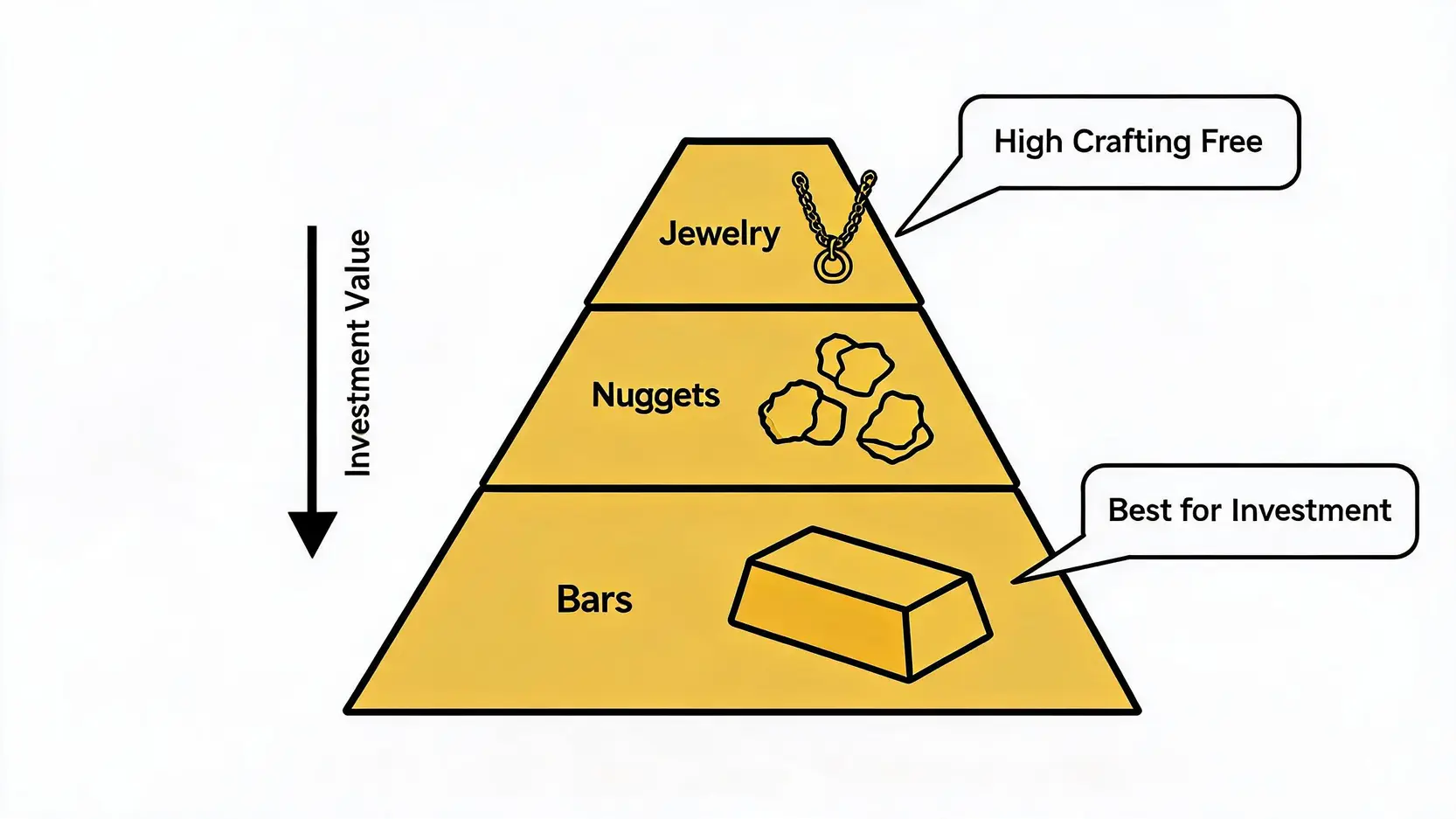
For investors who prefer physical gold, “what should I buy?” is a major question. Simply put, the investment value ranking is: Gold Bars > Gold Grains > Gold Jewelry.

Gold Investment Value Pyramid: Gold Bars > Gold Grains > Gold Jewelry
- Gold Jewelry: Purchase prices include high brand premiums and craftsmanship fees. When selling, these additional costs become worthless, as dealers only buy back based on the raw gold material price. The buy-sell spread can reach 20%-30%, making gold jewelry far from an ideal investment tool.
- Gold Grains/Gold Bars: These products are priced much closer to international gold prices and carry lower craftsmanship costs. The larger the gold bar size, the lower the unit cost. When purchasing, always choose reputable gold dealers or banks and request documentation with proof of purity. For storage, you may choose a home safe or rent a bank safety deposit box. The latter is safer but involves additional annual fees.
Recommended for Beginners: Why Gold ETFs Are the Preferred Choice for Modern Investors
For most retail investors, especially those just beginning their ETF investing journey, Gold ETFs (Exchange Traded Funds) are undoubtedly the most efficient and convenient choice. Like stocks, they can be traded directly on securities exchanges, offering flexible trading hours and excellent liquidity.
The operating principle of a gold ETF is straightforward: the fund company purchases large amounts of physical gold and stores it in professional vaults, then divides ownership of the gold into ETF units for public trading. Buying and selling ETF units is equivalent to indirectly holding a corresponding share of physical gold. This method perfectly combines the reliability of physical gold with the convenience of stock trading, while eliminating concerns related to storage, security, and high transaction costs.
Comparison of Popular Hong Kong Gold ETFs: SPDR Gold ETF (2840) vs. Value Gold ETF (3081)
Several gold ETFs are currently listed on the Hong Kong Stock Exchange, providing investors with a wide range of options. Among them, the SPDR Gold ETF (2840) and the Value Gold ETF (3081) are the most well-known and actively traded. Below is a detailed comparison of these major gold ETFs.
Comparison of Core Data for 4 Mainstream Hong Kong Gold ETFs
When selecting a gold ETF, management fees, assets under management (AUM), trading volume, and tracking error are core indicators that must be considered.
| ETF Name | Stock Code | Total Expense Ratio | Assets Under Management (AUM) | Approximate Minimum Lot Entry Cost |
Remarks |
| SPDR Gold ETF | 2840.HK | 0.40% | ~US$58 Billion (World’s Largest) | ~HK$1,500 | Longest History and Best Liquidity |
| Value Gold ETF | 3081.HK | 0.15% | ~HK$450 Million | ~HK$4,000 | Locally Issued in Hong Kong With the Lowest Management Fee |
| Hang Seng RMB Gold ETF | 83168.HK | 0.28% | ~RMB 500 Million | ~RMB 3,500 | RMB Counter, Suitable for Investors Holding RMB |
| Ping An Gold ETF | 3073.HK | 0.30% | ~HK$300 Million | ~HK$1,600 | Offers Both HKD and RMB Counters |
Note: The above data is accurate as of early 2026. Actual fees and entry costs are subject to the latest announcements from the exchange.
How to Choose the Most Suitable Gold ETF Based on Your Investment Goals?
Faced with the above options, investors can make decisions based on their own needs:
- Pursuing the lowest costs: If you are extremely cost-sensitive and intend to hold long term to benefit from gold price appreciation, the Value Gold ETF (3081), with the market’s lowest 0.15% management fee, is undoubtedly the best choice.
- Prioritizing liquidity and trading frequency: If you are a short-term trader or manage a larger amount of capital and require frequent market entry and exit, the SPDR Gold ETF (2840), which has the world’s largest scale and highest trading activity, will provide the best bid-ask spreads and execution efficiency.
- Holding RMB funds: If you wish to invest directly using RMB while avoiding currency conversion losses and exchange rate risks, you may consider the RMB counters of the Hang Seng RMB Gold ETF (83168) or the Ping An Gold ETF (3073).
FAQ: Common Questions About Gold Investing
Q: What are the risks of investing in gold?
A: The main risks of gold investing include price volatility risk. Gold prices can experience sharp short-term fluctuations due to multiple factors such as global economic data, interest rate policies, and geopolitical developments. In addition, gold itself does not generate interest or dividends and may underperform assets such as stocks during bull markets. Furthermore, if investing through paper gold or derivatives, investors must also bear issuer credit risk or counterparty risk.
Q: Is buying gold jewelry considered a good investment?
A: Strictly speaking, buying gold jewelry is not considered a good investment. The selling price of gold jewelry includes substantial craftsmanship fees, design costs, and brand premiums, all of which cannot be recovered upon resale. Its buy-sell spread is extremely large and usually much higher than that of investment-grade gold bars or gold grains. Gold jewelry should be regarded more as a consumer or collectible item with emotional value, rather than an investment tool for wealth preservation or appreciation.
Q: Can a gold ETF collapse?
A: For ETFs such as SPDR (2840), which are issued by large and reputable financial institutions and backed by physical gold, the risk of collapse is extremely low. The physical gold held by these ETFs is stored in vaults and managed by independent third-party custodians (such as HSBC). The assets are segregated from the fund company itself. Even if the fund company encounters financial problems, investors’ gold assets remain protected and will be handled under regulatory supervision during liquidation.
Q: Are taxes required when investing in gold?
A: In Hong Kong, capital gains (profits from price differences) earned from trading gold ETFs, paper gold, or physical gold are tax-free. This is one of the key advantages of investing in gold through Hong Kong as an international financial center. However, tax policies may differ in other countries or regions, so it is advisable to consult a local tax professional.
Conclusion
In summary, gold plays an indispensable role as a “stabilizer” and “insurance policy” in any well-constructed investment portfolio. It can effectively hedge against geopolitical risks and macroeconomic uncertainty. Through this article’s analysis of the 2026 gold price trend forecast, along with the detailed comparison of various gold investment channels, you should now have a clear blueprint for taking your first step into gold investing. Especially for Hong Kong investors seeking low costs and high efficiency, gold ETFs provide an almost perfect solution. Now is the time to begin building your gold position according to your risk tolerance and investment goals, adding a touch of stable golden value to your asset allocation.
Related Articles
-
2026 Gold Price Forecast Roundup: Where Do Goldman Sachs and Bank of America See It? The Gold Bull Market Is Not Over Yet! Wall Street Consensus: Gold Prices Are Generally Bullish in 2026, Where Is the Target Price Range? After an epic rally, gold’s recent high-level volatility has left many...2026 年 6 月 24 日
-
Global Asset Repricing: Why Has Japan’s Property Market Become a Safe Haven for Smart Money Amid Yen Depreciation? What Is “Global Asset Repricing”? Why Has Japan Become the Main Focus? While investment forums around the world are heatedly discussing yen depreciation pressure, the real smart money has already begun positioning...2026 年 6 月 23 日
-
Farewell to Negative Interest Rates! The Truth Behind Japan Meeting Its Inflation Target: Why Has Yen Depreciation Pressure Increased Instead of Easing? The Japanese economy is staging an extremely contradictory drama: after waiting for thirty years, it has finally welcomed the long-awaited Japan inflation, yet the market’s response has been...2026 年 6 月 23 日