2026 Gold Forecast: Goldman Sachs vs Bank of America

Updated: 2026/06/24  |  CashbackIsland

gold-price-goldman-sachs-bank-of-america

2026 Gold Price Forecast Roundup: Where Do Goldman Sachs and Bank of America See It? The Gold Bull Market Is Not Over Yet!

Wall Street Consensus: Gold Prices Are Generally Bullish in 2026, Where Is the Target Price Range?

After an epic rally, gold’s recent high-level volatility has left many investors full of questions: Has this gold bull market come to an end? Is the risk of chasing prices now too high? In fact, although gold prices have seen a short-term technical pullback, the mainstream view among the world’s top investment banks remains quite optimistic. This article will provide a comprehensive summary of the latest 2026 gold price forecasts from authoritative institutions such as Goldman Sachs, Bank of America, and Barclays, deeply analyze the core momentum supporting the continued advance of this bull market, and explore the key factors affecting 2026 gold prices in the current complex economic environment. Now may be the critical moment to seize the starting point of the next golden decade. 


Goldman Sachs: Reaffirms US$5,400 Target, Short-Term Selling Pressure Does Not Change the Long-Term Bullish Structure

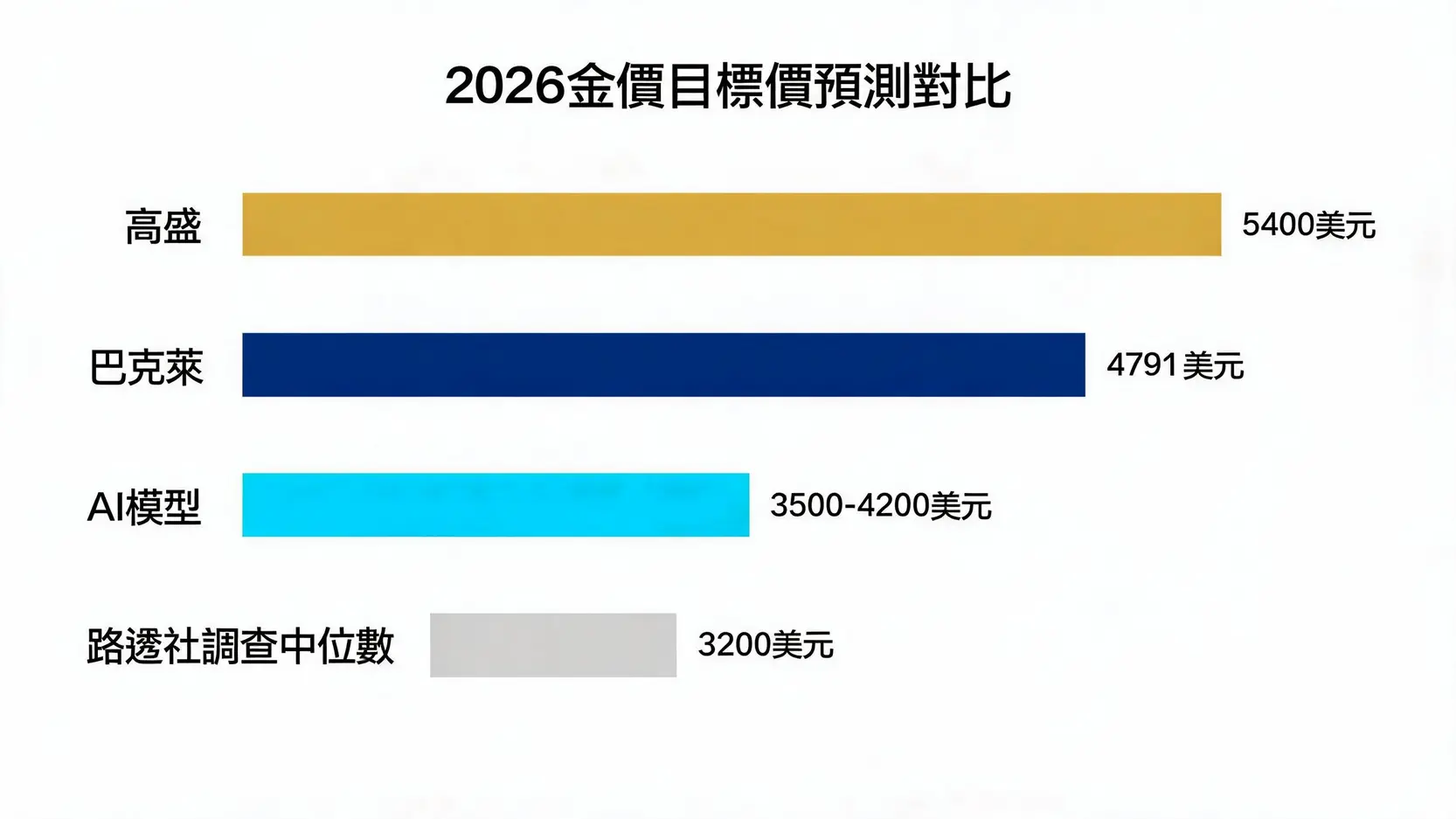
As one of Wall Street’s most bullish investment banks on gold, Goldman Sachs recently reaffirmed its ultra-high target for gold prices. They believe that although short-term selling pressure may emerge due to profit-taking or fluctuations in market sentiment, this does not change gold’s long-term bullish structure. Goldman Sachs’ analysis points out that global central banks, especially those from emerging markets, have far from fully satisfied their demand for gold purchases. This major trend of “de-dollarization” will provide very solid bottom support for gold prices. Therefore, they maintain their optimistic forecast that gold prices will reach US$5,400 per ounce by the end of 2026.


Barclays: Technical Reset, 2026 Target Price of US$4,791

Barclays’ view is relatively more cautious, but it is also bullish on the long-term trend. They believe that after a rapid rise, gold prices need a “technical reset” to digest gains and consolidate support levels. Barclays’ analytical model takes into account multiple variables, including interest rate expectations, inflation trends, and dollar strength. It forecasts that gold prices will resume their upward trend after consolidation. Their target price for 2026 is US$4,791 per ounce. Although this figure is less aggressive than Goldman Sachs’ forecast, it still implies considerable upside potential.


Bank of America: Referencing Historical Cycles, Average Bull Market Gains Could Reach 300%

Bank of America analyzes the market from a broader historical cycle perspective. They reviewed gold bull markets over the past few decades and found a striking pattern: once gold confirms a bull market cycle, its average gain can often reach an astonishing 300%. If the starting point of this bull market (around US$2,000) is used as the benchmark, this means the theoretical peak could far exceed what most people currently imagine. Bank of America emphasizes that although history does not simply repeat itself, in the current environment where structural inflation and geopolitical risks coexist, referencing historical cycles can help investors build a broader market perspective and avoid being easily shaken out by short-term volatility.


Other Analyst Views: Reuters Survey Median Forecast and AI Model Forecasts

In addition to the above giants, other voices in the market are also worth referencing. A Reuters survey of dozens of analysts shows that the median forecast for gold prices by the end of 2026 is around US$3,200. At the same time, some AI forecasting models based on big data and machine learning, after incorporating variables such as global money supply, debt levels, and geopolitical conflict indices, have also given forecasts in the range of US$3,500 to US$4,200. These data indicate that even under relatively conservative expectations, the future trend of gold remains clearly upward.一張比較各大投行及機構對2026年金價預測的條形圖,其中高盛預測最高為5400美元。

Forecast Ranges for 2026 Gold Prices From Wall Street Giants and Market Analysts


The Three Core Engines Driving the Continued Gold Bull Market

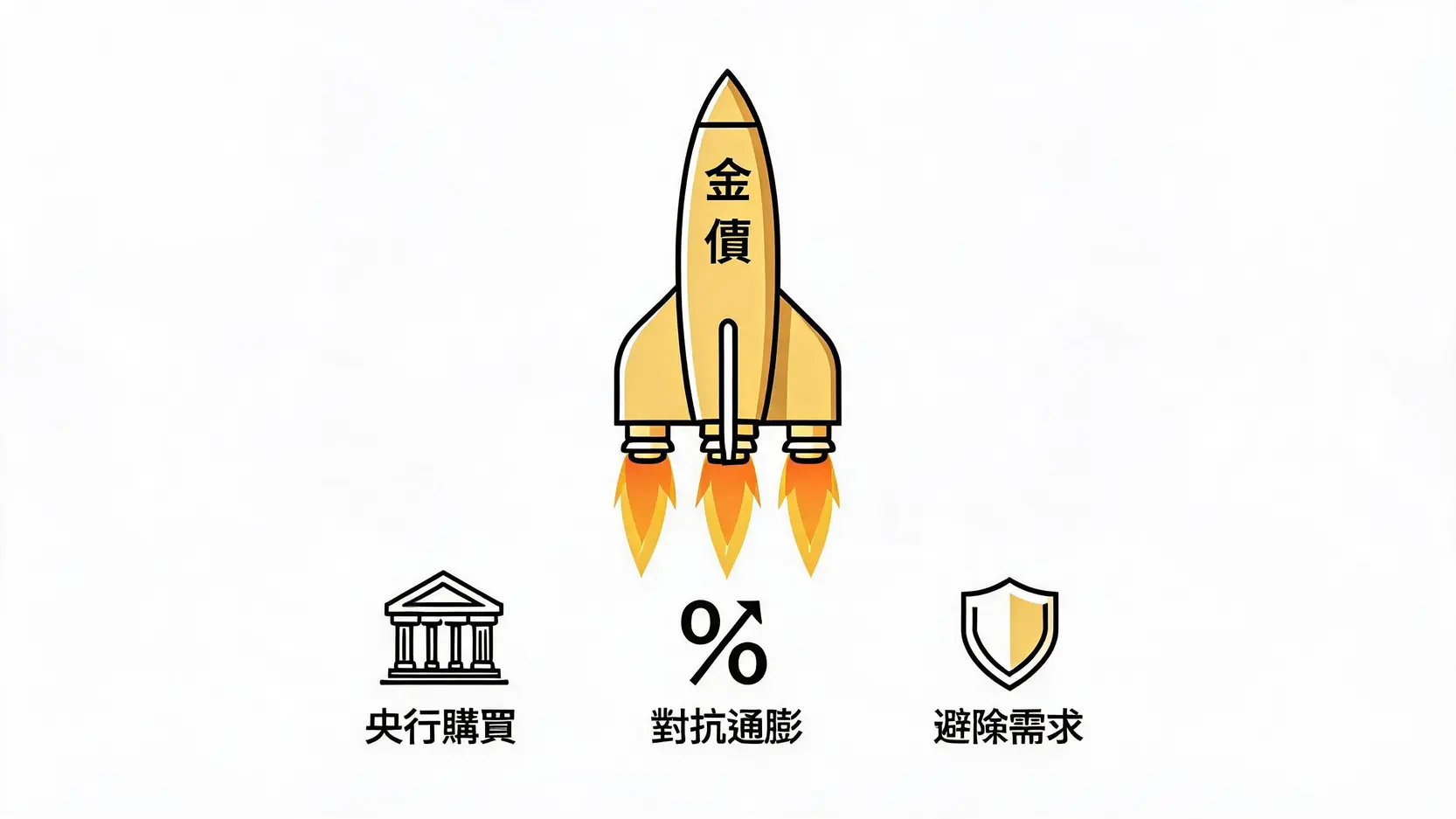
What forces are driving this seemingly endless gold bull market from behind? Only by understanding these key factors affecting 2026 gold prices can you move forward with greater confidence on the investment path. In summary, there are mainly three core engines continuously powering gold prices.

一張概念圖,展示驅動金價上漲的三大核心引擎:央行購買、對抗通膨和避險需求,共同推動金價火箭上升。

The Three Core Engines Driving the Continued Rise in Gold Prices


Engine One: Global Central Banks Shift Reserve Assets, the De-Dollarization Trend Remains Unchanged

In recent years, central banks around the world have become the most committed buyers in the gold market. According to data from the World Gold Council, central banks have continued to break historical records for net gold purchases over the past few years. Behind this is a profound global trend: de-dollarization. As the US weaponizes the dollar, implements financial sanctions, and continues to expand its own debt scale without limit, many countries have begun seeking diversification of reserve assets. Gold, as a supranational asset that does not belong to any country, naturally becomes the best choice. As long as this trend remains unchanged, central banks’ “sweeping purchases” will continue to provide strong support for gold prices. 

Engine Two: Structural Inflation Is Hard to Resolve, Highlighting Gold’s Store-of-Value Function

Over the past two years, the world has been battling stubborn inflation. Although central banks have adopted aggressive rate hikes, inflation has not fallen as quickly as expected. Many economists believe that we may have entered an era of “structural inflation”. Factors such as global supply chain restructuring, rising labor costs, and green inflation brought by the energy transition all make it difficult for price levels to return to past lows. In this environment where money is becoming increasingly “thin”, gold’s role as the most reliable store of value over thousands of years has once again been valued by the market, attracting large inflows of capital seeking asset preservation. 

Engine Three: Geopolitical Conflicts Become Normalized, Safe-Haven Demand Becomes a Market Necessity

From the war in Ukraine to conflicts in the Middle East, and then to trade frictions among major global economies, we are in an era of frequent geopolitical risks. This uncertainty has changed from a “black swan” into a “gray rhino”, becoming the market’s normal state. Whenever the international situation becomes tense and capital markets grow unstable, gold’s safe-haven function immediately becomes prominent. Investors instinctively flow into gold in search of an asset safe harbor. Since there are currently no signs of easing in global tensions, this safe-haven demand will become a “rigid demand” in the gold market and continue to exist in the foreseeable future. 

(Differentiated Highlight) Potential Risks and End Signals of the Gold Bull Market

Although the outlook appears bright, every investment comes with risks. Staying rational and alert, and identifying potential risks and possible signals that the bull market may end, are required lessons for mature investors. As for how long the gold bull market can continue, we need to pay attention to the following areas.

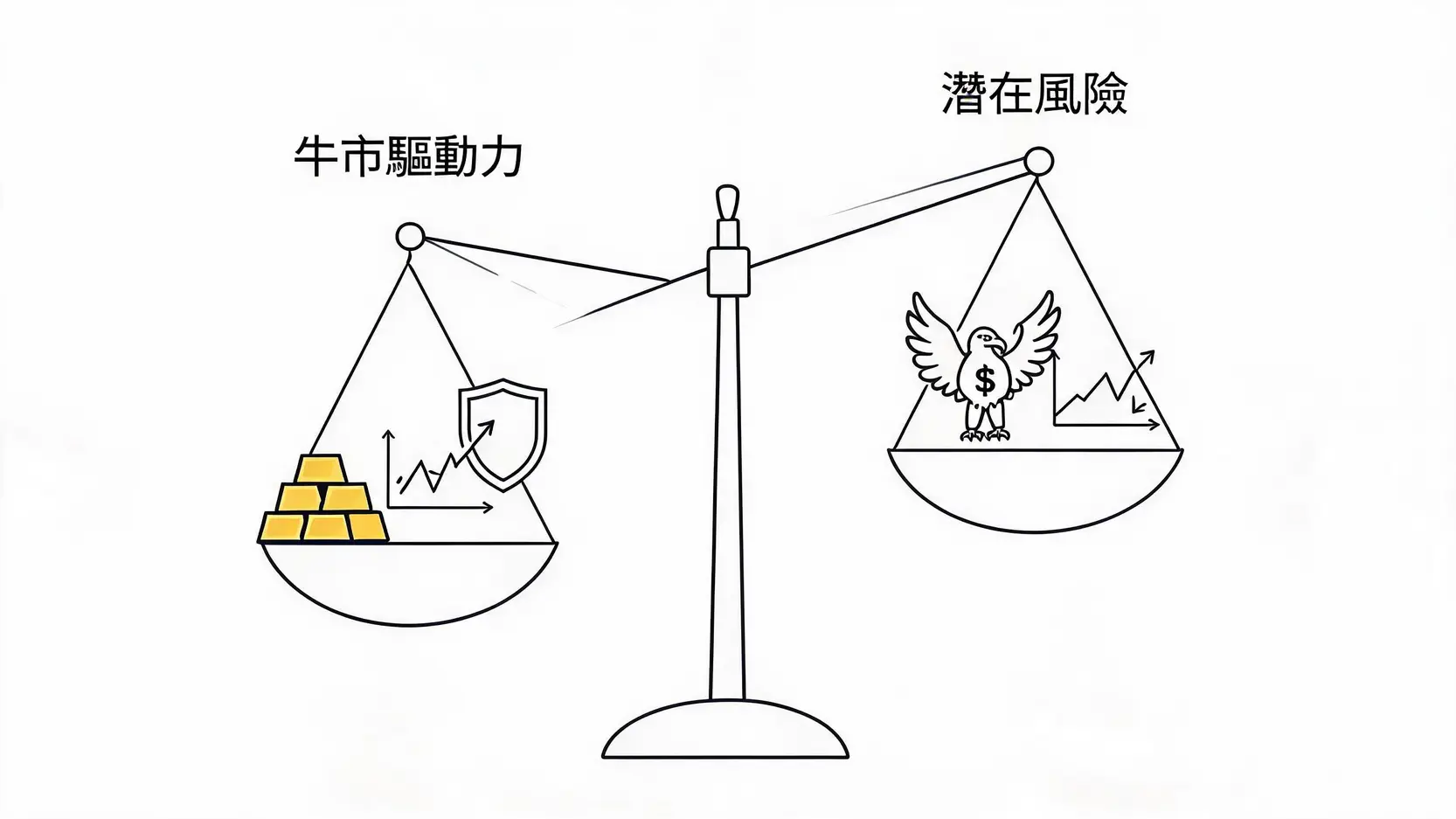
一張天平對比圖,左邊是較重的牛市驅動力(央行購買、抗通膨、避險),右邊是較輕的潛在風險(聯準會鷹派、美元走強),顯示目前多頭佔優。

Balancing the Drivers and Potential Risks of the Gold Bull Market


Risk One: The US Federal Reserve’s Hawkish Stance Exceeds Expectations

Gold and dollar interest rates usually have a negative correlation. If US inflation data rises again, forcing the Federal Reserve (Fed) to adopt a more hawkish stance than the market expects (such as raising rates again or maintaining high interest rates) for a long period, it will push up the opportunity cost of holding gold and put pressure on gold prices. 

Risk Two: The US Dollar Index Strengthens Unexpectedly, Suppressing Gold Price Performance

The price of dollar-denominated gold is also closely related to the trend of the US Dollar Index. If the US economy performs with unexpected resilience, or if other major economies, (such as the eurozone) fall into recession, causing safe-haven funds to flow into the dollar rather than gold, then a strong dollar will suppress the upside potential of gold prices.


Signal One: Global Central Banks Significantly Slow Gold Purchases or Shift to Selling

Central banks are an important driver of this bull market. Investors should closely monitor the central bank gold reserve reports released quarterly by the World Gold Council. Once the reports show that global central banks have significantly slowed their pace of gold purchases, or even shifted from buying to selling, this will be a very important warning signal.


Signal Two: Inflation Data Falls Back to the Target Range and Remains Stable

Gold’s anti-inflation appeal comes from a high-inflation environment. If global inflation data can smoothly fall back to the 2% target range set by central banks and remain stable for a long time, then market demand for gold as a store of value will decline sharply, and capital may shift to other income-generating assets.


Frequently Asked Questions About 2026 Gold Price Forecasts and Gold Investment

Q: If I invest in gold now, will I be buying at the highest point?

A: This is a common concern among many investors. What needs to be understood is that in a long-term bull market structure, prices “reaching record highs” will be the norm. The key is not whether you buy at the absolute lowest point, but whether the long-term trend has changed. Based on the analysis above, the core engines supporting the bull market remain solid. Therefore, instead of worrying about buying at the “highest point”, it is better to view any technical pullback caused by short-term news as a strategic opportunity to build positions in batches or add to positions. Long-term holding and batch positioning are the core principles for dealing with this kind of market.

Q: Besides buying physical gold, what other investment methods can be used to participate in the gold bull market?

A: There are many ways to participate in the gold market, and buying physical gold (gold bars, gold coins) is not the only option. For ordinary investors, more convenient methods with better liquidity include:

  • Gold ETFs: Traded on stock exchanges, they track gold price movements and have low management fees, making them one of the most mainstream investment tools for participating in gold market trends.
  • Gold passbook: A service provided by banks that makes small investments convenient, but usually does not involve physical delivery.
  • Gold mining company stocks: Investing in listed companies that mine gold. Their stock prices are usually linked to gold prices and carry a leverage effect, but investors also need to bear the operating risks of individual stocks.
  • Gold futures/contracts for difference (CFDs): High-leverage financial derivatives with extremely high risk, suitable for professional and experienced traders.

Q: If gold prices really rise in 2026, when should I sell?

A: Trying to predict the market’s highest point and “exit at the top” is very difficult, and even professional investors find it hard to do. A more practical strategy is to act based on your investment goals and risk monitoring. You can set a target return, such as selling part of your position first to lock in profits when gains reach 50% or 100%. Another more rational approach is to continuously monitor the “bull market end signals” mentioned earlier. When you observe that global central banks begin to shift to selling gold, or that inflation has clearly been brought under control, it may be time to consider gradually reducing holdings, no matter how high the price is at that time.


Conclusion

Overall, although investment banks differ in their specific 2026 gold price forecasts, with predictions ranging from US$3,200 to US$5,400, the mainstream view consistently believes that the foundation of the gold bull market remains very solid. Driven by continued central bank buying, unresolved structural inflation, and geopolitical safe-haven demand, the long-term upward trend in gold prices is clear. For investors, understanding and accepting short-term price volatility is the ticket to participating in this opportunity. With full awareness of the potential risks, any current technical pullback should be viewed as a valuable opportunity for strategic positioning. Investors should hold patiently to capture this gold bull market trend, which may last for several years.

编者
Evan Lin

Evan Lin

我是Evan Lin,从大学时期开始接触外汇交易,至今已有多年实战经验,熟悉技术分析与EA策略,热衷于研究市场脉动与风险管控,喜欢分享实战经验和交易技巧,和大家一起学习、一起进步!

If you liked this article, please share it!

Related Articles

  • Why Japan Property Is Attracting Global Investors
    Global Asset Repricing: Why Has Japan’s Property Market Become a Safe Haven for Smart Money Amid Yen Depreciation? What Is “Global Asset Repricing”? Why Has Japan Become the Main Focus? While investment forums around the world are heatedly discussing yen depreciation pressure, the real smart money has already begun positioning...
    2026 年 6 月 23 日
  • Japan Ends Negative Rates: Why Is the Yen Still Weak?
    Farewell to Negative Interest Rates! The Truth Behind Japan Meeting Its Inflation Target: Why Has Yen Depreciation Pressure Increased Instead of Easing? The Japanese economy is staging an extremely contradictory drama: after waiting for thirty years, it has finally welcomed the long-awaited Japan inflation, yet the market’s response has been...
    2026 年 6 月 23 日
  • YCC to QT: BOJ & Fed Policy Shift Analysis
    A Complete Analysis of Central Bank Policy Shifts: From YCC to QT, Decoding the BOJ and the Fed’s Next Move The Bank of Japan (BOJ) and the US Federal Reserve (Fed), two giants of the global financial markets, are seeing their diverging monetary policy directions become the core force driving...
    2026 年 6 月 23 日
返回顶部