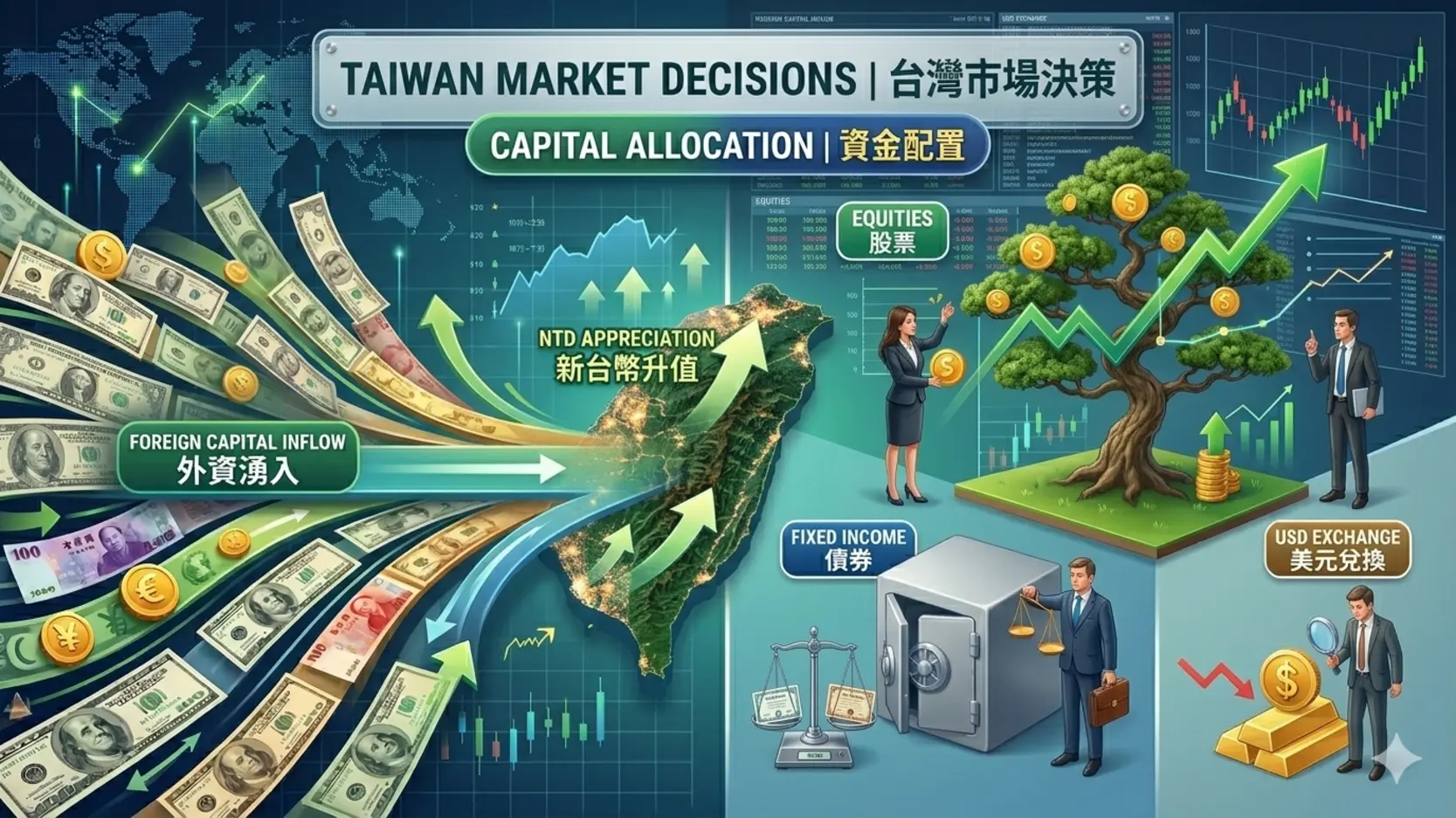
Three Investment Scenarios: Choose Your Strategy Based on Risk Preference
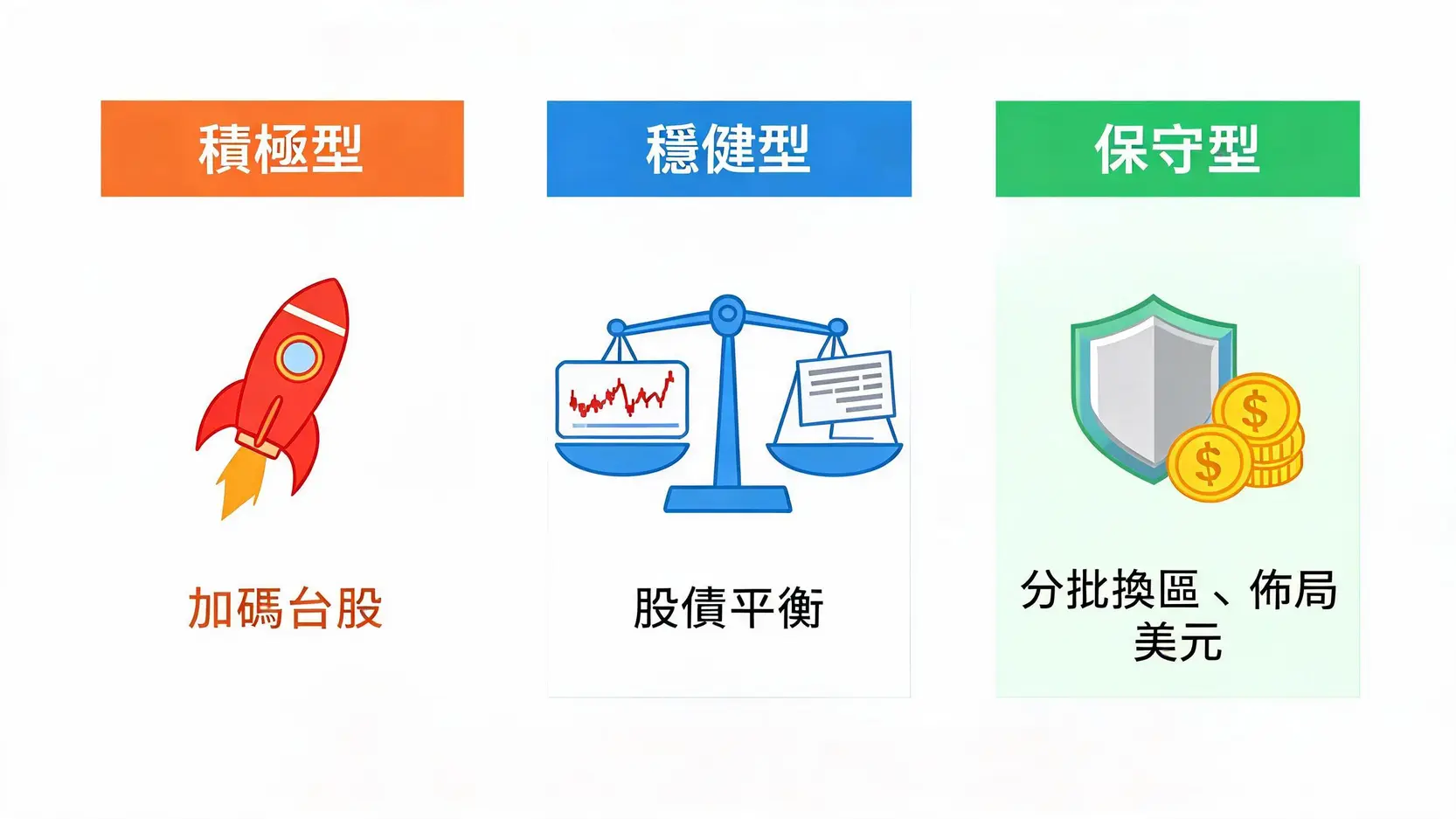
Scenario 1 (Aggressive): Go With the Trend and Increase Exposure to Taiwan Stocks and Taiwan Dollar Assets
Suitable for investors with a high risk tolerance who believe the current liquidity-driven rally will continue.
- Core Strategy: Concentrate your efforts, embrace the trend, and maximize capital gains.
- Suggested Actions:
1. Increase Taiwan Stock Exposure: Prioritize sectors that benefit from Taiwan dollar appreciation, such as leading financial stocks, asset stocks, and large-cap heavyweight stocks favored by foreign investors.
- Reduce US Dollar Exposure: Convert part of your US dollar assets into Taiwan dollars and invest them in Taiwan stocks or Taiwan dollar-denominated investment products to reduce potential foreign exchange losses.
- Utilize Leveraged ETFs: For experienced investors who understand market dynamics, a small allocation to leveraged ETFs such as Yuanta Taiwan 50 Leveraged 2X ETF (00631L) can amplify returns. However, strict stop-loss discipline is essential.
Scenario 2 (Balanced): Maintain a Stock-Bond Balance and Increase Holdings of Taiwan Dollar-Denominated Bond ETFs
Suitable for investors with moderate risk tolerance who want to capture opportunities while controlling downside risk.
- Core Strategy: Combine stocks and bonds to achieve both growth and protection while pursuing stable returns.
- Suggested Actions:
1. Maintain Core Equity Holdings: Continue holding fundamentally strong Taiwan stocks to participate in market gains.
- Increase Taiwan Dollar Bond ETF Exposure: Allocate part of your portfolio to Taiwan dollar-denominated investment-grade corporate bond ETFs or government bond ETFs. These Taiwan bond ETFs can benefit from hot money inflows while providing a buffer during stock market corrections.
3.Rebalance US Dollar Assets: Avoid rushing to convert all US dollar assets back into Taiwan dollars. Maintain a certain allocation as a defensive position and observe future exchange rate trends before making further adjustments.
Scenario 3 (Conservative): Gradually Exchange Currency, Accumulate US Dollar Assets on Weakness, and Wait for a Trend Reversal
Suitable for investors with lower risk tolerance or those who believe the market is overheating and prefer a contrarian approach.
- Core Strategy: Prioritize risk management and wait patiently for more attractive entry opportunities.
- Suggested Actions:
1.Maintain Strong Cash Reserves: When Taiwan stocks are trading at elevated levels, consider taking partial profits and increasing your Taiwan dollar cash holdings.
2. Gradually Buy US Dollars: Take advantage of the strong Taiwan dollar by gradually building US dollar positions through dollar-cost averaging or phased purchases. This is equivalent to buying US dollar assets “at a discount” and preparing for future overseas investment opportunities.
- Monitor Reversal Signals: Closely watch the monetary policy direction of the US Federal Reserve (Fed), the stance of Taiwan’s central bank, and foreign capital flows. When signs of hot money outflows emerge, your established US dollar positions can serve as both a hedge and a potential source of profit.
Hedging Tools Beyond Buying and Selling
In the current wave of capital inflows, investors can do more than simply adjust their allocations among stocks, bonds, and currencies. More advanced investors may also utilize hedging tools to manage risk, an important step toward building a more resilient portfolio.
Foreign Exchange Futures and Options: Lock In Exchange Rates and Reduce Currency Risk
For business owners or investors holding substantial US dollar assets, or those with significant future US dollar payment obligations, foreign exchange derivatives can be used for hedging. For example, investors may purchase “USD/TWD” forward contracts or call options to lock in future exchange rates. Even if the Taiwan dollar depreciates significantly in the future, they can still obtain US dollars at the previously agreed exchange rate, effectively reducing currency risk.
Inverse ETFs: A Hedging Tool When Hot Money Retreats
Every market rally eventually comes to an end. When foreign investors shift from net buying to net selling and hot money begins to exit, Taiwan stocks may face substantial correction pressure. In such situations, inverse ETFs such as the Yuanta Taiwan 50 Inverse ETF (00632R) can become useful tools. These ETFs track the inverse daily performance of the Taiwan stock index. When the index falls, the ETF’s net asset value rises, helping offset losses in long equity positions. However, investors should note that inverse ETFs are not suitable for long-term holding and are primarily intended for short-term hedging or speculative purposes. Learning more about what ETFs are and the fundamentals of ETF investing can help investors use these instruments more effectively.
Gold: The Role of a Traditional Safe-Haven Asset in the Current Environment
Gold has long been regarded as the ultimate safe-haven asset and typically performs well during periods of market panic, heightened geopolitical risk, or currency depreciation. In the current environment of Taiwan dollar appreciation and relative US dollar weakness, US dollar-denominated gold prices have some support. However, gold does not generate income, and its price generally has a negative correlation with real interest rates. If global central banks shift toward tighter monetary policy in the future, gold prices may face downward pressure. Therefore, gold should serve as an “insurance policy” within a portfolio, with a moderate allocation as a defensive asset against extreme risks. A comprehensive beginner’s guide to gold investing can provide additional insights.
Related Reading (Highly Recommended)
[2025 US Dollar Investment Guide] Understand 4 Major US Dollar Investment Methods in One Article! Includes Offers From More Than 30 Banks
Fourth Largest Net Buying in History! Foreign Investors Sweep NT$62.7 Billion of Taiwan Stocks, Revealing the Three Key Drivers Behind the Simultaneous Rise in Stocks and the Currency…
Frequently Asked Questions (FAQ)
Q: Is now a good time to exchange for US dollars?
A: That depends on your investment objectives and outlook for the market. If you believe the Taiwan dollar appreciation trend is approaching its peak, or you have long-term US dollar asset allocation needs, such as investing in US stocks or overseas travel, then gradually buying US dollars while the Taiwan dollar remains relatively strong may be a cost-effective strategy. Conversely, if you believe the current liquidity-driven rally will continue to support the Taiwan dollar, there is no need to rush into currency conversion.
Q: With the Taiwan dollar appreciating, is buying TSMC a good choice?
A: As an export-oriented company, TSMC (2330) theoretically faces pressure on its profit margins when the Taiwan dollar appreciates. However, TSMC is the primary investment target for foreign investors in the Taiwan stock market. When foreign capital flows into Taiwan on a large scale, TSMC is often one of the biggest beneficiaries of buying interest, and its share price tends to rise alongside the broader market. Therefore, in the short term, share price performance may be influenced more by market positioning and capital flows (particularly foreign investor buying), but over the long run, it will still be driven by the company’s industry position and fundamentals. Before investing, exchange rates, capital flows, and the company’s prospects should all be considered comprehensively.
Q: What happens if hot money suddenly leaves the market?
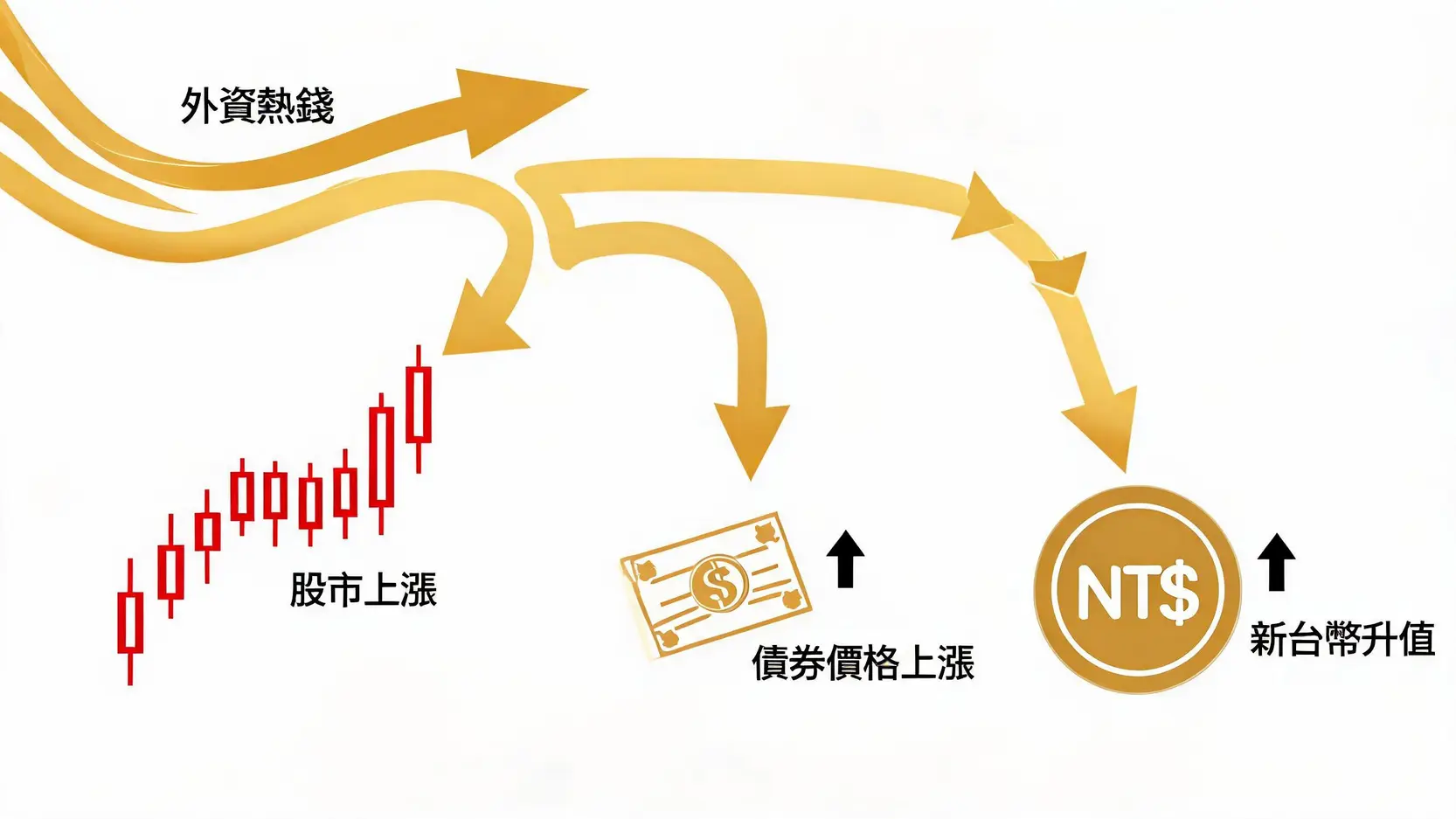
A: If hot money exits rapidly due to global risk events or a shift in US monetary policy, it could trigger a simultaneous decline in “stocks, currencies, and bonds”. First, large-scale foreign selling could cause a sharp drop in Taiwan stock indices. Second, foreign investors would sell Taiwan dollars and convert back into US dollars to repatriate funds, leading to a rapid depreciation of the Taiwan dollar. Finally, capital previously parked in the bond market would also leave, causing bond prices to fall and yields to surge. The impact on Taiwan’s financial markets could be extremely severe.
Q: How can small investors participate in a liquidity-driven market?
A: Investors with limited capital are generally not advised to chase popular thematic stocks or engage in high-risk trading. A more prudent approach is to invest regularly through Taiwan stock ETFs, such as “Yuanta Taiwan 50 ETF (0050)” or “Fubon Taiwan 50 ETF (006208)”. This allows investors to participate in market gains while reducing single-stock risk through diversification, making it a relatively safe way to benefit from the liquidity-driven market.
Conclusion
In an environment of Taiwan dollar appreciation and hot money inflows, there is no single perfect strategy, only the asset allocation strategy that best suits your needs. This liquidity-driven market presents both opportunities and challenges. Investors should first calmly assess their own risk tolerance, investment objectives, and financial situation, then combine that assessment with the market analysis and three investment scenarios outlined in this article to adjust their portfolios accordingly. Whether you are an aggressive surfer riding the waves or a steady navigator charting a cautious course, maintaining rational judgment and practicing sound risk management are the keys to navigating this wave of capital and capturing opportunities that align with your goals.