Fund Trading Guide: 5 Steps from Buy to Redemption

Fund Trading Process Guide: From Subscription to Redemption, Master the Key Investment Steps in 5 Steps (With Fee Summary)
Want to grow your wealth through fund investing, but feel overwhelmed by the complex subscription and redemption processes and the wide range of fund fees? Many beginner investors hesitate because they do not understand the full fund trading process, or their final returns are affected by overlooked hidden costs. Do not worry! This article will provide you with the clearest guide to the fund trading process, from account opening and fund selection to placing subscription orders and redeeming profits, while also breaking down various fund fees in detail, helping you avoid investment traps and take a steady first step.
What Are Fund Subscription and Redemption? Essential Concepts Before Investing
Before entering the fund market, you must first understand two fundamental terms: “subscription” and “redemption”. These correspond to “buy” and “sell” in stock trading, but they carry specific meanings and processes in fund transactions.
Fund Subscription: How to Buy Your First Fund?
Fund subscription refers to the act of “purchasing” or “buying” fund units from a fund company. When you are optimistic about the future potential of a particular fund and decide to invest, you will execute a subscription. You can submit a subscription request through channels such as banks, brokerage firms, or online fund platforms, and pay the corresponding amount. Once completed, you become one of the fund holders, and your capital is pooled into the fund’s assets and managed by professional fund managers.
Fund Redemption: How to Sell Your Fund and Withdraw Cash?
Fund redemption is the opposite of subscription. It refers to “selling back” your fund units to the fund company in exchange for cash. When you believe your investment goal has been achieved, need funds, or want to switch investment targets, you can submit a redemption request. The fund company will calculate the amount you can receive based on the fund’s NAV on the day of your request or the next trading day, and transfer the funds to your designated account within a few working days.

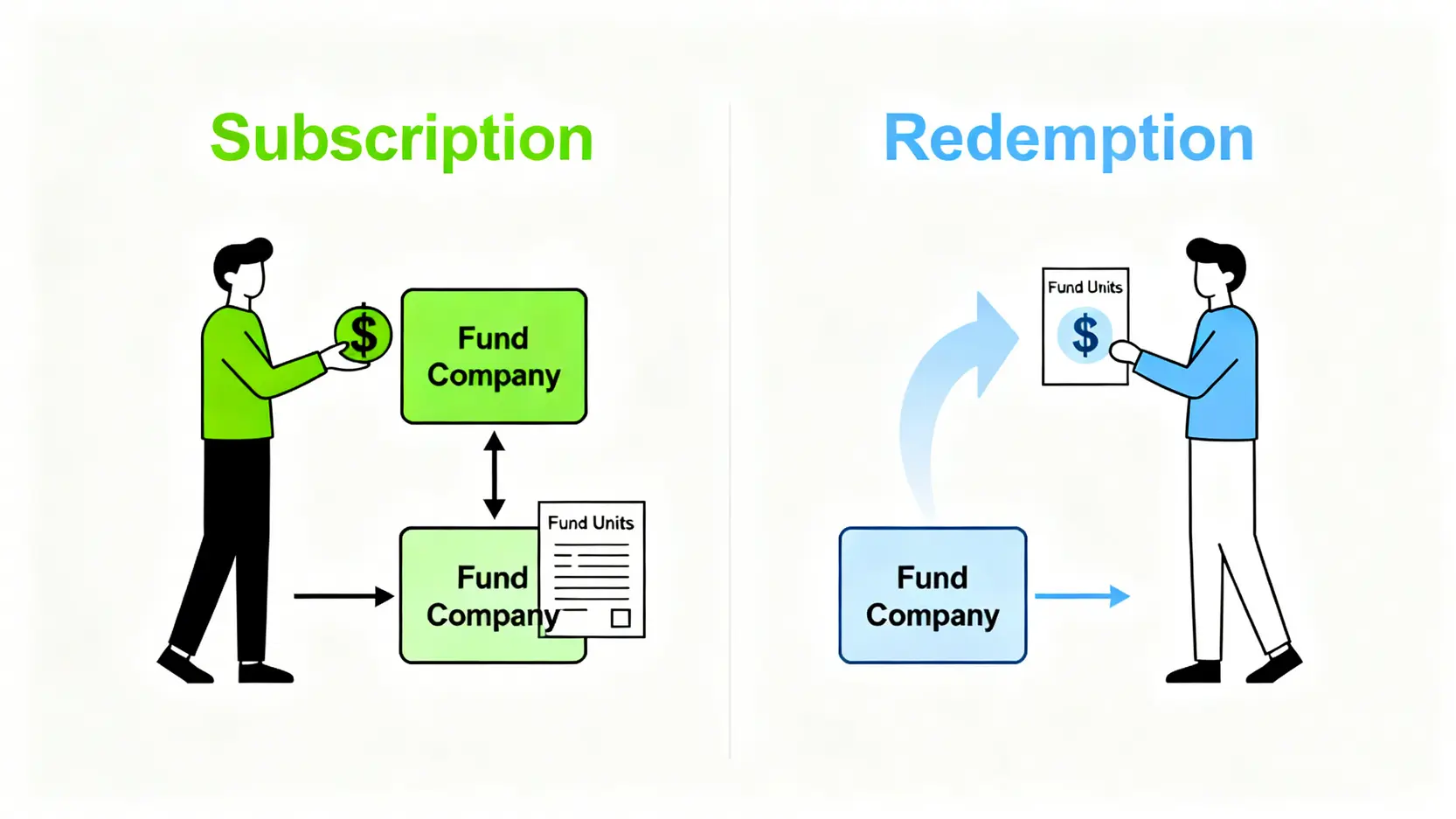
“Subscription” means investing capital in exchange for fund units, while “redemption” means selling units to receive cash.
How Are Subscription and Redemption Prices Calculated? Understanding NAV
Fund trading prices are not real-time market prices like stocks, but are based on the “Net Asset Value” (NAV). The calculation of NAV is relatively straightforward:
Fund Net Asset Value (NAV) = (Total Assets of the Fund – Total Liabilities) / Total Units Issued
Fund companies calculate NAV only once per day (usually after market close). Therefore, when you place a subscription or redemption order today, the transaction price will be based on the NAV published after the market closes on the same day. This is known as “forward pricing”. This is very different from stock trading, where prices can be specified, and is something beginners need to pay special attention to.
Fund Trading Process Breakdown: Complete Your First Investment in 5 Steps
After understanding the basic concepts, we will now break down the actual fund trading process into five simple steps, allowing you to get started easily by following along.

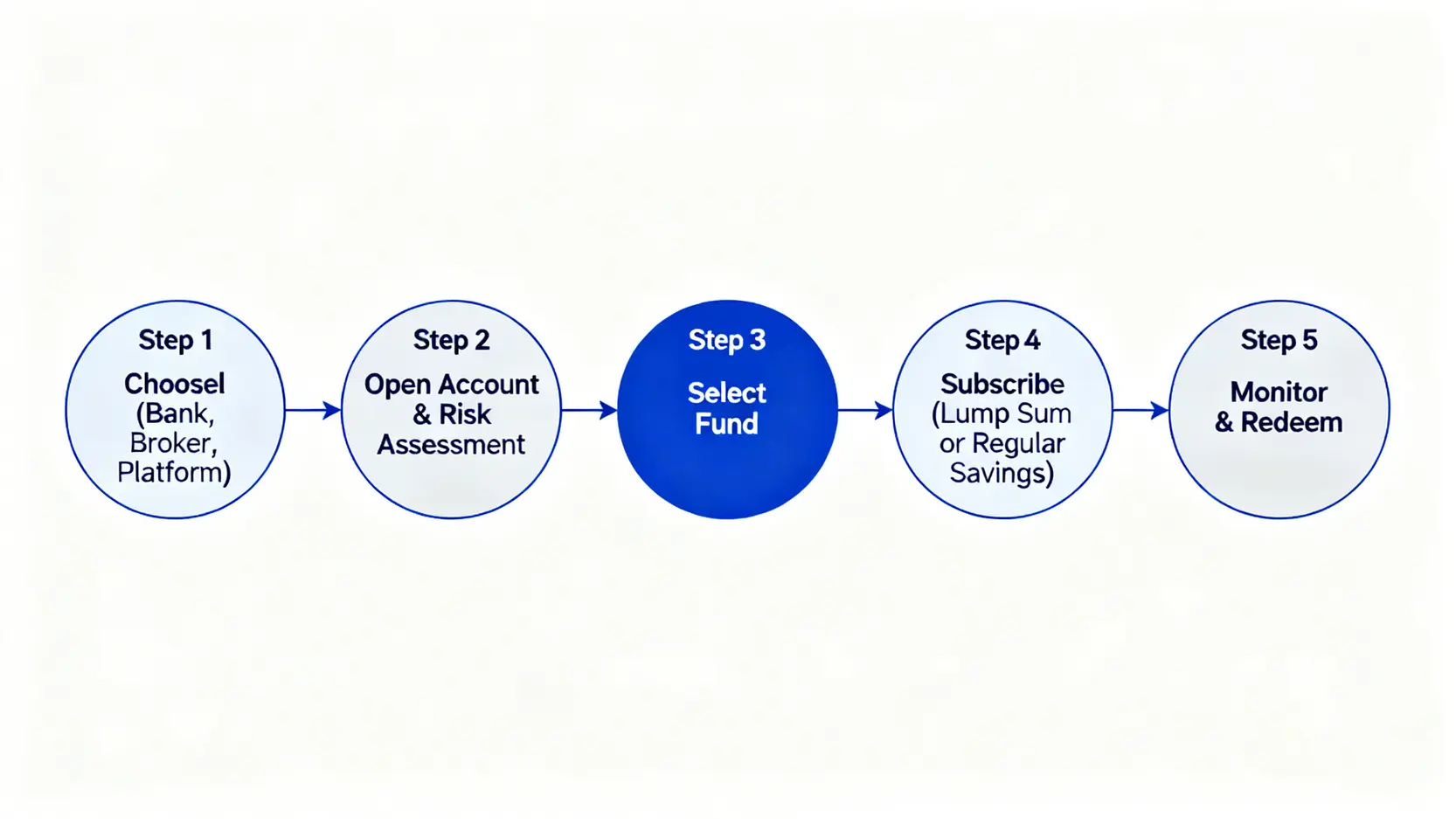
Five Steps to Fund Investment: Account Opening, Evaluation, Selection, Subscription, Redemption.
Step 1: Choose an Account Opening Channel (Banks, Brokerage Firms, Fund Platforms) and Compare
There are three main channels for purchasing funds, each with its own advantages and disadvantages. The choice of channel will directly affect your fund fees and convenience.
| Channel Type |
Advantages |
Disadvantages | Suitable For |
| Traditional Banks | Many branches with dedicated service; convenient fund deposit and withdrawal, integrated within the same account | Relatively limited fund selection; subscription fees are usually the highest | Investors who prefer in-person service and are not familiar with online operations |
| Brokerage Firms | Can invest in multiple instruments such as stocks and funds; professional investment advice | Fund selection may not be the most comprehensive; fees are between banks and platforms | Investors who want to manage multiple investment instruments within a single account |
| Online Fund Platforms | The widest and most comprehensive fund selection; the lowest subscription fees, sometimes even zero fees; transparent information and convenient comparison | Almost no physical service, all processes must be completed online; fund transfers may require additional time | Self-directed investors who seek low costs, a wide range of choices, and are familiar with online operations |
Step 2: Complete Account Opening and Client Risk Assessment
After selecting a channel, you need to prepare identification documents and proof of address, and follow the instructions to complete the account opening process. During this process, financial institutions are required by regulations to ask you to complete a “Know Your Customer” (KYC) questionnaire. This questionnaire is designed to understand your investment experience, financial situation, risk tolerance, and investment objectives. Based on the results, you will be classified as a conservative, balanced, or aggressive investor, which will serve as the basis for recommending funds with corresponding risk levels.
Step 3: Select a Fund That Suits You (Equity Funds, Bond Funds, Balanced Funds)
This is the most critical step. There are many types of funds, and beginners can start with the following broad categories:
- Equity Funds: Primarily invest in stocks, with higher risk and potential returns, suitable for aggressive investors seeking long-term capital appreciation.
- Bond Funds: Primarily invest in government or corporate bonds, with relatively stable risk and returns, suitable for conservative investors seeking stable income.
- Balanced Funds: Invest in both stocks and bonds, with risk and return between the two, suitable for balanced investors.
When selecting, in addition to considering the fund type, you should also carefully read the “prospectus” to understand its investment objectives, strategies, historical performance, and fee structure. This document is the most authoritative source of information about a fund. To learn more fund selection techniques, you can refer to this guide on how to buy funds: a beginner’s guide covering everything from account opening and subscription to redemption.
Step 4: Execute the “Subscription” Order (Lump Sum vs Dollar-Cost Averaging)
After selecting your preferred fund, you can proceed with the subscription order. There are two main methods:
- Lump Sum Investment: Invest a fixed amount at once. Suitable for investors who have a certain view on market timing or have idle capital to invest.
- Dollar-Cost Averaging: Agree to automatically invest a fixed amount on a fixed date each month. This method spreads time risk and uses the “average cost method”, buying fewer units when prices are high and more units when prices are low. Over time, it effectively smooths out costs and is very suitable for small investors or beginners.
Step 5: Understand the Timing and Process of “Redemption”
The ultimate goal of investing is to realize profits. Common redemption timing includes reaching a preset profit target, finding that the fund’s performance is below expectations, or having an urgent need for funds. The redemption process is simple. You only need to submit a redemption request on the trading platform and choose the number of units or amount to redeem. It is important to note that the funds will not be credited immediately. It usually takes several working days, (known as T+N days, for the funds to arrive.
Further Reading (Highly Recommended)
The Devil Is in the Details: Understand All Fund Fees in One Article
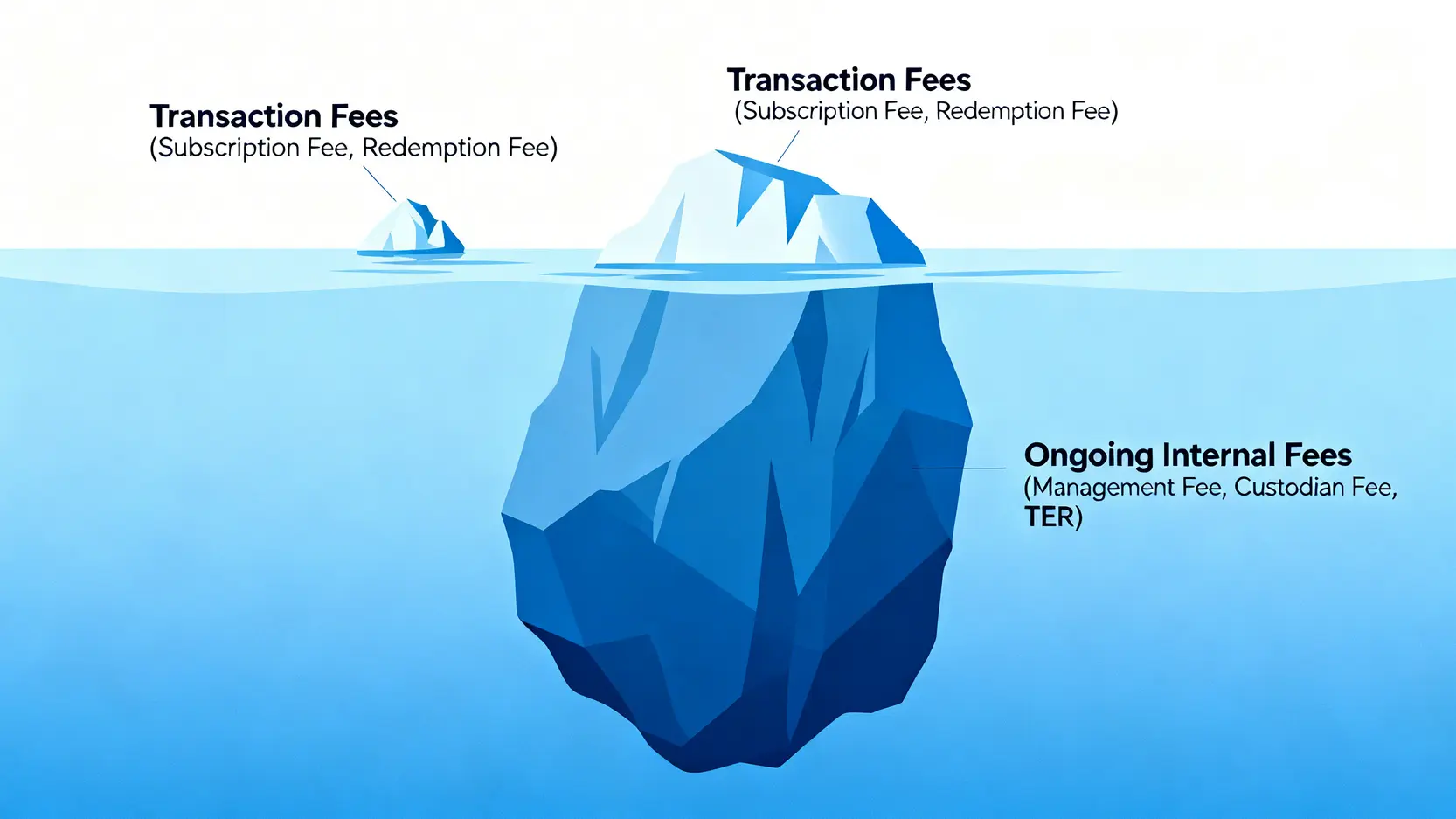
Fund fees are the hidden killer that erodes your investment returns, so fully understanding them is crucial. Fund fees are mainly divided into two categories: transaction fees and ongoing expenses.

Fund fees are like an iceberg. Transaction fees are only the tip, while ongoing expenses are the main factor that erodes returns.
Transaction Fees: Subscription Fee, Redemption Fee, Switching Fee
These are one-time charges incurred when you buy, sell, or switch funds.
- Subscription Fee: This is the most common fee, charged as a percentage of the subscription amount when you purchase a fund. The rate varies depending on the fund type and sales channel, usually ranging from 1% to 5%. Online fund platforms often offer discounts or even waive this fee.
- Redemption Fee: Some funds charge a fee for redemption within a short holding period, (such as within one year) to encourage long-term holding. This fee is usually returned to the fund assets to compensate other long-term holders.
- Switching Fee: When you transfer funds from Fund A to Fund B within the same fund company, a switching fee may be charged, which is usually lower than the subscription fee.
Ongoing Expenses: Management Fee, Custodian Fee
These fees are not directly charged to you but are deducted daily from the fund’s NAV, making them easier to overlook.
- Management Fee: Paid to the fund company and managers as compensation for managing the fund’s assets. This is the main ongoing expense, usually charged at 0.5% to 2% of assets annually.
- Custodian Fee: Paid to the third-party financial institution (usually a bank), responsible for safeguarding the fund’s assets to ensure security and independence.
- Other Operating Expenses: Include administrative, legal, and accounting costs.
All ongoing expenses are combined into a ratio called the “Total Expense Ratio” (TER). This represents the total annual operating cost of the fund as a percentage of its assets and is an important metric for comparing the actual cost of different funds. You can find this information in the fund’s prospectus or monthly reports.
How to Compare Total Costs Across Different Platforms? Practical Tips to Save Money
To reduce the cost of fund investing, you can focus on the following:
- Prioritize Online Fund Platforms: They offer the most discounts on subscription fees, sometimes even zero fees, saving a significant upfront cost.
- Compare Total Expense Ratio (TER): When deciding between two similar funds, choose the one with a lower TER, as the long-term compounding effect will be more significant.
- Avoid Frequent Switching: Unless there is a major change in your investment strategy, frequent switching only accumulates unnecessary switching fees.
- Pay Attention to Redemption Fee Terms: Before subscribing, understand whether the fund has redemption fees and holding period requirements to avoid penalties due to short-term liquidity needs.
Frequently Asked Questions About Fund Trading (FAQ)
Q: How long does it take for redemption proceeds to be credited?
A: This depends on the fund type and registration location. Generally, equity funds have shorter settlement periods (typically 3 to 5 working days), while funds investing in overseas markets or less liquid assets may take 7 to 10 working days or longer.
Q: What are T+1 and T+2 trading days, and how do they affect fund trading?
A: “T” represents the transaction day, which is the day you place the order. T+1 and T+2 refer to the first and second working days after the transaction day. Fund transactions use the NAV calculated after the market closes on T day as the transaction price, while settlement and unit confirmation are usually completed on T+N days. For example, T+2 settlement means the funds are credited to your bank account on the second working day after placing the order.
Q: Can I cancel a regular investment plan or redeem funds at any time?
A: Yes, most funds allow investors to pause or terminate a regular investment plan at any time and to submit redemption requests at any time, offering high liquidity. However, changes or cancellations usually require several working days in advance to take effect before the next deduction date. When redeeming, you should also consider the settlement time and whether short-term redemption fees apply.
Q: Do I need to pay taxes when buying and selling funds?
A: This depends on your tax jurisdiction. In Taiwan, capital gains from fund trading are currently tax-free, but if the fund’s income includes domestic dividends or interest, it will be included in personal income tax or subject to separate taxation. In Malaysia, capital gains from funds for local residents are generally also tax-free. It is recommended to consult a local tax professional for the most accurate information.
Conclusion
In summary, mastering a clear fund trading process, understanding fund subscription and redemption mechanisms, and carefully evaluating all fund fees are the foundation of successful investing. Although the process may seem complex, by following the steps in this guide, from choosing the right channel and opening an account to selecting funds and executing transactions, you can get started with ease. Most importantly, take the first step and continue learning along the way. Start comparing different investment platforms now, choose the plan that suits you best, and implement your financial plan!
Related Articles
-
How Do Federal Reserve Interest Rate Hikes Trigger Waves of Cryptocurrency Liquidations? Understanding the Logic Behind It in One Article Introduction Late at night, alarm bells ring across the market. The prices of Bitcoin and other cryptocurrencies suddenly plunge, causing hundreds of thousands of investors to be liquidated within moments....2026 年 6 月 12 日
-
The Interest Rate and Exchange Rate Seesaw: How Does the Central Bank Use the "Dual-Rate Policy" to Stabilize Taiwan's Economy? Interest rates and exchange rates are the two lifelines of a country's economy. Any movement in either one directly affects the stock market, property market, corporate profitability, and even the...2026 年 6 月 12 日
-
US-Japan Interest Rate Differential Out of Control? Uncovering the Root Causes of Yen Depreciation and the Bank of Japan's Policy Dilemma Recently, even though Japan's Ministry of Finance has repeatedly deployed large-scale intervention measures, the yen has only enjoyed brief periods of relief before returning to its depreciation trend. This...2026 年 6 月 9 日