Interest Rates vs Exchange Rates: Taiwan’s Policy Guide

The Interest Rate and Exchange Rate Seesaw: How Does the Central Bank Use the “Dual-Rate Policy” to Stabilize Taiwan’s Economy?
Interest rates and exchange rates are the two lifelines of a country’s economy. Any movement in either one directly affects the stock market, property market, corporate profitability, and even the value of the money in our pockets. Achieving the right balance between these two forces is the core responsibility of a central bank through its dual-rate policy (which coordinates interest rate policy and exchange rate policy). This policy is much like walking a tightrope: on one side is the need to control inflation, and on the other is the need to preserve export competitiveness. What exactly is the relationship between interest rates and exchange rates? How does a central bank manage both to respond to complex economic conditions? This article will take an in-depth look at the Central Bank of Taiwan’s dual-rate policy and reveal how it influences both our investments and everyday lives.
What Is the Dual-Rate Policy? The Relationship Between Interest Rates and Exchange Rates
The “dual-rate policy” does not refer to a single policy. Rather, it is a collective term for the central bank’s comprehensive consideration and coordination of two key variables, “interest rates” and “exchange rates” when implementing monetary policy. These two variables are like opposite ends of a seesaw. They constrain and influence one another, and the central bank’s goal is to find the balance point that best serves the overall economy.
Interest Rate Policy: Controlling the Cost of Capital and Influencing Inflation and Investment
Interest rates can be understood as the “price of money”. When you deposit money, the bank pays you interest. When you borrow money, you pay interest to the bank. By adjusting policy rates (such as the discount rate), the central bank can directly influence the cost of funds throughout the financial system and achieve its policy objectives.
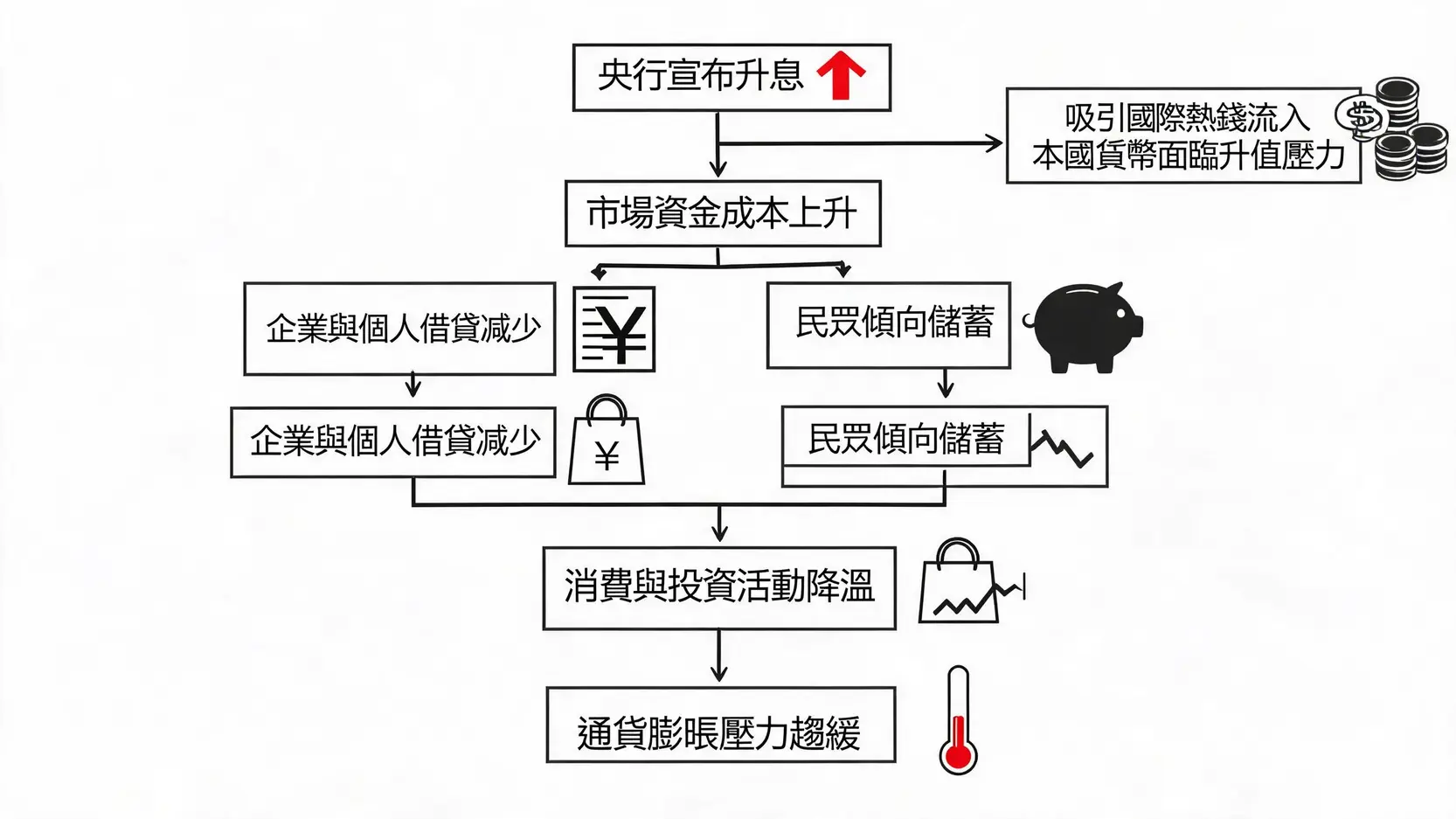
- Interest Rate Hikes: When the economy overheats and inflationary pressures increase, the central bank may raise interest rates. Higher interest rates increase the cost of borrowing. Consumers are more likely to save money in banks to earn higher interest rather than spend or invest, while businesses may reduce expansion plans due to higher financing costs. As excess liquidity is reduced, inflationary pressures can ease. Readers interested in learning more may refer to The Impact of Interest Rate Hikes on the Economy: Understanding the Role of the Central Bank and Its Influence on Stocks, Property, and Personal Finances.

How Do Interest Rate Hikes Affect the Economy? Understanding the Transmission Mechanism at a Glance
- Interest Rate Cuts: When economic conditions weaken and stimulus is needed, the central bank may lower interest rates. Reduced borrowing costs encourage consumer spending and business investment, channeling money from bank deposits into the real economy, supporting market activity and economic growth.
Exchange Rate Policy: Influencing Trade Competitiveness and the Balance of Payments
The exchange rate refers to the value at which one currency can be exchanged for another, such as how many New Taiwan dollars can be exchanged for one US dollar. Changes in exchange rates have a direct impact on Taiwan’s import and export industries.
- Taiwan Dollar Appreciation: When the Taiwan dollar appreciates (for example, moving from NT$32 to NT$31 per US dollar), the purchasing power of the Taiwan dollar increases. This benefits importers and travelers because fewer Taiwan dollars are needed to purchase the same foreign goods or services. However, it creates challenges for exporters, as overseas customers must spend more foreign currency to purchase Taiwan’s products. This weakens export competitiveness and may result in foreign exchange losses for export-oriented industries such as technology companies.
- Taiwan Dollar Depreciation: When the Taiwan dollar depreciates (for example, moving from NT$31 to NT$32 per US dollar) exports generally benefit. Taiwan’s products become cheaper in international markets, helping to increase export orders. However, the cost of imported goods and raw materials also rises, potentially leading to “imported inflation” and making consumers feel the impact of higher prices. Readers interested in Taiwan dollar exchange rate analysis and the five major drivers of appreciation and currency exchange timing may explore related materials.
An Impossible Mission? An Introduction to the Mundell-Fleming Model’s “Impossible Trinity”
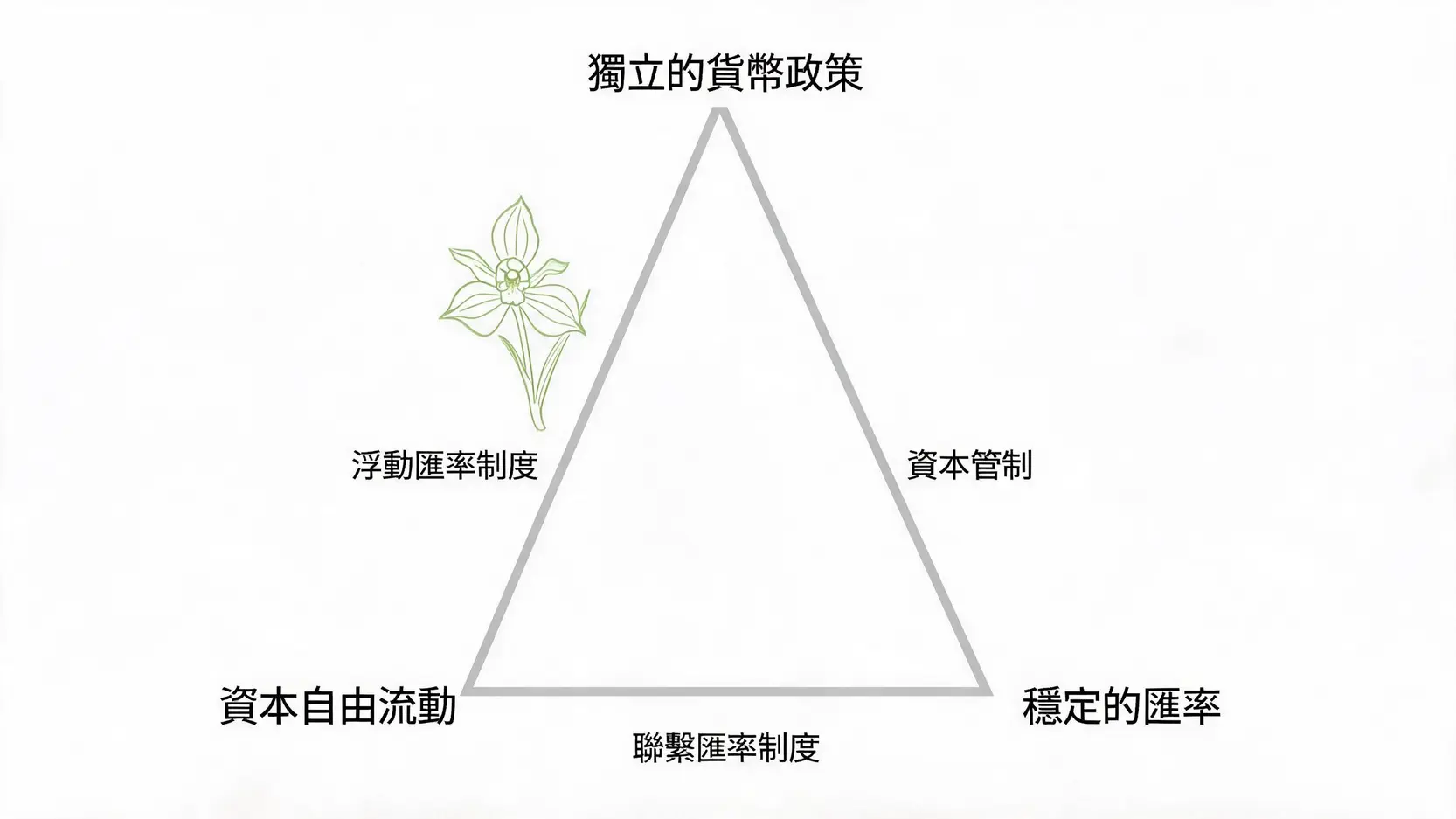
To understand the challenges of the dual-rate policy, it is essential to understand the famous economic theory known as the “Impossible Trinity”, also called the “Trilemma”. Developed by economists Robert Mundell and Marcus Fleming, the theory states that a country cannot simultaneously achieve all three of the following monetary policy objectives:
- Independent Monetary Policy: The central bank can independently determine interest rate levels to address domestic inflation or economic downturns.
- Stable Exchange Rates: The country’s currency is pegged or fixed to a foreign currency (such as the US dollar).
- Free Capital Mobility: Capital can move freely across borders without restrictions.

The Impossible Trinity: The Eternal Triangle of Monetary Policy Challenges
A country can choose at most two of these three objectives. For example, Hong Kong has chosen exchange rate stability (the Linked Exchange Rate System) and free capital movement, which means it must give up an independent monetary policy. As a result, its interest rate policy must closely follow that of the US Federal Reserve. By contrast, Taiwan has chosen independent monetary policy and free capital mobility. This means it must give up a fixed exchange rate and instead adopt a “managed floating exchange rate system”. This is the fundamental reason why Taiwan’s central bank must continually balance its dual-rate policy. Readers seeking a more academic explanation of this theory may refer to the relevant Wikipedia entry.
Related Reading (Highly Recommended)
The Core Objectives and Tools of Taiwan’s Dual-Rate Policy
According to the statutory responsibilities of Taiwan’s central bank, its monetary policy objectives are multifaceted, including promoting financial stability, maintaining sound banking operations, preserving price and exchange rate stability, and supporting economic development under these conditions. To achieve these goals, which can sometimes conflict with one another, the central bank maintains a diverse policy toolkit.
Main Objectives: Promoting Financial Stability, Maintaining Sound Banking Operations, and Preserving Price Stability
The objectives of Taiwan’s monetary policy are explicitly stipulated in Article 2 of the “Central Bank Act”. In summary, its core responsibilities can be categorized as follows:
- Price Stability: Keep inflation within a moderate and acceptable range (typically around 2%), preventing either excessive inflation or deflation and maintaining stable purchasing power.
- Financial Stability: Ensure the smooth functioning of the banking system and prevent systemic risks, such as financial crises triggered by overheating property markets or excessive corporate borrowing.
- Economic Growth: On the foundation of price and financial stability, foster an appropriate monetary environment that supports economic development and full employment.
Interest Rate Tools: The Rediscount Rate, Open Market Operations, and More
To regulate both the “quantity” and “price” of money in the market, the central bank primarily utilizes the following three interest rate tools:
- Rediscount Rate: The rediscount rate is the primary policy rate indicator. It is the interest rate charged when commercial banks seek short-term funding from the central bank due to liquidity shortages. Adjustments to the rediscount rate serve a “signaling function”, directly conveying the central bank’s assessment of future economic conditions and guiding market interest rates accordingly.
- Open Market Operations: This is the central bank’s most frequently used policy tool. When market liquidity is excessive, the central bank issues “negotiable certificates of deposit (NCDs)” to absorb funds. When liquidity becomes tight, it injects funds into the market. Through these daily operations, the central bank fine-tunes liquidity conditions.
- Reserve Requirement Ratio: This refers to the percentage of deposits that commercial banks are required to hold at the central bank and cannot lend out. Raising the reserve requirement ratio directly “immobilizes” a significant amount of market liquidity. Due to its powerful tightening effect, it is used relatively infrequently.
Exchange Rate Tools: Foreign Exchange Market Intervention (Through Buying and Selling US Dollars)
Although Taiwan adopts a managed floating exchange rate system, the central bank does not take a completely hands-off approach. When short-term market disorder or speculative activity causes excessive volatility in the New Taiwan dollar, the central bank may “intervene”, a practice often referred to as the “Willow Theory” or “counter-cyclical intervention”.
- When the Taiwan Dollar Appreciates Too Quickly: The central bank sells New Taiwan dollars and purchases US dollars in the foreign exchange market, increasing the supply of Taiwan dollars and helping ease appreciation pressures. This is also one of the primary reasons Taiwan’s foreign exchange reserves have continued to accumulate.
- When the Taiwan Dollar Depreciates Too Quickly: The central bank sells US dollars and purchases New Taiwan dollars to prevent panic-driven depreciation and stabilize market confidence.
The central bank’s objective is not to reverse long-term trends but rather to “maintain market order and dynamic stability”, preventing excessive volatility from disrupting the real economy.
The Trade-Offs and Dilemmas of the Dual-Rate Policy: Taiwan’s Real Challenges
Ideals are ambitious, but reality is often far more constrained. When implementing a dual-rate policy, central banks frequently face the dilemma that “you cannot have your cake and eat it too”. These trade-offs are what make dual-rate policy one of the greatest tests of policymakers’ judgment, and they are also a key area that investors should monitor closely.
Challenge 1: Price Stability vs. Export Competitiveness (Controlling Inflation May Require Rate Hikes, but This Could Lead to Taiwan Dollar Appreciation)
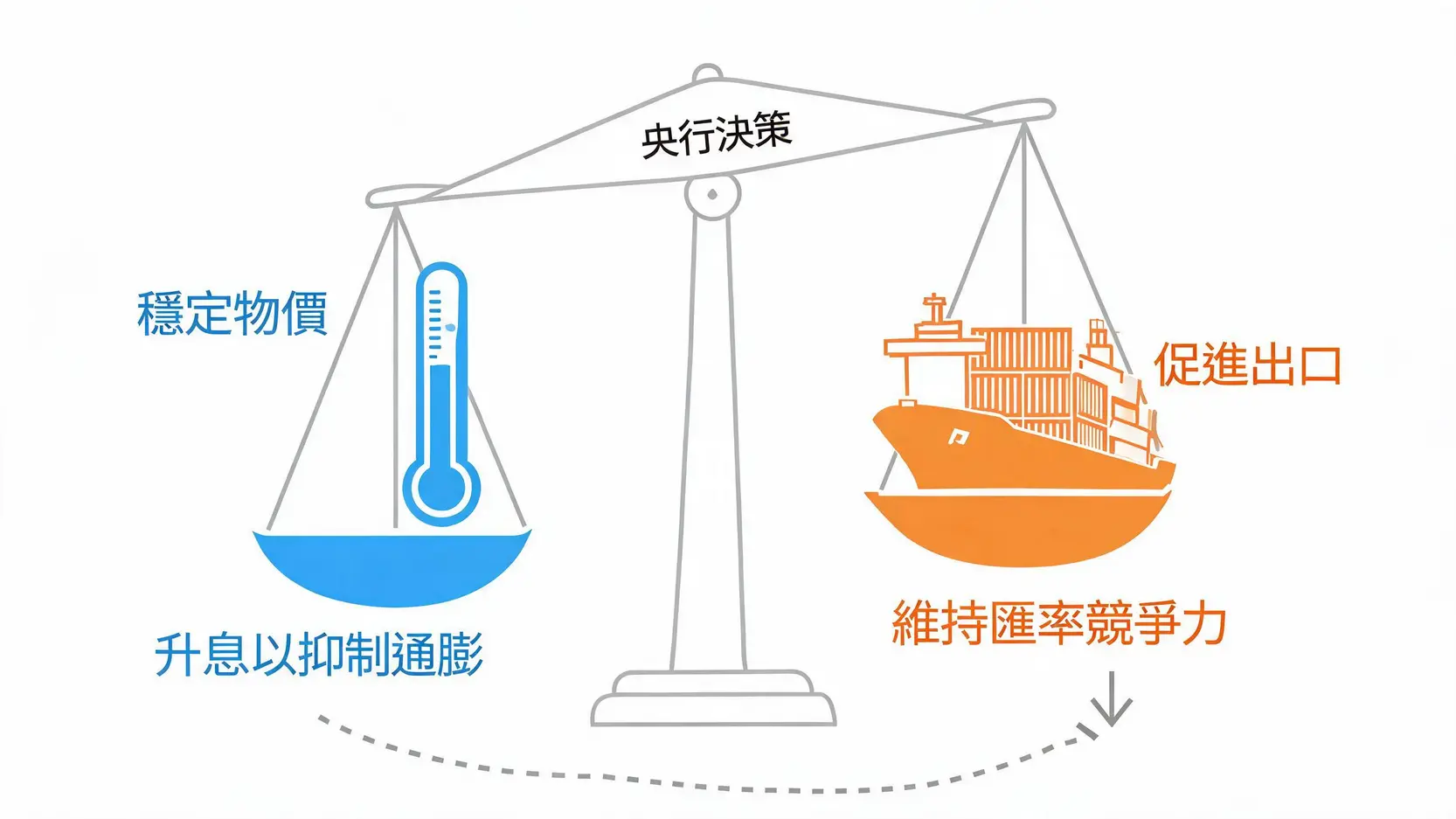
This is the most classic dilemma faced by Taiwan as a small open economy. Suppose the country is experiencing severe inflation. According to economic theory, the central bank should “raise interest rates” to suppress demand. However, once Taiwan’s interest rates exceed those of major economies such as the US, international hot money may be attracted to Taiwan in pursuit of higher interest rate differential returns. Large-scale capital inflows increase demand for the New Taiwan dollar, resulting in “Taiwan dollar appreciation”.

The Central Bank’s Balancing Act: The Difficult Choice Between Controlling Inflation and Supporting Exports
Taiwan dollar appreciation is a major challenge for Taiwan’s export-oriented technology sector, machine tool industry, and other export-driven industries because higher product prices weaken international competitiveness and may even erode corporate profits. Therefore, when deciding whether to raise interest rates to curb inflation, the central bank must simultaneously evaluate the impact on exchange rates and the ability of export industries to absorb the pressure. This is also one of the reasons why Taiwan’s pace of interest rate hikes has often been relatively moderate during global tightening cycles.
Challenge 2: Financial Stability vs. Economic Growth (Raising Rates to Cool the Property Market vs. Cutting Rates to Stimulate Investment)
Another common conflict occurs in the property market. When the housing market overheats and speculative activity becomes excessive, the central bank may adopt “selective credit controls” or consider “raising interest rates” to increase borrowing costs for homebuyers and cool the market.
However, raising interest rates is a broad and indiscriminate tool. It not only affects property speculators but also increases borrowing pressure on first-time homebuyers and businesses. For companies seeking financing for expansion, higher interest rates reduce investment incentives and may ultimately drag down overall economic growth. Therefore, the central bank must make difficult choices between “property market regulation” and “supporting economic growth”.
Case Study: How Taiwan’s Central Bank Responded to the US Federal Reserve’s Aggressive Rate Hikes in Recent Years
Beginning in 2022, the US Federal Reserve (Fed) launched a series of “aggressive rate hikes” to combat the most severe inflation in forty years, rapidly raising the federal funds rate from near-zero levels. This created significant challenges for central banks around the world, including Taiwan.
- If Taiwan Did Not Follow With Rate Hikes: The interest rate differential between Taiwan and the US would widen sharply, causing substantial capital outflows from Taiwan to the US and placing significant depreciation pressure on the Taiwan dollar. Severe depreciation could intensify imported inflation (as imported goods become more expensive) and could potentially trigger financial instability.
- If Taiwan Fully Matched US Rate Hikes: Taiwan’s inflation situation at the time was not as severe as that of the US, while economic growth was already facing pressure from slowing global demand. If Taiwan had matched the US pace of aggressive rate hikes, it would have significantly impacted domestic consumption and business investment, increasing the risk of economic recession.
Faced with this dilemma, Taiwan’s central bank ultimately chose a “middle path” by adopting a “moderate and gradual” interest rate hiking strategy. The magnitude and frequency of Taiwan’s rate hikes were far lower than those of the US. The primary objective was to narrow part of the interest rate differential and slow the pace of capital outflows, with “exchange rate stability” serving as one of the key priorities, while also avoiding excessive damage to Taiwan’s fragile economic recovery. This case perfectly demonstrates the flexibility and pragmatic approach of Taiwan’s central bank in implementing its dual-rate policy. At its core, every policy decision revolves around the principle of “stability”.
Frequently Asked Questions (FAQ)
Q: Does Taiwan use a fixed exchange rate system or a floating exchange rate system?
A: Taiwan currently adopts a “managed float exchange rate system”. In theory, the exchange rate of the New Taiwan dollar is determined by market supply and demand. However, when excessive volatility or irrational speculative activity occurs in the market, the Central Bank may intervene to maintain market order. Therefore, it is neither completely fixed nor completely freely floating.
Q: What is Central Bank Governor Yang Chin-Long’s view on the dual-rate policy?
A: Based on his public speeches and legislative reports over the years, the core principle of Governor Yang Chin-Long’s dual-rate policy is “maintaining dynamic stability”. He has repeatedly emphasized that Taiwan is a small and highly open economy that is easily affected by international developments. Therefore, monetary policy must remain flexible and adopt “counter-cyclical operations” when appropriate to mitigate external shocks. His decision-making style tends to be prudent and pragmatic, avoiding abrupt policy shifts while striving to balance multiple objectives (including price stability, economic growth, and financial stability).
Q: Why are Taiwan’s interest rates often lower than those of the US?
A: This is primarily due to the fundamental differences in the economic structures and financial environments of the two countries. First, Taiwan has maintained a very high household savings rate for many years, resulting in relatively abundant market liquidity and reducing the need for high interest rates to attract savings. Second, Taiwan’s inflation rate has historically been lower than that of the US, making it unnecessary to adopt interest rate policies as aggressive as those in the US. Finally, Taiwan’s economic growth relies heavily on exports, and excessively high interest rates could cause excessive Taiwan dollar appreciation, which would be detrimental to industrial development. As a result, the Central Bank sets interest rates according to domestic economic conditions rather than blindly following the US.
Q: Will raising interest rates always cause the Taiwan dollar to appreciate?
A: In most cases, yes. According to the “interest rate parity theory”, when a country raises interest rates and offers higher yields than other countries, it attracts capital inflows, which can drive its currency higher. However, this is not absolute. Exchange rates are influenced by many factors including economic prospects, stock market performance (whether foreign investors are net buyers or net sellers of Taiwan stocks), geopolitical risks, and global risk sentiment. In some cases, even if the Central Bank raises interest rates, the Taiwan dollar may still depreciate if foreign investors move substantial capital out of Taiwan due to a negative outlook for the stock market. Therefore, interest rates are only one of many important factors affecting exchange rates, not the sole determinant.
Conclusion
The dual-rate policy is a sophisticated balancing act performed by the Central Bank in a complex and constantly changing economic environment to maintain stability. It involves trade-offs and challenges, and no single policy decision can satisfy everyone’s expectations. Interest rate adjustments affect the costs faced by savers, borrowers, and businesses, while exchange rate fluctuations influence exporters’ profitability and the prices of imported goods. Understanding the coordination and conflicts between interest rates and exchange rates, as well as the Central Bank’s efforts to balance multiple objectives such as “price stability”, “export competitiveness”, “financial stability” and “economic growth” can help us better anticipate future economic trends and the Central Bank’s next moves. This, in turn, enables more informed investment and financial planning decisions. It is not merely a subject for economists, but an essential element of financial literacy for every modern citizen.
Related Articles
-
How Do Federal Reserve Interest Rate Hikes Trigger Waves of Cryptocurrency Liquidations? Understanding the Logic Behind It in One Article Introduction Late at night, alarm bells ring across the market. The prices of Bitcoin and other cryptocurrencies suddenly plunge, causing hundreds of thousands of investors to be liquidated within moments....2026 年 6 月 12 日
-
US-Japan Interest Rate Differential Out of Control? Uncovering the Root Causes of Yen Depreciation and the Bank of Japan's Policy Dilemma Recently, even though Japan's Ministry of Finance has repeatedly deployed large-scale intervention measures, the yen has only enjoyed brief periods of relief before returning to its depreciation trend. This...2026 年 6 月 9 日
-
The Ultimate Guide to Yen Carry Trade Unwinding: The Chain Reaction That Triggers Global Market Turmoil Recent violent fluctuations in the Japanese yen exchange rate, including the frequent intraday "flash crashes" and "surges", all point to one key term: the "carry trade unwinding chain reaction". This seemingly technical concept is...2026 年 6 月 9 日