How to Buy Funds: Beginner Guide & Steps

Updated: 2026/03/17  |  CashbackIsland

how-to-buy-funds-guide

Fund Buying Tutorial: Beginner’s Guide From Account Opening, Subscription to Redemption Procedures in One Complete Guide

Want to grow your wealth through investing but feel unsure where to start due to stock market volatility? Fund investing has a relatively low entry barrier and provides diversification, making it an ideal starting point for many beginners. This article provides the most comprehensive fund buying tutorial, guiding you step by step from account opening and fund subscription procedures to the final fund redemption process, helping you easily take the first step in financial planning and master the core techniques of how to buy funds. Whether you are a beginner investor or a working professional seeking asset growth, this guide offers clear direction.


Why Buy Funds? Understanding the Basics of Fund Investing

Before learning how to buy funds, you must first understand what a fund is and why it is an investment tool worth considering. Simply put, a fund pools capital from many investors and is managed by professional fund managers, investing in a basket of assets such as stocks, bonds, or other financial instruments with the goal of generating returns for investors.


What Is a Fund? How Is It Different From Buying Stocks Directly?

When buying and selling stocks directly, you must research which companies are worth investing in and determine the timing of buying and selling yourself, which can be difficult for beginners. The biggest difference with funds is that professionals manage them for you. Fund managers use their expertise and research teams to build a diversified investment portfolio on your behalf.

一張概念圖,比較基金投資與股票投資的分別,展示基金如何集合多人資金分散風險。

Fund investing pools capital from many investors and is managed by professionals to achieve diversification of risk.

The following are the main differences between the two:

Comparison Items Investing in Funds

Buying Stocks Directly

Decision Maker Professional Fund Manager Team The Investor Themselves
Risk Diversification High (capital invested in a basket of assets) Low (risk concentrated in a single stock)
Required Knowledge Relatively low, need to understand how to select funds Relatively high, need to conduct in depth research on individual stocks
Entry Threshold Relatively low, can be as low as several hundred dollars Relatively high, one lot of stocks often costs several thousand to tens of thousands of dollars


Investment Funds: 3 Key Benefits and Potential Risks

Although funds are considered beginner-friendly investments, every investment has two sides. Understanding both the advantages and the risks is the foundation for making informed decisions.

Benefits of Investing in Funds:

  • Risk Diversification: This is the most fundamental advantage of funds. Because a fund spreads its capital across dozens or even hundreds of different assets, even if one or two assets perform poorly, the impact on the overall portfolio is relatively limited. This effectively avoids the risk of “putting all your eggs in one basket”.
  • Professional Management: Investing is no longer a one-person task. Behind the scenes are professional fund managers and research teams who continuously monitor market developments and adjust the investment portfolio for you, saving a significant amount of time and effort that would otherwise be spent researching the market yourself.
  • Low Entry Threshold: You do not need a large amount of capital to begin. Through online platforms, fund subscriptions can sometimes start from just a few hundred or one thousand dollars, making them highly suitable for small investors or those just starting their investment journey.

Potential Risks of Investing in Funds:

  • Market Risk: The value of a fund fluctuates with the prices of the assets it holds. If the overall market (such as the stock or bond market) declines, the fund’s net asset value will also fall accordingly.
  • Management Fees: Professional services are not free. Fund companies charge management fees, custody fees, and other expenses, which are directly deducted from the fund’s assets. Over the long term, these fees can erode your investment returns.
  • Manager Risk: A fund’s performance largely depends on the decisions of the fund manager. If the manager’s investment strategy proves ineffective or if the fund changes managers, it may affect the fund’s performance. To learn more about this topic, you can refer to What Are the Risks of Bonds? A Deep Analysis of Fund Investment Risks and Risk Hedging Strategies, which explains how investors can better manage these risks.


Understanding Common Types of Funds: Equity, Bond, and Balanced Funds

There are many types of funds available in the market, but most can generally be categorized into the following types. Understanding their characteristics can help you choose according to your own risk tolerance.

  • Equity Funds: These primarily invest in stocks. They offer higher potential returns but also carry greater volatility and risk. Suitable for investors seeking capital appreciation and who have a higher tolerance for risk.
  • Bond Funds: These mainly invest in government or corporate bonds. They generally carry lower risk and lower expected returns, with the primary objective of generating stable interest income. Suitable for investors seeking stable cash flow and lower risk exposure.
  • Balanced Funds (or Mixed Funds): These invest in both stocks and bonds, aiming to balance risk and return. The allocation between equities and bonds may be adjusted depending on market conditions. Suitable for investors who prefer a moderate investment style.


Further Reading (Highly Recommended)

[Top Securities Brokers 2025] Which Broker Is Best? Five Key Selection Criteria for Beginners and Popular Broker Comparisons

Beginner’s Guide to Gold Investment: Five Investment Channels Explained With Pros and Cons


Preparation Before Buying Funds: Comparing Two Account Opening Channels and Understanding the Process

Once you decide to invest in funds, the next step is choosing where to open an investment account. Currently, the two most common channels are traditional banks and emerging online fund platforms. Each has its own advantages and disadvantages in terms of fees and convenience.


Buying Funds Through Banks: Advantages, Disadvantages, and Key Considerations

For many investors, banks are the most familiar and trusted channel. While handling routine banking matters, you can also consult relationship managers about fund investments.

  • Advantages:
    • Confidence and Trust: Banks are large institutions that often provide a stronger sense of reliability.
    • One-Stop Services: Investment accounts can be linked to savings accounts, making fund transfers convenient.
    • Dedicated Support: Relationship managers can provide guidance, though investors should note that (such advice may be influenced by sales targets).
  • Disadvantages:
    • Higher Fees: Subscription fees, switching fees, and other charges are typically higher, with limited room for negotiation.
    • Limited Selection: Banks usually only distribute products from partner fund companies.
    • Lower Flexibility: Account opening or certain transactions may require visiting a branch in person.


Buying Funds Through Online Fund Platforms: Fee and Convenience Comparison

In recent years, online fund platforms have grown rapidly, attracting many investors, especially younger ones, with their lower fees and greater convenience.

  • Advantages:
    • Lower Fees: This is the biggest selling point! Many platforms offer “zero subscription fees”, significantly reducing investment costs.
    • Wide Selection: Platforms aggregate funds from companies around the world, offering a broader range of choices.
    • Convenient Operations: From account opening to trading, the entire process can be completed online without restrictions on time or location.
    • Transparent Information: Platforms often provide powerful screening tools and charts to help investors compare fund performance easily.
  • Disadvantages:
    • Self-Directed Investing: Without dedicated advisors, investors need to conduct their own research and make their own decisions.
    • Brand Recognition: Some investors may be unfamiliar with newer platforms.

Channel Comparison:

Item

Bank

Online Fund Platform
Subscription Fee Usually 1–3% Many offer 0%
Fund Selection Limited Very broad
Convenience Moderate, or may require visiting a branch High, with 24/7 online operations
Customer Service Dedicated relationship manager available Primarily online customer service and email support
Suitable For Investors who prefer traditional channels and require personalized service Investors seeking lower costs and comfortable with independent research


Opening an Investment Account: Required Documents and Process

Regardless of which channel you choose, the account opening process is largely similar and generally includes the following steps:

  1. Submit Application: Fill in personal information, investment experience, and a risk tolerance questionnaire.
  2. Identity Verification: Upload identification documents (such as an ID card or passport) and proof of address (such as a utility bill or bank statement issued within the last three months).
  3. Link Bank Account: This will be used for future deposits and withdrawals.
  4. Approval Process: The platform or bank will review your information, which usually takes a few working days.


Practical Guide: Step-by-Step Fund Subscription Process

Once your account is successfully opened, congratulations! The next step is the most exciting part: putting your knowledge into practice. This section explains each step of the fund subscription process in detail, allowing you to confidently complete your first investment. 

How to Choose Your First Fund?

With thousands of options available, how should beginners start? Consider the following points:

  • Set Your Investment Goal: What is the purpose of your investment? Is it long-term retirement planning, a mid-term education fund for children, or short-term wealth growth? Your goal determines your investment horizon and risk preference.
  • Assess Your Risk Tolerance: How much volatility can you accept? If seeing a 10 percent loss in your account causes significant stress, a high-risk equity fund may not be suitable for you.
  • Use Platform Tools: Most platforms provide fund screening tools that allow you to filter by fund category (equity or bond), region (global, US, or Asia), or industry (technology or healthcare), helping you narrow down your choices.
  • Read Fund Documents: Before making a decision, carefully read the “Key Facts Statement (KFS)”. It contains essential information such as the fund’s investment objective, strategy, risks, and fees. This step is crucial for protecting your rights as an investor. Hong Kong investors may also refer to the Securities and Futures Commission investor education resources for official guidance.


Fund Subscription Process Explained

Assuming you have already selected a fund, the typical subscription process is as follows:

一張基金認購流程圖,展示從搜尋基金到完成交易的五個步驟。

Fund Subscription Process at a Glance: Search, Enter Amount, Choose Plan, Confirm, Complete.

  1. Log in to the Platform and Search for the Fund: Enter the fund name or code (ISIN).
  2. Open the Fund Details Page: Review the latest net asset value (NAV), historical performance, and fee structure.
  3. Click “Subscribe” or “Buy”: Enter the trading page.
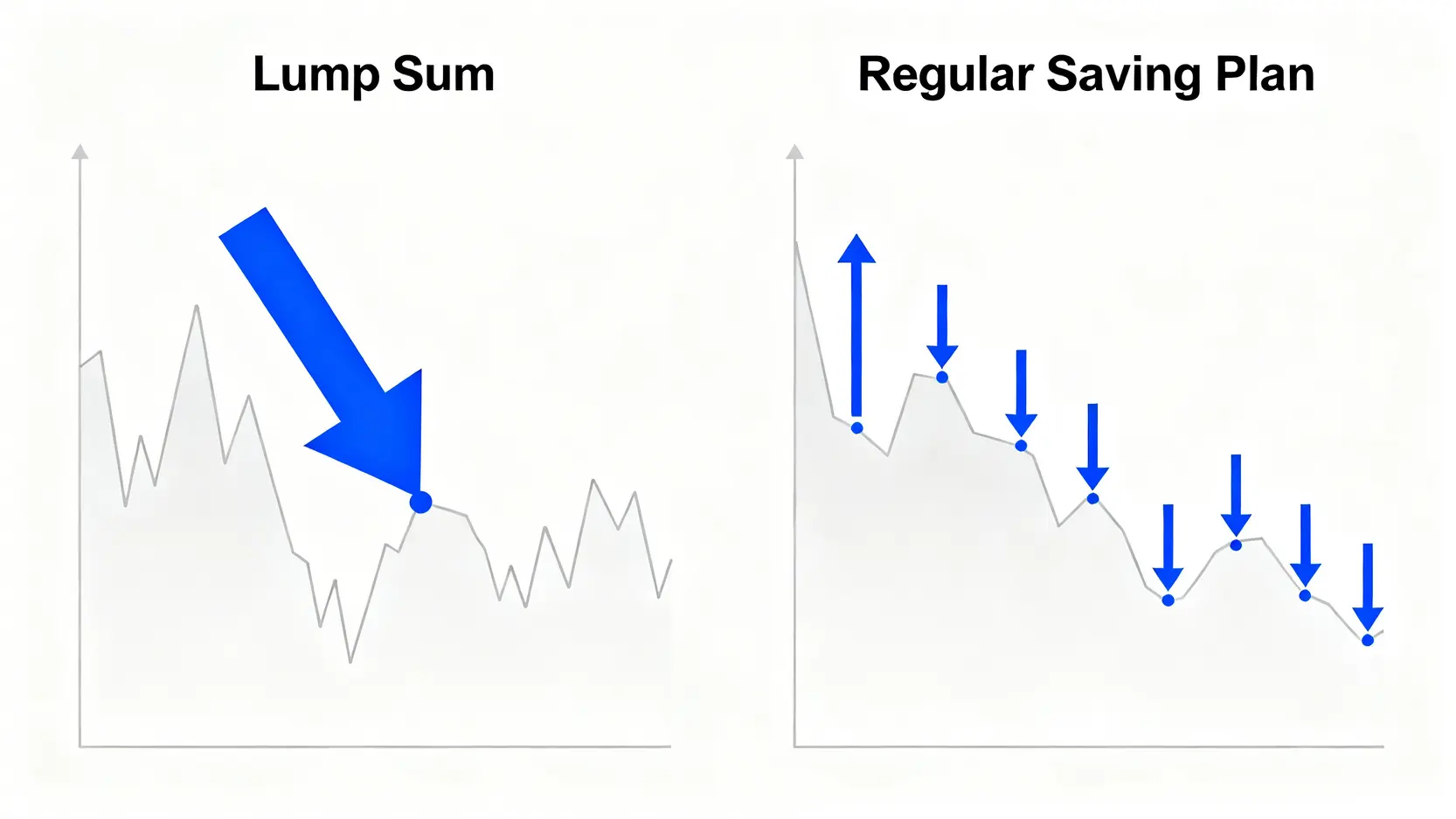
  4. Choose the Investment Method: Decide between a “lump sum investment” or a “regular savings plan”.
  5. Enter the Investment Amount: Input the amount you wish to invest. The platform will show the estimated number of units you will receive.
  6. Confirm Transaction Details: Carefully verify the fund name, amount, and estimated charges before submitting.
  7. Complete the Transaction: The platform will confirm that the order has been accepted. Units are usually confirmed within one to two working days (T+1 or T+2).


How to Choose Between Lump Sum and Regular Investment?

This is a common question for beginners. There is no absolute right or wrong choice. The key is whether the method suits your personal situation.

一張對比圖,解釋單次投資與定期定額投資策略的分別,展示平均成本法的概念。

Lump sum investment depends more on market timing, while regular investing spreads risk through dollar cost averaging.

  • Lump Sum: Invest a large amount of capital at once. If you enter the market at a low point, the return potential can be significant. However, if you invest near a market peak, you may face larger short-term losses. This approach is more suitable for investors who have some ability to judge market timing or who have idle capital available.
  • Regular Saving Plan: Invest a fixed amount on a fixed date each month. This method uses “dollar cost averaging”. When prices are high, you purchase fewer units. When prices are low, you purchase more units. Over the long term, this helps smooth the average purchase cost and reduces market timing risk. This strategy is particularly suitable for beginners or salaried workers with stable income.


Fees Involved When Buying Funds

Fees are a key factor that directly affects your final investment returns, so it is important to understand them clearly. Common fees include:

  • Initial Charge: A one-time fee charged when purchasing a fund, typically calculated as a percentage of the investment amount. Many online platforms offer fee waivers for this charge.
  • Management Fee: A fee charged by the fund company for managing your assets. It is deducted daily from the fund’s net asset value. Although you will not see this fee directly, it is reflected in the fund’s overall performance.
  • Switching Fee: If you want to transfer your investment from Fund A to Fund B within the same fund company, a switching fee may be charged.
  • Redemption Fee: A fee that may be charged when selling the fund. This fee is less common and usually only applies if the holding period is very short.


Fund Redemption Process: How to Sell a Fund and Retrieve Your Capital

The ultimate goal of investing is to realize profits. Understanding the redemption process allows you to convert your investment into cash smoothly when needed. 

Three Key Considerations Before Redeeming a Fund

Selling a fund requires even more judgment than buying one. Apart from market sentiment, decisions should be based on rational factors:

  1. Investment Goal Achieved: If the financial goal you originally set (such as saving enough for a property down payment) has been reached, you may consider redeeming the fund to lock in profits.
  2. Deteriorating Fundamentals: If there are negative changes in the fund’s investment strategy, management team, or the underlying market conditions, you should reassess whether continuing to hold the fund is appropriate.
  3. Periodic Portfolio Rebalancing: If a particular fund grows significantly and becomes too large a proportion of your portfolio, you can sell part of it to restore your original asset allocation and control risk.


Fund Redemption Process and Timeline Explained

The redemption process is similar to the subscription process, but in the opposite direction:

  1. Log in to the platform and select the fund you want to redeem.
  2. Click “Redeem” or “Sell”.
  3. Enter the redemption amount or the number of units.
  4. Confirm the transaction.

The key factor is the time required for settlement. Fund redemption is not instant. Generally, it takes several working days from submitting the redemption request to receiving the funds (usually between T+3 and T+7, depending on the fund type and region). Therefore, if you anticipate needing cash urgently, advance planning is essential.


Important Notes on Redemption Fees and Terms

Before clicking the redemption button, always check whether there are redemption fees or deferred charges. Some funds encourage long-term investment by imposing higher redemption fees on investors who sell within a certain holding period (such as one to three years). These conditions are clearly stated in the fund’s offering documents. Understanding them in advance can help you avoid unnecessary expenses.


FAQ About Buying Funds

Q: What Is the Minimum Investment Amount for Buying Funds

A: It depends on the platform. Traditional banks may require a higher minimum investment, typically starting from HKD 10,000 per transaction. However, through online fund platforms, the entry threshold has been significantly reduced. Regular investment plans usually require only HKD 1,000 per month, or even less, making small-scale investing widely accessible.

Q: When Will the Redemption Proceeds Be Credited

A: Generally, money market funds are the fastest, with settlement possibly within T+1 or T+2. Equity or bond funds take longer, and the proceeds are typically credited to your designated bank account within three to seven working days after submitting the redemption request. Funds investing in emerging markets or specialized sectors may take even longer.

Q: How Can You Evaluate Whether a Fund Performs Well

A: Evaluating fund performance should not rely solely on short-term returns. You should review the fund’s long-term performance (over at least three to five years), compare it with similar funds and benchmark indices, and examine risk indicators such as the Sharpe Ratio to assess whether the return generated per unit of risk is attractive.

Q: Do You Still Pay Management Fees if the Fund Loses Money

A: Yes. Management fees are calculated as a percentage of the fund’s total net asset value and are deducted daily. Whether the fund generates profits or losses in a given year, the fund company still charges this fee because it provides asset management services. This is why the expense ratio is an important factor when choosing a fund, as it directly affects long-term compound returns.


Conclusion

In summary, buying funds is an investment approach suitable for beginners that helps diversify risk. From understanding basic fund concepts and comparing account opening channels to mastering the actual subscription and redemption procedures, this comprehensive fund buying guide aims to clear the confusion on your investment journey. Investing is a long-term process. The most important thing is not chasing quick profits but building a strategy that suits you and consistently following it. Take action now, choose the investment platform that fits your needs, and begin your journey toward growing your wealth!

If you liked this article, please share it!

Related Articles

  • Volatility Surface Guide: Skew Trading Strategies
    Practical Applications of Volatility Surfaces: From Options Modeling to Advanced Skew Trading Strategies In options markets, implied volatility is never a flat line. Instead, it forms complex "smile" or "skew" surfaces. For advanced traders, mastering the practical applications of volatility surfaces is equivalent to possessing a lens that reveals market...
    2026 年 6 月 3 日
  • Foreign Capital Flow Model: Track Institutional Money
    Building a Foreign Capital Flow Copy Trading Model: A Stock Market Indicator for Accurately Tracking Institutional Positioning In Asia-Pacific stock markets, foreign capital inflows and outflows often determine the direction of the index. However, simply looking at daily net buy and sell data is no longer enough. Only by building...
    2026 年 6 月 3 日
  • Options Buying Strategies for Extreme Market Risks
    Options Buyer Strategies During Extreme Market Conditions: Black Swan Hedging and Cross-Market Arbitrage During Volatility Surges The most terrifying aspect of financial markets is not a gradual decline, but overnight flash crashes and cross-market capital withdrawals accompanied by volatility surges. In the highly unpredictable global macroeconomic environment of 2026, geopolitical...
    2026 年 6 月 3 日
返回顶部