US-Japan Rate Gap: The Real Cause of Yen Weakness

US-Japan Interest Rate Differential Out of Control? Uncovering the Root Causes of Yen Depreciation and the Bank of Japan’s Policy Dilemma
Recently, even though Japan’s Ministry of Finance has repeatedly deployed large-scale intervention measures, the yen has only enjoyed brief periods of relief before returning to its depreciation trend. This raises an important question: can intervention alone truly cure the yen’s chronic weakness? The core issue points directly to the increasingly out-of-control US-Japan interest rate differential and the deeper policy dilemma facing the Bank of Japan. This article provides an in-depth analysis of the true drivers behind yen depreciation, revealing the structural challenges and limitations behind market intervention and helping you understand the currency battle that continues to shape global capital markets.
The Core Driver: What Is the US-Japan Interest Rate Differential, and How Does It Drive the Yen?
To understand why the “yen continues to weaken”, it is essential to understand the “US-Japan interest rate differential”. Simply put, it is the gap between benchmark interest rates in the United States and Japan. This gap directly influences global capital flows and, in turn, drives the USD/JPY exchange rate.
Interest Rate Parity Theory: Why Capital Flows From Low-Interest-Rate Countries to High-Interest-Rate Countries
Finance theory includes a fundamental concept known as “Interest Rate Parity”. Its core principle is that in an efficient global market, capital naturally flows from countries with lower interest rates to those offering higher rates in pursuit of superior returns. Just as water flows downhill, capital naturally flows toward where returns are higher. When US interest rates are significantly higher than those in Japan, international investors tend to favor US dollar-denominated assets (such as US Treasury bonds) because they offer higher interest income. This process involves selling yen and buying US dollars, which in turn creates persistent downward pressure on the yen exchange rate.

Illustration of How the US-Japan Interest Rate Differential Drives Global Capital Flows
Visualizing the Strong Correlation Between the US-Japan 10-Year Yield Differential and USD/JPY
If we compare the chart of the “US-Japan 10-year government bond yield differential” with the “USD/JPY exchange rate”, we observe a remarkably close relationship. Historically, the two have shown a strong positive correlation:
- When the US-Japan interest rate differential widens (either because US yields rise or Japanese yields fall), USD/JPY generally moves higher (indicating yen depreciation).
- When the US-Japan interest rate differential narrows (either because US yields decline or Japanese yields rise), USD/JPY generally moves lower (indicating yen appreciation).
This close relationship clearly demonstrates that the interest rate differential remains the most direct and powerful force driving the yen. Exchange rate movements that diverge from this fundamental factor, including those caused by short-term intervention, often struggle to remain sustainable.
Fuel for Carry Trades: How Interest Rate Differentials Encourage Yen Selling
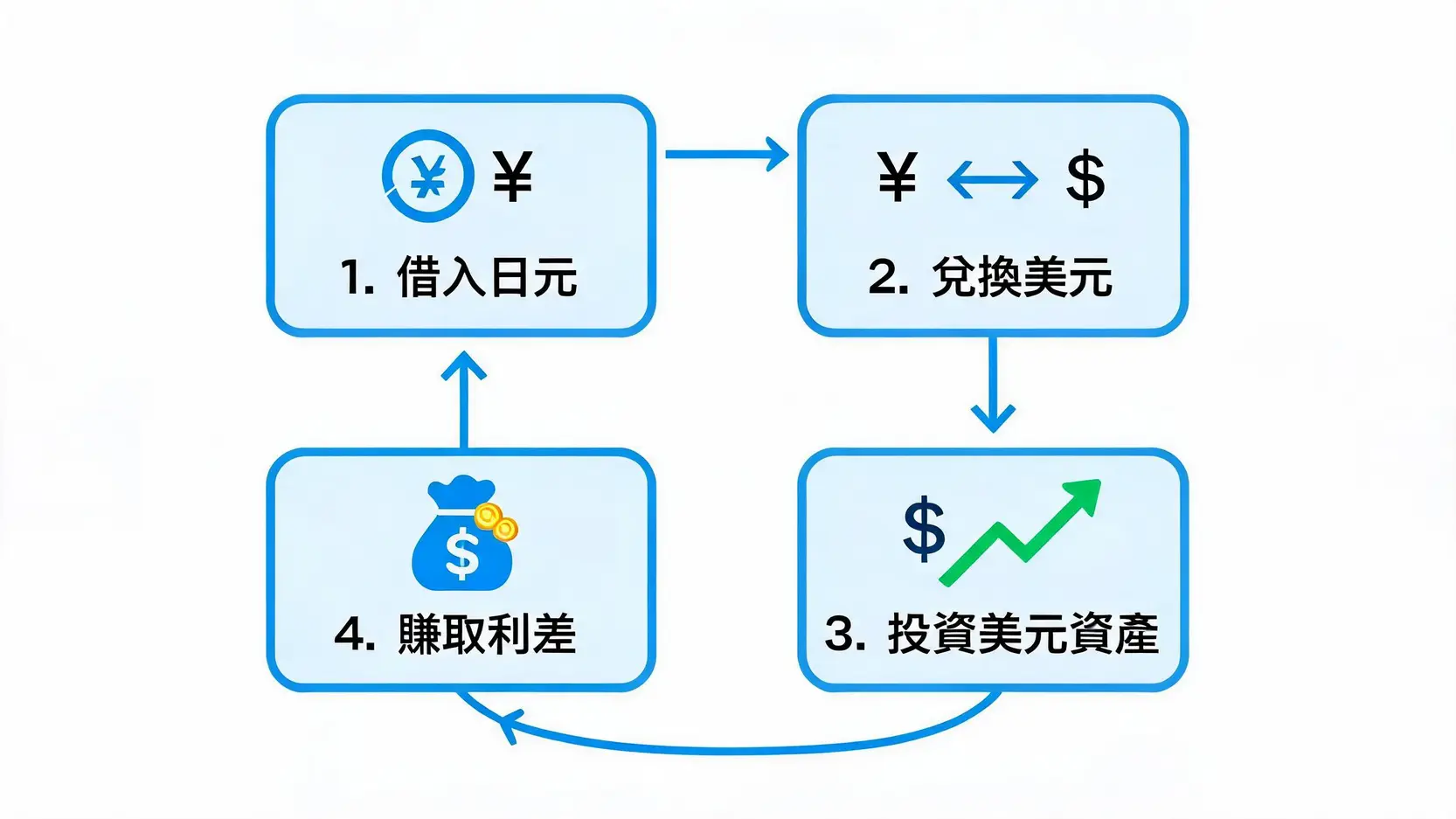
The widening US-Japan interest rate differential provides ideal conditions for a strategy known as the “Carry Trade”. The process is straightforward:
- Borrow a low-interest-rate currency: Traders borrow large amounts of yen at near-zero financing costs.
- Convert into a higher-yielding currency: The borrowed yen is sold in the market and exchanged for US dollars.
- Invest in higher-yielding assets: The US dollars are used to purchase US Treasuries or other high-yield dollar-denominated investments.
- Earn the interest rate differential: As long as the yen does not appreciate significantly beyond expectations, traders can profit from the interest rate spread.

Simplified Illustration of the Carry Trade Process
This strategy is essentially a “short yen, long US dollar trade”. The larger the US-Japan interest rate differential becomes, the greater the potential profit. This attracts more participants into selling yen, creating a self-reinforcing cycle of depreciation.
Further Reading (Highly Recommended)
Diverging Policies: The Fed’s Hawkish Rate Hikes vs. Japan’s Dovish Monetary Easing
The reason the US-Japan interest rate differential has expanded to levels not seen in decades is rooted in the completely opposite policy directions taken by the two central banks, the Federal Reserve (Fed) and the Bank of Japan (BOJ). One has been aggressively “hawkish”, while the other has remained persistently “dovish”.
The Federal Reserve (Fed): An Aggressive Rate-Hiking Cycle to Combat Inflation
Since 2022, the Federal Reserve has launched its most aggressive rate-hiking cycle since the 1980s to combat inflation levels not seen for decades. The federal funds rate climbed from near zero to above 5%. Each rate hike further increased the attractiveness of the US dollar and contributed to the widening US-Japan interest rate differential. For investors, the impact of Fed rate hikes extends far beyond the United States, strengthening the US dollar and significantly influencing global capital flows.
The Bank of Japan (BOJ): Trapped by Deflationary Thinking and Economic Fragility
Unlike the US inflation challenge, Japan has spent decades battling “deflation”. To stimulate economic activity and escape a prolonged period of falling prices, the Bank of Japan maintained ultra-low and even negative interest rates for many years. According to the Bank of Japan’s 2026 monetary policy guidance, although inflation has recently risen, policymakers remain cautious about whether inflation can sustainably remain above the 2% target. They worry that raising rates too early or too aggressively could derail the fragile economic recovery. As a result, even after symbolically ending negative interest rates in 2024, policy rates remain extremely low compared to those in the United States.
How Policy Divergence Expanded the Interest Rate Differential to Multi-Decade Highs
On one side stands the Federal Reserve with aggressive rate hikes. On the other stands the Bank of Japan, reluctant to tighten policy. This massive divergence has pushed the yield gap between US and Japanese government bonds to unprecedented levels. The result has been a historic opportunity for carry trades and tremendous depreciation pressure on the yen. Markets clearly understand that unless this fundamental policy divergence changes, any effort to reverse the yen’s weakness will remain an uphill battle.
The Bank of Japan’s “Policy Shackles”: Why Is Raising Rates So Difficult?
Many people wonder why the Bank of Japan does not simply raise interest rates like other central banks to narrow the interest rate gap and stabilize the currency. The answer is that the BOJ is constrained by several powerful “policy shackles” that severely limit its flexibility. Understanding these constraints is essential to understanding Japan’s unique situation.
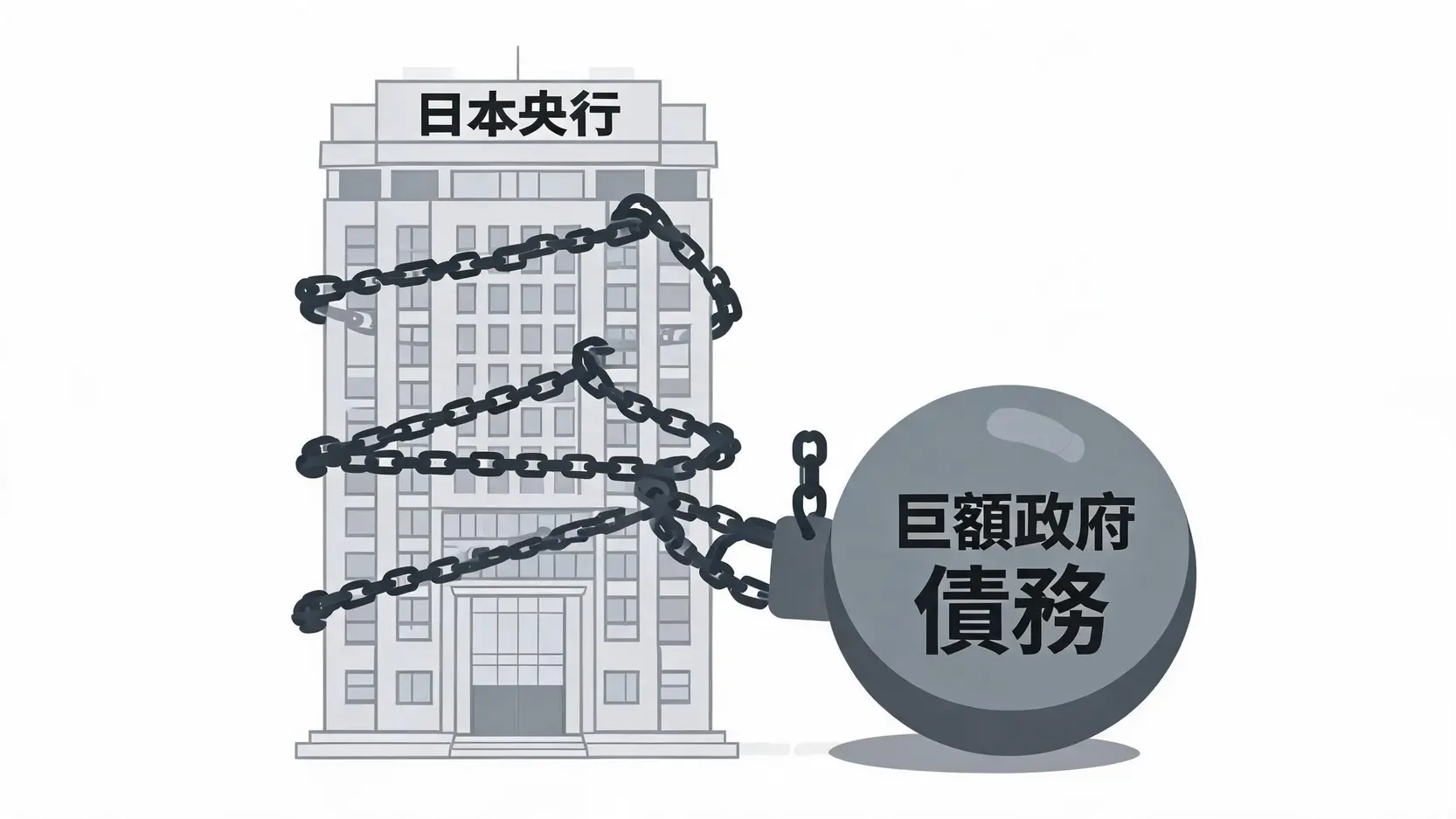
Shackle One: Massive Government Debt, Where Rate Hikes Could Trigger a Fiscal Crisis
This is arguably the most critical constraint. Japan has one of the highest government debt burdens in the world. According to forecasts from the International Monetary Fund (IMF) and other institutions, Japan’s government debt-to-GDP ratio is expected to exceed 200% by 2026. Under these conditions, even a small increase in interest rates can have enormous fiscal consequences. Imagine that the Bank of Japan raises rates by 1%. The government would then need to pay trillions of additional yen in annual interest expenses on its debt. Where would the money come from? Higher taxes or reduced public spending, both of which would place significant strain on an already fragile economy and society. As a result, the Bank of Japan remains extremely cautious about raising rates, fearing that doing so could trigger a fiscal crisis of its own making.

The Bank of Japan Remains Tightly Constrained by the “Shackles” of Massive Government Debt
Shackle Two: The Survival of Zombie Companies and Their Dependence on Cheap Credit
Decades of ultra-low interest rates have allowed the emergence of large numbers of so-called “Zombie Companies” in Japan. These firms are often inefficient and uncompetitive and would normally struggle to survive in a competitive market. However, because borrowing costs remain exceptionally low, they can continue operating by rolling over cheap loans. If the Bank of Japan were to raise rates significantly, financing costs for these companies would surge. Many could face liquidity crises, triggering widespread bankruptcies and rising unemployment. Such an outcome could threaten both financial stability and social stability. To avoid a hard landing, policymakers often prefer maintaining accommodative conditions and allowing these companies to continue operating.
Shackle Three: The Deflation Ghost Still Lingers, and Confidence in Sustainable Inflation Remains Weak
Although Japan’s inflation rate has recently risen and even exceeded the 2% target, the Bank of Japan remains unconvinced. Policymakers believe that much of the recent inflation has been driven by higher import costs for energy and raw materials, representing “cost-push inflation” rather than “demand-pull inflation” generated by strong domestic demand and sustained wage growth.
After decades of deflation, Japanese households and businesses have developed deeply ingrained deflationary expectations. Consumers remain cautious about spending, while companies are reluctant to raise prices and wages. Without clear evidence that wage growth and inflation are reinforcing one another in a healthy cycle, the Bank of Japan fears that raising rates could quickly push the economy back into deflation. This lack of confidence continues to slow the path toward monetary policy normalization.
Further Reading (Highly Recommended)
The Path Forward: Possible Ways to Break the Deadlock
Faced with mounting internal and external challenges, the yen will require a combination of domestic and international factors to truly escape its depreciation cycle. Market participants generally believe that the most likely paths to breaking the current deadlock come from two directions.
External Variable: Waiting for a Federal Reserve Policy Shift (Rate Cuts)
This is the most direct, yet also the most passive, solution. If US inflation comes under control and economic growth begins to slow, the Federal Reserve may initiate a rate-cutting cycle. Once the Fed starts lowering interest rates, the attractiveness of the US dollar would diminish, and the US-Japan interest rate differential would naturally narrow. This would significantly ease depreciation pressure on the yen and could even trigger large-scale carry trade unwinding, potentially driving a rapid appreciation of the Japanese currency. As a result, global markets closely monitor every piece of economic data and every statement from the Federal Reserve, searching for signs of a policy shift. In many respects, the fate of the yen remains heavily influenced by the decisions of the Federal Reserve.
Internal Reform: The Necessity and Challenges of Structural Economic Reform in Japan
Fundamentally, if Japan wishes to reduce its dependence on ultra-loose monetary policy, it must pursue meaningful structural economic reforms. These include:
- Improving labor productivity: Enhancing corporate profitability through technological innovation and deregulation.
- Promoting wage growth: Reforming the labor market and encouraging businesses to translate profits into higher wages, thereby supporting domestic demand.
- Addressing population aging: Implementing more effective policies to cope with labor shortages and the growing burden of social welfare costs.
However, these structural reforms are far easier to propose than to implement. They often involve challenging vested interests and require substantial political determination and broad social consensus. Such changes cannot be achieved overnight. Nevertheless, they represent the most effective long-term solution for restoring Japan’s organic growth potential and permanently escaping the shadow of deflation.
FAQ
Q: What are Quantitative Easing (QE) and Yield Curve Control (YCC)?
A: Quantitative Easing (QE) and Yield Curve Control (YCC) are both unconventional monetary policy tools. Quantitative Easing refers to a central bank purchasing large quantities of government bonds and other assets in the open market to inject liquidity into the financial system and lower long-term interest rates. Yield Curve Control goes a step further by directly setting a target yield level for long-term government bonds (such as the 10-year Japanese government bond) and committing to unlimited bond purchases to ensure yields do not rise above that target. Both policies have been central tools used by the Bank of Japan to combat deflation and maintain an extremely accommodative financial environment.
Q: What impact would a Bank of Japan rate hike have on the Japanese economy?
A: It would be a double-edged sword. On the positive side, higher interest rates could narrow the US-Japan interest rate differential, support the yen, and reduce imported inflation. However, the negative consequences could be substantial. First, the government’s enormous debt-servicing costs would rise sharply, increasing concerns about fiscal sustainability. Second, borrowing costs for businesses (particularly zombie companies) and households would increase, potentially reducing investment and consumption and even triggering a wave of bankruptcies. Finally, asset prices, including real estate and equities, could come under pressure as liquidity tightens. Overall, given the fragility of the current economy, the short-term pain of rate hikes may outweigh the benefits.
Q: Besides the US-Japan interest rate differential, what other factors influence the yen?
A: Although the US-Japan interest rate differential is the dominant driver, several other factors also matter. 1. Risk sentiment: During financial crises or periods of geopolitical uncertainty, the yen is often viewed as a “safe-haven currency” due to Japan’s low interest rates and stable financial system, attracting capital inflows and supporting appreciation. 2. Trade balance: Japan’s import and export performance also affects the exchange rate. Persistent trade surpluses tend to support the yen, while deficits create depreciation pressure. In recent years, high energy prices have contributed to larger trade deficits and have been one factor behind yen weakness. 3. Market sentiment and speculative activity: In the short term, positioning changes by large hedge funds and shifts in expectations regarding central bank policy can generate significant exchange rate volatility.
Q: What opportunities and risks does yen depreciation create for ordinary investors?
A: Yen depreciation creates both opportunities and risks. On the opportunity side, it lowers costs for those planning to travel to Japan or purchase Japanese goods. It may also benefit foreign investors in the Japanese stock market (such as those investing in the Nikkei 225 Index), as weaker yen levels can improve the earnings of Japanese exporters and support equity prices. On the risk side, individuals holding yen-denominated assets or earning income in yen may see the global purchasing power of those assets decline. In addition, anyone trading yen-related foreign exchange products should be mindful of the risk of sudden Bank of Japan intervention or sharp market reversals driven by changes in global sentiment.
Conclusion
In summary, foreign exchange intervention by Japan’s Ministry of Finance is ultimately a short-term measure that treats the symptoms rather than the underlying problem. If the yen is to genuinely escape its depreciation cycle, the fundamental solution lies in a meaningful narrowing of the US-Japan interest rate differential. This largely depends on two key factors: externally, when the Federal Reserve begins cutting interest rates, and internally, whether the Bank of Japan can gradually free itself from its policy constraints without triggering a domestic fiscal or economic crisis, while simultaneously pursuing effective structural economic reforms. Until then, yen volatility driven by interest rate differentials is likely to remain a defining feature of global financial markets, and investors should approach this reality with clear understanding and adequate preparation.
Related Articles
-
The Ultimate Guide to Yen Carry Trade Unwinding: The Chain Reaction That Triggers Global Market Turmoil Recent violent fluctuations in the Japanese yen exchange rate, including the frequent intraday "flash crashes" and "surges", all point to one key term: the "carry trade unwinding chain reaction". This seemingly technical concept is...2026 年 6 月 9 日
-
Japanese Yen Futures Trading Volume Surges! Is Smart Money Flowing In? A Complete Guide to Positioning for the Opportunity Fundamentals: What Are Japanese Yen Futures? To understand the significance behind a surge in Japanese yen futures trading volume, we first need to answer a basic question: "What are Japanese yen...2026 年 6 月 5 日
-
Practical Applications of Volatility Surfaces: From Options Modeling to Advanced Skew Trading Strategies In options markets, implied volatility is never a flat line. Instead, it forms complex "smile" or "skew" surfaces. For advanced traders, mastering the practical applications of volatility surfaces is equivalent to possessing a lens that reveals market...2026 年 6 月 3 日