What Is US Dollar Hedging? Fund Strategy Guide

Updated: 2026/03/03  |  CashbackIsland

基金「美元對沖」是什麼意思?投資必學的避險貨幣與澳元對沖策略

What Does Fund “US Dollar Hedging” Mean? Essential Investment Knowledge on Safe-Haven Currencies and Australian Dollar Hedging Strategies

When investing in overseas funds, do terms such as “US Dollar Hedging” and “Australian Dollar Hedging” often leave you confused? Fluctuations in the foreign exchange market may at any time erode your investment returns, or even leave you in a situation where you gain in fund net asset value but lose on exchange rate differences. This article will explain the “meaning of fund US Dollar hedging” in a clear and accessible manner, compare the specific differences between US Dollar and Australian Dollar hedging, and introduce the concept of “safe-haven currencies“. It will help you effectively manage exchange rate risk and make the most informed decisions in your global investment allocation. 


Understand Currency Hedging in Seconds: Why Your Overseas Fund Needs to Manage Exchange Rate Risk

When you invest in an overseas fund denominated in a foreign currency, your final return depends not only on the fund’s performance, but also on exchange rate movements between the fund’s base currency and your domestic currency. This is known as “exchange rate risk” or “foreign exchange risk”. Currency hedging is a financial strategy used to reduce or even eliminate this risk.


The Basic Principle of “Hedging”: Lock in the Exchange Rate and Buy Insurance for Your Assets

The core concept of hedging is like purchasing “exchange rate insurance” for your overseas assets. Fund managers use derivative instruments such as forward contracts or currency options to lock in an exchange rate for a future date in advance. The purpose is to ensure that if the fund’s base currency depreciates, your investment returns will not shrink due to exchange losses. In simple terms, a hedging strategy aims to strip out the impact of exchange rate fluctuations, allowing investors to focus purely on the performance of the fund’s underlying assets (such as stocks or bonds).


Case Study: Why Does a Euro-Denominated Fund Offer a US Dollar Hedged Share Class?

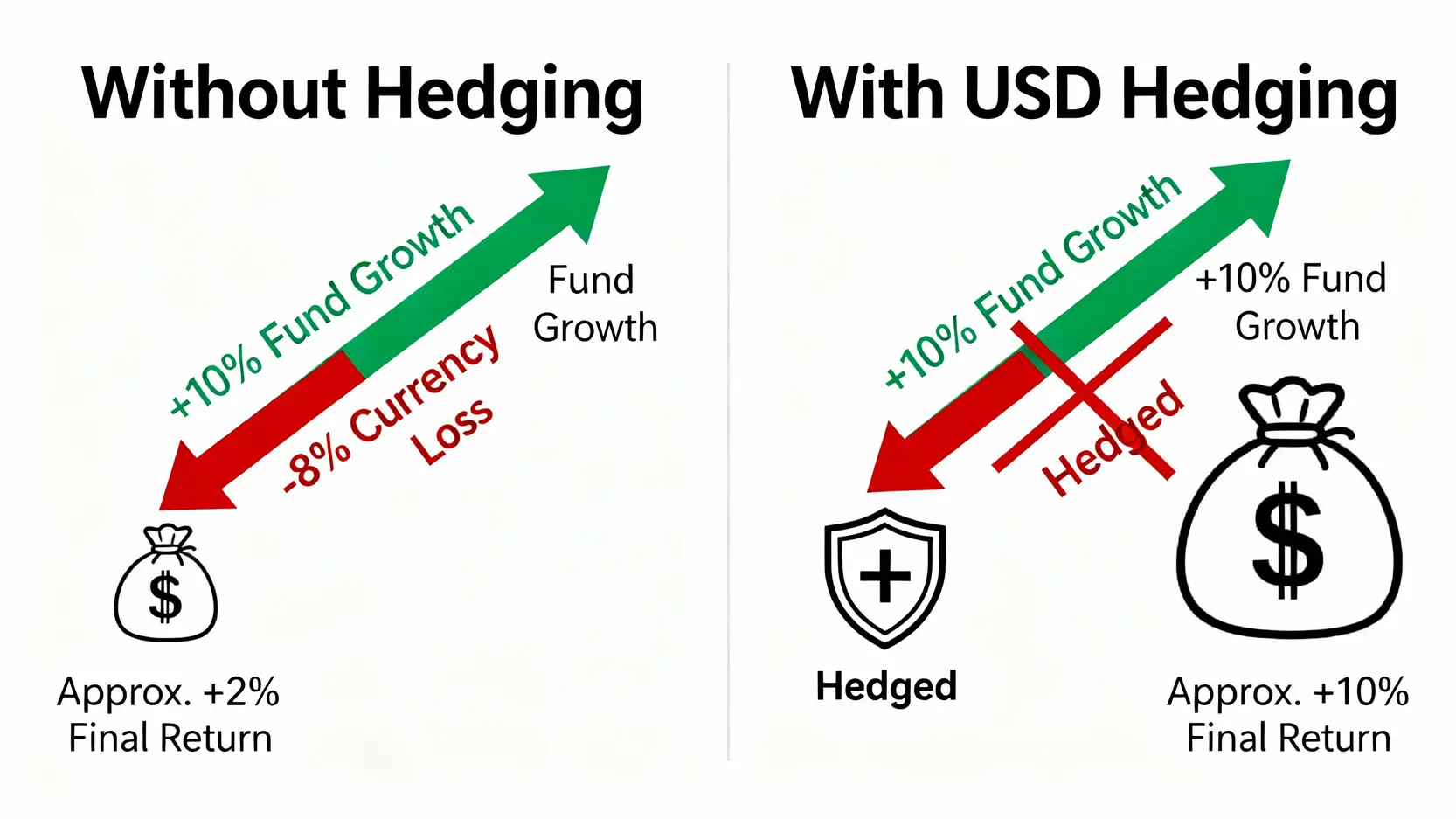
Assume an investor whose primary currency is US dollars purchases a fund investing in European equities, and the fund is denominated in euros (EUR). Within one year, the fund’s net asset value rises by 10%, which is a strong performance. However, during the same period, the EUR/USD exchange rate declines by 8%.

  • Unhedged share class: The investor’s final return in US dollars would be approximately 2% (10% – 8%). The depreciation of the euro significantly erodes the investment profit.
  • US Dollar hedged share class: Since the fund manager has locked in the exchange rate through financial instruments, the investor’s return would be close to 10%, largely unaffected by the euro’s depreciation.

This example clearly shows that for investors whose base currency differs from the fund’s base currency, selecting a currency hedged share class can substantially protect investment results from adverse exchange rate movements.

美元投資者投資歐元基金時,有無貨幣對沖的最終回報對比圖。

The Protective Effect of Currency Hedging: Even if the fund itself performs well, exchange rate fluctuations may still erode your profits.

Potential Costs and Risks of Hedged Share Classes You Must Know

There is no free lunch. Currency hedging is not without cost. When fund companies implement hedging strategies, transaction expenses are incurred, which are typically reflected in the fund’s management fees. As a result, the expense ratio of hedged share classes is usually slightly higher than that of unhedged share classes. In addition, hedging involves the following risks:

  • Missing appreciation opportunities: If the fund’s base currency appreciates instead of depreciates, the hedging strategy may cause you to miss additional gains from currency appreciation.
  • Imperfect hedging: It is difficult to achieve 100% precision in hedging operations. Significant market volatility may reduce hedging effectiveness and result in “tracking error”.
  • Interest rate differential costs: Hedging costs are also affected by interest rate differences between the two currencies and may sometimes be substantial.

Therefore, before deciding whether hedging is necessary, you must weigh the protection it provides against the potential costs. To gain a deeper understanding of related risk management, you may refer to the 2026 Beginner’s Guide to Foreign Exchange Trading: Master Risk Management and Broker Selection for Steady Profits!

US Dollar Hedging vs Australian Dollar Hedging: A Complete Analysis of Fund Share Classes

After understanding the basic principles of hedging, let us examine the two most common hedged share classes in the market: US Dollar hedged and Australian Dollar hedged, each designed to meet different investor needs.


What Does “Fund US Dollar Hedging” Mean? Which Investors Is It Suitable For?

A “Fund US Dollar Hedged” share class aims to minimize exchange rate risk between the fund’s base currency (such as euros, Japanese yen, or British pounds) and the US dollar. This type of share class is particularly suitable for the following investors:

  • Investors who primarily use US dollars: For investors located in Taiwan, Malaysia, and other regions who habitually use US dollars as their main investment and accounting currency, a US Dollar hedged share class allows them to focus on fund performance without worrying about fluctuations between other currencies and the US dollar.
  • Investors expecting the US dollar to strengthen: If you believe the US dollar will appreciate relative to the fund’s base currency in the future (meaning the fund’s base currency will depreciate), choosing a US Dollar hedged share class can protect your assets from exchange losses.


How “Australian Dollar Hedging” Works and Investment Considerations

An “Australian Dollar Hedged” share class operates in exactly the same way as US Dollar hedging, except that the target hedging currency is the Australian dollar (AUD). Its primary function is to eliminate exchange rate risk between the fund’s base currency and the Australian dollar. This type of fund is mainly designed for domestic investors in Australia, or for international investors who are optimistic about Australian dollar assets and wish to use the Australian dollar as their settlement currency.


Quick Comparison: How Should I Choose Between Hedged and Unhedged Share Classes?

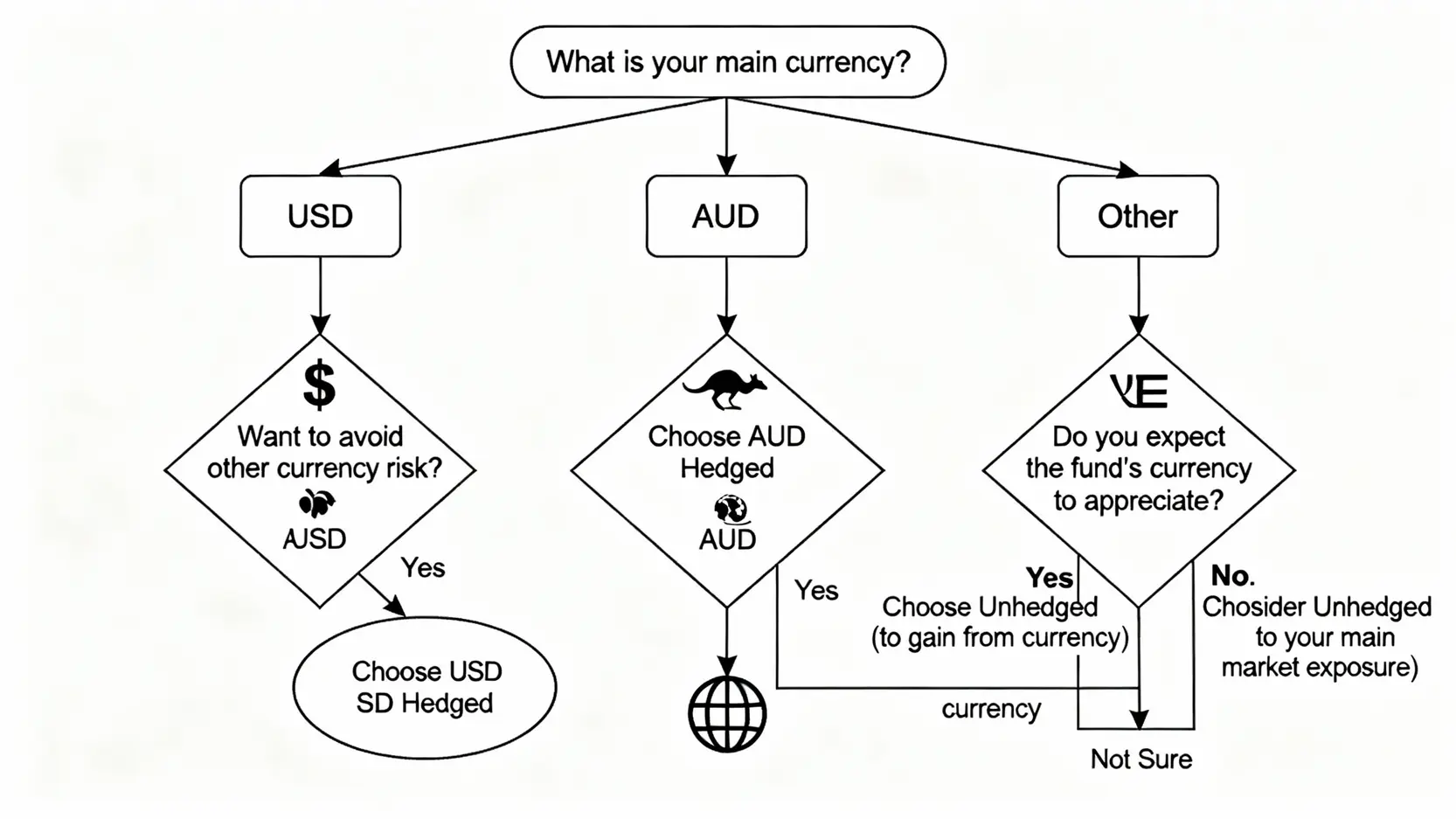
When faced with a wide range of fund share classes, how should you decide? You can quickly assess your choice through the following table:

Your Situation

Investment Strategy Recommended Choice

Use the US Dollar as the Base Currency and Do Not Wish to Bear the Risk of Other Currencies Against the US Dollar

Expect the US Dollar to Remain Relatively Strong, or Only Wish to Earn the Fund’s Own Returns US Dollar Hedged (USD Hedged) Share Class
Use the Australian Dollar as the Base Currency and Do Not Wish to Bear the Risk of Other Currencies Against the Australian Dollar Expect the Australian Dollar to Remain Relatively Strong Australian Dollar Hedged (AUD Hedged) Share Class
Optimistic About the Future Appreciation Potential of the Fund’s Base Currency (Such as the Euro) Wish to Earn Both the Fund’s Returns and Potential Foreign Exchange Gains Unhedged Share Class
Have No Clear View on Exchange Rate Trends and Wish to Diversify Risk Seek the Most “Pure” Exposure to Overseas Market Investments Unhedged Share Class

選擇基金對沖級別的決策流程圖,幫助投資者根據自身貨幣和市場預期做出選擇。

One Chart to Help You Decide Whether to Choose US Dollar Hedged, Australian Dollar Hedged, or Unhedged Share Class.


Further Reading (Highly Recommended)

2026 Beginner’s Guide to Foreign Exchange Trading: Master Risk Management and Broker Selection for Steady Profits!

What Is the S&P 500? A Beginner’s Investment Guide: Understand Constituents, ETFs, and How to Buy 

Introduction to Safe-Haven Currencies: A Capital Shelter During Market Turbulence

In addition to managing risk through a fund’s hedged share class, directly understanding and investing in “safe-haven currencies” is also a common strategy. When global financial markets experience panic or uncertainty, these currencies often become a shelter for capital.


Definition of Safe-Haven Currencies: Why Can They Withstand Risk?

A safe-haven currency refers to a currency that investors generally regard as stable in value, or even likely to appreciate, during periods of heightened risk aversion. The issuing countries of these currencies typically possess the following characteristics:

  • Stable political and economic systems: A sound rule of law, transparent governance, and predictable economic policies.
  • Large and highly liquid financial markets: Capable of accommodating substantial global capital inflows and outflows.
  • Current account surplus: Typically net creditor nations, meaning they hold more foreign assets than foreigners hold of theirs.
  • Relatively independent monetary policy: Central banks capable of maintaining currency stability.

避險貨幣的四大核心特徵示意圖,包括穩定的政治經濟、高流動性市場等。

Safe-haven currencies are considered “safe” because their issuing countries possess strong economic and political stability.


Overview of the Three Major Safe-Haven Currencies: Characteristics of the US Dollar, Japanese Yen, and Swiss Franc

The three globally recognized major safe-haven currencies are the US dollar (USD), Japanese yen (JPY), and Swiss franc (CHF). Each has distinct safe-haven attributes.

  • US Dollar (USD): As the world’s primary reserve currency, the US dollar’s position is unshakable. During crises, global demand for US dollar liquidity rises sharply, as most international trade and financial transactions are denominated and settled in US dollars, making it the ultimate “safe harbor”.
  • Japanese Yen (JPY): Japan is the world’s largest net creditor nation, with substantial overseas assets. During global market turmoil, Japanese investors tend to repatriate overseas capital, driving up the yen exchange rate and creating what is known as “safe-haven appreciation”.
  • Swiss Franc (CHF): Switzerland’s long-standing political neutrality, robust financial system, and extremely low inflation have made its currency a traditional safe-haven choice. Although its economy is relatively small, the credibility of the Swiss franc makes it highly favored during periods of global instability. To learn more about the types and applications of safe-haven currencies, you may read What Are Safe-Haven Currencies? The 2024 Guide to Three Major Safe-Haven Currencies, Gold, and Government Bond Investment.


Frequently Asked Questions About US Dollar Hedging and Safe-Haven Currencies

Q: Do currency hedged share classes incur additional fees?

A: Yes. When fund companies implement currency hedging strategies, they use financial derivatives, which generate transaction costs and management expenses. Therefore, the expense ratio of hedged share classes is usually slightly higher than that of unhedged share classes. These fees are the “insurance premium” paid in exchange for exchange rate stability.

Q: If I am optimistic about a particular currency (such as the Australian dollar), should I still choose a hedged share class?

A: No. If you expect the fund’s base currency (for example the euro) to appreciate against the currency you wish to hold (such as the Australian dollar), you should choose an “Unhedged” share class. In this way, you can benefit not only from the rise in the fund’s net asset value, but also from additional gains resulting from currency appreciation. Choosing a hedged share class would instead cause you to miss this potential profit.

Q: The US dollar itself is a safe-haven currency. Why does a fund still need “US Dollar Hedging”?

A: This is a crucial question. A fund’s “US Dollar Hedging” function applies to funds that are “denominated in currencies other than the US dollar”. For example, a Japanese equity fund denominated in Japanese yen has exchange rate risk arising from fluctuations between the yen and the US dollar. Even though both the US dollar and the Japanese yen are safe-haven currencies, their relative exchange rate still fluctuates. The purpose of US Dollar hedging is to eliminate the risk of the “JPY/USD” currency pair, allowing US dollar investors to focus on the performance of the Japanese stock market without concern for yen movements.

Q: Can currency hedging completely eliminate exchange rate risk?

A: In theory it can come close, but in practice it is difficult to achieve 100% elimination. Hedging strategies involve certain technical limitations, such as contract precision and changes in market liquidity, which may result in minor “tracking error”. However, an effective hedging strategy can usually eliminate more than 95% of exchange rate volatility impact.

Q: How can I check whether a fund has a currency hedged share class?

A: It is very simple. You can review the full name of the fund, which usually clearly indicates it, such as “XXX Fund USD Hedged” or “XXX Fund Australian Dollar Hedged“. In addition, the fund’s prospectus or investor information document (KIID) will provide detailed information on whether the investment strategy of that share class includes currency hedging. 

Conclusion

In summary, understanding the “meaning of fund US Dollar hedging” and the hedging strategies of different currencies is the crucial first step in managing foreign exchange risk and optimizing a global investment portfolio. Whether you choose US Dollar hedging to stabilize US dollar-denominated returns, use Australian Dollar hedging to lock in the value of the Australian dollar, or directly invest in safe-haven currencies such as the US dollar or Japanese yen, the core consideration lies in your personal investment objectives, domestic currency, and expectations for future market trends. Through the analysis in this article, you should now have a clear understanding of the principles and application scenarios of various tools. The next step is to review your investment portfolio and select the most suitable strategy to protect and grow your assets.

If you liked this article, please share it!

Related Articles

  • How Hedging Works: Hedge Fund Strategies & Trading Guide
    How Does Hedging Work? Advanced Hedge Fund Strategies and Practical Trading Guide In the rapidly changing financial markets, relying solely on a “buy-and-hold” strategy often makes it difficult to withstand severe market volatility and achieve stable long-term profits. If you have heard Wall Street leaders discuss risk hedging, you are...
    2026 年 7 月 14 日
  • What Is Hedging? A Beginner’s Risk Management Guide
    What Is Hedging? A Risk Management Guide Every Financial Beginner Should Read In the investment market, we often hear the term “hedging”, but what exactly does it mean? Why do professional investors use it? Hedging means adopting strategies to protect assets from adverse price movements. Whether in the stock, foreign...
    2026 年 7 月 14 日
  • 2026 US Treasury Yield Guide: Trends & Strategies
    2026 Complete Guide to US Treasury Yields: Trend Analysis, Impact of Surging Yields, and Asset Allocation Strategies In the rapidly changing global financial market, US Treasury yields have long been regarded as the most important benchmark for the risk-free rate. Entering 2026, amid recurring shifts in inflation expectations and dynamic...
    2026 年 7 月 13 日
返回顶部