2026 Gold Market In-Depth Analysis: Why Did Gold Fall Below 4,000? A Complete Guide to Expert Forecasts and Investment Strategies Amid Rate Hike Expectations
Watching gold prices fall below the psychological threshold of US$4,000 overnight, are you feeling anxious? Discussion about gold falling below US$4,000 has intensified across the market, with strong Federal Reserve (Fed) rate hike expectations identified as the primary cause. Is this market turbulence triggered by monetary tightening merely a short-term correction, or the beginning of a long-term bear market? This article provides an in-depth analysis of the fundamental reasons behind the decline in gold prices and presents expert views from Wall Street and practical investment strategies for navigating the challenging rate hike environment, helping you understand the key factors for future positioning.
Why Did Gold Fall Below US$4,000? Revealing the Main Causes
Gold’s fall below the key US$4,000 level was not triggered by a single event, but resulted from the combined effects of multiple macroeconomic factors. The Federal Reserve’s hawkish stance, a strong US dollar, and shifting market risk appetite have formed the three major forces weighing on gold prices.
Federal Reserve (Fed) Rate Hike Expectations: Why Are They Gold’s Biggest Threat?
The main focus of the current market is undoubtedly the direction of the Federal Reserve’s monetary policy. According to the Federal Reserve’s latest meeting minutes, policymakers generally believe that although inflation data has eased, it remains some distance from the 2% target, while the labor market is still strong. This has reinforced market expectations that interest rates will remain high during the second half of 2026, with another rate hike not being ruled out. Rate hike expectations deal a severe blow to gold primarily because they directly increase the “opportunity cost” of holding it. Gold itself does not generate interest. When interest rates rise, investors can earn higher risk-free returns by depositing funds in banks or purchasing bonds, significantly reducing the appeal of holding gold.
The Double Blow of a Strong US Dollar: How Exchange Rates Affect Gold’s Value
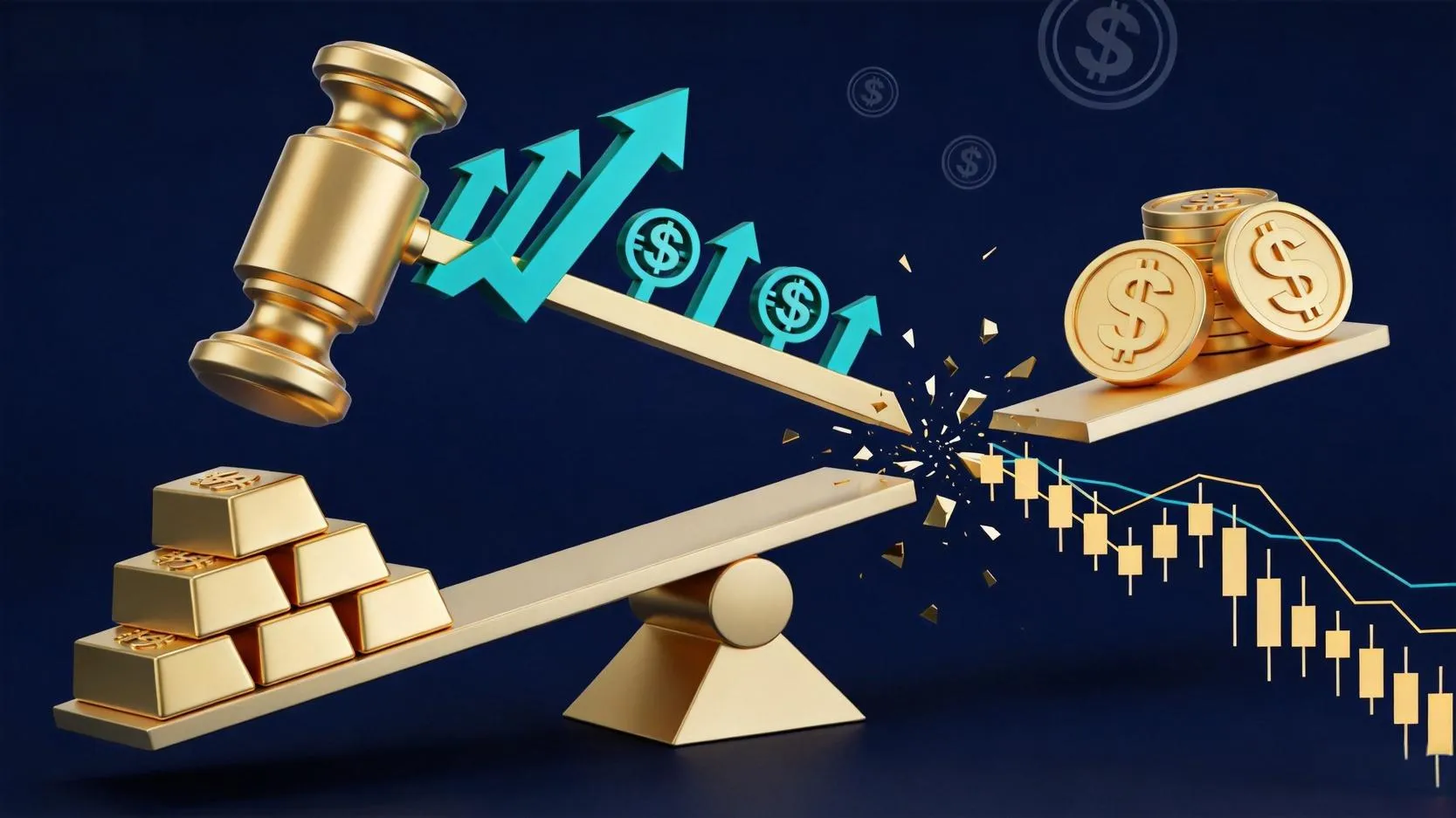
The relationship between the US dollar and gold is like the two ends of a seesaw, showing a strong negative correlation. As gold is priced in US dollars in international markets, when the US dollar appreciates (the US Dollar Index rises), gold becomes more expensive for investors holding other currencies, directly suppressing market demand. Recently, the Federal Reserve’s stance has been far more hawkish than those of other major central banks (such as the European Central Bank and the Bank of Japan), prompting large amounts of international capital to flow into the US in pursuit of higher interest returns. This has further strengthened the US dollar and placed additional pressure on gold prices.
Cooling Safe-Haven Sentiment: Where Has the Capital Gone?
Traditionally, gold has been regarded as the ultimate safe-haven asset during periods of geopolitical instability or economic recession. However, in the current market environment, gold’s safe-haven appeal appears to have faded somewhat. As the global economy gradually recovers from the pandemic, uncertainty remains, but market panic has eased significantly from its peak. Capital has begun flowing out of safe-haven assets such as gold and into areas offering higher returns, including high-yielding short-term government bonds and blue-chip stocks in specific industries. This shift in capital flows is also one of the key factors behind gold’s fall below the US$4,000 support level.
Further Reading (Highly Recommended)
A Complete Guide to Federal Reserve Interest Rate Decisions: A Concise Guide to Fed Policy and 2025 Investment Opportunities!
Your Money Is Losing Value! Understanding How Inflation Affects the Purchasing Power of the New Taiwan Dollar and Asset Allocation
Rate Hikes = Falling Gold Prices? Understanding the Seesaw Relationship Between Interest Rates and Gold
Many beginner investors simply equate “rate hikes” with “falling gold prices”, but the relationship between the two is far more complex than it appears. Understanding the underlying economic logic is essential for making more informed decisions amid market volatility.
Opportunity Cost Analysis: Holding Gold vs. Earning Interest
Opportunity cost is central to understanding the relationship between interest rates and gold prices. Imagine that you have a sum of money and can choose either to purchase physical gold and keep it in a safe or deposit it in a bank or buy US Treasury bonds.
- When interest rates are close to zero, holding gold involves almost no loss of potential interest income, highlighting its advantage as a store of value.
- However, when the Federal Reserve raises interest rates to 3% or higher, the same amount of money invested in the bond market can reliably earn 3% interest each year. By comparison, non-interest-bearing gold becomes less attractive.
This contrast makes institutional investors more inclined to sell gold and shift into fixed-income products during periods of high interest rates, placing downward pressure on gold prices.
Historical Data Backtesting: Gold’s Performance During Previous Rate Hike Cycles
Historical data shows that gold has not always moved in a single downward direction during rate hike cycles. According to research by the World Gold Council, gold’s price response usually depends on rate hike “expectations” and their “implementation”
| Stage |
Market Behavior |
Potential Impact on Gold Prices |
| Rising Expectations |
The market begins pricing in the possibility of rate hikes, the US dollar strengthens, and bond yields rise. |
The greatest pressure occurs during this stage. Gold prices usually decline in advance, reflecting future monetary tightening. |
| First Rate Hike Implemented |
The Federal Reserve officially announces a rate hike, and the “negative news is fully priced in”. |
A short-term rebound may occur. As market uncertainty is removed, some short sellers cover their positions. |
| Ongoing Rate Hike Cycle |
Interest rates continue to rise, and opportunity costs keep increasing. |
Range-bound with a downward bias. Gold prices tend to struggle during this stage, mainly influenced by the hawkish or dovish tone of each meeting and inflation data. |
| End of the Rate Hike Cycle |
The market expects the rate hike cycle to end soon and even begins discussing the possibility of future rate cuts. |
Range-bound with a downward bias. Gold prices tend to struggle during this stage, mainly influenced by the hawkish or dovish tone of each meeting and inflation data. |
Therefore, determining which stage the market is currently in is crucial. In the second half of 2026, the market generally believes that we are in the latter half of the “ongoing rate hike cycle”. This means that although gold prices remain under pressure, the turning point of the cycle may not be far away.
Gold Price Outlook: Is Gold Still Worth Investing in During the Second Half of 2026?
Faced with weak gold prices, many investors are asking the same question: Has the gold bull market already ended? Does gold still offer investment value in the second half of 2026? Let us examine the views of professional institutions and the key indicators that require attention.
Wall Street Investment Bank Views: Latest Price Target Forecasts from Major Institutions
Despite short-term pressure, Wall Street has not turned completely bearish on gold over the long term, although institutions have adjusted their price targets. For example, according to Reuters, Goldman Sachs lowered its year-end 2026 gold price target from US$5,400 to US$4,900 in June, reflecting expectations that interest rates may remain elevated in the short term. Meanwhile, J.P. Morgan analysts believe that once the end of the Federal Reserve’s tightening cycle is confirmed, gold prices will enter a period of structural upside. Overall, institutions generally expect gold prices to fluctuate between US$3,800 and US$4,700 in the short term, while remaining optimistic about the outlook beyond 2027.
Key Indicators to Monitor: Inflation Data (CPI) and Employment Reports
For gold investors, two macroeconomic indicators require close attention over the coming months:
- Consumer Price Index (CPI): This is a key measure of inflation. If CPI data continues to exceed expectations, the Federal Reserve may be forced to adopt more aggressive rate hikes, which would be negative for gold. Conversely, if CPI cools significantly, the Federal Reserve may slow the pace of monetary tightening, giving gold prices some breathing room.
- Nonfarm Payrolls (NFP): Strong employment data indicates that the economy remains overheated, giving the Federal Reserve greater confidence to continue raising interest rates. If employment data begins to weaken and the unemployment rate rises, the risk of an economic recession will increase, which may instead reignite safe-haven demand for gold.
Investment Strategies Under Different Scenarios: Short-Term Swing Trading vs. Long-Term Holding
In the current environment, investment strategies should be developed according to individual risk tolerance and investment horizon:
- Short-term swing traders: They can monitor market volatility before and after the release of the key economic data mentioned above. Near the key support level of US$3,800, signs of stabilization may present a short-term buying opportunity. Conversely, near the resistance zone of US$4,500, investors may consider taking profits. This strategy carries higher risk and requires strict stop-loss settings.
- Long-term allocation investors: If you believe in gold’s long-term inflation-hedging and safe-haven value within an asset allocation strategy, the current price correction may be viewed as an opportunity to build positions in stages. Rather than attempting to predict the market bottom, investors may adopt a regular fixed-amount investment approach or purchase a portion whenever the price falls by a certain amount (such as US$150 to US$200). This strategy focuses on a potential rate-cut cycle and economic uncertainty over the coming years rather than short-term price fluctuations.
Further Reading (Highly Recommended)
2026 Gold Investment Instrument Comparison: How to Choose Between Gold Passbooks, Gold ETFs, and Physical Gold?
Why Is the US Dollar So Strong? Revealing the Four Core Drivers Behind the “Dollar Support”
Frequently Asked Questions (FAQ)
Q: Is now a good time to buy gold?
A: This depends on your investment strategy. For short-term traders, market volatility is severe and risks are high. For investors seeking long-term asset allocation, the current decline from previous highs provides a relatively lower cost basis, and they may consider beginning to build positions in stages. However, they must be mentally and financially prepared for the possibility of further price declines.
Q: Besides rate hikes, what other factors affect gold prices?
A: Gold prices are influenced by a wide range of factors, mainly including: 1. The US dollar exchange rate (which usually has a negative correlation with gold); 2. Geopolitical risks, (as wars and political instability increase safe-haven demand); 3. Gold purchases by global central banks (as increases in central bank gold reserves provide stable demand); 4. Physical supply and demand (such as demand from the jewelry and industrial sectors); 5. Market sentiment and speculative activity.
Q: How should investors choose between gold ETFs, physical gold, and gold passbooks?
A: These three instruments each have their own advantages and disadvantages and are suitable for investors with different needs. Physical gold (such as gold bars and jewelry), provides the reassurance of tangible ownership, but involves storage issues and wider bid-ask spreads. Gold passbooks allow bank customers to trade small amounts conveniently, but offer lower liquidity. Gold ETFs (such as GLD) are traded on exchanges like stocks, offering excellent liquidity and the lowest trading costs. They are most suitable for investors seeking flexible trading and opportunities to capture price fluctuations.
Q: What key factors should investors monitor in Federal Reserve decisions?
A: When interpreting Federal Reserve decisions, investors should not focus only on whether interest rates are ultimately raised. More importantly, they should monitor the following: 1. Changes in the wording of the post-meeting statement: Look for signs of a “hawkish” stance (suggesting continued tightening) or a “dovish” stance (suggesting easing). 2. The dot plot: This shows officials’ forecasts for the future path of interest rates and is crucial for determining whether the rate hike cycle is approaching its end. 3. Chair Powell’s press conference: His remarks often reveal more details and possible future policy directions than the official statement.
Conclusion
In summary, gold’s fall below US$4,000 was primarily a market reaction driven by strong rate hike expectations and a stronger US dollar. Faced with a complex macroeconomic environment, investors should not panic, but should instead develop a deeper understanding of the seesaw relationship between interest rates and gold prices. The key is to formulate a clear response strategy based on your own risk tolerance and investment objectives, whether by using volatility for short-term trading or viewing the correction as a long-term entry opportunity. Only by continuously monitoring key economic data such as inflation and employment can investors navigate the volatile gold market steadily and capture potential opportunities in the next cycle.