Short Selling Explained: Meaning, How It Works & Risks

When the stock market declines, can you only sit and wait helplessly? You often hear others discuss the “meaning of short selling” or “Short Selling in Chinese“, but do you truly understand why short selling can generate profits and the significant risks behind it? Many people associate short selling with “betting everything”, or even link it to the Ding Hai Effect in the film “The Greed of Man”. In fact, short selling is a high-risk yet effective tool for market hedging and speculation. This article will explain in the simplest way the meaning of short selling, operational steps, profit calculation, and risk management strategies, enabling you to master investment techniques that can generate returns even in a bear market.
What Is Short Selling? Understand the Core Concept in One Sentence
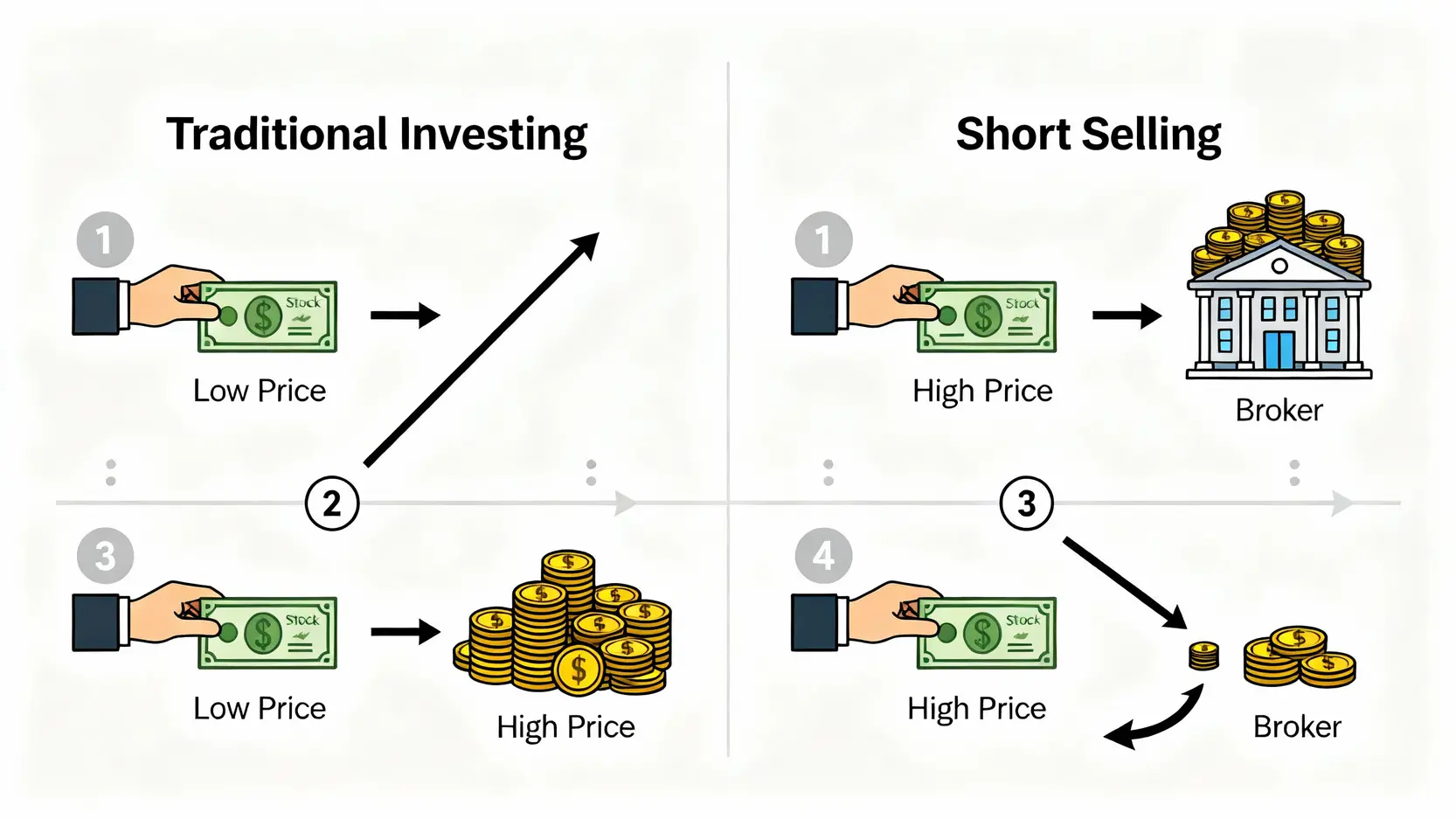
Short selling, also known as selling short or going short, is an investment strategy that anticipates the price of an asset will decline. The core operation is “sell high first, buy low later”, earning the difference in price. This is completely opposite to the traditional investment logic of “buy low, sell high”.

Meaning of Short Selling: An investment strategy opposite to the traditional “buy low, sell high” approach
Simply put, in traditional stock investing, you use your capital to buy a stock, hold it, wait for it to appreciate, and then sell it for profit. In contrast, when you expect a stock’s price to fall, you first “borrow” the stock from a broker and sell it in the market at the current higher price. When the price falls as expected, you repurchase the same number of shares at a lower price and “return” them to the broker. The difference between borrowing and returning, after deducting interest and transaction fees, becomes your profit.
How Can Short Selling Generate Profits? A Simple Example of the Profit Model
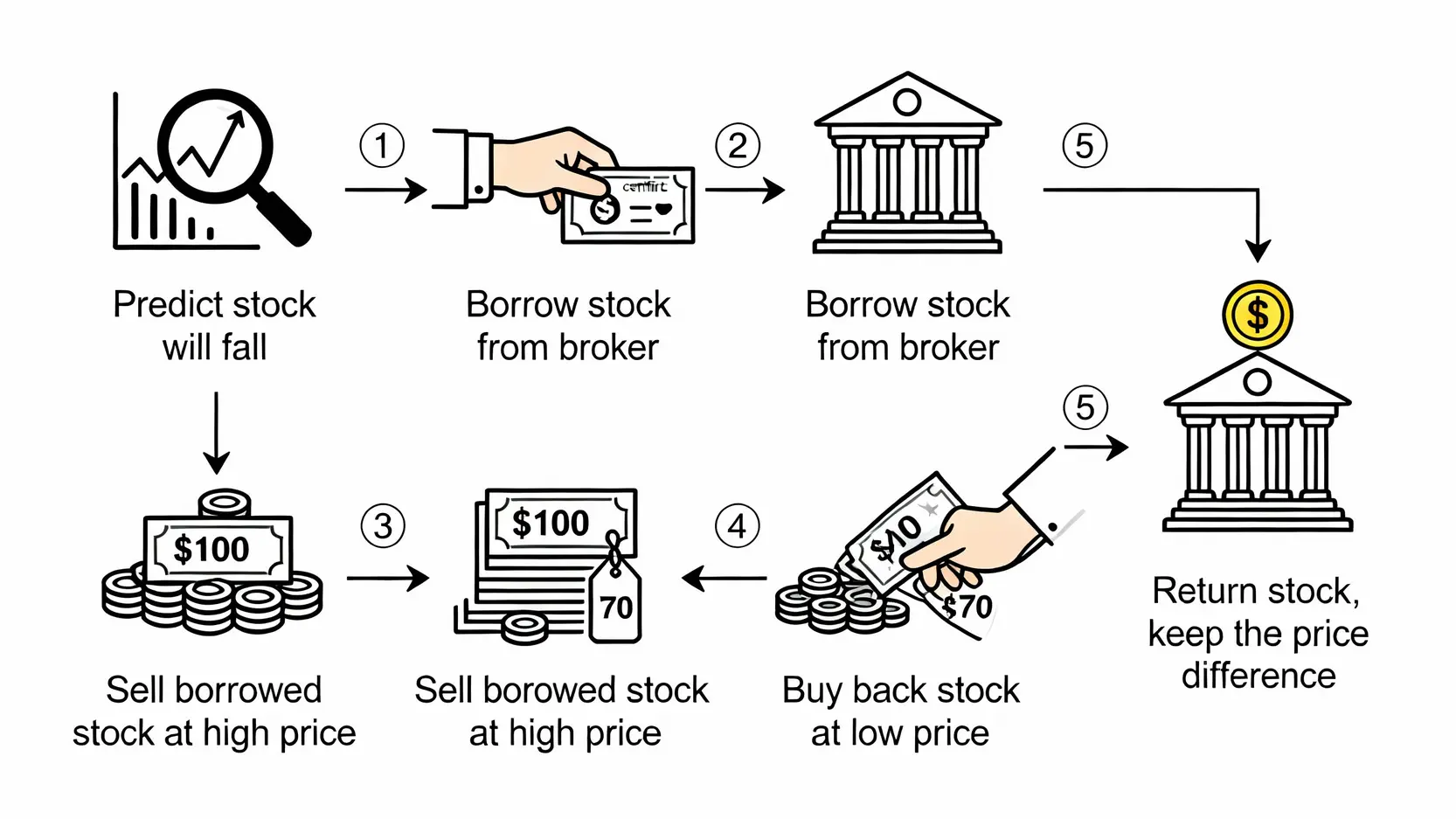
Let us use a specific example to explain how short selling works:
- Judgment: After analysis, you believe that “Overvalued Company” (XYZ), currently priced at $100 per share, is overvalued and will decline to $70 within the next month.
- Borrow shares: You borrow 1,000 shares of XYZ from your brokerage firm.
- Sell at a high price: You immediately sell the 1,000 shares in the market at $100 per share, receiving $100,000 in cash.
- Wait for the decline: One month later, as expected, the stock price drops to $70 per share.
- Buy back at a lower price (close the position): You repurchase 1,000 shares of XYZ at $70 per share, spending a total of $70,000.
- Return the shares: You return the 1,000 shares to the brokerage firm and complete the transaction.
In this process, your gross profit is $100,000 minus $70,000, which equals $30,000. Of course, in actual operations, borrowing interest and trading commissions must also be deducted, but this illustrates the basic principle of how short selling generates profit.

How to Execute Short Selling? A Four-Step Guide for Hong Kong and US Stocks
After understanding the meaning of short selling, how should you execute it in practice? Whether in Hong Kong or US markets, the process is largely similar and mainly consists of the following four steps. This short selling guide will walk you through the entire procedure.
Step One: Open a Margin Account
Since short selling involves “borrowing shares”, it is inherently a leveraged activity. Therefore, you cannot use a regular cash account to execute it. You must open a margin account, commonly known as “margin trading” with a brokerage firm. Opening such an account typically requires depositing a minimum margin as collateral to fulfill your repayment obligation.
Step Two: Borrow Shares From the Broker
After selecting the stock you wish to short sell, you must submit a borrowing request to the broker. The broker will determine whether the shares are available for borrowing and in what quantity (based on its inventory or other sources). Not all stocks are eligible for short selling. Typically, only stocks with higher liquidity and larger market capitalization are included in the list of shortable securities.
Step Three: Sell the Borrowed Shares in the Market
Once the shares are successfully borrowed, you can place a sell order in the market just as you would when selling shares you own. After execution, the proceeds will be credited to your margin account. However, strictly speaking, this cash remains part of the borrowing arrangement and serves as part of the collateral.
Step Four: Buy Back the Shares After the Price Falls and Return Them (Close the Position)
This is the final step of a short selling transaction, also known as “closing the position” or “short covering”. When the stock price falls to your target level, or when you decide to end the trade, you must repurchase the same number of shares in the market. After repurchase, the shares are automatically returned to the broker, and the transaction is completed. Your final profit or loss will be settled at this point.
The Greatest Risk of Short Selling: Why Are Potential Losses Unlimited?
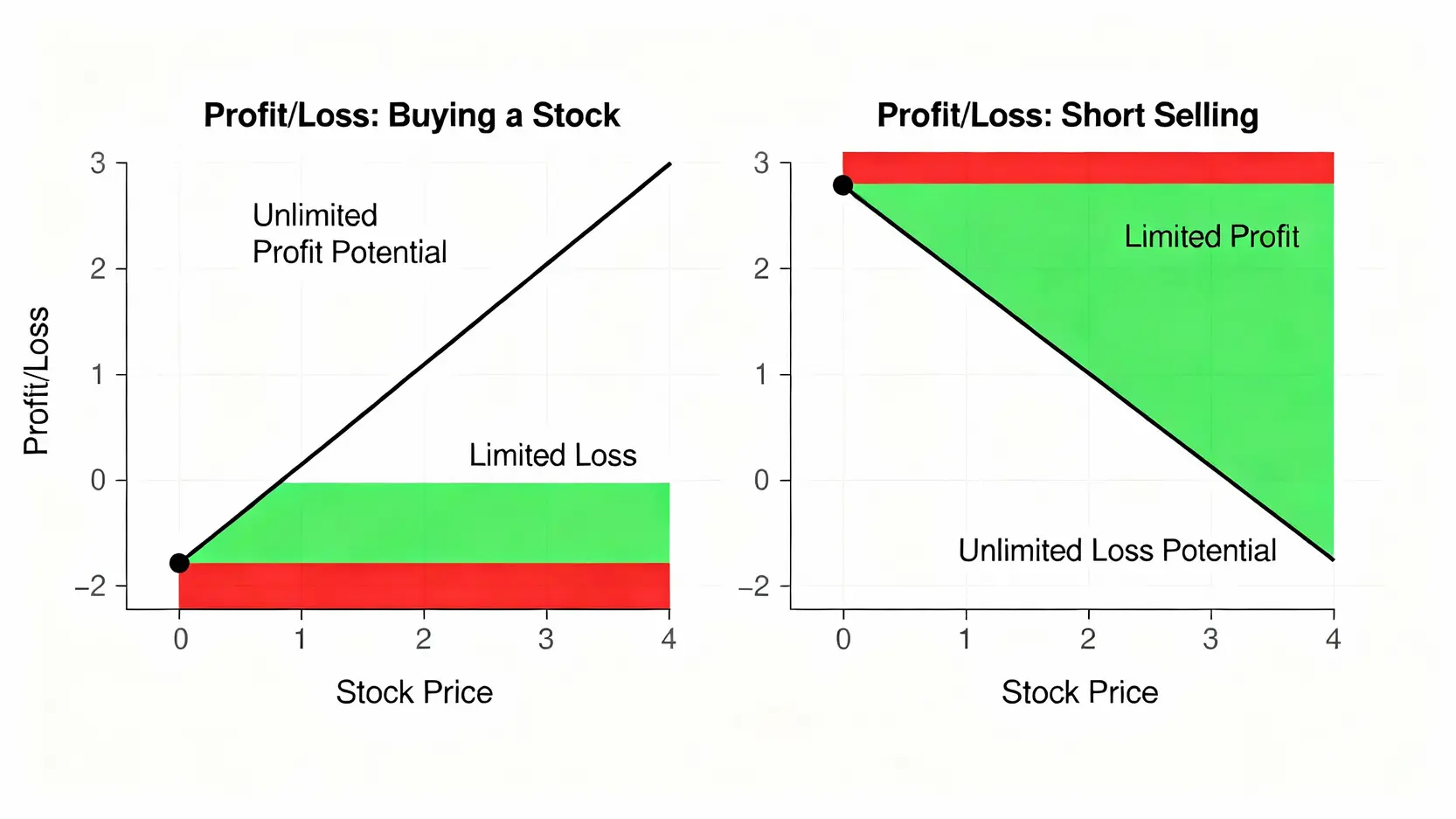
Although short selling provides an opportunity to profit in a bear market, it is widely recognized as one of the highest-risk investment strategies. Understanding the potential risks of short selling is far more important than learning how to execute it. Why can short selling lead to devastating losses? The reason lies in its structure of “limited profit, unlimited loss”.
Risk One: If the Stock Price Rises Instead of Falls, Losses Have No Upper Limit
This is the core risk of short selling. When you buy a stock (go long), the worst-case scenario is that the price falls to zero, and your maximum loss is the total capital invested. However, when you short a stock and its price rises instead of falls, the upside in theory is unlimited. For example, if you short a stock at $20 and it rises to $50, you must buy it back at $50 to return it, resulting in a loss of $30 per share. If it continues to rise to $100, $200, or even higher, your losses will keep expanding, far exceeding your initial margin.

Further Reading (Highly Recommended)
US IPO Guide: Essential New Stock Subscription Methods, Process, and Recent Highlights for Beginners
Risk Two: Short Squeeze Risk
A short squeeze, also known as “short covering” is the greatest nightmare for short sellers. When the share price of a heavily shorted stock suddenly rises instead of falling, it triggers a chain reaction:
- Trigger stop loss or forced covering: As the stock price rises, short sellers incur losses, and brokers may issue a “margin call”, requiring them to deposit additional funds, otherwise positions will be forcibly closed.
- Buying pressure surges: Whether through voluntary stop loss or forced liquidation, short sellers must “buy back” shares in the market.
- Vicious cycle: Massive buying further pushes up the stock price, causing more short sellers to trigger covering orders, creating a self-reinforcing cycle that drives explosive price increases within a short period. The well-known GameStop (GME) event is a typical example of a short squeeze.
Risk Three: Paying Borrowing Interest and Other Fees
Short selling is not free. You must pay interest on the borrowed shares, and the rate depends on the supply and demand of that stock. If many investors want to short a particular stock (high demand) while the amount available for borrowing in the market is limited (low supply), the borrowing interest rate may become very high. In addition, if the stock pays dividends during the borrowing period, the short seller must pay the lender an amount equivalent to the dividend (known as a substitute dividend). These are hidden costs of short selling transactions.
Legal Requirements for Short Selling Stocks in Hong Kong
In Hong Kong, short selling is strictly regulated by the Securities and Futures Commission (SFC). Before engaging in short selling of Hong Kong stocks, investors must understand the relevant legal requirements to avoid violating the law.
What Is “Covered Short Selling”?
Under Hong Kong law, all lawful short selling must be “covered short selling”. This means that before placing a sell order, you must have entered into a valid securities borrowing agreement with a licensed intermediary, such as a broker, and have “reasonable grounds” to believe that you can successfully borrow the required number of shares and complete settlement on time. In simple terms, you must “borrow the shares before selling”.
Strict Prohibition of “Naked Short Selling”
In contrast to covered short selling is “naked short selling”. This refers to placing a sell order in the market without having borrowed the shares, or even without confirming any source of shares, in the hope of buying them back in the market before the settlement date (T+2) to complete delivery. This practice is strictly prohibited in Hong Kong and constitutes a criminal offense. According to the regulations of the Securities and Futures Commission, engaging in naked short selling may result in severe fines or even imprisonment. The purpose of this regulation is to prevent settlement default risk and maintain financial market stability.
Frequently Asked Questions About the Meaning and Risks of Short Selling
Q: Can all stocks be short sold?
A: No. In Hong Kong, only stocks included in the “Designated Securities Eligible for Short Selling List” issued by the Hong Kong Exchanges and Clearing Limited (HKEX) may be short sold. This list is updated regularly and generally includes stocks with larger market capitalization and higher liquidity, such as blue-chip stocks and most constituent stocks of major state-owned enterprise indices. Penny stocks, GEM-listed stocks, or newly listed stocks are usually not eligible for short selling.
Q: What is the difference between short selling and “selling”?
A: These are two completely different concepts. “Sell” refers to selling stocks that you already own and is a traditional action to close a position and exit the market. “Short Sell” refers to selling shares that you have borrowed and is an opening position based on the expectation that the stock price will decline. The two differ fundamentally in operational premise, risk structure, and purpose.
Q: Is short selling suitable for retail investors?
A: Short selling involves extremely high risk, particularly due to its characteristic of “unlimited losses”. It requires substantial capital strength, high risk tolerance, and strong market judgment. For most retail investors or beginners, it is not recommended to attempt short selling lightly. Entering the market without fully understanding its mechanisms and risk management strategies may lead to severe losses.
Q: What fees are involved in short selling?
A: There are three main costs: 1. Trading Commission: Similar to ordinary stock transactions, commissions and related charges must be paid when selling borrowed shares and when buying them back to close the position. 2. Borrowing Interest: Calculated daily and determined by the scarcity of the borrowed stock. Heavily shorted stocks may carry high borrowing rates. 3. Dividend Compensation: If the stock pays a dividend during the borrowing period, the short seller must pay the lender an amount equivalent to the dividend.
Conclusion
In summary, short selling is a double-edged sword. It provides the possibility of profiting in a declining market, but its unlimited loss risk cannot be ignored. It is not merely about predicting a price decline, but a contest involving capital management, risk control, and psychological resilience. Before attempting short selling, investors must thoroughly understand its operating principles, potential costs, and legal requirements, particularly Hong Kong’s strict regulations on “covered short selling”. Beginners are advised to practice first in a demo account and always maintain proper risk management in order to use this tool effectively rather than be harmed by it.
Related Articles
-
Practical Applications of Volatility Surfaces: From Options Modeling to Advanced Skew Trading Strategies In options markets, implied volatility is never a flat line. Instead, it forms complex "smile" or "skew" surfaces. For advanced traders, mastering the practical applications of volatility surfaces is equivalent to possessing a lens that reveals market...2026 年 6 月 3 日
-
Building a Foreign Capital Flow Copy Trading Model: A Stock Market Indicator for Accurately Tracking Institutional Positioning In Asia-Pacific stock markets, foreign capital inflows and outflows often determine the direction of the index. However, simply looking at daily net buy and sell data is no longer enough. Only by building...2026 年 6 月 3 日
-
Options Buyer Strategies During Extreme Market Conditions: Black Swan Hedging and Cross-Market Arbitrage During Volatility Surges The most terrifying aspect of financial markets is not a gradual decline, but overnight flash crashes and cross-market capital withdrawals accompanied by volatility surges. In the highly unpredictable global macroeconomic environment of 2026, geopolitical...2026 年 6 月 3 日