Computing Power Investment: Find the Next Nvidia

Updated: 2026/05/14  |  CashbackIsland

computing-power-investment-guide

The Ultimate Guide to Computing Power Investment: How to Position for Computing Power Securitization and Discover the Next Nvidia?

Have you sensed how the AI wave is reshaping the world at an unprecedented speed, yet struggled to find the precise investment entry point? As Nvidia’s share price continues reaching record highs, many investors have realized that “computing power” is the true core engine behind this revolution. This article provides an in-depth analysis of the revolutionary concept of computing power as a new asset class, explores how the concept of computing power securitization allows ordinary investors to share in this era’s opportunities, and comprehensively examines the enormous potential of computing power investment, helping you secure an early advantage in the next decade of technological transformation. 


Why Is Computing Power Becoming a New Asset Class?

In the past, when discussing assets, people typically thought of gold, oil, stocks, or real estate. However, with the exponential development of artificial intelligence (AI), a completely new and intangible asset class is rapidly emerging: “computing power”. It is no longer merely a technology term, but the key fuel driving the future economy, with its value now being redefined by the world’s leading investment institutions.


The New Oil of the AI Era: Explosive Growth in Computing Power Demand

If data is the new oil of the modern era, then computing power is the engine that refines and drives that data. From training large language models (such as ChatGPT) to scientific research, drug development, climate simulation, and high-frequency trading in financial markets, all rely on enormous computational capabilities. The complexity of AI models doubles every few months, and the demand for computing power rises explosively alongside it. This almost limitless demand gives computing power strategic importance comparable to oil during the industrial age, making it a scarce and valuable resource.


From Data Centers to the Cloud: The Core Value and Irreplaceability of Computing Power

The value of computing power is reflected not only in demand, but also in the complexity and high barriers associated with supply. Building a high-performance data center requires massive capital investment to purchase top-tier chips (such as Nvidia GPUs), construct expensive cooling and power systems, and maintain continuous operational management. This highly capital-intensive and technology-intensive nature gives computing power characteristics similar to physical assets. Whether it is Amazon AWS, Google Cloud, or Microsoft Azure, the cloud computing services they provide are essentially the commercialization and leasing of computing power. This irreplaceability forms the solid foundation that enables computing power to become an independent asset class.


BlackRock CEO’s Prediction: Why Will Computing Power Futures Become the Next Major Market?

Larry Fink, CEO of BlackRock, the world’s largest asset management company, has publicly stated that the importance of computing power will continue increasing, and that financial derivatives such as “computing power futures” may eventually emerge. Behind this prediction lies his recognition of the massive volatility and hedging demand within the computing power market. Companies seeking to lock in future AI model development costs require tools to hedge against rising computing power prices, while investors need channels to directly participate in the computing power market. Just as oil futures allow market participants to trade future oil prices, the emergence of computing power futures would formally establish computing power as a standardized, investable, and tradable asset.


What Is Computing Power Securitization? How Can Ordinary Investors Invest in Supercomputers?

After understanding the concept of “computing power as an asset”, the next natural question becomes: how can ordinary investors participate? “Computing power securitization” is an innovative financial concept designed to solve this exact problem. Its purpose is to break down the high barriers of computing power investment and allow more people to benefit from the AI era.


Concept Explanation: Transforming Intangible Computing Power Into Tradable Financial Products

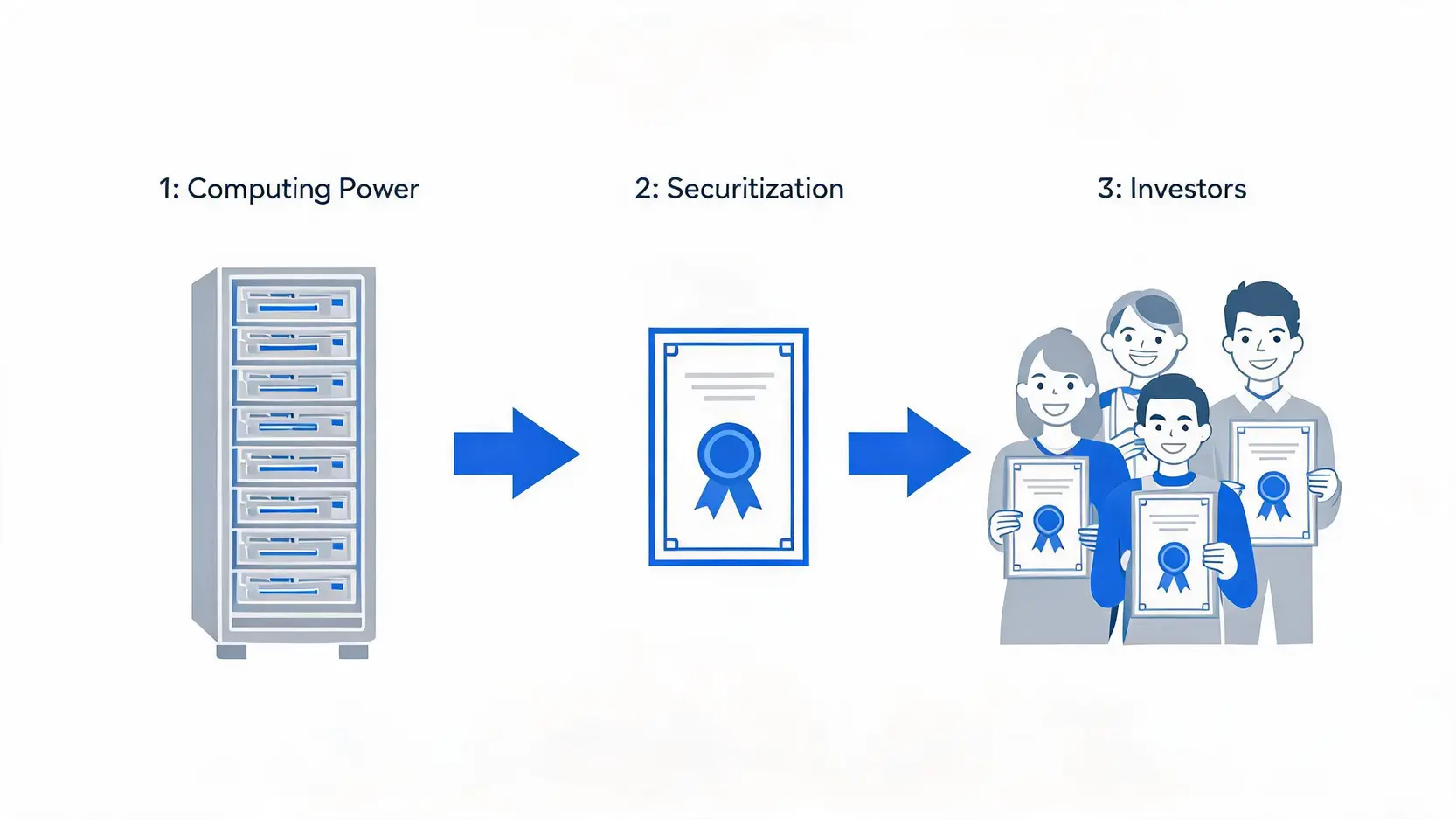
Simply put, computing power securitization involves packaging and dividing the computational capabilities of data centers or supercomputers into standardized “computing power shares”, which are then issued and traded in the market in the form of securities (such as stocks, funds, or tokens). This is similar to how Real Estate Investment Trusts (REITs) divide large commercial properties into smaller shares, allowing investors to invest in shopping malls or office buildings as easily as buying stocks. Through computing power securitization, what investors purchase is no longer merely a company’s stock, but rather direct ownership rights or income rights linked to a portion of a “supercomputer’s” computing power.

算力證券化概念圖,展示了如何將數據中心的算力轉化為可供投資者交易的金融份額。

The Process of Computing Power Securitization: Transforming Massive Computational Capabilities Into Financial Products Accessible to Everyone.


What Computing Power Investment Channels Currently Exist in the Market? (Concept Stocks, ETFs, and Cloud Computing Platforms)

Although standardized “computing power securities” have not yet become widely adopted, several indirect methods for participating in computing power investment already exist in the market:

  • Investing in computing power concept stocks: This is the most direct approach, involving the purchase of stocks related to companies across the computing power industry chain. Examples include GPU manufacturers such as Nvidia and AMD, as well as cloud service providers such as Amazon and Microsoft.
  • Investing in related thematic ETFs: By purchasing semiconductor, cloud computing, or AI-themed ETFs, investors can gain diversified exposure to multiple computing power-related companies, effectively reducing risk. Readers seeking deeper understanding may refer to “What Is a VIX ETF? Can You Profit From the Fear Index? Complete VIX ETF Investment Guide and Risk Analysis” to learn more about ETFs.
  • Cloud computing platforms: Some platforms allow users to directly purchase or lease specific amounts of computing power for tasks (such as AI model training or rendering), while some are also beginning to explore the possibility of computing power trading.


Computing Power Securitization vs. Cryptocurrency Mining: Core Differences, Advantages, and Disadvantages

Many people confuse computing power investment with cryptocurrency “mining”, such as Bitcoin mining, but the two are fundamentally different:

Characteristics Computing Power Securitization

Cryptocurrency Mining

Source of Value Derived From the Economic Value Generated by Practical Applications Such as AI and Scientific Computing. Primarily Derived From Blockchain Network Consensus Mechanisms and Token Rewards.
Underlying Asset General-Purpose Computing Power That Can Be Used Across Multiple Commercial Scenarios. Specialized Computing Power (ASIC), Usually Limited to Specific Algorithms.
Market Risk Affected by Technological Development and Industry Application Demand. Heavily Influenced by Extreme Cryptocurrency Price Volatility and Regulatory Policies.
Potential Advantages More Closely Integrated With the Real Economy, Providing Stronger Value Support. Relatively Higher Market Maturity and More Diverse Trading Channels.

In summary, the value foundation of computing power securitization is rooted in real productivity demand, while the value of cryptocurrency mining is more closely tied to the prices of specific virtual currencies. The risk and return models of the two are fundamentally different.


Further Reading (Highly Recommended)

What Is a VIX ETF? Can You Profit From the Fear Index? Complete VIX ETF Investment Guide and Risk Analysis

Complete Guide to US Stock Market Live Quotes: Trend Analysis, Technology Giants, and Market Capitalization Rankings …


In-Depth Analysis of Computing Power Investment Potential in 2026: Three Major Sectors and Risk Assessment

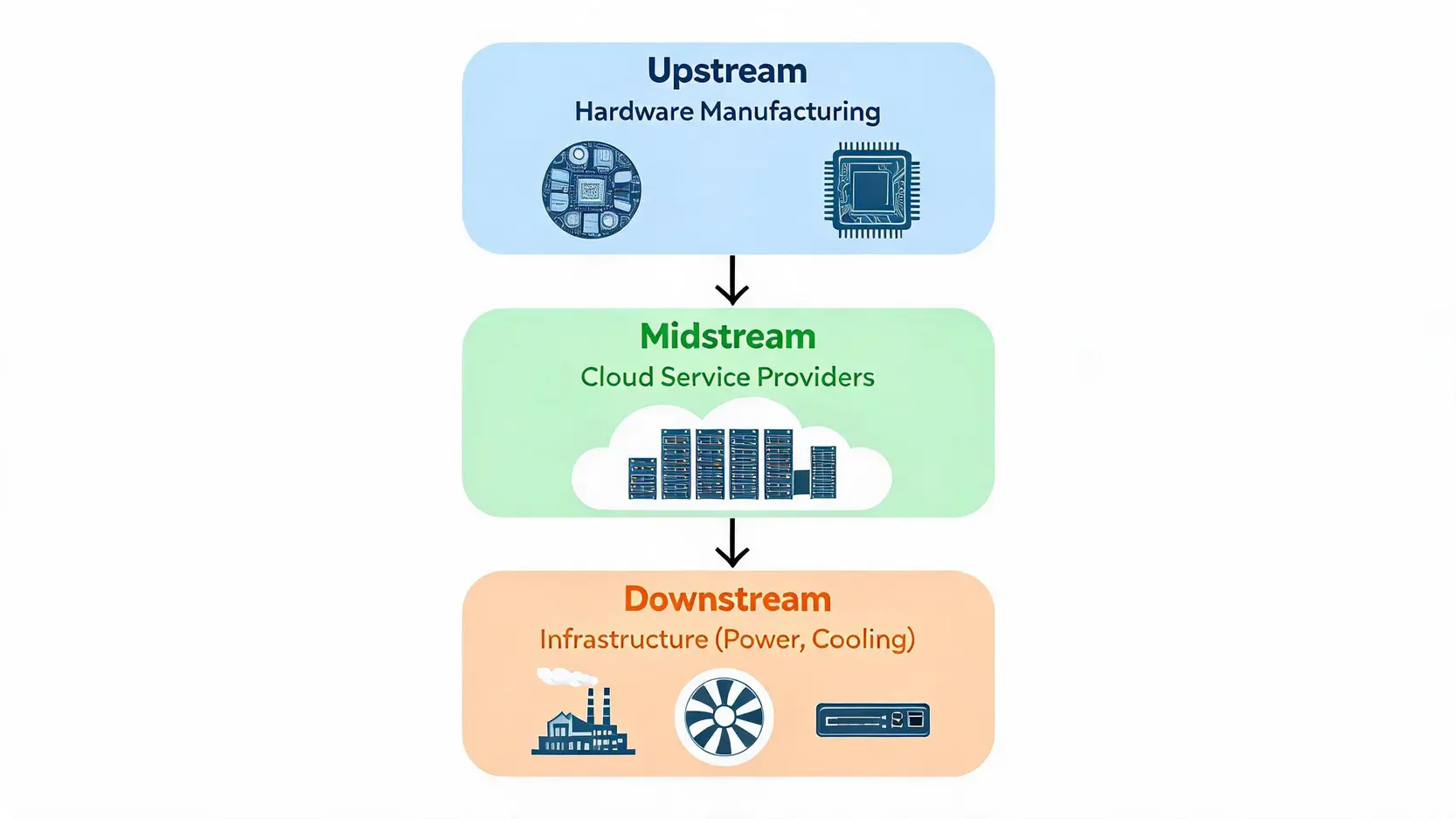
To accurately position for computing power investment, it is essential to understand the full structure of the industry chain. It can be simplified into three major sectors: upstream, midstream, and downstream. Each sector has its own unique investment potential and risks. Understanding these areas is the key to identifying the most suitable position within the enormous opportunities of computing power investment.

算力產業鏈三大賽道圖,從上游的硬件製造,到中游的雲服務,再到下游的基礎設施。

Three Major Investment Sectors in the Computing Power Industry Chain: Opportunities Exist Everywhere, From Chips to Electricity.


Sector One: Upstream Hardware Manufacturers (Nvidia, AMD, TSMC)

This forms the foundation of the entire computing power industry and mainly includes chip designers and manufacturers. They are effectively the “shovel sellers” in the AI gold rush.

  • Nvidia: The absolute leader in AI chips. Its GPUs are currently the standard hardware for training large AI models. Nvidia not only provides hardware, but has also established the powerful CUDA software ecosystem moat, which is difficult to challenge in the short term.
  • AMD: As Nvidia’s main challenger, its MI series chips are rapidly closing the performance gap while attracting customers through stronger price-performance value.
  • TSMC: The world’s most advanced semiconductor foundry. Nearly all top chip design companies rely on its manufacturing process. Its production capacity and technological progress directly determine the global upper limit of computing power supply.

Investment potential: Directly benefits from growing computing power demand, with high earnings visibility.
Risks: Technology iteration risks, geopolitical impacts (such as chip export restrictions) and high valuation pressure.


Sector Two: Midstream Cloud Computing Service Providers (Amazon AWS, Google Cloud, Microsoft Azure)

These technology giants play the role of “computing power integration and distribution”. They purchase massive quantities of upstream chips, build large-scale data centers, and lease computing power to businesses and individual users through cloud services.

  • Amazon AWS: The global leader in the cloud computing market, with the broadest customer base and most comprehensive service offerings.
  • Microsoft Azure: Leveraging its deep partnership with OpenAI, Azure has experienced rapid growth in AI cloud services and stands as AWS’s strongest competitor.
  • Google Cloud: Equipped with its self-developed TPU chips and deep AI expertise, Google Cloud holds advantages in specific AI application fields.

Investment potential: Stable market demand, mature business models, and strong cash flow.
Risks: Massive capital expenditures, intense competition leading to price wars, and the need for continuous innovation.


Sector Three: Downstream Infrastructure (Electricity, Cooling, and Network Equipment)

This is often overlooked but critically important. Data center operations depend on stable large-scale electricity supply, efficient cooling technologies, and high-speed data transmission equipment.

  • Power companies: AI data centers consume enormous amounts of electricity, placing heavy pressure on power grids while simultaneously creating new growth opportunities for power providers, especially renewable energy suppliers.
  • Cooling technology companies: Companies such as Vertiv and Eaton provide various data center temperature control solutions ranging from liquid cooling to air conditioning systems, forming a critical component in ensuring stable computing power output.
  • Network equipment providers: Companies such as Arista Networks and Cisco provide high-speed switches and optical modules within data centers, ensuring low-latency data transmission across tens of thousands of GPUs.

Investment potential: “Hidden champions” benefiting from the AI wave, with relatively reasonable valuations and strong growth potential.
Risks: Sensitivity to macroeconomic conditions, changing technology standards, and long project cycles.


Must Read Before Investing: The 3 Major Potential Risks of Computing Power Investment and How to Avoid Them

Although the potential of computing power investment is enormous, every investment carries risks. Before joining this trend, it is essential to remain rational:

  1. Technology bubbles and excessive valuations: Current market expectations surrounding AI and computing power are extremely optimistic, with related leading stocks already trading at historically high valuations. Any signs of slower-than-expected technological development or weakening demand could trigger sharp price corrections.
  2. Energy and environmental challenges: The enormous energy consumption associated with computing power has become a global concern. Future stricter environmental regulations and rising electricity costs may limit data center expansion, affecting the cost and stability of computing power supply.
  3. Geopolitical risks: The production and supply of high-performance chips are highly concentrated in a small number of countries and regions. International trade tensions and technology restrictions could directly disrupt the global computing power industry chain, making this a major macroeconomic factor investors must carefully consider.

Frequently Asked Questions About Computing Power Investment (FAQ)

Q: Does Investing in Computing Power Simply Mean Buying Chip Stocks?

A: Not entirely. Purchasing chip stocks (such as Nvidia) is one of the most direct ways to invest in computing power, but computing power investment covers a much broader industry chain. As mentioned earlier, investors can also invest in midstream cloud service providers (such as Amazon and Microsoft) or downstream infrastructure suppliers (such as power and cooling companies). Allocating assets across different sectors helps diversify the risks associated with any single segment.

Q: When Will “Computing Power Securitization” Products Become Mainstream?

A: At present, “computing power securitization” remains in the early exploration stage. Achieving large-scale adoption requires solving multiple complex issues, including computing power standardization, valuation and pricing mechanisms, market regulation, and trading liquidity. Industry experts generally expect that as AI applications mature and market demand grows, more mature and scalable financial products related to computing power, such as computing power ETFs or futures, may emerge within the next three to five years.

Q: Besides Buying Stocks, What Other Ways Can Individual Investors Participate in Computing Power Investment?

A: In addition to directly purchasing individual stocks, individual investors may consider focusing on semiconductors, cloud computing, or AI themes ETFs (exchange-traded funds). This is a low-barrier and highly diversified investment method. Furthermore, some emerging cloud computing platforms have begun offering computing power leasing or sharing services. Although these carry higher risks, they provide opportunities for smaller investors to participate. Before investing, it is essential to thoroughly research the platform’s credibility and operating model.

Q: Could Computing Power Investment Become Another Dot-Com Bubble Like in 2000?

A: This is an excellent question. The current AI boom does indeed share similarities with the internet frenzy of the early 2000s, including elevated market sentiment and high valuations for certain companies. However, the key difference is that today’s AI technologies are already generating real commercial value and cash flow across various industries, rather than remaining merely conceptual. As the foundational infrastructure supporting all of this, demand for computing power is genuine and ongoing. Therefore, while short-term market volatility or even speculative bubbles may emerge, the long-term value foundation is significantly stronger than during the dot-com era. A rational approach is to focus on industry leaders with solid fundamentals and strong core competitiveness, while avoiding purely speculative concept stocks.


Conclusion

In summary, computing power as a new asset class has evolved from a forward-looking concept into a growing market consensus, driven by the irreversible and enormous demand created by artificial intelligence development. Meanwhile, the concept of computing power securitization presents a vision for investors, suggesting that future investment channels participating in this technological transformation will become increasingly diversified and accessible. Although the market still faces challenges related to technology, regulation, and excessive valuations, the tremendous potential of computing power investment remains undeniable. Investors should begin researching the related industry chain immediately, from hardware manufacturing and cloud services to infrastructure, incorporating computing power into their investment radar in order to seize what may become one of the defining wealth opportunities of the next decade.

编者
Evan Lin

Evan Lin

我是Evan Lin,从大学时期开始接触外汇交易,至今已有多年实战经验,熟悉技术分析与EA策略,热衷于研究市场脉动与风险管控,喜欢分享实战经验和交易技巧,和大家一起学习、一起进步!

If you liked this article, please share it!

Related Articles

  • 2026 Gold Forecast: Goldman Sachs vs Bank of America
    2026 Gold Price Forecast Roundup: Where Do Goldman Sachs and Bank of America See It? The Gold Bull Market Is Not Over Yet! Wall Street Consensus: Gold Prices Are Generally Bullish in 2026, Where Is the Target Price Range? After an epic rally, gold’s recent high-level volatility has left many...
    2026 年 6 月 24 日
  • Why Japan Property Is Attracting Global Investors
    Global Asset Repricing: Why Has Japan’s Property Market Become a Safe Haven for Smart Money Amid Yen Depreciation? What Is “Global Asset Repricing”? Why Has Japan Become the Main Focus? While investment forums around the world are heatedly discussing yen depreciation pressure, the real smart money has already begun positioning...
    2026 年 6 月 23 日
  • Japan Ends Negative Rates: Why Is the Yen Still Weak?
    Farewell to Negative Interest Rates! The Truth Behind Japan Meeting Its Inflation Target: Why Has Yen Depreciation Pressure Increased Instead of Easing? The Japanese economy is staging an extremely contradictory drama: after waiting for thirty years, it has finally welcomed the long-awaited Japan inflation, yet the market’s response has been...
    2026 年 6 月 23 日
返回顶部