Real-Time US Stock Quotes: Tech Leaders & Rankings

Want to step into the vast US stock market but feel overwhelmed by complex information and fast-changing price movements? Many investors face the same dilemma: unable to find reliable real-time US stock market quote tools, struggling to understand the logic behind US stock trend analysis, and unsure which leading US tech stocks to focus on. This article provides a one-stop solution, from practical market tracking tool recommendations to the latest analysis of US stock market cap rankings, helping you grasp market dynamics with ease and develop your own winning investment strategy.
To Do a Good Job, You Must First Sharpen Your Tools: 5 Essential Real-Time US Stock Market Tracking Tools
To accurately track the ever-changing US stock market, a stable and powerful quote tool is indispensable. Whether it is a free website platform or a professional broker app, both can provide critical data support for your investment decisions. Below are several highly rated tools in the market to help you easily track US stock trends.
Recommended Free Website Platforms: TradingView vs. Yahoo Finance
For beginners or investors who do not want to commit significant upfront costs, free website platforms are an excellent starting point. Among them, TradingView and Yahoo Finance are the two most comprehensive choices.
- TradingView:
Often regarded as a powerful charting tool. It offers extremely robust and smooth HTML5 charts, built-in hundreds of technical indicators and drawing tools, and even supports Pine Script for users to customize their own indicators. Its community features are also a major highlight, allowing you to view analyses and opinions from traders around the world and exchange ideas. For investors focused on technical analysis, TradingView is undoubtedly the top choice.
Advantages: Top-tier charting functions, diverse indicators, active community, attractive interface.
Disadvantages: The free version includes advertisements, and some advanced data (such as real-time pre-market and after-hours quotes) may be delayed. - Yahoo Finance:
A long-established financial information website with extensive data coverage. In addition to basic stock price quotes, it provides detailed company financial reports, news, and analyst ratings for fundamental analysis. If you are a value investor who needs in-depth company research, Yahoo Finance can provide most of the information you need.
Advantages: Comprehensive fundamental data, fast news updates, completely free.
Disadvantages: Charting functions are relatively basic, and the technical analysis experience is not as strong as TradingView.

Professional Broker App Comparison: Futu and Interactive Brokers
When you are ready to invest real capital in the market, broker apps become the core tool for trade execution. They not only provide real-time quotes but also integrate order placement, account management, research reports, and other services in one platform.
- Futu:
The interface design aligns well with the habits of Asian users, making it intuitive and easy to use. Its community feature, “Niuniu Circle”, is highly active, with lively discussions and fast information exchange. It offers free Level 2 market depth quotes, allowing you to see detailed bids and ask for order book data, which is particularly important for short-term traders. To learn more about comparisons of free US stock quote apps, you may refer to related articles. - Interactive Brokers (IBKR):
A leading global online broker known for its professionalism and broad range of tradable products. Its mobile app, “IBKR Mobile”, is powerful and offers highly competitive financing rates and trading fees. Although the interface is relatively complex and requires time to adapt, for experienced investors seeking top-tier trading performance and global asset allocation, IB is an irreplaceable choice.
Further Reading (Highly Recommended)
TSMC and Hon Hai Dividend Policy Analysis: Tech and Electronics Stock Investment Strategies
2026 Latest US Stock Market Cap Rankings: Who Is the Current Leading US Tech Stock?
Understanding the current market leaders is a key step toward successful investing. Market capitalization not only represents the scale of a company, but also reflects the market’s collective recognition of its future prospects. Especially in an era dominated by technology stocks, keeping track of these leading companies means grasping the core pulse of the market. According to authoritative financial websites such as Yahoo Finance, the companies with the highest market capitalization in the US are currently mostly concentrated in the technology sector.
The following are the technology giants that firmly rank at the top of the market cap list. Their business developments have a profound impact on the overall market trend.
| Company (Ticker) | Core Business |
Recent Growth Drivers |
Key Investment Watchpoints |
| Microsoft (MSFT) | Cloud computing (Azure), operating systems (Windows), productivity software (Office 365), gaming (Xbox) | Sustained strong growth in the Azure cloud business, AI product integration (Copilot) driven by its partnership with OpenAI | AI monetization capabilities, cloud market share and competition with Amazon (AWS) |
| Apple (AAPL) | iPhone, Mac, iPad and other hardware devices, service businesses such as the App Store and Apple Music | Rising share of services revenue, steady demand for higher-end iPhones, exploration of new product lines such as Vision Pro | Growth drivers after global smartphone market saturation, antitrust regulatory risks |
| NVIDIA (NVDA) | GPU graphics processors, AI chips, data center solutions | Explosive growth in demand for data center chips (such as the H100) amid the AI revolution | Whether its leading position in the AI chip market can be sustained, supply chain conditions, and competition from rivals (AMD, Intel) |
Closely following are equally well-known technology giants. Each holds a strong competitive moat in its respective field and represents a core potential component that should not be overlooked in an investment portfolio.
- Alphabet (GOOGL/GOOG): The parent company of Google, holding dominant positions in search engines, digital advertising, cloud computing (GCP), and AI. The current focus is on how its AI model Gemini integrates with its core businesses and how it competes with Microsoft in the AI wave.
- Amazon (AMZN): A global leader in both e-commerce and cloud computing. AWS cloud services are its primary profit driver, while its e-commerce business provides stable cash flow. Improvements in retail profit margins and growth in its advertising business are key areas of market attention.
- Tesla (TSLA): A pioneer and leader in the electric vehicle industry. Beyond EV sales, its developments in autonomous driving (FSD), energy storage, and robotics offer significant potential. Production capacity expansion, market competition, and Elon Musk’s personal moves are key factors influencing its stock price.
- Meta Platforms (META): Owner of major social platforms such as Facebook, Instagram, and WhatsApp. Its core business is digital advertising. In recent years, it has heavily invested in the Metaverse while actively expanding in AI, aiming to create its next growth curve.
Even Beginners Can Understand! Learn Basic US Stock Trend Analysis in 3 Steps
Faced with complex stock price fluctuations, many beginners feel overwhelmed. In fact, through some basic analytical methods, you can develop a foundational understanding of market trends. US stock trend analysis is mainly divided into two schools: fundamental analysis and technical analysis. Here, we begin with the most accessible key points.
Step 1: Understand Key Economic Data (CPI, Non-Farm Payrolls)
Macroeconomic data serves as the “weather forecast” for the overall stock market. Two data points are particularly important because they directly influence the monetary policy of the Federal Reserve (Fed) (such as raising or cutting interest rates).
- Consumer Price Index (CPI):
A core indicator of inflation. If CPI remains persistently high, it signals strong price pressures, and the Fed may raise interest rates to curb inflation. Rate hikes usually pressure the stock market, as they increase corporate borrowing costs. Conversely, a decline in CPI gives the Fed room to cut rates, which is generally positive for stocks. - Non-Farm Payrolls (NFP):
Reflects the health of the US labor market. Strong employment data indicates economic activity, but may also trigger wage increases and intensify inflation concerns. Weak data may signal a potential recession. The market typically prefers “moderate” data, meaning stable economic growth without triggering excessive inflation.
Step 2: Master Basic Technical Indicators (Moving Averages, MACD)
Technical indicators use historical price and volume data to forecast future trends. Beginners do not need to learn every indicator. Mastering the two most classic ones is sufficient.
- Moving Average (MA):
MA is the most fundamental trend identification tool. It smooths out short-term price fluctuations to present a clearer long-term trend. Commonly used are the 5-day MA (weekly line), 20-day MA (monthly line), and 60-day MA (quarterly line).
– Golden Cross: A short-term moving average (such as the 20MA) crossing above a long-term moving average (such as the 60MA), considered a buy signal.
– Death Cross: A short-term moving average crossing below a long-term moving average, considered a sell signal.

- Moving Average Convergence Divergence (MACD):
MACD is a momentum indicator used to assess trend strength and turning points. It consists of the fast line (DIF), the slow line (MACD/DEA), and the histogram.
– Buy Signal: The fast line crosses above the slow line above the zero axis (golden cross), and the histogram turns from negative to positive.
– Sell Signal: The fast line crosses below the slow line below the zero axis (death cross), and the histogram turns from positive to negative.
Learning more advanced technical analysis methods, such as Complete Guide to DMI Indicator Usage: Interpreting ADX Trend Strength and Parameter Settings, can help you judge market trends more accurately.
Frequently Asked Questions (FAQ)
Q: Which US stock quote app is the best to use?
A: It depends on your needs. For beginners, Futu offers a user-friendly interface and an active community, making it a great entry-level choice. For traders focused on technical analysis, TradingView’s charting functions are unmatched. For value investors who need to research company fundamentals, Yahoo Finance provides the most comprehensive free financial reports and news data. For experienced investors seeking low costs and global trading access, Interactive Brokers is a more professional option.
Q: Which companies are referred to as the “Magnificent Seven” in the US stock market?
A: The “Magnificent Seven” typically refers to: Apple, Microsoft, Alphabet (Google), Amazon, NVIDIA, Tesla, and Meta Platforms. These seven companies are the largest technology firms by market capitalization in the S&P 500 Index, and their stock performance has a significant impact on the overall index.
Q: How can I determine whether the US stock market is currently in a bull market or a bear market?
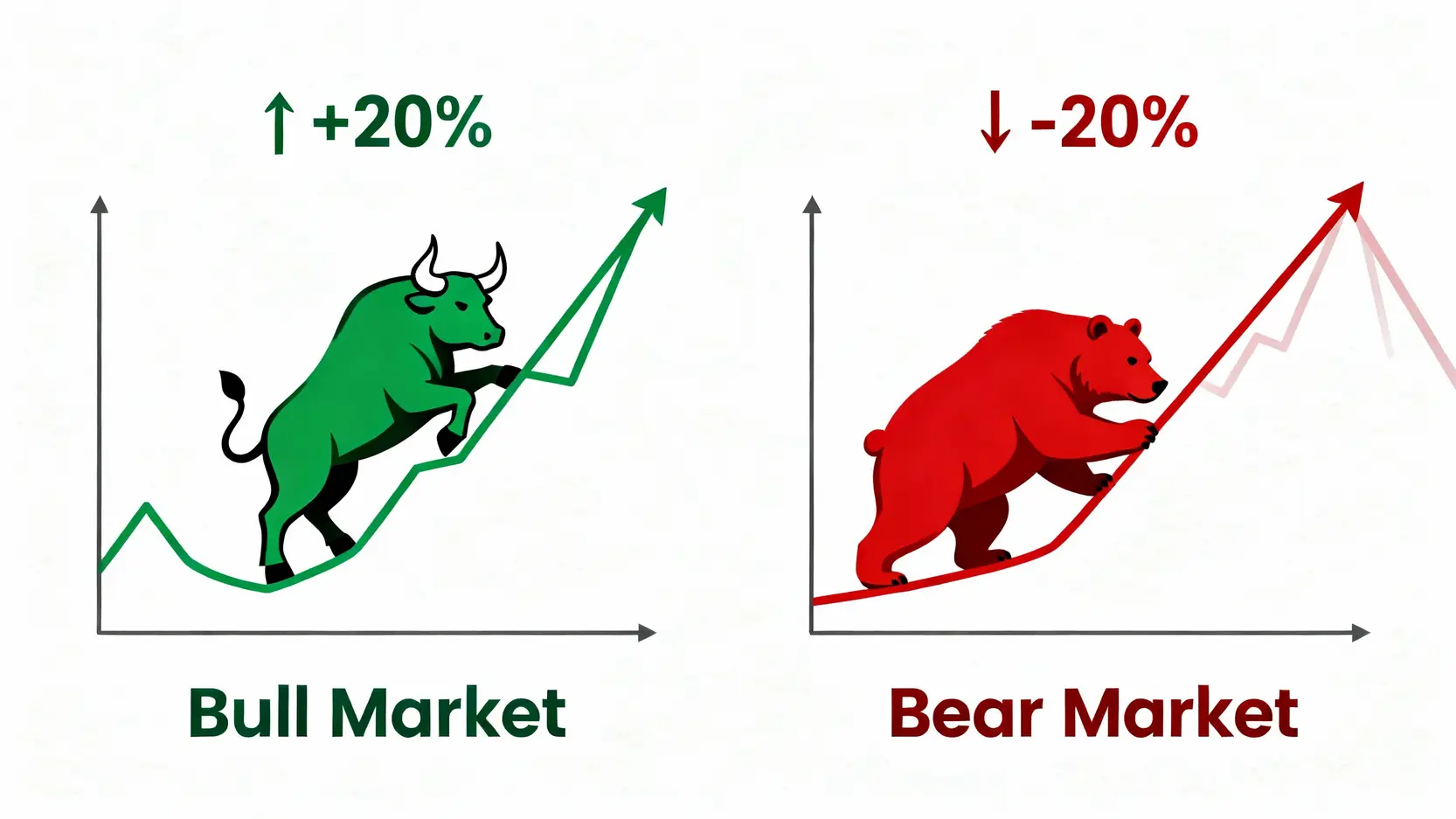
A: Generally, the widely accepted definition is that when a major stock index (such as the S&P 500 Index) falls more than 20% from its recent high, it enters a technical bear market; when it rises more than 20% from its low, it is considered to have entered a bull market. You may also refer to other supporting indicators, such as the VIX fear index (below 20 usually indicates optimism, above 30 indicates panic), and the 200-day moving average (when the index is above it, it is usually regarded as a bull market, and below it as a bear market).

Q: Do I need to pay attention to time differences when investing in US stocks?
A: Yes, special attention is required. The regular trading hours of the US stock market are 9:30 a.m. to 4:00 p.m. Eastern Time (ET). For Asia, this corresponds roughly to 9:30 p.m. to 4:00 a.m. the next day (during daylight saving time), or 10:30 p.m. to 5:00 a.m. the next day (during standard time). This means most trading activity occurs late at night in Asia. However, most brokers offer good-till-canceled or conditional order functions, allowing you to preset buy and sell prices without staying up to monitor the market.
Conclusion
Successful investing in the US stock market begins with mastering accurate real-time US stock market quotes, combined with an in-depth understanding of leading US tech stocks and objective US stock trend analysis. This guide, which includes the latest US stock market cap rankings, aims to serve as a valuable companion on your investment journey. Investing is a continuous learning process. Choose a suitable tool, start following market leaders, and apply basic analytical methods, and you can take the first steady step toward investing while seeking your own opportunities in the world’s largest capital market.
Related Articles
-
Practical Applications of Volatility Surfaces: From Options Modeling to Advanced Skew Trading Strategies In options markets, implied volatility is never a flat line. Instead, it forms complex "smile" or "skew" surfaces. For advanced traders, mastering the practical applications of volatility surfaces is equivalent to possessing a lens that reveals market...2026 年 6 月 3 日
-
Building a Foreign Capital Flow Copy Trading Model: A Stock Market Indicator for Accurately Tracking Institutional Positioning In Asia-Pacific stock markets, foreign capital inflows and outflows often determine the direction of the index. However, simply looking at daily net buy and sell data is no longer enough. Only by building...2026 年 6 月 3 日
-
Options Buyer Strategies During Extreme Market Conditions: Black Swan Hedging and Cross-Market Arbitrage During Volatility Surges The most terrifying aspect of financial markets is not a gradual decline, but overnight flash crashes and cross-market capital withdrawals accompanied by volatility surges. In the highly unpredictable global macroeconomic environment of 2026, geopolitical...2026 年 6 月 3 日