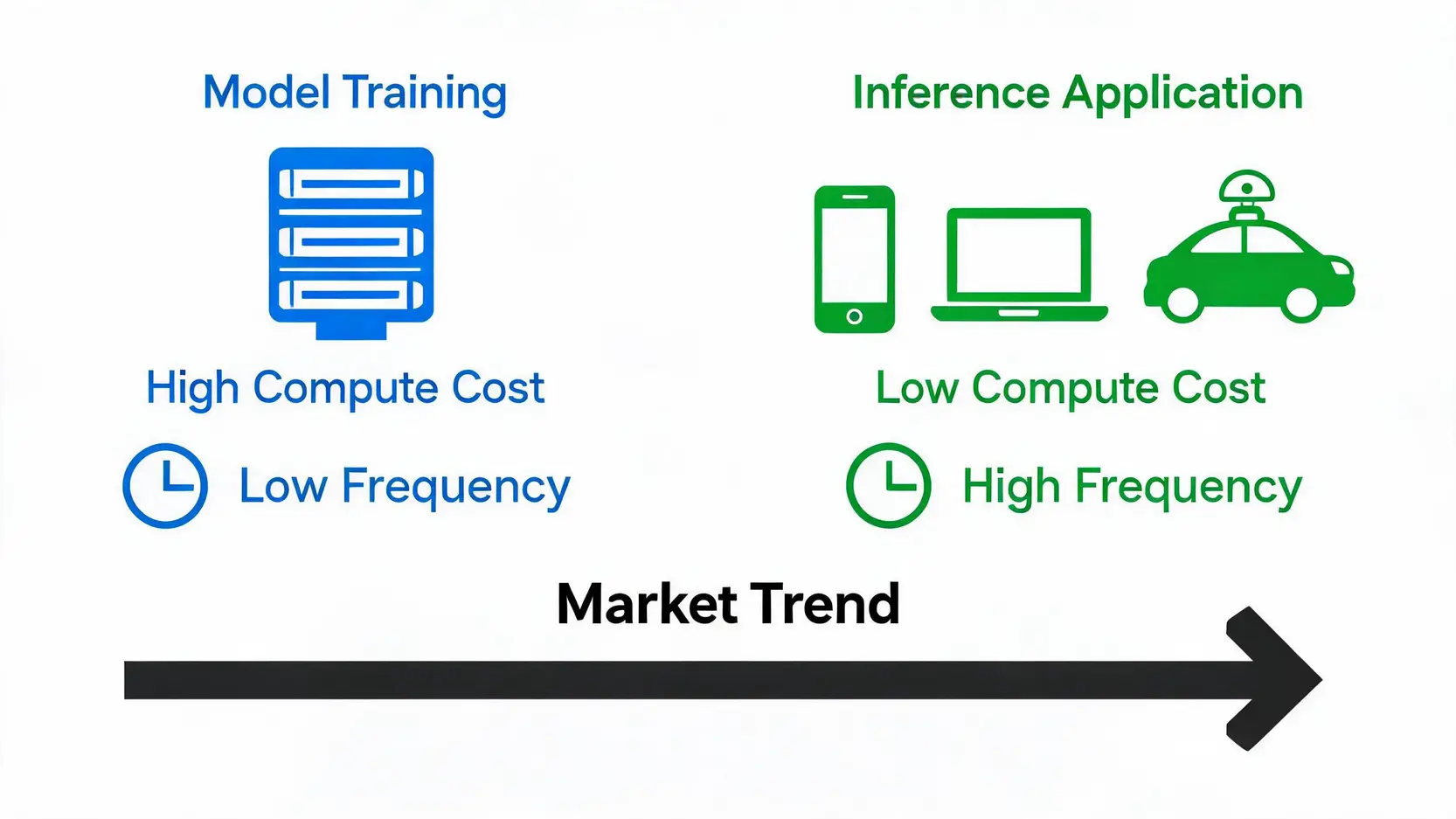
The Structural Shift in Computing Power Demand: From Centralized Training to Distributed Inference.
The Structural Shift in Computing Power Demand: From Centralized Training to Distributed Inference.
The core carrier of AI computing power is the data center. To meet surging demand, data centers worldwide are expanding in scale and density at unprecedented speed. However, this also brings major challenges:
- Power consumption: A large AI data center can consume as much electricity as a small city. Energy costs and supply stability have become critical bottlenecks restricting computing power development.
- Cooling issues: High-density computing generates enormous heat. Traditional air-cooling systems are gradually becoming insufficient, making advanced cooling technologies such as liquid cooling new market hotspots.
- Green energy: To comply with environmental regulations and achieve sustainable development goals, demand for green energy sources (such as solar and wind power) is becoming increasingly urgent among data centers. This is also creating investment opportunities in energy management and energy storage sectors.
Cloud Computing and Edge Computing: The Two Major Battlefields of Computing Power Democratization
The deployment models for computing power are also showing two major trends:
- Cloud Computing: Cloud giants such as Amazon AWS, Microsoft Azure, and Google Cloud provide powerful AI computing power leasing services, allowing businesses and developers to access top-tier computing resources on demand without building expensive data centers themselves. This is currently the primary model driving the democratization of computing power. For investors, cloud computing-related investment targets remain core choices.
- Edge Computing: This refers to computation performed on “edge” devices located near the data source (such as smartphones, autonomous vehicles, and industrial robots). This model significantly reduces latency and enhances data privacy protection. With the development of IoT and autonomous driving applications, demand for high-performance, low-power edge AI chips is rapidly growing.
Global Computing Power Market Outlook Analysis and Major Players
The enormous potential of the AI computing power market has attracted the attention of global capital and technology giants, creating a complex landscape combining both monopolistic dominance and intense competition. Conducting a thorough computing power market outlook analysis helps identify the best investment entry points.
Market Size Forecasts and Core Growth Drivers
Authoritative research institutions are generally optimistic about the future of the computing power market. According to forecasts from organizations such as Gartner, the global AI chip market is expected to maintain rapid growth over the coming years and may reach several hundred billion US dollars by 2030. The core growth drivers behind this market include:
- The full-scale explosion of generative AI: From text and image generation to video creation, generative AI applications are being implemented across industries, continuously driving higher demand for computing power.
- Demand for scientific computing: AI is becoming a new paradigm for supercomputing in fields such as drug development, weather forecasting, and materials science.
- The intelligent transformation of traditional industries: Manufacturing, finance, healthcare, and other sectors are rapidly embracing AI, creating enormous new demand for computing power.
The Leadership Landscape: Nvidia, AMD, and Other Challengers
The current AI computing power market presents a “one dominant leader with multiple strong challengers” structure:
-
- Nvidia: With its CUDA ecosystem and powerful GPU product lineup (such as the H100 and B200), Nvidia controls more than 80% of the AI training market and remains the undisputed market leader. Any discussion regarding computing power inevitably involves this company.
- AMD: As the strongest challenger, AMD has launched the MI300 series chips, with performance approaching Nvidia’s flagship products. Through its open software platform ROCm, AMD is attempting to break Nvidia’s ecosystem dominance.
-
- Intel: Through its Gaudi series AI accelerators, Intel focuses on providing cost-effective solutions for enterprise customers.
- Cloud giants’ self-developed chips: Google’s TPU, Amazon’s Trainium and Inferentia, and Microsoft’s Maia are all designed to optimize the cost and efficiency of AI services within their own cloud platforms.
- Startups: Companies such as Cerebras and SambaNova focus on developing innovative AI computing architectures, attempting to achieve breakthroughs in specific areas.
Emerging Business Models: The Rise and Investment Value of Computing Power Leasing
For most companies, the cost of directly purchasing and maintaining top-tier AI servers is difficult to bear. As a result, “computing power leasing” or “Compute-as-a-Service” has emerged.
Beyond the public cloud giants mentioned earlier, many specialized computing power leasing platforms have appeared in the market. These platforms integrate idle GPU resources from various sources and provide them to small and medium-sized enterprises and developers at more flexible and lower-cost pricing. This sector not only lowers the barriers to AI development, but also creates a new monetization channel for companies possessing computing power resources, forming a dynamic computing power trading market.
Frequently Asked Questions About AI Computing Power (FAQ)
Why Are GPUs So Important for AI Computing Power?
CPUs are designed to process complex single instructions, similar to an experienced project manager handling tasks in an organized manner. GPUs, on the other hand, contain thousands of smaller cores and were originally designed to process massive numbers of graphics rendering tasks simultaneously, functioning like a large workforce capable of executing repetitive work in parallel. AI model training and inference are essentially massive matrix calculations, and this highly parallel computational workload perfectly matches the strengths of GPUs, making them the preferred hardware for AI computing power.
What Are the Main Ways to Invest in the AI Computing Power Market?
The main methods of investing in the AI computing power market include:
- Direct investment in leading chip companies: Such as purchasing shares of Nvidia or AMD.
- Investing in related ETFs: Selecting semiconductor or AI-focused ETFs, such as SMH or SOXX, helps diversify single-company risk.
- Monitoring upstream and downstream supply chains: Including semiconductor foundries (such as TSMC), server manufacturers (such as Super Micro Computer), cooling solution providers, and data center REITs.
- Investing in cloud service providers: Amazon, Microsoft, and Google are among the major providers of computing power services.
What Environmental Impact Will Growing AI Computing Power Demand Create?
The main environmental impact of rising AI computing power demand is massive energy consumption and carbon emissions. Data center cooling systems also require enormous water resources. To address these challenges, the industry is actively seeking solutions, including adopting more energy-efficient chip architectures, developing high-efficiency cooling technologies such as liquid cooling, building data centers in colder regions to utilize natural cooling, and purchasing renewable energy sources such as solar and wind power on a large scale to power data centers.
What Is the Specific Difference Between CPUs and GPUs in AI Computing?
CPUs (Central Processing Units) are designed for low latency. They contain a small number of powerful cores and excel at handling complex logical decisions and sequential tasks. GPUs (Graphics Processing Units), by contrast, are designed for high throughput. They contain thousands of smaller cores and are specifically built for large-scale parallel computing. To use an analogy, a CPU is like a surgeon precisely performing complex operations, while a GPU is like a large construction crew capable of laying thousands of bricks simultaneously. The enormous mathematical operations involved in AI model training are ideally suited to the “many workers make light work” architecture of GPUs.
Conclusion
In summary, the future development of AI is deeply tied to continuous breakthroughs in computing power. From the perspective of AI computing power demand trends, the market is currently experiencing a period of rapid growth driven jointly by model training and inference applications. Understanding the intrinsic relationship between AI development and computing power is the critical first step in analyzing the outlook for the computing power market. Whether for business leaders seeking transformation or investors searching for opportunities, gaining clear insight into the technological evolution, market landscape, and emerging business models within this sector will help position them to capture core opportunities and remain competitive throughout the AI era.