Yen Carry Trade Unwinding: Global Market Impact

Updated: 2026/06/09  |  CashbackIsland

yen-carry-trade-unwind-guide

The Ultimate Guide to Yen Carry Trade Unwinding: The Chain Reaction That Triggers Global Market Turmoil

Recent violent fluctuations in the Japanese yen exchange rate, including the frequent intraday “flash crashes” and “surges”, all point to one key term: the “carry trade unwinding chain reaction”. This seemingly technical concept is actually the key to understanding trillions of dollars in global capital flows and the market chain reactions they trigger. As the decades-long era of ultra-low-interest-rate yen “free lunches” comes to an end, a global financial storm is beginning to take shape. In this article, we will break down, in the simplest way possible, what the Yen Carry Trade is and why the unwinding process can trigger such massive turbulence across global markets. 


What Is the Yen Carry Trade?

Simply put, the Yen Carry Trade is a global capital strategy built on “borrowing cheaply to invest profitably”. Its core logic is to profit from “interest rate differentials” between countries. Because Japan has maintained ultra-low and even negative interest rates for an extended period, the cost of borrowing yen has remained extremely low, making it the ideal “funding currency” for global investors.


Core Principle: Borrow Low-Interest Yen and Invest in Higher-Yield Assets

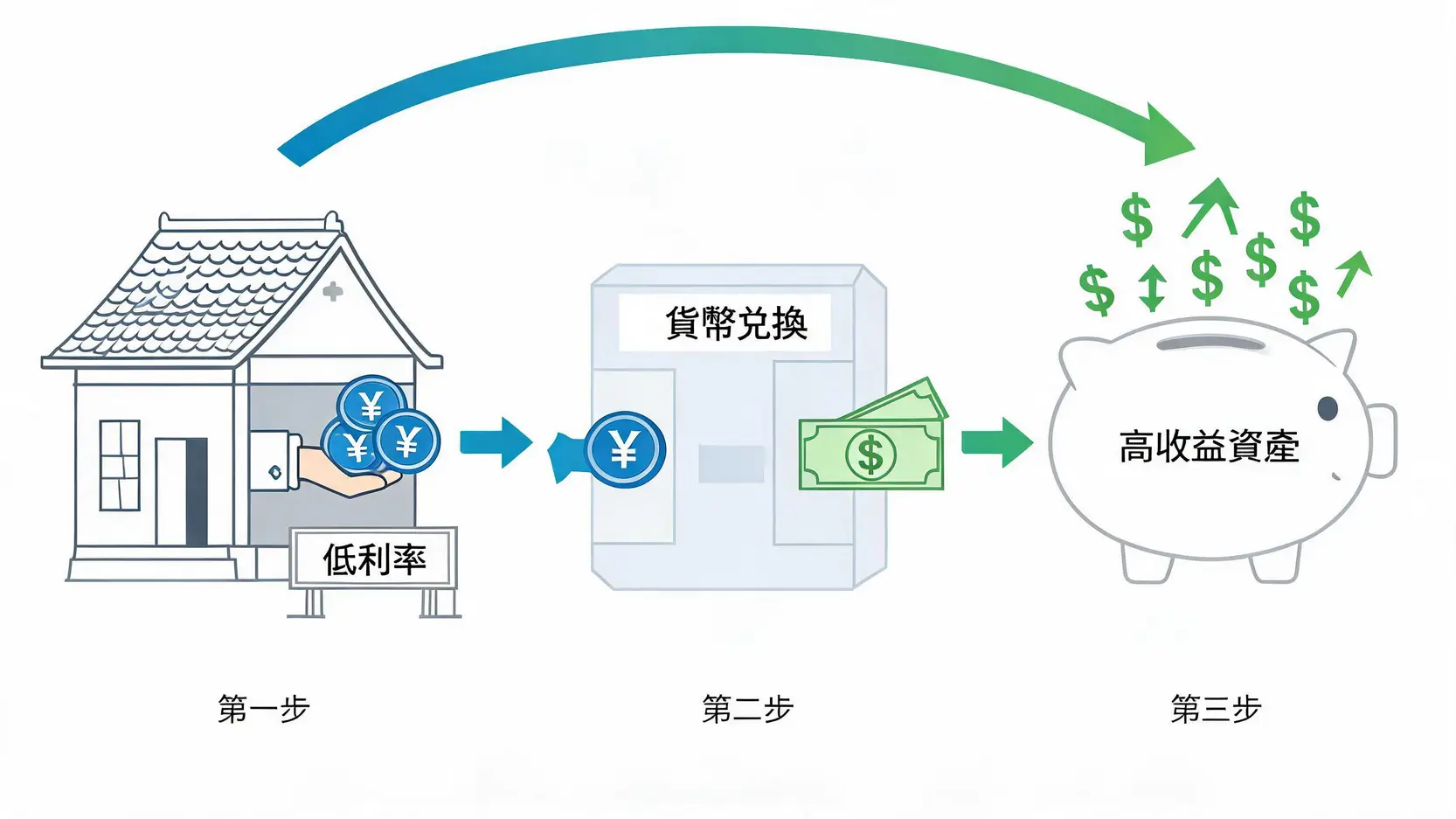
Imagine being able to borrow a large amount of yen at almost zero cost, convert it into US dollars, Australian dollars, or Mexican pesos, and then invest those funds in government bonds or bank deposits that offer higher interest rates. The spread between the borrowing cost and the investment return becomes your profit. This is the essence of a carry trade. As long as the higher-yielding currency does not depreciate significantly against the yen, it can appear to be an almost risk-free profit opportunity.

  • Borrowing side: Borrow yen (JPY) at interest rates close to zero.
  • Currency exchange side: Sell the borrowed yen in the market and convert it into higher-yielding currencies (such as USD or AUD).
  • Investment side: Purchase assets in those higher-yield countries, such as government bonds or highly rated corporate bonds.
  • Profit model: Consistently earn the “interest rate differential” between the two countries while betting that the yen remains weak or stable.

日元套息交易原理示意圖,展示借入低息日元、兌換為高息貨幣並投資的過程。

The Yen Carry Trade: A Global Capital Game of “Borrowing Low and Investing High”


Why Is the Yen the Perfect Funding Currency?

For more than two decades, the Bank of Japan (BOJ) has maintained extremely low interest rates in an effort to combat deflation. This has made the yen the most attractive and cheapest source of funding for global speculators, earning it the nickname of the “world’s ATM”. As long as Japan’s monetary policy remained unchanged, this strategy could continue indefinitely, with large amounts of capital flowing out of Japan and into higher-yielding opportunities around the world.


Who Are the Main Participants in Carry Trades?

The participants in this capital feast are extremely diverse, spanning the entire financial ecosystem:

  • Large institutional investors: Hedge funds, investment banks, and sovereign wealth funds are the biggest players, often managing positions worth billions or even hundreds of billions of US dollars.
  • Corporate treasury departments: Many multinational corporations use low-cost yen loans to fund global expansion or manage corporate finances.
  • Retail investors: Particularly domestic Japanese investors, including the famous “Mrs. Watanabe”, who use forex margin trading to deploy household savings into these high-risk interest rate differential trades.


The Beginning of the Storm: What Triggers a Carry Trade “Unwinding Wave”?

When the foundations of a previously stable profit model begin to crack, a panic-driven unwinding wave can erupt rapidly. “Unwinding” refers to closing a carry trade position by selling higher-yield assets, converting the proceeds back into yen, and repaying the original yen loan. When thousands of market participants attempt to do this simultaneously within a short period, it creates a massive “unwinding wave”. The primary catalysts behind such events include the following:


Catalyst 1: Expectations of a Bank of Japan Policy Shift

This is the most fundamental trigger. After years of effort, Japan’s inflation has finally shown signs of sustained acceleration. Markets have increasingly expected the Bank of Japan to abandon its ultra-loose monetary policy and begin raising interest rates. Once the Bank of Japan starts hiking rates, borrowing yen becomes more expensive, reducing the profitability of carry trades and potentially eliminating profits altogether. Sophisticated traders often act before policy changes are officially implemented, closing positions in advance and triggering the first wave of unwinding.


Catalyst 2: Sudden Market Intervention and Sharp Exchange Rate Volatility

When yen depreciation becomes excessive and begins to negatively impact Japan’s domestic economy (such as through rising import costs), the Japanese government or central bank may directly intervene by purchasing large amounts of yen to support the currency. Such sudden interventions can cause the yen to appreciate sharply within a short period. For carry traders, a stronger yen is a nightmare because it means they need more high-yield currencies to buy back enough yen to repay their loans. This can result in substantial foreign exchange losses and may even trigger margin calls, forcing positions to be liquidated.


Catalyst 3: Rising Global Risk Aversion

Carry trades are fundamentally a “risk-on” strategy. When major geopolitical conflicts, severe economic deterioration, or financial crises occur globally, investors’ appetite for risk can quickly collapse, shifting markets into a “risk-off” environment. In such situations, investors sell assets perceived as risky (including high-yield currencies and emerging market assets) and move capital into assets considered safe havens. The Japanese yen, which is widely regarded as a safe-haven currency, tends to appreciate rapidly as capital flows into it, once again undermining the foundation of carry trades. 

Further Reading (Highly Recommended)

Yen Leverage Blow-Up Case Study: Understanding Interest Rate Differential Trading Risks Through the Mrs. Watanabe Tragedy

[Safe-Haven Asset Comparison] What Should You Invest in During a Recession? Comparing the Pros and Cons of Gold, the US Dollar, and the Japanese Yen


The Chain Reaction Path: A Global Butterfly Effect

日元套息交易平倉引發的全球金融市場連鎖效應圖。

The Butterfly Effect of Carry Trade Unwinding: From the Foreign Exchange Market to a Chain Reaction Across Global Assets

The unwinding of carry trades does not only affect the foreign exchange market. Like a virus, it spreads through the tightly interconnected global financial network, triggering a series of chain reactions. This is also what makes it so dangerous.


Stage One: Surging Yen Demand Creates a Self-Reinforcing Currency Rally

The first step in unwinding is buying back yen. When everyone in the market rushes to sell US dollars, Australian dollars, and other currencies in exchange for yen, demand for the yen can explode almost instantly. This pushes the yen even higher, worsening losses for traders who have not yet unwound their positions and forcing them to do the same. This creates a vicious cycle that can drive extraordinary currency gains within a short period.


Stage Two: Forced Selling of Invested Assets (Such as US Treasuries and High-Yield Currencies)

To raise funds to buy back yen, traders must sell the assets they originally invested in. This can lead to the following outcomes:

  • High-yield currencies plunge: Traditional high-yield currencies such as the Australian dollar, New Zealand dollar, and Mexican peso face intense selling pressure.
  • US Treasury sell-off: Because US Treasuries are a common carry trade investment, large-scale selling can push Treasury prices lower and yields higher.
  • Emerging market assets suffer: Many emerging market stocks and bonds are also destinations for carrying trade capital. An unwinding wave can trigger capital outflows from these markets, intensifying financial instability.


Stage Three: Global Liquidity Tightens, Hitting Risk Assets Such as Stocks and Cryptocurrencies

Over the past several decades, the Yen Carry Trade has injected massive amounts of low-cost liquidity into global markets. When this flow of capital rapidly reverses, it is equivalent to tightening the global liquidity “tap”. With less money circulating in the market and borrowing costs rising, all liquidity-dependent assets can come under pressure.

  • Global equities: High-valuation sectors, particularly technology stocks, are highly sensitive to liquidity conditions and often decline sharply.
  • Cryptocurrencies: As the ultimate representation of risk assets, cryptocurrencies typically experience even steeper declines than traditional assets when liquidity dries up.


Illustrated Example: How Capital Flows Reverse in a Hypothetical Scenario

Let’s look at a simplified example to understand the process:

  1. Position opening (Carry Trade): Hedge Fund A borrows 1 billion yen at an interest rate of 0.1%. At the time, the USD/JPY exchange rate was 150. The fund converts the 1 billion yen into approximately US$6.67 million.
  2. Investment: The fund uses the US$6.67 million to purchase US Treasuries yielding 5%. It earns a stable annual interest rate differential of approximately 4.9%.
  3. Unwinding trigger: One day, following hawkish comments from the Bank of Japan, USD/JPY plunges from 150 to 140.
  4. Unwinding: To avoid further foreign exchange losses, Fund A decides to unwind the position. It sells the US Treasuries and recovers US$6.67 million. However, at the new exchange rate, those US$6.67 million can only be converted into 6.67 million × 140 = 934 million yen.
  5. Result: Even after earning some interest income, the fund suffers a foreign exchange loss of 1 billion – 934 million = 66 million yen. If leverage is high, this alone may be enough to trigger liquidation. Now imagine thousands of Fund A’s across the market doing the same thing simultaneously. The resulting impact becomes easy to understand.


How Can Investors Respond to Market Turbulence Caused by Carry Trade Unwinding?

While individual investors cannot control the market, they can adopt strategies to protect their portfolios from this type of systemic risk.


Identifying Early Warning Signals

Markets do not collapse without warning. Several leading indicators deserve close attention:

  • Monitor Bank of Japan meetings: Closely follow BOJ meeting minutes and public comments from policymakers. Any change in language regarding an exit from accommodative policy is an important signal.
  • Japanese Yen Volatility Index (JYVIX): Similar to the stock market’s VIX Index, a sharp spike in the JYVIX often signals potential market turbulence ahead.
  • Global interest rate differentials: Monitor the interest rate gap between Japan and other major economies (particularly the US). A rapid narrowing of the differential reduces the attractiveness of carry trades.


Defensive Asset Allocation Strategies

From an asset allocation perspective, investors can adopt a more defensive stance:

  • Reduce leverage: During periods of market instability, reduce the use of leveraged instruments such as margin trading and maintain sufficient cash reserves.
  • Increase safe-haven assets: Consider allocating more to traditional safe-haven assets such as gold, US dollar cash holdings, or short-term US Treasuries.
  • Diversify risk: Avoid concentrating assets excessively in currencies or markets that are highly linked to carry trades (such as the Australian dollar or emerging market equities).


FAQ

Q: Is the Yen Carry Trade legal?

A: Completely legal. Carry trading is a common and well-established strategy in the global foreign exchange market that takes advantage of macroeconomic differences between economies. As long as it is conducted through regulated financial institutions, there are no legal concerns. The risks stem from market volatility rather than legal issues.

Q: Can retail investors participate in carry trades? What are the risks?

A: Yes. Many forex margin trading platforms offer products that allow retail investors to participate. However, the risks are extremely high. The primary risks include: 1) Exchange rate risk: A sudden appreciation of the yen can cause substantial losses. 2) Interest rate risk: Unexpected rate cuts in the target investment country or sudden rate hikes in Japan can erode profits. 3) Leverage risk: Forex margin trading typically involves high leverage, which magnifies losses and can easily lead to liquidation.

Q: How many large-scale Yen Carry Trade unwinding events have occurred historically?

A: Some of the most notable large-scale Yen Carry Trade unwinding events have occurred during global financial crises. Examples include the 1998 Russian debt default and the collapse of Long-Term Capital Management (LTCM), as well as the 2008 Global Financial Crisis. Both events triggered large-scale deleveraging and carried trade unwinding, causing the yen to appreciate sharply over a short period and amplifying global market volatility.

Q: How long does carry trade unwinding last?

A: The duration depends on the severity of the trigger. Unwinding driven by short-term market sentiment or intervention may last only a few days or weeks. However, if it is triggered by a fundamental shift in Bank of Japan monetary policy (such as the beginning of a sustained rate-hiking cycle), the deleveraging process may continue for months or even years, significantly reshaping global capital flows.


Conclusion

The Yen Carry Trade is a powerful yet largely hidden force within the global financial system. Over the past two decades, it has provided markets with a continuous source of liquidity while simultaneously planting the seeds of vulnerability. When the rules of the game change, the chain reaction triggered by large-scale unwinding extends far beyond the foreign exchange market, affecting equities, bonds, cryptocurrencies, and virtually every risk asset. For investors, understanding how this mechanism works and how risks are transmitted can help explain short-term market volatility while enabling more effective strategic positioning to avoid potential systemic risks.

If you liked this article, please share it!

Related Articles

  • US-Japan Rate Gap: The Real Cause of Yen Weakness
    US-Japan Interest Rate Differential Out of Control? Uncovering the Root Causes of Yen Depreciation and the Bank of Japan's Policy Dilemma Recently, even though Japan's Ministry of Finance has repeatedly deployed large-scale intervention measures, the yen has only enjoyed brief periods of relief before returning to its depreciation trend. This...
    2026 年 6 月 9 日
  • Yen Futures Surge: Smart Money Positioning Guide
    Japanese Yen Futures Trading Volume Surges! Is Smart Money Flowing In? A Complete Guide to Positioning for the Opportunity Fundamentals: What Are Japanese Yen Futures? To understand the significance behind a surge in Japanese yen futures trading volume, we first need to answer a basic question: "What are Japanese yen...
    2026 年 6 月 5 日
  • Volatility Surface Guide: Skew Trading Strategies
    Practical Applications of Volatility Surfaces: From Options Modeling to Advanced Skew Trading Strategies In options markets, implied volatility is never a flat line. Instead, it forms complex "smile" or "skew" surfaces. For advanced traders, mastering the practical applications of volatility surfaces is equivalent to possessing a lens that reveals market...
    2026 年 6 月 3 日
返回顶部